Presentation feedback form and questions to hand out after a talk
The best presentation feedback questions ask the audience about things they saw and heard: was the purpose clear, were the points easy to follow, did the slides help, and can they use what they heard? The core 12 covers that in about four minutes. Add a set for delivery, Q&A, a conference session or classmate peer feedback, then send it as a link, print the form, or poll the room.
- 37questions
- 12in the core
- 4 minfor the core
- 5optional sets
By Michael Hodge, BSc Psychology Updated September 2026
Core questions for any talk, then delivery, slides and Q&A
The core 12 is ticked for you. Add a set that suits your talk, or mix single questions from several. Under each one you see what people choose from and what their answers mean for the speaker. Send your pick as a link, print it, or paste it as text.
The core 1212 questions
Seven statements about what the audience saw and heard, the level of detail, an overall rating, two open questions and how well people knew the topic beforehand. It works on its own after any talk.
-
I knew early on what this talk would cover.
Strongly disagree12345Strongly agree1 = Strongly disagree, 5 = Strongly agreeA clear purpose in the first minutes. Low agreement usually means the opening told a story but never said where it was going.
-
The main points were easy to follow.
Strongly disagree12345Strongly agree1 = Strongly disagree, 5 = Strongly agreeStructure as the room felt it. A low score points to missing signposts between sections, not to the content itself.
-
The speaker used words I understood.
Strongly disagree12345Strongly agree1 = Strongly disagree, 5 = Strongly agreeCatches jargon and unexplained acronyms. Read it next to the familiarity question at the end of the core.
-
The slides helped me follow the talk.
Strongly disagree12345Strongly agree1 = Strongly disagree, 5 = Strongly agreeWhether the deck supported the speaker or competed with them. The slides set has the detail when this is low.
-
The talk held my attention from start to finish.
Strongly disagree12345Strongly agree1 = Strongly disagree, 5 = Strongly agreeAttention across the whole talk. When this is low and the rest is fine, the length or the middle section is the usual culprit.
-
The examples made the ideas feel real to me.
Strongly disagree12345Strongly agree1 = Strongly disagree, 5 = Strongly agreeStories, cases and demos are what people remember. A low score says the talk stayed abstract.
-
I will use at least one idea from this talk.
Strongly disagree12345Strongly agree1 = Strongly disagree, 5 = Strongly agreeThe payoff question. A talk can be clear and enjoyable and still leave nothing to act on.
-
For you, the level of detail was:
Too basicA bit basicAbout rightA bit advancedToo advancedTells you which way to adjust the depth. Read the spread, because an average of "about right" can hide two unhappy halves.
-
Overall, how would you rate this presentation?
ExcellentGoodFairPoorVery poorOne number to compare talks over time. It also works on its own as a live poll at the end.
-
What was the most useful part of the talk for you?
Open answerNames what to keep. People answer this one readily, and the answers often point to one slide or story.
-
If the speaker gave this talk again, what should they change first?
Open answerAsks for one change, so the answers turn into a short to-do list rather than general praise.
-
Before today, how well did you know this topic?
Not at allA littleQuite wellVery wellLets you split every answer by experience. Beginners and experts often rate the same talk very differently.
Voice and delivery5 questions
Add these when the speaker wants coaching notes on voice, eye contact and habits, for a rehearsal or a new speaker you are developing.
-
The speaker's pace was:
Too slowA little slowAbout rightA little fastToo fastNerves speed most speakers up. This says which way to adjust, and by how much.
-
I could hear the speaker clearly the whole time.
Strongly disagree12345Strongly agree1 = Strongly disagree, 5 = Strongly agreeVolume and microphone use. A low score from the back rows is a room or equipment fix.
-
The speaker looked at us more than at the slides.
Strongly disagree12345Strongly agree1 = Strongly disagree, 5 = Strongly agreeEye contact asked as something the audience noticed, not a technique they have to judge.
-
The speaker sounded sure of the subject.
Strongly disagree12345Strongly agree1 = Strongly disagree, 5 = Strongly agreeConfidence as it came across. Low scores often go with reading from notes or slides.
-
Did anything pull your attention away from what was said? Pick any that apply.
Reading slides aloudFiller wordsPacing or fidgetingSpeaking too quietlyRunning over timeNothing didTick all that applyNames the habit to drop. One or two ticks from most of the room is a clear rehearsal target.
Slides and handouts4 questions
For talks that lean on a slide deck, a chart or a handout.
-
I could read every slide from my seat.
Strongly disagree12345Strongly agree1 = Strongly disagree, 5 = Strongly agreeFont size and contrast, checked from where people actually sat.
-
Each slide was easy to take in at a glance.
Strongly disagree12345Strongly agree1 = Strongly disagree, 5 = Strongly agreeA low score means slides full of text, so people read instead of listening.
-
Charts and pictures made the ideas clearer.
Strongly disagree12345Strongly agree1 = Strongly disagree, 5 = Strongly agreeWhether visuals explained something or only decorated the slide.
-
Would you like a copy of the slides or a handout?
Yes, before the talkYes, after the talkNo, thanksTells you whether to share the deck, and when. Early copies suit technical talks where people want to take notes.
Questions and interaction4 questions
When the talk had time for questions, a poll or an activity, or when the audience wanted one.
-
There was enough time for questions from the audience.
Strongly disagree12345Strongly agree1 = Strongly disagree, 5 = Strongly agreeRunning over usually eats the Q&A first. This shows whether the room noticed.
-
The speaker answered questions directly.
Strongly disagree12345Strongly agree1 = Strongly disagree, 5 = Strongly agreeStraight answers build trust. Low scores point to answers that wandered or dodged.
-
I felt comfortable asking a question or joining in.
Strongly disagree12345Strongly agree1 = Strongly disagree, 5 = Strongly agreeWhether people felt they could speak up, which matters more than how many hands went up.
-
What would you like more of next time?
Live pollsTime for questionsStories and examplesShort activitiesNothing, the mix was rightTick all that applyLets the audience design the next version. A big "Live polls" share is an easy win for the next talk.
Conference and event sessions5 questions
For sessions at a conference, meetup or company event, answered by attendees. The recommend question gives organisers one number to compare speakers.
-
How closely did the session match its description in the program?
ExactlyMostlyPartlyNot at allA talk can be good and still not be the one people signed up for. This checks the abstract as well as the speaker.
-
How did you attend this session?
In the roomOnline, liveWatched the recordingHybrid audiences hear and see a different talk. Split the core answers by this before you compare speakers.
-
I would choose another session by this speaker.
Strongly disagree12345Strongly agree1 = Strongly disagree, 5 = Strongly agreeThe question organisers use when they plan the next program.
-
How likely are you to recommend this session to a colleague?
0123456789100 = Not at all likely, 10 = Extremely likelyA 0 to 10 score to track across sessions and years. Ask it after the other questions so it sums them up.
-
What topic would you like a future session to cover?
Open answerBuilds next year's call for speakers from what attendees want to hear.
Class presentations (classmates answer)7 questions
Classmates answer these about one presenter or group. Each statement is something a student can judge from their seat, and the two comment boxes ask for a moment and a next step.
-
The opening made me want to listen.
Strongly disagree12345Strongly agree1 = Strongly disagree, 5 = Strongly agreeThe hook. Students notice a strong opening straight away, and a weak one too.
-
I could sum up the main idea in one sentence.
Strongly disagree12345Strongly agree1 = Strongly disagree, 5 = Strongly agreeThe best single test of a class presentation: did the point get across?
-
The evidence and examples backed up the main idea.
Strongly disagree12345Strongly agree1 = Strongly disagree, 5 = Strongly agreeSeparates a well-researched talk from a confident one.
-
Every group member had a clear part to play.
Strongly disagree12345Strongly agree1 = Strongly disagree, 5 = Strongly agreeFor group presentations only. Low scores flag an uneven split of the work.
-
The ending pulled the main points together.
Strongly disagree12345Strongly agree1 = Strongly disagree, 5 = Strongly agreeWhether the talk finished or just stopped.
-
Name one thing the presenter did well and when they did it.
Open answerTying praise to a moment makes it useful and keeps comments kind and specific.
-
Suggest one thing to try next time, and how to do it.
Open answerA next step with a how is far easier to act on than "be more confident".
One form per seat, collected at the door
Leave a form on each seat or hand them out with the agenda, then collect the pile at the door. Both files are sized for letter and A4.
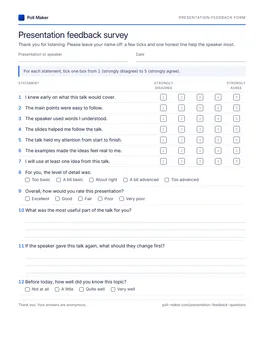
Presentation feedback form
The core 12 comes first, with tick boxes and room to write. The delivery, slides, questions, conference and classmate sets follow on their own pages.
Download PDF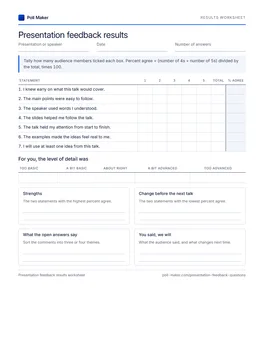
Results worksheet
Tally each rating statement and the level-of-detail question by hand, turn the tallies into percentages, and write down the single change for the next talk.
Download PDFA QR code on your last slide, five answers back
Two minutes before the applause is enough for five answers. These cover structure, attention, usefulness and an overall rating, with one open box for the change people want most.
- 01The main points were easy to follow.
- 02The talk held my attention from start to finish.
- 03I will use at least one idea from this talk.
- 04Overall, how would you rate this presentation?
- 05If the speaker gave this talk again, what should they change first?
Before the room empties: three habits
Most presentation surveys fail before the first question: sent too late, too long, or read without a baseline. Three habits fix that.

Ask before the room empties
Put a QR code for the survey on your final slide and give the room two minutes before you take questions. Answers arrive while the talk is fresh and people are still in their seats. At a conference, ask the session chair to read out the link; in class, hand out the paper form with the last slide.

Keep it short enough to finish
A speaker form can be short and still dependable. Conference planners in emergency medicine built a three-item speaker evaluation, about a third the length of the forms they compared it with, and its three items held together closely as one score.1 The core 12 follows the same idea: seven statements, a few choices and two open boxes. Add a set only when you will act on what it tells you.

Rate yourself before you read the results
Answer the seven core statements yourself, then put your answers next to the room's. In a study of oral presentations, students' self-scores were mostly higher than their teachers' marks,3 so the gaps between your view and the audience's are where the most useful surprises sit. The same study found students very positive about peer feedback as a source of outside advice.
After a short talk, one question can do the work of a whole form. Put the overall rating up as a live poll the room answers from their seats, then share the result on the big screen. The guide to making and sharing a poll covers links, QR codes and embeds.
Read the room's answers in one chart
Type in how many people chose each number on the seven statements in the core. Each one is phrased so a high score is good news, and the lowest bar marks the part of the talk to rework first.
- 1Add up the 4s and 5s for each statement and divide by the number who answered. The chart works it out while you type.
- 2Check the level-of-detail answers beside the plain-words statement. If both point the same way, change the depth of the talk, not only the wording.
- 3When the room mixed beginners and experts, split the chart by the familiarity question. One talk can land with one group and miss the other.
- 4Sort the one-change answers into piles. The biggest pile, plus the shortest bar, is your plan for the next time you give this talk.
Core 12 results
Presentation feedback examples by part of the talk
Useful comments name a moment and suggest a move. Use these as models for the open questions, or share them with students before a round of peer feedback.
| Part | Praise that helps | A next step that helps |
|---|---|---|
| Opening | The late-train story made the problem feel urgent. | Say what we will learn in the first minute, then tell the story. |
| Structure | The three numbered parts made it easy to keep my place. | Add a one-line recap before each new part. |
| Slides | The single chart on slide 6 made the cost jump obvious. | Cut slide 4 to one sentence; I read it instead of listening. |
| Voice | Pausing after the key figure gave it time to sink in. | Slow down in the last five minutes; the ending felt rushed. |
| Examples | The customer email you quoted showed the issue better than any statistic. | Give the second idea its own example too. |
| Questions | Repeating each question meant the whole room heard it. | Keep ten minutes for questions; hands were still up at the end. |
Each example is specific enough that the speaker knows exactly what to repeat or change. Comments like "great job" or "be more engaging" feel kind but leave nothing to work on.
Peer feedback on class presentations
The classmate set turns a round of student presentations into feedback each presenter can use, and gives the teacher a quick read on the whole class.
Share the criteria before anyone presents
Show the five classmate statements on the board before the first presentation, so students know what they are listening for. A meta-analysis of 48 studies found that peer marks came closest to teacher marks when students made overall judgements against criteria they understood well.2
One short form per presenter
Give each student the five statements and the two comment boxes for every presenter they watch. On phones, open the survey once per talk; on paper, print a stack of the classmate page and collect it after each presentation.
Pass comments on without names
Students hand forms to the teacher, not the presenter. The teacher passes the comments on unsigned, which keeps them honest and kind.
Grade the talk, use the comments to coach
Peer ratings are a strong second view next to your own marks. The written comments are where students learn the most, from giving them as well as reading them.
Good questions to ask a presenter afterwards
In the audience and want something to ask in the Q&A? These work after almost any talk, and the answers often cover what the slides left out.
- What would you do first if you were in our position?
- Which finding surprised you most while you were preparing this?
- Could you go back to the chart on slide 6 and walk us through it?
- What would you add if you had another ten minutes?
- Where can we read more about the study you mentioned?
- How would this work for a smaller team or a tighter budget?
- What is the most common mistake people make when they try this?
Speakers welcome a good question: it shows someone listened closely. Running a session yourself? Put two or three of these on a slide to get the Q&A started.
Presentation questions that get vague answers, rewritten
Each weak version turns up on feedback forms everywhere and gets a shrug in return. More question sets for every kind of survey are on the survey questions hub.
Was the presentation clear and engaging?
The main points were easy to follow.
The talk held my attention from start to finish.
Two ideas share one answer. Pew Research calls these double-barreled questions: hard to answer and hard to interpret afterwards.<sup><a href="#ref-4">4</a></sup>
How would you rate the speaker's presentation skills?
The speaker looked at us more than at the slides.
I could hear the speaker clearly the whole time.
A skills rating asks the audience to judge like a coach. What they saw and heard is easier to answer, and it tells the speaker what to change.
Did you like the slides?
I could read every slide from my seat.
Liking is taste. Whether the back row could read the slides is something the speaker can fix before the next talk.
Any comments?
If the speaker gave this talk again, what should they change first?
A bare comment box collects thanks. Asking for one change collects a to-do list.
Speakers and teachers ask about presentation feedback
For speakers, event organisers and teachers.
What questions should I ask after a presentation for feedback?
Ask whether the purpose was clear, whether the points were easy to follow, whether the slides helped, whether the talk held attention and whether people will use what they heard. Add an overall rating and one open question about what to change. Every one of those is in the core 12 above.
How do I ask for feedback after a presentation?
Put the survey link or a QR code on your final slide, tell the room you want the one change they would make, and give them two minutes before questions end. If you send the link afterwards, send it the same day while the talk is still fresh.
Should presentation feedback be anonymous?
For an audience or a class, yes. People write more candidly when no name is attached. In class, students hand their forms to the teacher, who passes the comments on without names.
What is a good example of feedback on a presentation?
Good feedback names a moment and suggests a next step, for example: "The chart on slide 6 made the cost jump obvious. Cut slide 4 to one sentence so we can listen instead of read." The examples table on this page has one for each part of a talk.
How many questions should a presentation feedback form have?
Five for a QR code at the end of a talk, twelve for most sessions, and one extra set for a conference session or a graded class presentation.
Get feedback on your next talk
Load the core 12 into the builder, add a set for your event or class, and put the link on your last slide or print a form for every seat.