Confidence scale questionnaire: 31 questions, the 1-5 labels and a scoring method
A confidence scale asks how sure someone is that they can do a specific thing, on five labelled points from Not at all confident to Extremely confident. Here are the labels for the 1 to 5, 0 to 10 and 0 to 100 versions and 31 questions learners answer at the end of a training or course.
- 31questions
- 12in the core set
- 5labelled points
- 4 minto answer the core
By Michael Hodge, BSc Psychology Updated September 2026
Confidence scale labels for 1-5, 0-10 and 0-100
Three versions cover almost every use. All three ask the same thing: how sure are you that you can do this?
| Scale | Labels to print | Best for |
|---|---|---|
| 1 to 5 | 1 Not at all confident 2 Slightly confident 3 Moderately confident 4 Very confident 5 Extremely confident | End of a session, paper forms, live polls |
| 0 to 10 | 0 Cannot do at all 5 Moderately certain 10 Highly certain I can | Small gains after a short course |
| 0 to 100, in tens | 0 Cannot do 50 Moderately certain can do 100 Highly certain can do | Studies that follow Bandura |
Which one to pick
The five-point version suits most surveys. Every point carries a word, so a 3 means the same to everyone, on paper or on a phone. Bandura's guide to self-efficacy scales goes wider, 0 to 100 in steps of ten, because people shy away from the ends of a short scale and it shrinks to two or three usable points.2 The wider format has paid off in practice: with middle school writers, a 0 to 100 version predicted grades and teacher ratings, and a Likert version of the same items did not.3 Choose 0 to 10 when a course is short and you expect modest gains.
The line that goes above the scale
Start with one instruction: "For each line, mark how confident you are that you can do it today." Then write every statement as something the person can do, starting "I can". The printable questionnaire below opens with exactly that line.
Confidence labels or agree labels?
"I feel confident using the new system", rated on an agree-disagree scale, is an agreement item: people react to a sentence about a feeling. A confidence scale asks for the strength of the belief itself, and each label names how strong. Both are ordered five-point scales and both get called Likert. Pick one for a set of statements and keep it.
All 31 confidence scale questions
The core 12 starts ticked. Bolt on the set for before the course, a month later, a staff skills check or a quiz, or pick single questions. Every row shows its full scale and why it earns its place.
Core 12: at the end of the training12 questions
Seven "I can" statements that climb from doing the main task to adapting it, one look back at where the learner started, two planning questions and two open answers. Swap "the main task" for your own skill if you like.
-
I can do the main task from this training alone.
Not at all confident12345Extremely confident1 = Not at all confident, 5 = Extremely confidentThe headline number. Ask it before and after the course and the gap is your result.
-
I can explain the key steps to someone else.
Not at all confident12345Extremely confident1 = Not at all confident, 5 = Extremely confidentExplaining is a harder test than doing. A low score flags understanding that is still thin.
-
I can tell when I have made a mistake with it.
Not at all confident12345Extremely confident1 = Not at all confident, 5 = Extremely confidentPeople who cannot spot their own errors repeat them. This shows who needs worked examples.
-
I can recover when something goes wrong midway.
Not at all confident12345Extremely confident1 = Not at all confident, 5 = Extremely confidentCovers the messy middle of a real task, which tidy practice exercises tend to skip.
-
I can adapt it to a case the course did not cover.
Not at all confident12345Extremely confident1 = Not at all confident, 5 = Extremely confidentThe step from following steps to owning the skill. Expect it to be the lowest of the seven.
-
I can still do it well when I am short of time.
Not at all confident12345Extremely confident1 = Not at all confident, 5 = Extremely confidentPractice is unhurried and real work is not. A gap here calls for timed practice.
-
I can find the help or notes I need when stuck.
Not at all confident12345Extremely confident1 = Not at all confident, 5 = Extremely confidentKnowing where help lives makes a new skill usable on day one. A one-page job aid lifts this fast.
-
Before this training, how confident were you doing the main task alone?
Not at allSlightlyModeratelyVeryExtremelyThe then rating, on the same five labels. Set it beside the first statement from the same person to see the change in one sitting.4
-
When will you first use this outside the training?
This weekThis monthLater onNot sureOpportunity, asked apart from ability. A skill with no chance of use soon is the one people lose.
-
What would raise your confidence most now?
More practiceA checklistA coach to askA refresherNothing moreTurns a low score into a next step you can plan and budget for.
-
Which part do you feel least sure about, and why?
Open answerNames the exact step to teach again. Read it next to the lowest statement.
-
What in the training helped your confidence most?
Open answerTells you what to protect when you shorten the course or run it again.
Before it starts (learners answer)4 questions
Send these a few days before the first session, together with the seven "I can" statements from the core. That gives you a starting line to measure against.
-
How often have you done this task before?
NeverOnce or twiceA few timesOftenSeparates beginners from people brushing up, so you compare like with like.
-
Why are you taking this training?
I chose itMy manager askedNeeded for my roleNeeded for my courseLets you compare people who opted in with people who were sent.
-
I can pick up a new skill like this one quickly.
Not at all confident12345Extremely confident1 = Not at all confident, 5 = Extremely confidentBelief in their own learning. Low scores tell you who needs an early win in the first hour.
-
What do you most want to be able to do afterwards?
Open answerShows the trainer which tasks to build the practice around.
A month later (learners answer)4 questions
Send these about 30 days after the course, again with the seven "I can" statements, once real use has had time to start.
-
Since the training, how often have you used it?
Not yetOnce or twiceEvery weekMost daysRead every confidence score next to this answer. Use is what keeps a skill sharp.
-
What has got in the way of using it?
No chance yetNo timeMissing toolsForgot stepsNo supportTick all that applyMost blockers can be fixed by someone other than the learner. This shows by whom.
-
Someone has asked me how it is going since then.
Strongly disagree12345Strongly agree1 = Strongly disagree, 5 = Strongly agreeShows whether anyone checked in after the course. A low score is a follow-up job for managers or tutors.
-
Describe one time you used it since the training.
Open answerReal examples to share with the next group, and proof the skill is in use.
Work skills check, 0 to 10 (staff answer)6 questions
For planning a development programme. Staff rate six everyday work skills from 0, cannot do at all, to 10, highly certain I can: the wider format Bandura recommends for small differences.
-
I can present my work to a group of ten or more.
0123456789100 = Cannot do at all, 10 = Highly certain I canPresenting is a common gap. Scores under 5 point to a short speaking workshop.
-
I can give a colleague feedback they can act on.
0123456789100 = Cannot do at all, 10 = Highly certain I canTells you who needs practice with specific, usable feedback before a review cycle.
-
I can run a meeting that ends with clear actions.
0123456789100 = Cannot do at all, 10 = Highly certain I canMeeting skill spreads: one confident chair saves everyone at the table time.
-
I can stay calm in a tense conversation.
0123456789100 = Cannot do at all, 10 = Highly certain I canA low score here is a good reason to add role play to the programme.
-
I can learn a new software tool on my own.
0123456789100 = Cannot do at all, 10 = Highly certain I canShows who will need a guided session when a new system arrives.
-
I can plan a project with dates and owners.
0123456789100 = Cannot do at all, 10 = Highly certain I canPlanning confidence predicts who volunteers to lead. Use it to spot people ready to step up.
Answer confidence, after a quiz (learners answer)3 questions
Ask these after a knowledge check. How sure someone felt adds a second layer to the mark: a confident wrong answer needs different help from a lucky guess.
-
How sure are you that your answer is right?
Just guessingFairly sureCertainPaired with the mark, it splits right answers into known ones and lucky ones.
-
If you were unsure, what was the reason?
New to meMixed up two ideasMisread itShort of timeEach reason has a different fix: teach it, contrast the two ideas, reword it, or give more time.
-
Which topic would you like to go over again?
Open answerThe learners' own pick for the review session.
About you (optional)2 questions
Only when you plan to compare groups. Share results for a group once it is big enough to keep every answer anonymous.
-
How did you take this training?
In personLive onlineSelf-paced onlineA mixShows whether confidence gains differ by format.
-
How long have you been in this role or subject?
Under 1 year1 to 3 years4 to 10 yearsOver 10 yearsLets you compare gains for newcomers and old hands separately.
Measuring the change a course makes
A single end-of-course rating tells you where people are. The change tells you what the course did.

Before and after
Send the seven "I can" statements a few days before the first session and again at the end, word for word, on the same scale. The two optional sets above add a starting-line module and a check a month later.
Then and now, in one sitting
Training often shows people how much they did not know, so their first ratings can run high and the measured gain shrinks. Howard's review of this response-shift bias recommends retrospective ratings: at the end, people rate today and also look back at how confident they were before.4 The core's "Before this training" question does this for the main task, with no second survey to chase.
How to score a confidence scale
Count, compare, then act on the statement that moved least. It takes one sheet of paper or a few spreadsheet cells.
A worked example
For each statement, count the people who chose 4 or 5, Very or Extremely confident, before and at the end. Here is how that looks for an example group of 20 learners:
| Statement | Before | At the end |
|---|---|---|
| I can do the main task alone | 5 | 16 |
| I can explain the key steps | 4 | 12 |
| I can adapt it to a new case | 2 | 6 |
The main task gained 11 people and adapting gained 4, so next time's practice goes to new cases. For one score per person, add up the seven statements: on the five-point scale that gives a total between 7 and 35.
Report counts and medians
Confidence ratings are ordinal: the gap between Slightly and Moderately is not the same as the gap between Very and Extremely. Report counts, percents and the median for each statement, and treat a plain average with care. The guide to levels of measurement explains why.
When you need a published scale
Student researchers and nurse educators often need a validated measure. One example: the Confidence in Managing Challenging Situations scale has 21 items on a five-point scale from no confidence to high confidence, was used with 70 nursing students before and after a two-day teaching programme, and reached a Cronbach's alpha of 0.86.1 Take a published scale's items from its paper and credit the authors. For judging a whole programme rather than one skill, pair this page with the program evaluation questions.
Three habits that keep confidence ratings honest
Three habits keep a confidence scale honest and useful to the person who has to plan the next session.
Put one task in every statement
"I feel confident at work" gives you a mood. "I can present my work to a group of ten or more" gives you something to train. Bandura's guide says confidence scales must be written for the particular skill you care about, with items that step up in difficulty.2 The core climbs the same way: doing the main task, explaining it, spotting errors, recovering, then adapting it to something new.
Phrase each item as what people can do today
"Will you use this?" measures a plan. "I can do this" measures belief in a capability, and the two are separate things. The same guide asks people to judge what they can do as of now, not what they hope to manage one day.2 Keep "will" for the one question about when people expect to use the skill, which sits in the core on its own.

Check the ratings against one real task
Confidence and skill travel together less often than you might hope. A review of how doctors rate themselves found that 13 of 20 comparisons showed little, no or an inverse link with observed skill, and the least skilled and most confident were the least accurate.5 So end the session with one short practical task or quiz as well. High confidence plus a strong result means ready; high confidence plus a weak result is the person to coach first.
In the middle of a session, one question does the job. Put "What would raise your confidence most now?" up as a quick live poll and adjust the second half on the spot. For more in-session questions, see the training feedback polls.
When the session overruns: a five-question version
When the session runs over, ask these five: can people do the main task, can they adapt it, where did they start, what are they least sure of, and what would help.
- 01I can do the main task from this training alone.
- 02I can adapt it to a case the course did not cover.
- 03Before this training, how confident were you doing the main task alone?
- 04Which part do you feel least sure about, and why?
- 05What would raise your confidence most now?
Collect paper answers before people leave the room
Paper in the last ten minutes of a session gets an answer from everyone in the room, including people who never open emailed links. Each file prints on A4 or letter.
Running a short session? and hand them out before the last break.
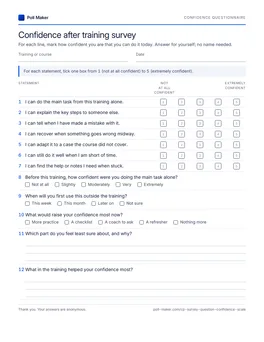
Confidence questionnaire
Page one: the instruction line, then the core 12 with all five labels above each tick row. The before, month-later, skills and quiz sets follow for when you need them.
Download PDF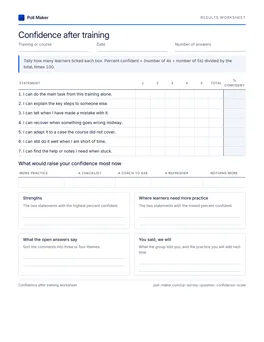
Scoring sheet
Tally how many chose each point on every statement, work out what share picked Very or Extremely confident, and circle the statement that needs more practice.
Download PDFCommon slips in confidence items, and the fixes
Four common slips, each with a fix. The survey question writing guide covers the same faults for every other kind of question.
Are you confident with the new system?
I can process a refund in the new system alone. (Not at all confident to Extremely confident)
Yes or no about a whole system hides which part people struggle with. A named task with a scale gives the trainer a target.
How confident and ready are you to lead meetings?
I can run a meeting that ends with clear actions.
When will you first use this?
Two questions in one. Readiness depends on the calendar, confidence on skill, and one answer cannot report both.
Will you use what you learned today?
I can adapt it to a case the course did not cover.
"Will" asks for a promise. "Can" asks how capable people feel, which is what the course set out to change.
Rate your confidence: 1 2 3 4 5
Not at all confident
Slightly
Moderately
Very
Extremely confident
An unlabelled middle means different things to different people. Words on every point make answers comparable.
Questions trainers ask about the confidence scale
For trainers, teachers and students writing a questionnaire.
What is a confidence scale?
A rating scale that asks how sure someone is that they can do a specific thing. The usual version has five labelled points, from Not at all confident to Extremely confident, and each item names one task.
What are the five points on a confidence scale?
Not at all confident, Slightly confident, Moderately confident, Very confident and Extremely confident, scored 1 to 5. Print all five words, not only the two ends.
Is a confidence scale a Likert scale?
People often call it one, because it is an ordered five-point scale. Strictly, a Likert item asks how much you agree with a statement, while a confidence scale asks how sure you are that you can do something.
How do you summarise confidence scale results?
Give each statement one line: how many answered, the share at Very or Extremely confident, and the median. Sort the lines from lowest to highest. The bottom line is where the next round of practice should go.
Can I use a 1 to 10 confidence scale?
Yes. A 0 to 10 version with 0 as cannot do at all and 10 as highly certain picks up smaller changes than five points. The work skills set on this page uses it.
Measure confidence at your next session
Put the confidence core in front of your group as a link, bolt on the before-it-starts set if you want a starting line, and share the link before the last break. Or print the questionnaire and collect it at the door.