Teacher evaluation questions students feel safe answering
Questions students can answer honestly, starting with a core 12 that takes about five minutes. Add a module when you need one, then run it online, print it for class, or turn any question into a live poll.
- 25questions
- 12in the core set
- 5 minto answer the core
- Grade 6through college
By Michael Hodge, BSc Psychology Updated September 2026
Five for the last ten minutes of a lesson
Short on class time? These five cover understanding, feedback, pace and access to help, and leave room for one thing to change.
- 01My teacher explains things in a way I understand.
- 02When I get work back, I know what to do better next time.
- 03We don't move on until most of the class has got it.
- 04It is easy to ask my teacher for help.
- 05What is one change that would help you learn more in this class?
The 25 questions, from understanding to online lessons
Every question shows the answers students choose from and what the result tells you. Tick what you want, then open it as a survey, print it, or copy it into another tool.
The core 1212 questions
Ten statements about things students can see in every lesson, one question about pace, and two open questions. On their own they make a complete evaluation.
-
My teacher explains things in a way I understand.
Strongly disagree12345Strongly agree1 = Strongly disagree, 5 = Strongly agreeTells you whether explanations land with this group, not whether the teacher knows the subject.
-
When I'm stuck, my teacher tries a new way of showing me.
Strongly disagree12345Strongly agree1 = Strongly disagree, 5 = Strongly agreeSeparates a fresh explanation from the same one repeated more slowly.
-
I could tell a friend what each lesson was meant to teach me.
Strongly disagree12345Strongly agree1 = Strongly disagree, 5 = Strongly agreeShows whether lesson goals actually reach students, which is the point of stating them.
-
When I get work back, I know what to do better next time.
Strongly disagree12345Strongly agree1 = Strongly disagree, 5 = Strongly agreeAsks about the use of feedback, not its volume. A grade with no comment scores low here.
-
We don't move on until most of the class has got it.
Strongly disagree12345Strongly agree1 = Strongly disagree, 5 = Strongly agreeA low score usually means the class runs at the pace of its fastest students.
-
My teacher treats every student with respect.
Strongly disagree12345Strongly agree1 = Strongly disagree, 5 = Strongly agreeThe fairness question. Read it next to the open answers, where students say where it slips.
-
Very little class time is spent waiting around.
Strongly disagree12345Strongly agree1 = Strongly disagree, 5 = Strongly agreeAn observable way to ask about classroom management without asking students to judge discipline.
-
My teacher believes I can do difficult work.
Strongly disagree12345Strongly agree1 = Strongly disagree, 5 = Strongly agreeStudents notice expectations quickly. This shows whether high expectations are felt, not just held.
-
It is easy to ask my teacher for help.
Strongly disagree12345Strongly agree1 = Strongly disagree, 5 = Strongly agreeApproachability. A low score here often explains low scores on feedback and understanding.
-
The pace of this class is:
Too slowA little slowAbout rightA little fastToo fastThe one question that says which way to adjust. An average hides it, so read the spread.
-
What does your teacher do that helps you learn the most?
Open answerNames what to keep doing. Students answer this one in detail.
-
What is one change that would help you learn more in this class?
Open answerOne change, not a list. The answers fall into two or three themes you can act on.
Lessons and engagement4 questions
Add these when the teacher wants to know how lessons feel from a desk, not only whether they are clear.
-
Lessons in this class make me want to find out more.
Strongly disagree12345Strongly agree1 = Strongly disagree, 5 = Strongly agreeEngagement asked without "do you like this class", which invites a popularity answer.
-
My teacher connects what we learn to things outside school.
Strongly disagree12345Strongly agree1 = Strongly disagree, 5 = Strongly agreeRelevance. Low scores point to lessons that feel like content for its own sake.
-
We spend part of most lessons talking through ideas, not just listening.
Strongly disagree12345Strongly agree1 = Strongly disagree, 5 = Strongly agreeShows how much of the lesson belongs to students.
-
Assignments in this class are worth the time they take.
Strongly disagree12345Strongly agree1 = Strongly disagree, 5 = Strongly agreeTells you whether practice work is doing its job or just filling time.
Grading and fairness4 questions
Add these in courses where grades carry weight, or when the open answers keep mentioning marks.
-
I know how my work will be graded before I start it.
Strongly disagree12345Strongly agree1 = Strongly disagree, 5 = Strongly agreeClear criteria up front: the most fixable grading complaint there is.
-
Grades in this class are fair.
Strongly disagree12345Strongly agree1 = Strongly disagree, 5 = Strongly agreeExpected grades colour this answer, so read it next to the question about knowing how work is graded.3
-
I get work back while the comments are still useful.
Strongly disagree12345Strongly agree1 = Strongly disagree, 5 = Strongly agreeTurnaround, asked as usefulness rather than a number of days.
-
If I disagree with a grade, I can talk to my teacher about it.
Strongly disagree12345Strongly agree1 = Strongly disagree, 5 = Strongly agreeWhether students see a way to raise a problem before it becomes a complaint.
Online and hybrid classes3 questions
For classes that run partly or fully online, where most problems start before the lesson does.
-
Instructions for online work are clear.
Strongly disagree12345Strongly agree1 = Strongly disagree, 5 = Strongly agreeMost online frustration starts with unclear instructions, not with the work itself.
-
I can easily find materials and due dates.
Strongly disagree12345Strongly agree1 = Strongly disagree, 5 = Strongly agreeA course-design question the teacher can fix in an afternoon.
-
My teacher replies to messages within a reasonable time.
Strongly disagree12345Strongly agree1 = Strongly disagree, 5 = Strongly agreeThe online version of "it is easy to ask for help".
About you (optional)2 questions
Only when you need to compare groups. Keep every group large enough that nobody can be picked out.
-
What grade are you in?
Grade 6 to 8Grade 9 to 10Grade 11 to 12CollegePrefer not to sayOnly useful when one survey covers mixed classes.
-
How often do you come to this class?
Almost alwaysMost of the timeSometimesRarelyLets you see whether students who miss lessons experience the class differently.
Print it for class, or keep the PDF
Paper still wins in a classroom: hand it out at the start of the lesson and collect it before the bell. Both files print cleanly on letter or A4 paper.
Ten minutes at the end of class is enough.
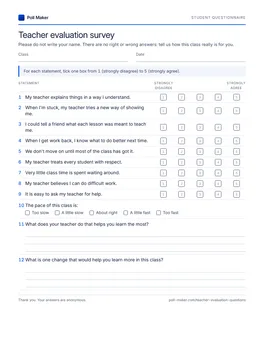
Student questionnaire
The core 12 on page one with tick boxes students fill in with a pencil. Every optional module on page two.
Download PDF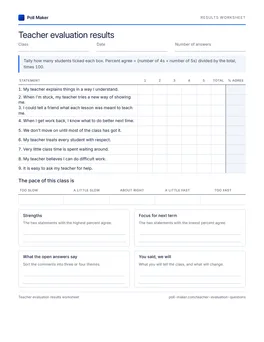
Results worksheet
Tally the paper answers by hand, work out percent agree, and pick next term's two focus areas on one sheet.
Download PDFWhat makes students tell you the truth
Four habits separate a survey students shrug at from one that changes the next lesson.

Run it twice a term
Once around week four to six, while there is still time to change something, and once at the end. The first round is for the teacher; the second shows whether the change worked.
Average response rate across eight comparisons
Give it ten minutes of class time
Surveys answered in class come back far more complete. In a review of eight comparisons, online course surveys averaged a 33% response rate against 56% for paper surveys handed out in class.2 Open the survey link on phones in the room, or hand out the printed version, and collect it before the bell.

Promise confidentiality and keep it
Students only write what they think when they know the teacher cannot trace it. The MET project put it plainly: "Student confidentiality is a must."1 Ask for no names, have someone other than the teacher collect paper copies, and only share results for groups large enough to stay anonymous.

Stick to what students can see
Well-built student surveys work. The MET project found that teachers' student survey results predicted their students' achievement gains, and gave more consistent results than classroom observations.1 The strength comes from asking about specific things that happen in lessons. Broad "rate your teacher" questions pick up the noise instead: in one study of 23,001 ratings, overall scores tracked students' expected grades and gender bias more closely than teaching quality.3 Every statement in the core 12 describes something a student has watched happen.
For a quick check in the middle of a lesson, one question beats a full survey. Pick any question above and run it as a live poll the class answers on their phones. New to polls in class? How to make a poll covers every way to share one.
A one-page report from the answers
Type how many students chose each number. The chart shows where the class agrees, where it does not, and which two statements to work on first. Print it and share it with the class.
- 1For each statement, work out the percent who agree: students who chose 4 or 5, divided by everyone who answered. The report builder does it for you.
- 2Compare the statements with each other, not this teacher with other teachers. The two lowest statements are next term's focus.
- 3Read the open answers after the numbers and sort them into three or four piles. They usually explain the lowest scores.
- 4Tell the class what you heard and what will change. Students who see their answers used take the next survey seriously.
Class results
Three weak questions, and what to ask instead
The same three fixes work on any survey. The survey question guide has more, with examples for every question type.
Is your teacher a good teacher?
My teacher explains things in a way I understand.
A general rating measures how much students like the teacher. A specific statement gives the teacher something to change.
Does your teacher give clear and timely feedback?
When I get work back, I know what to do better next time.
I get work back while the comments are still useful.
Two questions in one. A student who answers "no" cannot say which half is the problem.
How much do you enjoy this class?
Lessons in this class make me want to find out more.
Enjoyment depends on the subject and the grade a student expects. The better version asks about the lessons.
What teachers ask before handing it out
Short answers to what comes up before the first survey goes out.
How many questions should a teacher evaluation have?
Twelve is enough for most classes: ten statements, one about pace, and two open questions. Students finish in about five minutes. Add a module only when you know what you will do with the answers.
Should student evaluations of teachers be anonymous?
Yes. Names change answers. Collect responses through a link that asks for no name, or on paper collected by someone other than the teacher, and report results only for groups big enough that nobody can be identified.
What age can students answer these questions?
The statements are written for students in grade 6 and up. For younger classes, read each statement aloud and switch to a three-point scale: yes, sometimes, no.
Can I use this for a college course evaluation?
Yes. Open the set in the builder and change "teacher" to "instructor". The grading and online modules fit most college courses as they are.
Hand it out at the end of your next lesson
Open the core 12 as an online survey your students answer on their phones, or print the questionnaire for your next lesson.