A talent management questionnaire for employees, and for retention research
A talent management questionnaire asks employees how their organization hires, reviews, develops, moves and keeps its people. The core 12 covers every stage in about four minutes. Add sets on talent pools and retention, or use the full set in a study of talent management and employee retention.
- 38questions
- 12in the core set
- 4 minto answer the core
- 6stages of the talent cycle
By Michael Hodge, BSc Psychology Updated September 2026
Hiring to retention: every talent management question
Twelve core questions are pre-selected for you. Add sets for hiring, reviews, growth, talent pools and retention as you need them. The talent profile is a named form, and the final set is for the HR or leadership team to answer.
The core 1212 questions
Eight statements that walk through the talent cycle as an employee sees it, then three closed questions on talent pools, plans to stay and what would keep people, and one open question.
-
People hired onto my team are a good fit for the work.
Strongly disagree12345Strongly agree1 = Strongly disagree, 5 = Strongly agreeAttraction and selection as the team feels it. Colleagues often see a poor fit well before the first review does.
-
My last review gave a fair picture of my work.
Strongly disagree12345Strongly agree1 = Strongly disagree, 5 = Strongly agreeReviews usually feed talent decisions. If people doubt their own review, they will doubt every list built from it.8
-
I know how people are chosen for talent programs here.
Strongly disagree12345Strongly agree1 = Strongly disagree, 5 = Strongly agreeClarity about selection. People judge talent programs on principle once the reasons behind them are explained openly.3
-
I have a development plan my manager and I revisit.
Strongly disagree12345Strongly agree1 = Strongly disagree, 5 = Strongly agreeSeparates a plan that is used from a form filed once a year and never opened again.
-
My manager puts real time into developing our team.
Strongly disagree12345Strongly agree1 = Strongly disagree, 5 = Strongly agreeCIPD puts spotting and growing talent in every line manager's job, so this is often the statement that explains the others.1
-
My current role makes good use of my strengths.
Strongly disagree12345Strongly agree1 = Strongly disagree, 5 = Strongly agreeThe engagement stage: talent the organization already pays for but does not use.
-
Staff here get a real chance at roles that open up.
Strongly disagree12345Strongly agree1 = Strongly disagree, 5 = Strongly agreeDeployment and internal mobility. A low score suggests people believe they must leave to move up or across.
-
Outstanding work here gets noticed and rewarded.
Strongly disagree12345Strongly agree1 = Strongly disagree, 5 = Strongly agreeReward and recognition, a retention lever employees see every working day.
-
Has anyone told you whether you are in a talent pool?
Yes, I am in oneYes, I am not in oneNo one has told meWe have no talent poolNot sureShows whether talent decisions reach the people they are about. People who believe they were picked tend to be more committed and less inclined to leave.2
-
How long do you plan to stay with this organization?
Under 1 year1 to 2 years3 to 5 yearsOver 5 yearsNot sureYour retention outcome. Set every other answer against it to see which practices go with people planning to stay.
-
Which would do most to keep you here?
A clear next roleBetter payMore trainingMore flexibilityMore recognitionStaff choose the first lever. Each option maps back to one stage of the talent cycle.
-
What would make you more likely to stay and grow here?
Open answerThe open answers name specific programs, managers and moves, which a rating never can.
Hiring and your first 90 days3 questions
For people who joined in the last year: did the hiring promise match the job, and how fast did they get up to speed?
-
The interviews gave me a realistic view of the job.
Strongly disagree12345Strongly agree1 = Strongly disagree, 5 = Strongly agreeAn accurate picture at hiring means fewer surprises, and fewer regrets, in the first months.
-
My manager set clear goals for my first 90 days.
Strongly disagree12345Strongly agree1 = Strongly disagree, 5 = Strongly agreeEarly goals turn a new hire into a contributor sooner and give the first review something to measure.
-
How long did it take you to feel fully up to speed?
Under a month1 to 3 months3 to 6 monthsOver 6 monthsNot there yetTime to full productivity, in bands a new hire can judge. Compare it across teams and roles.
Reviews and potential4 questions
Add these when reviews feed your talent decisions, to check that people trust the ratings behind them.
-
How often do you get useful feedback on your work?
WeeklyMonthlyEvery few monthsOnce a yearRarely or neverFrequency of useful feedback, not of meetings. Feedback once a year arrives too late to change the work it describes.
-
My review ended with clear goals for the next period.
Strongly disagree12345Strongly agree1 = Strongly disagree, 5 = Strongly agreeA review that ends without goals has judged the past and left the next year to chance.
-
Ratings are applied the same way across teams.
Strongly disagree12345Strongly agree1 = Strongly disagree, 5 = Strongly agreeConsistency between managers. Talent lists built from uneven ratings reward generous managers, not strong people.
-
I know how my manager rates my potential.
Strongly disagree12345Strongly agree1 = Strongly disagree, 5 = Strongly agreePotential is often judged separately from performance. This shows whether the person has heard the verdict.
Talent pools and succession4 questions
Add these before a succession review, to see how deep the bench looks from inside the teams.
-
Someone could cover my role well if I left tomorrow.
Strongly disagree12345Strongly agree1 = Strongly disagree, 5 = Strongly agreeSuccession depth as the team sees it. Low scores mark single points of failure.
-
Our leaders are often promoted from within.
Strongly disagree12345Strongly agree1 = Strongly disagree, 5 = Strongly agreeTells you whether staff believe the top jobs are open to them.
-
People outside talent programs still get noticed.
Strongly disagree12345Strongly agree1 = Strongly disagree, 5 = Strongly agreeThe other side of any exclusive program: whether everyone else still sees a way forward.
-
Would you like to be considered for a leadership role?
Yes, as soon as possibleYes, in a year or twoMaybe laterNo, I prefer an expert pathSeparates ambition from ability. Some of your strongest people want to grow as experts, not managers.
Learning and growth3 questions
Add these when development scores low in the core, to see which kinds of growth people actually get.
-
Which of these helped you grow in the past year?
Formal trainingCoaching or mentoringA stretch assignmentA move or rotationLearning from peersNone of theseTick all that applyShows the mix of development on offer. Coaching, mentoring, secondments and projects all count, not only courses.1
-
My development includes real projects, not just courses.
Strongly disagree12345Strongly agree1 = Strongly disagree, 5 = Strongly agreeChecks that learning reaches real work, where new skills actually get used.
-
Everyone here gets a fair shot at development.
Strongly disagree12345Strongly agree1 = Strongly disagree, 5 = Strongly agreeWhether development reaches the whole workforce or only a chosen few, asked of the people who would know.
Staying or leaving3 questions
Add these when retention is the question, or when you need a second outcome measure for a study.
-
In the last three months, have you looked at other jobs?
NoBrowsed a few adsApplied for one or moreI have an offerJob search is a behavior, so it is easier to answer honestly than a question about loyalty.
-
If you left in the next year, what would be the main reason?
PayCareer growthMy managerWorkloadFlexibilityPersonal reasonsNames the push before an exit interview has to. Compare it with the lever people chose in the core.
-
My manager has asked me what would keep me here.
Strongly disagree12345Strongly agree1 = Strongly disagree, 5 = Strongly agreeChecks whether stay conversations happen at all. They are far easier before someone has an offer in hand.
About you (optional)2 questions
Use these for group comparisons only. Keep every reported group at five people or more.
-
How long have you worked here?
Under 1 year1 to 2 years3 to 5 years6 years or morePrefer not to sayShows whether plans to stay change with time served.
-
Which best describes your role?
Individual roleSupervisor or team leadManagerSenior leaderPrefer not to sayShows whether people at every level see the same talent system.
Your talent profile (named)3 questions
A separate, named form, kept apart from the anonymous survey. Each person completes it ahead of a talent review or a career conversation.
-
Which moves would interest you in the next two years?
A promotion in my areaA move to another teamLeading peopleA deeper expert roleA short project or secondmentStaying in my roleTick all that applyGives the talent review each person's own view of their next step, so nobody is moved on a guess.
-
What work here would stretch you in a good way?
Open answerSurfaces projects and roles the manager may not know the person wants.
-
Your name and current job title
Open answerLinks the profile to the talent review. Keep it separate from the anonymous survey answers.
HR and leadership practice audit4 questions
For the HR or leadership team to answer about its own system. Set the answers beside the staff results: the gaps are the agenda.
-
We have named the roles that matter most to our plans.
Strongly disagree12345Strongly agree1 = Strongly disagree, 5 = Strongly agreeIdentifying critical positions is one of the four areas in the Integrated Talent Management Scale. Without it, succession planning has no target.4
-
Each critical role has a successor ready within a year.
Strongly disagree12345Strongly agree1 = Strongly disagree, 5 = Strongly agreeBench strength in one line. Compare it with what staff said about cover for their own roles.
-
Managers are judged on how well they grow people.
Strongly disagree12345Strongly agree1 = Strongly disagree, 5 = Strongly agreeIf developing people earns managers nothing, expect a low score on the manager statement in the core.
-
We tell people if they are in a talent pool, and why.
Strongly disagree12345Strongly agree1 = Strongly disagree, 5 = Strongly agreeThe leadership view of the talent pool question. A gap with staff answers shows where the message is lost.
Six stages of talent management, and the questions for each
CIPD, the professional body for HR, defines talent management as the systematic attraction, identification, development, engagement, retention and deployment of the people who are valuable to an organization.1 Employees see every one of those stages from the inside, so the core 12 asks them about each.

| Stage | What employees can tell you | Core | Go deeper with |
|---|---|---|---|
| Attraction | Whether hiring brings in people who fit the work | 1 | Hiring and your first 90 days |
| Identification | Whether reviews are fair and selection for programs is clear | 2, 3, 9 | Reviews and potential |
| Development | Whether plans are used and managers invest time | 4, 5 | Learning and growth |
| Engagement | Whether each role uses the person's strengths | 6 | The open question |
| Deployment | Whether open roles go to people already here | 7 | Talent pools and succession |
| Retention | Whether good work is rewarded and people plan to stay | 8, 10, 11 | Staying or leaving |
To hear about the attraction stage from outside, ask candidates with the job applicant survey. For a wider staff survey that also covers workload and wellbeing, pick sets from the full library of employee survey questions.
Build a talent management results report
For each of the eight talent statements, enter the number who picked each answer. The chart scores each stage of your talent cycle, marks the pair to tackle first, and prints as a single page for the talent review.
- 1Every statement gets one bar, split into its five answers, with the agree share at the right.
- 2Group the bars by stage: attraction 1, identification 2 and 3, development 4 and 5, engagement 6, deployment 7, retention 8.
- 3Set the lowest stages against question 10. A practice that scores lowest among people planning to leave soon is the one to fix first.
- 4Name one person to own each focus stage, set a deadline, and tell staff what will change.
Talent management results
Should people know they are in a talent pool?
Some organizations pick an exclusive pool of high performers and high potentials, some develop everyone, and some blend the two.1 Whichever you run, question 9 shows whether employees know about it, and research says that matters for commitment and for fairness.
Three findings make the case for telling people. A study of 769 managers and professionals in nine Nordic multinationals asked whether each person had been identified as talent: yes, no or do not know. Those who believed they had been picked were more likely to commit to rising performance demands, to build skills the company values and to back its strategic priorities, and they were less inclined to leave. People who did not know their status looked much like those who believed they had not been picked.2, 8
In a Canadian study of 123 employees across 76 companies, manager input, open communication and a formal evaluation of the program all made identification feel fairer, to people in the pool and outside it. And a survey of 2,660 employees in 21 European organizations warned that talent who do not know their status may skip the activities meant for them.8
Reading question 9
| Answer | What it means | Next step |
|---|---|---|
| Yes, I am in one | The program is visible to the people in it | Compare their plans to stay with everyone else's |
| Yes, I am not in one | People outside the pool know where they stand | Show them a route in, and growth that does not depend on the pool |
| No one has told me | Decisions exist but have not reached people | Have each manager tell each person where they stand, and why |
| We have no talent pool | Either true, or the pool is kept quiet | If you run one, a large share here means it is invisible |
| Not sure | The idea itself has never been explained | Describe the approach in plain words before the next round |
Example: a first round with 140 staff
| Answer to question 9 | Share of staff | Of them, plan to stay 3 years or more |
|---|---|---|
| Yes, I am in one | 12% | 71% |
| Yes, I am not in one | 10% | 43% |
| No one has told me | 46% | 39% |
| We have no talent pool | 22% | 45% |
| Not sure | 10% | 38% |
In this example company, which does run a talent pool, nearly half the staff have heard nothing about it, and their plans to stay look like those of people who were told no. The first fix costs nothing: every manager has one conversation with each person about where they stand and what would move them forward.
Run it around your talent calendar
The survey is most useful when its results land on the table where talent decisions are made. Four habits get it there.
Send it four to six weeks before the talent review
Many organizations hold a yearly talent review, often with a calibration meeting where managers compare ratings. Close the survey a month before, so each manager arrives with their team's scores for reviews, development and internal moves alongside their own nominations. After the review, tell staff what came out of it.

Explain how people are picked
People judge a talent program partly by whether it helps them. In two studies, their principles about equal or merit-based treatment only came into play once the organization gave a transparent justification for its approach.3 So publish the criteria for any pool or program, name who decides, say how often membership changes, and tell everyone else what they can do to be considered. Question 3 in the core then shows whether the message landed.
Still at the company two years later
Count internal moves, not only promotions
LinkedIn calls internal mobility one of the best ways to keep people. In LinkedIn's data, 75% of employees who had taken a new internal role were still at their company two years on; among those who had not moved, 56% were.7 Lateral moves, secondments and project roles all count. Question 7 and the talent pools set show whether staff see those moves as open to them.
Put the answers next to your talent numbers
CIPD advises reviewing the outcomes of every talent activity.1 The survey tells you how the system feels from inside; your HR data tells you what it does. Set question 7 beside the share of open roles filled from inside, question 10 beside regretted exits, and the succession set beside how many critical roles have a named successor. Where the two disagree, you have found either a hidden strength or a message that never arrived.
At a town hall, the question about what would keep people here makes a strong anonymous live poll: people vote from their seats and the result appears on screen at once. The poll set-up walkthrough explains sharing it on a screen or in a team chat.
Keep an eye on retention between full surveys
Send these five each quarter. They cover development, internal moves and recognition, then ask how long people plan to stay and what would keep them.
- 01My manager puts real time into developing our team.
- 02Staff here get a real chance at roles that open up.
- 03Outstanding work here gets noticed and rewarded.
- 04How long do you plan to stay with this organization?
- 05Which would do most to keep you here?
Talent management questionnaire PDF and tally sheet
Paper suits shop floors, clinics and branches without shared computers. Pass the sheets round at a team huddle, and let a colleague rather than the manager collect them.
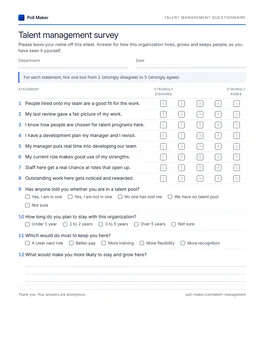
Talent management questionnaire
Sheet one lists the twelve core talent questions. Optional sets follow on later sheets, finishing with the named talent profile and the HR audit.
Download PDF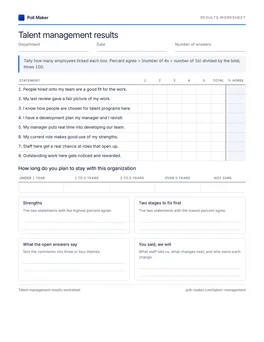
Talent results worksheet
Count the answers to the eight talent statements and the plans-to-stay question by hand, then choose the two stages that need work.
Download PDFQuestionnaire on talent management and employee retention
Writing a thesis or project on whether talent practices keep people? This questionnaire already has the shape that research uses: practices as predictors, plans to stay as the outcome.
Published studies follow the same design. A regression study of IT employees found people preferred to stay where they could develop and climb the career ladder, and that pay plans helped attract and keep them.5 A survey of identified talent and a control group inside one multinational found talent management practices had a positive effect on intention to stay, with career-related factors key to keeping people.6
- Measure the practices. Add the optional sets for the stages you test. Identification, development and deployment each reach four or more statements that way; average each stage into one score.
- Measure the outcome. Question 10 is your dependent variable. Code the four time bands 1 to 4 and set "Not sure" aside, or keep it as a category. The two job-search questions in Staying or leaving give you a second outcome.
- Check each score holds together. Report Cronbach's alpha for every stage score before you use it.
- Test the links. Correlate each stage score with plans to stay, then put all the stages into one ordinal or linear regression to see which practice still matters once the others are counted.
- Plan the sample. In an organization of 300, about 170 completed questionnaires keep the margin of error to roughly 5 points at 95 percent confidence.
Where a supervisor asks for a validated scale alongside these questions, the Integrated Talent Management Scale was developed with 506 employees in 17 organizations across three industries. It measures four areas: identifying critical positions, competence training, development and reward management.4 It is published open access, so you can read the full scale and compare your stage scores with its structure.
Start the questionnaire with a consent statement such as: "Your answers are anonymous, taking part is voluntary, and you may stop at any point." Then send the survey link, or print copies for staff who work offline.
Talent survey questions to fix before they go out
Employees do not think in HR terms, so every fix below swaps the label for something they have seen happen. Our page on choosing survey questions has more on wording for other topics.
How satisfied are you with our talent management practices?
My last review gave a fair picture of my work.
I know how people are chosen for talent programs here.
Few employees could say what "talent management practices" covers. Ask about the parts they have been through.
Do you have opportunities for career development and training?
I have a development plan my manager and I revisit.
Two topics and a yes or no. The better version asks about one thing and whether it is actually used.
Are you a high-potential employee?
Has anyone told you whether you are in a talent pool?
People cannot rate their own label. They can say what they have been told, which is what you need to know.
Are you planning to leave the company?
How long do you plan to stay with this organization?
A direct question about leaving gets a guarded "no". A time frame gets a range of answers you can compare across survey rounds.
What HR teams and researchers ask
Short answers for people planning a talent survey or a study.
What is a talent management questionnaire?
A set of questions employees answer about how their organization attracts, identifies, develops, deploys and keeps its people. This one has 38: a core 12 covering every stage, plus optional sets on hiring, reviews, growth, talent pools, retention, a named talent profile and an HR audit.
How do you measure talent management?
Ask employees about practices they have been through, work out the percentage agreeing with each statement, and compare those scores with how long people plan to stay. Repeat once a year, a month before the talent review, and follow each stage over time.
Can I use this questionnaire for a research project?
Yes. Use the core 12 plus the sets that match your research questions, open with a consent line, and cite this page as the source. The retention study section above covers the analysis.
Is there a talent management questionnaire PDF?
Yes. The questionnaire PDF leads with the core 12 talent questions and continues with every optional set, ready to print. A separate results worksheet lets you tally paper answers by hand.
Should a talent management survey be anonymous?
The survey should be. People will not rate reviews, promotions and their manager honestly with a name attached. The talent profile is the exception: it feeds talent reviews and career conversations, so it needs a name.
See your talent system the way employees do
Send the core 12 before your next talent review, then walk into the meeting with the two weakest stages, one owner apiece and a date to report back.