Career development questions to ask employees, plus a form for the career talk
Ask employees whether they can see a next step here, whether their manager helps them get there, and what would help most. Twelve core questions cover it in roughly five minutes, and optional sets go further into career conversations, training, internal moves and what managers need.
- 36questions
- 12in the core
- 5 minto answer the core
- 5sets to add
By Michael Hodge, BSc Psychology Updated September 2026
Every career question, from next steps to manager support
Every item below lists the choices an employee picks from and what its answer is good for. Twelve core items come pre-selected; tick any extra set, then load them into the survey builder, print a copy or grab the wording for another tool.
The core 1212 questions
Eight statements on what decides whether a career moves forward here, the date of the last career talk, what would help, plus a pair of open questions. That is a full annual survey by itself.
-
I can see a realistic next step for my career here.
Strongly disagree12345Strongly agree1 = Strongly disagree, 5 = Strongly agreeThe opportunity question. Development support only kept people in one study when they could also see a way forward inside.1
-
I know what it takes to get a bigger role here.
Strongly disagree12345Strongly agree1 = Strongly disagree, 5 = Strongly agreeCriteria clarity. Ambitious people who score this low usually have a path nobody has explained to them.
-
My manager helps me turn my goals into next steps.
Strongly disagree12345Strongly agree1 = Strongly disagree, 5 = Strongly agreeManager support asked as an action, not a feeling. A friendly manager who never plans anything scores low here.
-
My current work builds skills for my next role.
Strongly disagree12345Strongly agree1 = Strongly disagree, 5 = Strongly agreeMost growth happens on the job. This shows whether assignments are doing that work or just keeping people busy.
-
I can make time to learn during my working week.
Strongly disagree12345Strongly agree1 = Strongly disagree, 5 = Strongly agreeSeparates access from time. A generous course catalogue is no use to someone who can never step away.
-
I hear about open roles here before they are filled.
Strongly disagree12345Strongly agree1 = Strongly disagree, 5 = Strongly agreeInternal moves start with seeing the opening. Low scores mean people learn about roles after someone else has them.
-
Promotion decisions here are made fairly.
Strongly disagree12345Strongly agree1 = Strongly disagree, 5 = Strongly agreeRead it by team and level. A gap between groups matters more than the overall figure.
-
In two years, I expect to still be growing here.
Strongly disagree12345Strongly agree1 = Strongly disagree, 5 = Strongly agreeA stay signal worded around growth. People who disagree with the first statement rarely agree with this one.
-
When did you last talk with your manager about your career, not just your current work?
In the last month1 to 6 months ago6 to 12 months agoOver a year agoNeverThe cadence check. Add up the last two answers: that is the share of staff nobody is having the conversation with.
-
Which of these would help your career most in the next year?
Harder projectsA courseA mentorA team moveA clear path upMore feedbackTick all that applyTells you what to fund. Count the ticks by team before you choose next year's program.
-
Where would you like your career to be in two years?
Open answerSort the answers into up, across, deeper expertise and elsewhere. The mix shows whether a promotion ladder alone can meet it.
-
What is one thing this organization could do that would help your career most?
Open answerOne thing, not a wish list. The answers fall into a handful of themes you can act on.
Learning and training5 questions
Use this set when the budget question is on the table: courses, mentoring, feedback or time on the job.
-
Training on offer here fits the work I want next.
Strongly disagree12345Strongly agree1 = Strongly disagree, 5 = Strongly agreeRelevance to the future, not only to the current job. Low scores mean the catalogue serves last year's roles.
-
Feedback I get helps me grow, not only fix mistakes.
Strongly disagree12345Strongly agree1 = Strongly disagree, 5 = Strongly agreeDevelopmental feedback. A low score here often explains a low score on manager help.
-
I know how to ask for course funding or study time.
Strongly disagree12345Strongly agree1 = Strongly disagree, 5 = Strongly agreeMany learning budgets go unspent because nobody knows the route. This tells you whether yours is known.
-
How do you prefer to learn a new work skill?
With a colleagueA courseOnline, own paceA mentor or coachReadingMatch the format to the answers before you buy a program.
-
Do you have a mentor or coach at work?
Yes, and it helpsYes, rarely meetNo, would like oneNo, not neededShows the gap between wanting a mentor and having one: the size of the mentoring program you need.
Promotion and moving roles5 questions
For organizations that fill roles from inside, or want to. Keep this set anonymous.
-
A move to another team here would help my career.
Strongly disagree12345Strongly agree1 = Strongly disagree, 5 = Strongly agreeTests whether sideways moves are respected. Where a move looks like failure, people leave to make it.
-
I know how to apply for a role in another team.
Strongly disagree12345Strongly agree1 = Strongly disagree, 5 = Strongly agreeThe process question. Easy to fix with one page on the intranet.
-
My manager would back me applying for another team.
Strongly disagree12345Strongly agree1 = Strongly disagree, 5 = Strongly agreeManagers who hold on to good people block moves. This shows whether staff expect that to happen.
-
If your next step is not available here, what would you most likely do?
Wait for itA sideways moveRetrain hereLook outsideNot sureThe retention question behind development. The share choosing to look outside is the share at risk.
-
How long do you expect to stay in your current role?
Under a year1 to 2 years3 to 5 yearsOver 5 yearsNot sureWorkforce planning. Short answers from long-serving staff flag a bottleneck worth a closer look.
Before a career conversation (named)6 questions
Sent with names on, a week before a one-to-one, and read by the manager beforehand. Open questions suit this set because the answers turn into the plan.
-
Which parts of your work give you the most energy right now?
Open answerStarts from strengths, and hints at the kind of role that would suit the person next.
-
Which kind of move interests you most at the moment?
A step upA move acrossDeeper expertiseMore scope hereNot sure yetNot everyone wants to manage. This separates wanting a title from wanting to grow.
-
What would you like to be known for here a year from now?
Open answerA concrete aim in the person's own words, which the manager can help them work toward.
-
What would you like to learn in the next six months?
Open answerBecomes one development goal on the plan, with a way to learn it attached.
-
Who here would you like to learn from or work alongside?
Open answerNames a mentor, a shadowing day or a project team: the cheapest development there is.
-
What could get in the way of these plans, at work or outside it?
Open answerBrings up time, caring duties or confidence before they quietly stall the plan.
About you (optional)3 questions
Use these to compare teams, levels and ways of working. Hide any group smaller than five.
-
How long have you worked here?
Under a year1 to 2 years3 to 5 years6 to 10 yearsOver 10 yearsCareer needs shift with tenure. Compare the first two groups with everyone else.
-
Which best describes your role?
Individual contributorTeam leadManagerSenior leaderPrefer not to sayCompare paths by level, and separate the managers who answered the manager set.
-
Where do you mostly work?
On siteHybridRemoteTells you whether people away from the office see the same openings and get the same career talks.
For managers (managers answer)5 questions
Managers answer these about developing their own team. Compare them with what staff said about manager help and the last career talk.
-
Each person on my team had a career talk this year.
Strongly disagree12345Strongly agree1 = Strongly disagree, 5 = Strongly agreeThe manager's side of the career-talk question. When managers agree and staff say it never happened, the talks are not landing.
-
I know what each person on my team wants to do next.
Strongly disagree12345Strongly agree1 = Strongly disagree, 5 = Strongly agreeA manager who cannot answer this cannot plan assignments around it.
-
I have enough time to develop the people I manage.
Strongly disagree12345Strongly agree1 = Strongly disagree, 5 = Strongly agreeCapacity. Development is the first thing dropped when a manager is overloaded.
-
I get credit here when my people move up or across.
Strongly disagree12345Strongly agree1 = Strongly disagree, 5 = Strongly agreeIf managers lose out when people move on, they hold them back. This shows whether the incentives point the right way.
-
What would help you develop your team more?
Open answerAsks managers for the one thing they lack: time, budget, training or the authority to move people.
One questionnaire, three ways to send it
The same questions do different jobs depending on who reads the answers. Decide that first: it changes which sets you add and whether names go on.
| Version | Who reads it | What to send |
|---|---|---|
| Staff career survey | HR, as group results only | The core 12 once a year, plus Learning and training and Promotion and moving roles. It shows whether careers work here, team by team. |
| Career conversation prep | The employee and their manager | Before a career conversation, a week ahead, with names on. The answers become the first page of a development plan. |
| Quarterly pulse | HR and each manager, as group results | The five-question pulse further down, to check that last year's changes are landing. |
Keep the fairness and stay-or-go questions out of the named version. Someone weighing an exit will not say so on a form their manager reads, and nobody should have to. Untick questions 7 and 8 there, and leave question 21 for the anonymous survey. Other staff surveys, from pay to workload, are grouped under employee survey questions.
Where careers stall, team by team
Type in how many staff picked each answer. The chart shows where careers are working, where they stall, and which two statements to take on first. Print it for the leadership meeting.
- 1Type the count for each answer. The panel converts the counts into percent agreeing (a 4 or a 5) for each statement.
- 2Average statements 3, 4 and 5 for support and 1, 2 and 6 for opportunity, then find the team's box in the grid below.
- 3Take the two lowest statements as this year's focus and give each one an owner and a date.
- 4Check the last-career-talk answers next. If most people have not had one in six months, start there: it costs nothing but diary time.
Career survey results
Read support and opportunity side by side
In a study of 264 employees, support for development cut voluntary turnover only when people could see career opportunities inside the organization. Where they could not, the same support went with higher turnover.1 Score the two sides separately.
Support is the average percent agreeing with statements 3, 4 and 5 (manager help, skills from current work, time to learn). Opportunity is the average for statements 1, 2 and 6 (a next step, knowing what it takes, hearing about open roles). Each team lands in one box:
| Support | Opportunity low | Opportunity high |
|---|---|---|
| High | At risk: people are building skills they may take elsewhere. Open up internal moves and explain the paths. | Working: protect it and measure again next year. |
| Low | Stalled: start with career talks (question 9) and protected learning time. | Untapped: roles exist, but nobody is being readied for them. Put development money here. |
Worked example
| Side | Statements (illustrative scores) | Average |
|---|---|---|
| Support | 3: 70%, 4: 64%, 5: 58% | 64% |
| Opportunity | 1: 33%, 2: 40%, 6: 20% | 31% |
This made-up operations team of 30 sits in the at-risk box. Another course will not fix it. Posting openings inside before they go outside, and writing down what the next level needs, will.
What makes staff see a difference after the survey
Four habits separate a survey staff forget by Friday from one that shows up in their next year at work.

Ask about every direction, not only up
A ladder has few rungs, and not everyone wants to manage. The move question in the conversation set offers a step up, a move across, deeper expertise and more scope in the same role, so someone who wants to grow without a new title can say so. Sideways moves are worth making easy: in LinkedIn's data, people who had made an internal move had a 75% likelihood of still being with their company two years later, against 56% for those who had not.2
Reasons given for quitting a job in 2021 (US)
Treat the next step as a retention question
When Pew asked Americans who quit a job in 2021 why they left, no opportunities for advancement came up exactly as often as low pay: 63% each.3 Statements 1, 2 and 6 give you an early reading on that risk, long before it turns up in exit interviews.

Keep the named plan and the anonymous survey apart
Run the staff survey anonymously, with no name field anywhere, and publish results only for teams of five and up. The conversation prep works the other way round: it carries a name, reaches the manager a week before the meeting, and ends in a written plan with one to three goals. Mix the two and you get guarded survey answers and thin plans.
Answer back within a month
Within four weeks, tell staff which two statements came out lowest and the change planned for each, in a team meeting or a short note. Then act where the survey points. If few people hear about openings, post roles inside for a fixed period before advertising them. If career talks are rare, book one into every manager's calendar before the next survey goes out.
Curious how your team would answer before you send anything? Ask the career talk question at your next meeting as a live poll, and people vote from their phones without giving a name. The poll how-to walks through setting one up.
Checking progress between annual career surveys
Between annual surveys, these five show whether anything is moving: a visible next step, manager help, open roles, how recently people had a career talk, and the single change each person asked for.
- 01I can see a realistic next step for my career here.
- 02My manager helps me turn my goals into next steps.
- 03I hear about open roles here before they are filled.
- 04When did you last talk with your manager about your career, not just your current work?
- 05What is one thing this organization could do that would help your career most?
Paper for shift handovers and one-to-ones
Not everyone works at a desk. For shift teams, hand round printed copies when one shift takes over from another and collect them face down in an unmarked folder, or print the conversation set for a manager and employee to fill in together. The files are sized for both US Letter and A4 paper.
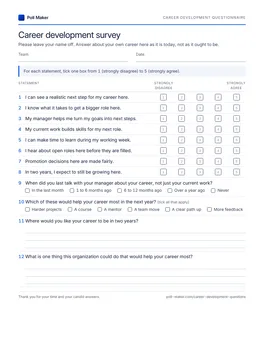
Employee questionnaire
The core 12 fills the first sheet. Every optional set follows on the pages after it.
Download PDF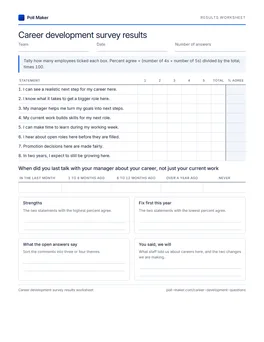
Results worksheet
Count the paper answers per statement, convert each count to a percent agreeing, add up when people last had a career talk, and pick two fixes.
Download PDFFor a thesis on career development
Students writing on career development and retention, performance or engagement can adopt the core 12 as a ready-made instrument. Settle three things in your methods chapter.
Map each variable to its questions
| Variable | Questions | Score |
|---|---|---|
| Perceived career opportunity | 1, 2 and 6 | Mean of three, 1 to 5 |
| Support for development | 3 to 5 and 13 to 15 | Mean of six, 1 to 5 |
| Promotion fairness | 7 | Single item, 1 to 5 |
| Intention to grow here | 8 and 21 | 8 as a score, 21 as groups |
| Background | 29 to 31 | Groups to compare |
Code it the same way every time
Score Strongly disagree as 1 through Strongly agree as 5, average each variable, and report the reliability of every multi-item score before testing anything with it.
When your supervisor wants published scales
Two established measures cover similar ground: the five-item career satisfaction scale by Greenhaus, Parasuraman and Wormley4 and the three-item perceived career opportunity scale by Kraimer and colleagues.1 Cite them and use their exact items when your findings need to be compared with earlier studies; their wording belongs to the authors and is not reprinted here. Every item on this page is new wording you can use as it stands.
Four career questions that need a sharper edge
Four familiar career survey questions, and the version that gets a usable answer. The question-writing guide has the same kind of fix for rating, choice and open questions.
Where do you see yourself in five years?
Where would you like your career to be in two years?
Five years is too far out to plan for, and the job-interview phrasing invites a rehearsed answer. Two years is close enough to act on.
Are you satisfied with training and career opportunities here?
Training on offer here fits the work I want next.
I can see a realistic next step for my career here.
This is two questions wearing one question mark. A low answer could be about the courses or about the openings, and you cannot tell which.
Do you want a promotion?
Which kind of move interests you most at the moment?
A yes or no about promotion hides everyone who wants to go deeper or sideways, and a no can read like a lack of ambition.
Does your manager support your development?
My manager helps me turn my goals into next steps.
Support is vague enough that almost everyone agrees. Asking about a concrete action separates managers who plan from managers who are pleasant.
Questions HR asks before the first career survey
Short answers for planning the first round.
What career development questions should you ask employees?
Start with whether they can see a next step here, whether they know what it takes, whether their manager helps them get there, and whether their work and their week leave room to learn. Add when they last had a career conversation, and ask in their own words what would help. Those ideas, plus a second open question, make up the core 12.
How do you create a career development plan for an employee?
Send the Before a career conversation set a week ahead, talk it through, then write one to three goals, each with the support it needs and a date to review it. Keep the plan to one page and look at it again within six months.
Should a career development survey be anonymous?
The staff survey, yes. It asks about fairness and whether people plan to stay, which few answer candidly with a name attached. The conversation prep is the opposite: it is meant to be named, because the manager needs the answers to help.
How often should you run a career development survey?
Once a year for the full survey, with the five-question pulse in between when you are changing something and want to see it work. Career conversations run on their own rhythm, at least once between surveys.
How can an organization improve career development?
Fix what the lowest statements point to, in that order. Three causes come up again and again: people cannot see openings (post roles inside first), do not know what the next level needs (write it down), or never get a career talk (put one in every manager's calendar). Then give managers credit when their people move up or across, so nobody hoards talent.
Ask your team where they want to go next
Staff can answer the core 12 online in five minutes, and the conversation set prints ready for the next one-to-one on your calendar.