Job application survey questions for every applicant, hired or not
Start with a core 12 that every applicant can answer within a day of applying, because the application is the one step everybody reaches. Add screening questions when the survey is the application itself, and sets for interviews, decisions and new hires as your round moves on.
- 38questions
- 12in the core check
- 4 minto answer the core
- 6sets to choose from
By Michael Hodge, BSc Psychology Updated September 2026
All 38 job application survey questions
Under every question sit the answers applicants choose from and what a choice tells you. The core 12 comes pre-selected, and you can tick a stage set once your round gets there.
The application check (core 12)12 questions
Send these to everyone who applied, within a day. Eight statements on the ad, the form and the reply, then the time it took, what nearly made them quit, and one change.
-
Where did you first see this job?
Our websiteA job boardSocial mediaSomeone I knowSomewhere elseShows which channels bring people all the way through the form. Set it beside where your best hires came from before you move any ad money.
-
The job ad made the pay, hours and location clear.
Strongly disagree12345Strongly agree1 = Strongly disagree, 5 = Strongly agreeThe three facts people look for first. A low score usually means one of them is missing from the ad.
-
I could picture a normal day in this job from the ad.
Strongly disagree12345Strongly agree1 = Strongly disagree, 5 = Strongly agreeChecks the description rather than the terms. A low score means people are applying on guesswork.
-
The form said up front how long it would take.
Strongly disagree12345Strongly agree1 = Strongly disagree, 5 = Strongly agreeThe cheapest fix on the list: one line at the top of the form.
-
Every question on the application related to this job.
Strongly disagree12345Strongly agree1 = Strongly disagree, 5 = Strongly agreeHow job-related a step looks is one of the strongest drivers of whether applicants see it as fair.1
-
The application worked well on the device I used.
Strongly disagree12345Strongly agree1 = Strongly disagree, 5 = Strongly agreeMost active job seekers start their search on a phone. Split this score by the device question to find where the form breaks.3
-
I had a fair chance to show why I suit this job.
Strongly disagree12345Strongly agree1 = Strongly disagree, 5 = Strongly agreeA chance to show what you can do is one of the best-supported fairness rules. Forms made only of tick boxes tend to score low here.2
-
I know when I will hear back about my application.
Strongly disagree12345Strongly agree1 = Strongly disagree, 5 = Strongly agreeTells you whether your confirmation message gives a date. If it does not, this is the easiest score on the page to raise.
-
Overall, applying for this job was easy.
Strongly disagree12345Strongly agree1 = Strongly disagree, 5 = Strongly agreeThe headline number to track from one opening to the next. It moves when the fixes behind the other statements land.
-
About how long did the application take you?
Under 10 minutes10 to 20 minutes20 to 40 minutesOver 40 minutesYour own estimate of the form is a guess until applicants answer this. Read it next to question 4.
-
Did anything nearly stop you from finishing?
The lengthRetyping my resumeMaking an accountA technical faultUnclear questionsNothingTick all that applyPeople who gave up never see this survey, so near misses among those who finished are your best clue to why others left.
-
What one change would have made applying easier?
Open answerOne change per person keeps the answers concrete. Sort them into piles; the biggest pile is your next fix.
Screening questions for the application form8 questions
For when the survey is the application itself. Each one helps decide who to call first, and none of them asks about age, family, health or origin.
-
When could you start?
Right awayWithin 2 weeksWithin a monthLater than thatSorts a shortlist by timing before anyone spends time on a phone call.
-
Which times could you work?
Weekday daysWeekday eveningsOvernightWeekendsTick all that applyFor shift work, the question that rules people in or out fastest. Ask it only when the hours are part of the job.
-
How much experience do you have in similar work?
None yetUnder 1 year1 to 3 years4 to 7 years8 years or moreExperience in bands is what a first screen needs, and it avoids graduation years, which point to age.5
-
Do you hold the license this job requires?
YesIn progressNoOnly for roles with a legal requirement, such as driving or care work. Name the license in the question.
-
What pay range are you hoping for in this role?
Open answerAsks what they want from this job rather than what they earn now. If the ad shows a range, this confirms the fit in one line.
-
What made you apply for this job?
Open answerMotivation in their own words. Short, specific answers are easy to compare side by side.
-
Tell us about some work you are proud of that fits this job.
Open answerGives every applicant room to show what they can do, the step applicants rate among the fairest in any process.2
-
Will you need any adjustments for our interview or task?
Yes, please contact meNoEEOC guidance allows this once applicants know what the steps are. It covers the hiring steps only, never the job itself.7
After an interview or task5 questions
Only for applicants who reached that step. Send it the day after, before the decision, so the answers are about the step and not the outcome.
-
What I was asked matched the work this role involves.
Strongly disagree12345Strongly agree1 = Strongly disagree, 5 = Strongly agreeWhether the step looked like the job. Applicants rate interviews and work samples highest, and both usually look like the work.1
-
I had enough time to show what I can do.
Strongly disagree12345Strongly agree1 = Strongly disagree, 5 = Strongly agreeRushed interviews and oversized tasks both score low here, so ask which step people mean if the score drops.
-
The people I met were ready for our conversation.
Strongly disagree12345Strongly agree1 = Strongly disagree, 5 = Strongly agreePreparation shows in whether they had read the application. It is also the simplest thing in this set to fix.
-
I was treated with courtesy at every step.
Strongly disagree12345Strongly agree1 = Strongly disagree, 5 = Strongly agreeWarmth and respect is one of the rules applicants judge every process by, including the ones that end in a no.2
-
I heard back by the date I was given.
Strongly disagree12345Strongly agree1 = Strongly disagree, 5 = Strongly agreeTests the promise, not the tone. A missed date here often explains a low score on courtesy.
After the decision4 questions
For everyone who has heard, hired or not. The outcome question comes first so every other answer can be read by outcome.
-
What was the outcome of your application?
I was offered the jobI was not selectedI withdrewStill waitingLets you read every other answer by outcome. Applicants who did well in a process rate it more favorably.1
-
How long after applying did you hear the decision?
Within a week1 to 2 weeks3 to 4 weeks1 to 2 monthsOver 2 monthsYour real time to decision, seen from the applicant side. Compare it with the date your confirmation message promised.
-
The decision message told me what I needed to know.
Strongly disagree12345Strongly agree1 = Strongly disagree, 5 = Strongly agreeExplanations are one of the best-supported fairness rules. A clear no with a line on what comes next scores well.2
-
I would apply here again for a different role.
Strongly disagree12345Strongly agree1 = Strongly disagree, 5 = Strongly agreeThe goodwill question. A rejected applicant who would apply again is a future hire, not a lost one.
New hires looking back5 questions
For people you hired from this round, three to six months in. They are the only applicants who can judge the process against the job it led to.
-
The job turned out to be the one the ad described.
Strongly disagree12345Strongly agree1 = Strongly disagree, 5 = Strongly agreeThe ad question again, with the benefit of doing the work. Compare it with the core statement about a normal day.
-
The hiring steps tested skills I really use here.
Strongly disagree12345Strongly agree1 = Strongly disagree, 5 = Strongly agreeJob relatedness judged by the only people who have seen both sides: the steps and the work.2
-
What I was told about pay and benefits proved accurate.
Strongly disagree12345Strongly agree1 = Strongly disagree, 5 = Strongly agreeBroken pay promises surface in the first months. This catches them while the hire is still there to tell you.
-
How long was it from applying to your offer?
Under 2 weeks2 to 4 weeks1 to 2 monthsOver 2 monthsTime to offer as the hire remembers it. Set it beside the dates in your own records.
-
What do you wish you had known before you accepted?
Open answerEvery answer here belongs in your next job ad or offer letter.
About you and how you applied (optional)4 questions
Use these to compare groups such as phone and laptop applicants. Skip any group so small that its members could be recognized.
-
Which device did you use to apply?
PhoneTabletLaptop or desktopSplit the device statement by this answer. If phone users score it lower, the fix is in the mobile form.
-
Have you applied to us before?
No, this is my first timeYes, once beforeYes, more than onceReturning applicants are the only ones who can say whether the process has changed since last time.
-
Are you working at the moment?
Yes, full timeYes, part timeNoStudying full timeUseful for research on how people look for work. Keep it in the feedback survey and out of the screening form.
-
What level was the job you applied for?
Entry levelExperiencedManagerSenior leaderSenior applicants usually go through different steps, so compare levels before you blame the form.
Screening, interview, decision: the set for each stage
Applicants weigh the hiring process itself more heavily the further they get through it.8 So each stage gets its own short set, and nobody answers the same question twice.
| Moment | Set to send | Who answers |
|---|---|---|
| While applying | Screening questions for the application form | Everyone, as part of the application |
| Within a day of applying | The application check (core 12) | Everyone who applied |
| The day after an interview or task | After an interview or task | Only those who took that step |
| Once the decision has gone out | After the decision | Everyone who heard, hired or not |
| Three to six months after a start date | New hires looking back | People hired from this round |
Bolt the about-you set onto any of them to compare groups, such as phone and laptop applicants or entry-level and senior roles.
Researching recruitment and selection?
For a dissertation or class assignment on how an organization recruits, the new-hire set is the usual starting point, because recent hires can judge both the process and the job it led to. Add the eight core statements, reworded to look back ("I knew when I would hear back about my application"), and ask the organization's permission before you survey its staff.
Decisions to make before the first applicant hears from you
Four decisions shape whether the answers help you hire better next time.

Send it to every applicant, not only the shortlist
Most people who apply never reach an interview, so the application is the only step they can tell you about. Send the core 12 to everyone within a day of applying. The SIOP white paper on applicant reactions opens with an applicant, Bob, who never heard back and is now telling friends about the company.2 A short survey is a sign that somebody reads what applicants say.
How applicants rate common hiring steps (average, 1 to 5)
Ask about steps that look like the job
Applicants judge a hiring step by whether it seems connected to the work. In a meta-analysis of 86 samples and 48,750 people, how job-related a step looked was among the strongest predictors of whether it felt fair, and applicants who saw a process as fair thought better of the employer and were keener to accept an offer and recommend it.1 The chart shows how applicants rate common steps. Questions 5 and 7 in the core put the same test to your own form.

Keep the survey apart from the decision
Applicants hold back criticism while they think a survey could count against them. Send it from a general address, open with a line saying it plays no part in hiring decisions, and have someone outside the hiring panel read the answers. Never break results down to a group of two or three.
Keep the form, and the survey, short
Long forms lose people. CareerBuilder found 60% of job seekers had abandoned an online application partway through because of its length or complexity, and an Appcast study of 500,000 job seekers saw completion rates fall by almost half when an application asked 50 or more questions rather than 25 or fewer.3 Hold your survey to that standard too. Applicants get through the core 12 in roughly four minutes.
Running an open hiring day? Show the first core question on a big screen as an instant live poll while people wait. By the first interview you will know which channels filled the room.
Turn the eight statements into a report
Enter how many applicants chose each number from 1 to 5. The chart sorts the eight statements from strongest to weakest, and the bottom two become the fixes for your next opening.
- 1Take each statement in turn: its 4 and 5 answers, over all the answers it got, give its agree share. The report builder works this out as you type.
- 2Split the answers by outcome before you compare anything. People who got through rate most steps higher, so compare offers with offers and rejections with rejections.
- 3Then read the time question and the near-miss question. Together they usually name the screen or field behind a low score.
- 4Fix the two lowest statements, write down the date, and send the same 12 on the next opening to see whether the scores move.
Application check results
A one-minute version for the confirmation page
Link these from the page or email applicants get right after they press submit. They take about a minute, and people answer while the form is still fresh in their mind.
- 01About how long did the application take you?
- 02Did anything nearly stop you from finishing?
- 03The application worked well on the device I used.
- 04I know when I will hear back about my application.
- 05What one change would have made applying easier?
What to leave off an application form
US equal employment guidance says an application should ask only for what shows whether someone is qualified for the job.5 These swaps keep your screening questions on the right side of that line.
| Instead of asking | Do this | Why |
|---|---|---|
| Are you a US citizen? | Add a line saying everyone hired will verify identity and eligibility to work | Most employers should not ask about citizenship before an offer, and the EEOC suggests this wording instead6 |
| Do you have a disability or health condition? | Describe the hiring steps and ask if anyone needs an adjustment to take part | Pre-offer questions about disability are prohibited; asking about adjustments for the process is allowed7 |
| What is your race or ethnicity? | Collect it only if you need it, on a separate tear-off sheet | A tear-off sheet keeps it away from the people judging qualifications4 |
| What year did you graduate? | Ask about experience in bands, as in the screening set | Questions that point to age should generally be avoided5 |
| Please attach a photo | Leave it out until an offer is accepted | The EEOC says to ask for a photograph only after an offer is made and accepted5 |
State and local rules can add to this list, so check the finished form against the rules where you hire. Every question in the screening set above was written to fit this table.
For walk-in hiring days and job fairs
Walk-in hiring days still run on paper. Hand the questionnaire over once an application is in, collect it at the desk, and tally the answers on the worksheet that evening.
Hiring day coming up? for the desk.
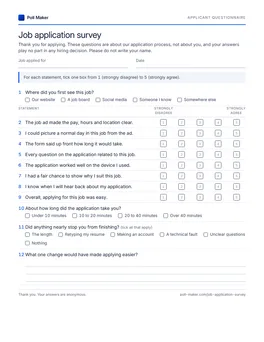
Applicant questionnaire
Sheet one carries the application check, with tick boxes beside every answer. Screening, interview, decision, new hire and about-you sets fill the later sheets.
Download PDF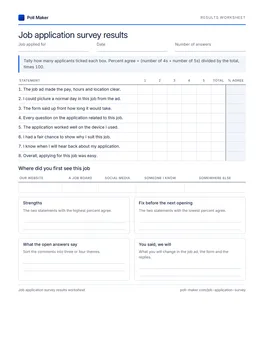
Results worksheet
Count the ticks for each statement, find the share who agree, and see which channels your applicants came through.
Download PDFVague, double and leading: applicant questions fixed
Three habits that spoil feedback from applicants, and the fix for each. For more examples by topic, and tips on unbiased wording, see the survey questions hub.
How was your application experience?
The form said up front how long it would take.
Every question on the application related to this job.
A general rating tells you the mood, not what to change. Specific statements each point at a fix.
Was our application quick, clear and easy to use on your phone?
About how long did the application take you?
The application worked well on the device I used.
Speed, clarity and mobile use in one breath. Someone who says no has no way to show which part let them down.
How much did you enjoy our simple application process?
Did anything nearly stop you from finishing?
The weak version hands people the answer before they give one. The better one lets them name the problem.
Hiring teams usually ask these first
What is a job application survey?
It means one of two things, and this page covers both. Usually it is a short feedback survey applicants answer about applying: the ad, the form and the replies. Some teams also run the application itself as a survey, with screening questions that have fixed answers so a shortlist sorts quickly.
Can I use these questions as the application form?
Yes. Tick the screening set, open it in the free form builder, add anything specific to the role, and link the finished form from your job ad.
Should applicants answer anonymously?
For the feedback sets, yes. Leave names out and send the survey from an address that has nothing to do with hiring decisions. The outcome question still lets you read results by offer and rejection without knowing who said what.
When should you send a job application survey?
Send the core 12 within a day of the application, while the form is fresh. Send the decision set once the answer has gone out, and the new-hire set three to six months into the job. The stage table above lists every set and its moment.
Is this the same as a candidate experience survey?
They overlap. This page centres on the application, which every applicant goes through. For an end-of-process survey that splits candidates by how their application ended, see the candidate experience survey on our sister site SuperSurvey.
Have it ready for the next opening
Put the application check in the builder and link it from your confirmation email, or print a stack of questionnaires for your next hiring day.