Skills survey questions that build a team skills matrix
A skills survey asks each person how well they can do the tasks your work depends on, using levels described in plain words, then lays the answers out as a skills matrix. The core 11 rates six skills most jobs share and finds out which ones people use every week and which ones their job never calls on.
- 33questions
- 11in the core set
- 5 minto answer the core
- 5described skill levels
By Michael Hodge, BSc Psychology Updated September 2026
Skills survey questions on one five-level scale
The core 11 comes ticked. Add a set, drop a skill, or rename one to fit the tools your team uses. Beneath every question you will find the options people pick from and a note on why a manager would ask it. Send your selection to the builder, to paper, or to the clipboard for another survey tool.
Core 11: the skills most jobs share11 questions
Six skill questions on the same five levels, then weekly use, how much of each person's ability the job draws on, the skill to build next and one skill that goes unused. Swap any of the six for a skill your team relies on more.
-
How well can you write clear emails, reports and instructions?
Not yetWith helpOn my ownEven hard onesCan teach itO*NET treats writing and speaking as two separate skills, so this question asks about writing alone.1
-
How well can you explain an idea out loud to a group?
Not yetWith helpOn my ownEven hard onesCan teach itThe spoken half, asked on its own so people with one strength and not the other can say so.
-
How well can you find the cause of a problem and fix it?
Not yetWith helpOn my ownEven hard onesCan teach itProblem solving as a task people can picture. Level 4 answers mark who to call when something breaks.
-
How well can you use the main software your job relies on?
Not yetWith helpOn my ownEven hard onesCan teach itName the actual tool in the builder. A specific tool gets a more accurate answer than "computer skills".2
-
How well can you work with numbers and data in a spreadsheet?
Not yetWith helpOn my ownEven hard onesCan teach itTells you who can check a budget or pull a report, and who needs help with both.
-
How well can you handle a customer or client who is unhappy?
Not yetWith helpOn my ownEven hard onesCan teach itService skill measured at its hardest moment. The gap between levels 3 and 4 matters most here.
-
Which of these skills do you use at least once a week in your job?
WritingSpeakingProblemsSoftwareDataCustomersTick all that applySeparates skills people have from skills they use. A 4 or 5 on a skill the person does not tick here is an unused skill.
-
How much of what you can do does your current job use?
Nearly all of itMost of itAbout halfLess than halfThe quickest read on wasted ability. "Less than half" answers are where the unused skills question pays off.
-
Which of these skills would help you most to build this year?
WritingSpeakingProblemsSoftwareDataCustomersOne choice per person, so the totals give you a ranked list of what people want to learn.
-
What is one skill you have that your current job does not use?
Open answerSurfaces languages, trades and past-job skills that no list of standard skills would catch.
-
Your name, so your answers can go into the team skills matrix
Open answerA skills matrix needs a name on every row. On paper it is the last line of page one.
Digital and data skills6 questions
For teams that run on software. Replace the examples with your own tools, and keep the same five levels so the answers sit in the same matrix.
-
How well can you build a spreadsheet that uses formulas?
Not yetWith helpOn my ownEven hard onesCan teach itThe step up from typing numbers in a grid. Level 3 and above means someone can maintain a shared file.
-
How well can you turn data into a clear chart or dashboard?
Not yetWith helpOn my ownEven hard onesCan teach itTells you who can report results without waiting for an analyst.
-
How well can you use an AI assistant to draft or check your work?
Not yetWith helpOn my ownEven hard onesCan teach itUse of AI tools can differ a lot between colleagues. The spread shows who could show the rest.
-
How well can you spot a phishing email or unsafe link?
Not yetWith helpOn my ownEven hard onesCan teach itA security skill everyone needs at level 3. Anyone below it is the first person to train.
-
How well can you automate a task you repeat every week?
Not yetWith helpOn my ownEven hard onesCan teach itTemplates, macros or workflow rules. Level 4 answers often point to hours the team could get back.
-
How well can you learn a new app without a training course?
Not yetWith helpOn my ownEven hard onesCan teach itA read on how the team will cope with the next tool change, before it happens.
People and leadership skills6 questions
For anyone who leads, trains or coordinates work, whatever their job title. These skills rarely appear on a job description, so they are easy to miss in a skills audit.
-
How well can you give a colleague feedback they can act on?
Not yetWith helpOn my ownEven hard onesCan teach itA skill that decides whether problems get raised early or late.
-
How well can you train a new starter in your part of the work?
Not yetWith helpOn my ownEven hard onesCan teach itThe people who answer 4 or 5 are your onboarding buddies.
-
How well can you run a meeting that ends with clear decisions?
Not yetWith helpOn my ownEven hard onesCan teach itAsked as an outcome, because running a meeting and ending one well are different skills.
-
How well can you settle a disagreement between two colleagues?
Not yetWith helpOn my ownEven hard onesCan teach itRarely taught and often needed. Low levels across a team point to a short workshop.
-
How well can you hand off a task and follow it through to the end?
Not yetWith helpOn my ownEven hard onesCan teach itDelegation without the jargon. Level 2 answers often come from new team leads.
-
How well can you plan a project from first step to delivery?
Not yetWith helpOn my ownEven hard onesCan teach itPlanning at project scale. Pair it with the matrix to see who could lead the next one.
Learning and growth4 questions
Add these when the survey will feed a training plan. They cover the time people have to learn, how they prefer to learn and who would teach.
-
In a typical month, how many hours of work time go to learning?
NoneUnder 1 hour1 to 4 hours5 or moreA reality check for any training plan. If most people answer "None", time is the first gap to close.
-
Which way of learning a work skill suits you best?
Shadow a colleagueShort courseOnline videoLearn by doingReadingMatches the format to the person once the matrix has chosen the skill.
-
Would you show colleagues how to do something you are good at?
Yes, gladlyYes, with time for itMaybeNoTurns level 5 answers into a list of willing teachers, and tells you who needs time set aside.
-
Which role, project or task would you like to try in the next two years?
Open answerLinks the skills people are building to where they want to go, which is what keeps them building.
Skills from outside your job3 questions
Most skills inventories stop at the job description. These three catch languages, certificates and experience people bring from elsewhere.
-
Which languages other than English could you use at work?
Open answerA classic inventory item. One bilingual colleague can save an outside interpreter.
-
Which of these do you hold right now?
First aidDriver's licenseTrade licenseProfessional certificationNoneTick all that applyShows who can cover a first aider's shift or a driving job, and which certificates are near renewal.
-
What skills from volunteering, hobbies or past jobs might be useful here?
Open answerA treasurer at a sports club can read a budget. This is where skills like that come to light.
About you3 questions
For sorting the matrix by team and experience. Share results with the person and their manager only.
-
Which team or department do you work in?
Open answerLets you build one matrix per team, which is the size a manager can act on.
-
How long have you been in your current role?
Under 1 year1 to 3 years4 to 10 yearsOver 10 yearsRead levels next to time in role: a 2 after three months and a 2 after three years call for different help.
-
Which best describes your role?
Team memberTeam leadManagerSenior leaderShows whether people skills sit only with managers or are spread through the team.
Five skill levels anyone can place themselves on
A bare 1 to 5 means something different to everyone who answers. Each option here describes what the person can do, so a 3 from one colleague means the same as a 3 from the next.
| Level | What it means | For writing, it looks like |
|---|---|---|
| 1 Not yet | Has not done it, or has only watched | Has not written a report here yet |
| 2 With help | Does it when someone guides or checks | Drafts emails a colleague reviews |
| 3 On my own | Handles the usual cases alone | Writes routine updates unaided |
| 4 Even hard ones | Copes with unusual or urgent cases | Writes complaint replies and proposals |
| 5 Can teach it | Others come to them; could train someone | Edits other people's writing |
Why tasks beat numbers
The US Department of Labor's O*NET database describes the level of all 35 skills it tracks with example tasks. For writing, a low level is "Write down a guest's order at a restaurant", a middle level is "Write an email to staff outlining new directives" and a high level is "Write a novel for publication".1 The levels above borrow that idea at the scale of one team. For your own skills, write a one-line example for each level in the same way, and paste it into the question in the builder.
Count levels 3 to 5 as "can do it alone". That line is what the matrix below counts.
How to conduct a skills survey
Four steps take you from a blank page to a skills map you can staff projects from.
Skills employers call core for their workforce, 2025
Start from the work, then pick six to ten skills
Write down the tasks your team does every week, then name the skills behind them. For any job title, O*NET OnLine lists the skills rated most important: for customer service representatives, active listening scores 75 and speaking 72 out of 100.1 Broad employer lists help too. In the World Economic Forum's 2025 survey, 69% of employers named analytical thinking a core skill.4 Some entries, such as resilience, are hard to rate as a task, so keep the ones your own tasks call for and leave the rest.

Describe each level in plain words
People judge their own ability only moderately well. Across 22 meta-analyses, self-ratings and measured performance correlated at .29 on average, and the match was closer when the question named a specific skill rather than a broad one.2 That is why every question here names one task and every answer describes what the person can do, from "With help" to "Can teach it".
Ask for names, and say what the answers are for
Unlike most staff surveys, a skills survey needs a name on each response, because the matrix has to show who can cover what. Say so in the invitation, together with the uses: planning training, sharing work fairly and finding who can teach. Say what it is not: a performance rating or a pay review. A "Not yet" is far easier to tick when it leads to help rather than a mark against the person.

Check each row with the person, then act
Self-ratings and manager ratings agree only in part. A meta-analysis found a correlation of .35 between the two, against .62 between peers and managers.3 So treat each row as the start of a ten-minute conversation, agree the levels, then use the grid. Repeat the survey every year: employers expect 39% of workers' core skills to change by 2030.4
Introducing the survey at a team meeting? Put the job-use question up as an anonymous live poll on the screen first, and let the result start the conversation before the named survey goes out. Our poll set-up walkthrough shows how to put a poll on a meeting screen.
Laying the answers out as a skills matrix
A skills matrix is one grid of names and skills, with each person's level where the two meet. Here a made-up team of five, called A to E, is laid out skill by skill.
| Skill | Levels for A, B, C, D, E | What it tells you |
|---|---|---|
| Writing | 4, 3, 3, 2, 3 | Four people at 3 or above. Covered. |
| Data | 5, 2, 1, 2, 2 | Only A works alone. One absence from a gap. |
| Customers | 3, 4, 3, 1, 5 | E could coach D, who is new to it. |
| Software | 2, 2, 2, 1, 2 | Nobody works alone yet. Train or hire here first. |
Four things to read in the grid
- Cover. For every skill the team uses each week, aim for at least two people at level 3 or above, so holidays and sick days do not stop the work.
- Single points of failure. A skill with only one person at 3 or above, like Data here, is a risk before it is a training need. Pair that person with the most willing learner now.
- Unused skills. Compare levels with the weekly-use question. A 4 or 5 on a skill someone never uses is capacity you already pay for.
- What to build next. Count the "build this year" votes, then check them against the thinnest skills. Train where the two agree first.
A spreadsheet is enough: one tab per team, with cells shaded from 1 to 5. Repeat it a year later, keeping the skills and levels unchanged, and the grid shows who moved up.
For the shop floor and field crews: a printed copy
Shop floor, warehouse and field staff often miss an emailed survey. Pass out printed copies at a shift briefing and collect them before people leave. The file fits both US letter and A4 sheets.
Collect the sheets before the briefing ends; a form taken home rarely comes back.
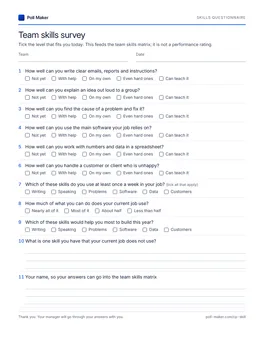
Skills questionnaire
Page one carries the core 11, with a name line and a box for every level. The digital, people, growth and outside-work sets follow on later pages, so print only the ones you send.
Download PDFSkill questions that tell you nothing, rewritten
Four common ways a skill question goes wrong, and how to fix each. For question types beyond skill levels, the survey questions hub has more fixes like these.
Rate your communication skills from 1 to 10.
How well can you write clear emails, reports and instructions?
How well can you explain an idea out loud to a group?
Communication is several skills, and a number with no words attached means something different to each person. Split it, then describe the levels.
Are you good with computers?
How well can you use the main software your job relies on?
Yes or no hides the level, and "computers" covers everything from email to databases. Name the tool.
Do you have leadership skills?
How well can you run a meeting that ends with clear decisions?
A label invites a flattering yes. A task is something a person can picture doing, or not.
List all of your skills.
What is one skill you have that your current job does not use?
An open box asking for everything gets job titles back. One narrow prompt finds the skills you did not know about.
Skills survey questions people ask
For managers, team leads and HR teams planning their first skills survey.
What is a skills survey?
A questionnaire in which each person on a team rates how well they can do the skills the work depends on, on the same set of levels. The answers go into a skills matrix that shows who can cover each task, where the team is thin and what to train next.
Should a skills survey be anonymous?
No. A skills matrix needs a name on every row. Keep it confidential instead: tell people who will see their answers (usually they, their manager and HR) and what the answers will be used for.
What rating scale works best?
Five levels, each described by what the person can do, work better than a bare 1 to 5 or 1 to 10. The five used here run from "Not yet" through "With help", "On my own" and "Even hard ones" to "Can teach it".
How often should we run a skills survey?
Once a year, and again when roles, tools or the team change. Keep the same skills and levels each time so you can see who moved up.
Is a skills survey the same as a reference check?
No. A reference check survey goes to people who have worked with a job candidate and asks them to rate that person. The survey on this page goes to your own team, and each person rates their own skills.
Map your team's skills this month
Pick your sets, send the survey with a two-line note on what the answers are for, and have a first matrix drawn up before the month is out.