Stakeholder survey questions for satisfaction and feedback
Ask partners, funders, clients, neighbors and your own staff whether they feel informed, heard and fairly treated, and whether working with you is worth their time. Every group answers the same core 12 in about five minutes, so you can compare them; a short set per group goes further.
- 40questions
- 12in the shared core
- 5 minto answer the core
- 5stakeholder group sets
By Michael Hodge, BSc Psychology Updated September 2026
One core for everyone, one set per group: 40 questions
The shared core comes ticked. Tick the set for each group you plan to ask. Each row lists the choices on offer and the decision an answer points to.
The shared core 1212 questions
Who is answering, eight statements in four pairs (kept informed, heard, trusted, easy to work with), overall satisfaction and two open questions. Every stakeholder group can answer all twelve.
-
Which best describes your connection to this organization?
Partner or supplierFunder or donorClient or userNeighborGovernmentStaff or boardThe split every other answer is read by. One overall average hides the group that most needs your attention.
-
I know what this organization is trying to achieve.
Strongly disagree12345Strongly agree1 = Strongly disagree, 5 = Strongly agreeKept informed, part one. If stakeholders cannot say what you are for, the fix is a clearer story, not more updates.
-
I hear about decisions that affect me early.
Strongly disagree12345Strongly agree1 = Strongly disagree, 5 = Strongly agreeKept informed, part two. News that arrives after a decision reads as a decision made without them.
-
When I raise a concern, I get a clear answer.
Strongly disagree12345Strongly agree1 = Strongly disagree, 5 = Strongly agreeHeard, part one. Responsiveness as people live it: an answer, not an acknowledgment and silence.
-
I can see how feedback like mine gets used.
Strongly disagree12345Strongly agree1 = Strongly disagree, 5 = Strongly agreeHeard, part two. Low scores usually mean views go in and nothing visible comes out, which is fixable by reporting back.
-
This organization keeps the commitments it makes.
Strongly disagree12345Strongly agree1 = Strongly disagree, 5 = Strongly agreeTrusted, part one. Reliability is the part of trust stakeholders can check for themselves.
-
I am treated with respect, even when we disagree.
Strongly disagree12345Strongly agree1 = Strongly disagree, 5 = Strongly agreeTrusted, part two. A relationship is tested in a dispute; read this one next to the open answers.
-
I know who to contact when I need something.
Strongly disagree12345Strongly agree1 = Strongly disagree, 5 = Strongly agreeEasy to work with, part one. A named contact is the cheapest fix on this list and often lifts the other scores.
-
Time I spend with this organization is well spent.
Strongly disagree12345Strongly agree1 = Strongly disagree, 5 = Strongly agreeEasy to work with, part two. Meetings, reports and consultations cost stakeholders time. A low score warns that people will stop turning up.
-
Overall, how satisfied are you with your relationship with this organization?
Very satisfiedSatisfiedNeutralDissatisfiedVery dissatisfiedThe headline figure: the share satisfied or very satisfied, which the commission's survey reports for every group and every year.1
-
What does this organization do well that it should keep doing?
Open answerNames what to protect when things change. Stakeholders answer this one generously and specifically.
-
What is one thing this organization should change about how it works with you?
Open answerOne change, about the relationship. The answers sort into three or four themes per group.
Project sponsors and users5 questions
Add these when the survey follows one project. Sponsors, clients and end users answer: the people who asked for it, paid for it or use what it delivered.
-
I knew what this project would deliver.
Strongly disagree12345Strongly agree1 = Strongly disagree, 5 = Strongly agreeScope as the stakeholder pictured it. Most late disagreements start with two different pictures of the finished work.
-
I was told early when plans or dates changed.
Strongly disagree12345Strongly agree1 = Strongly disagree, 5 = Strongly agreeChange notice. Stakeholders forgive a moved date far more readily than a surprise.
-
What was delivered does the job I needed.
Strongly disagree12345Strongly agree1 = Strongly disagree, 5 = Strongly agreeFitness for purpose, the verdict that matters more than on time or on budget.
-
How often did you want progress updates?
WeeklyEvery two weeksMonthlyAt milestones onlySets the rhythm of the next project from what stakeholders asked for, not what the plan assumed.
-
What should the team do differently on the next project?
Open answerLessons from the people outside the team, who see different problems from the ones inside it.
Partners and suppliers5 questions
For organizations that deliver work with you or for you: delivery partners, contractors, vendors and member groups.
-
Working together helps us reach our own goals.
Strongly disagree12345Strongly agree1 = Strongly disagree, 5 = Strongly agreePartnerships last when both sides gain. A low score here predicts a partner who quietly moves on.
-
Our agreement sets out clearly what each side does.
Strongly disagree12345Strongly agree1 = Strongly disagree, 5 = Strongly agreeMost partner friction starts with fuzzy roles, and it is fixed in a single meeting.
-
Paperwork is kept to what the work needs.
Strongly disagree12345Strongly agree1 = Strongly disagree, 5 = Strongly agreeReporting, invoicing and compliance steps as a cost to the partner. Cut what nobody reads.
-
I can raise a problem without fear of losing work.
Strongly disagree12345Strongly agree1 = Strongly disagree, 5 = Strongly agreeWhether bad news reaches you early. Partners who score this low tell you only when it is too late.
-
Over the next year, you expect to work with this organization:
MoreAbout the sameLessNot sureThe partner's own forecast of the relationship. Read every Less next to that partner's open answers.
Funders and donors4 questions
For the people and institutions that pay for the work: grant makers, sponsors, major donors and commissioning bodies.
-
Reports I receive show what our funding achieved.
Strongly disagree12345Strongly agree1 = Strongly disagree, 5 = Strongly agreeFunders renew on results they can see. A low score is a reporting problem before it is a performance problem.
-
I hear about problems early, not only successes.
Strongly disagree12345Strongly agree1 = Strongly disagree, 5 = Strongly agreeCandor. Funders who hear only good news stop believing it.
-
Funds are spent the way we agreed.
Strongly disagree12345Strongly agree1 = Strongly disagree, 5 = Strongly agreeStewardship in one statement. Anything below strong agreement deserves a phone call.
-
What would make you more likely to renew or increase your support?
Open answerThe funder's own terms for the next grant, in their words, ahead of the renewal conversation.
Community and neighbors5 questions
For residents, local groups and businesses near your sites or affected by your work, who never signed up for a relationship with you.
-
I know where to find out about plans for my area.
Strongly disagree12345Strongly agree1 = Strongly disagree, 5 = Strongly agreeWhether neighbors can get information before it becomes a rumor.
-
This organization takes local concerns seriously.
Strongly disagree12345Strongly agree1 = Strongly disagree, 5 = Strongly agreeThe neighbor's version of being heard. Split it by street or district when you can.
-
People nearby see real benefits from this work.
Strongly disagree12345Strongly agree1 = Strongly disagree, 5 = Strongly agreeLocal benefit as residents see it: jobs, services, events, a better street. It often differs from the benefit in your plan.
-
In the past year, which of these have you done?
Read an updateWent to a meeting or eventContacted the organizationTook part in a consultationNone of theseTick all that applyHow engaged each neighbor is, from reading to taking part. Compare the scores of people who came to a meeting with those who did not.
-
What concerns you most about this work in your area?
Open answerThe issue to answer first at the next public meeting, named by the people who live with it.
Staff, board and volunteers4 questions
Internal stakeholders see the relationships from the other side. Ask them too, then compare their view with the outside one.
-
I know what our key stakeholders expect from us.
Strongly disagree12345Strongly agree1 = Strongly disagree, 5 = Strongly agreeWhether the people who deal with stakeholders every day share one picture of what is owed to them.
-
I hear what partners and neighbors say about us.
Strongly disagree12345Strongly agree1 = Strongly disagree, 5 = Strongly agreeWhether outside feedback travels inside. Staff who never hear it cannot act on it.
-
Which group do you think rates us lowest?
Partners or suppliersFunders or donorsClients or usersNeighborsGovernmentCheck the guess against the real results. A wrong guess is a finding in itself: that group is not being heard.3
-
Which stakeholder relationship needs attention first, and why?
Open answerThe inside view of risk, often naming a relationship the outside survey did not reach.
Looking ahead3 questions
For any group, when the results will feed a plan, a budget or next year's engagement calendar.
-
Compared with a year ago, working with this organization is:
Much betterBetterAbout the sameWorseMuch worseDirection in one answer, and the easiest question to ask again next year.
-
How would you most like to give your views next time?
Short online surveyWorkshop or forumOne-to-one conversationKeep me informed onlyPlans the next round of engagement around what each group will actually take part in.
-
What change in your field should this organization prepare for?
Open answerStakeholders often see a shift coming first. Collect the answers before the next plan is drafted.
About you (optional)2 questions
Two splits that sharpen every result. Keep each split large, so no single stakeholder stands out.
-
How long have you been connected to this organization?
Under 1 year1 to 3 years4 to 10 yearsOver 10 yearsNew stakeholders judge on first impressions, long-standing ones on history. Their scores move for different reasons.
-
How often are you in contact with this organization?
WeeklyMonthlyA few times a yearOnce a year or lessPeople you rarely speak to often rate you on what they have heard. Read their answers as reputation.
Decide who gets the survey, and which set
Start with the list, not the questions. IFC's stakeholder handbook puts identification first, then asks how each group is affected, to what degree, and what influence it could have.2
Three questions build the list: who is affected by this work, and how much? Who can change how it turns out? Whose support will you need over the next year? Draw the list wide. The same handbook warns against defining stakeholders too narrowly, because groups just outside the line still feel the effects.2
| Stakeholder group | What you most need to learn | Add to the core |
|---|---|---|
| Partners and suppliers | Whether both sides gain and the paperwork is fair | Partners and suppliers |
| Funders and donors | Whether your reports show what their money did | Funders and donors |
| Clients and project sponsors | Whether what you delivered does the job | Project sponsors and users |
| Neighbors and local groups | Whether they know your plans and see local benefit | Community and neighbors |
| Government and regulators | Whether you are open and predictable | Looking ahead |
| Staff, board and volunteers | Whether the inside view matches the outside one | Staff, board and volunteers |
Build one survey in the builder with the core and every set you need, then send each group a link to its own copy, so the answers arrive already split. Other surveys about how an organization runs sit in the business survey questions collection.
Making the survey worth answering next year
Four habits from organizations that publish their stakeholder results, and from the handbook many of them work from.
Stakeholders satisfied with the regulator, by group, 2025
Report every group on its own
A single overall figure can hide the group you most need to reach. When Victoria's Essential Services Commission surveyed its stakeholders in 2025, 72% were satisfied overall; group by group, the figure ran from 91% of government agencies to 56% of businesses in its energy upgrades program.1 The split showed the commission which sectors wanted a different approach. The first core question asks everyone which group they belong to, so every answer splits the same way.

Interview a few, survey the rest
The commission invited 901 stakeholders and heard from 171 of them: 30 through in-depth interviews and 141 through an online survey.1 Copy the shape at any size. Sit down with the handful of partners whose decisions shape your year, and send the link to everyone else. IFC's handbook agrees that it is "not practical, and usually not necessary" to engage every group with the same intensity all the time.2

Tell people what changed
Once they have answered, "stakeholders will want to know which of their suggestions have been taken on board," as the IFC handbook puts it. It also advises explaining which suggestions were not taken up, and why, to build credibility and reduce consultation fatigue.2 The commission publishes its results along with the areas it will improve.1 Send each group its own results and one change within a month, and the next survey starts with goodwill.
Ask the same questions every year
The handbook describes an annual or semi-annual perception survey, run by someone independent, that "uses the same set of questions over time to achieve continuity."2 Asked the same way three years running, the commission's satisfaction figure went from 59% in 2023 to 62% in 2024 and 72% in 2025.1 Keep your version stored in the builder, leave the wording alone, and send it again at the same point next year.
At an annual stakeholder meeting or a partner webinar, show one question on screen and collect answers from every phone in the room. The year-on-year question makes a natural real-time audience poll, and making a poll takes five steps, from question to shareable link.
Score the relationship group by group
The eight core statements come in four pairs. Percent agree for a pair is the average of its two statements, and the relationship score is the average of all eight.
| Pair | Core statements | A low score usually means |
|---|---|---|
| Kept informed | Questions 2 and 3 | News arrives late or never explains the why |
| Heard | Questions 4 and 5 | Views go in and nothing visible comes back |
| Trusted | Questions 6 and 7 | A broken promise or a dispute handled badly |
| Easy to work with | Questions 8 and 9 | No named contact, or meetings that waste time |
A worked example
A community health charity hears from 18 partners, 20 neighbors and 14 funders, and works out the Heard pair for each group from the two statements in it.
| Group | Heard, percent agree | What the charity does |
|---|---|---|
| Partners (18) | 72 | Keeps the quarterly partner call |
| Funders (14) | 61 | Adds a short note on what changed after each report |
| Neighbors (20) | 35 | Holds a drop-in session and publishes a you-said, we-did page |
Treat a gap of 15 points or more between two groups as a finding, and a few points as noise. Next year, ask the same statements in the same words and check whether the neighbors' Heard score has closed on the partners'.
Build the one-page stakeholder report
Type how many people in one group chose each answer for the eight core statements. The report marks that group's strengths and the two statements to fix first, ready to print for the board or send back to the group.
- 1Enter the counts for one stakeholder group at a time and print that group's page. Then clear it and do the next group.
- 2Read the statements in their pairs: kept informed, heard, trusted, easy to work with. Two short bars in one pair name the problem.
- 3Lay the group pages side by side. A statement that is strong for partners and weak for neighbors tells you whose experience to fix.
- 4Send each group its page and name the single thing you will change before the next round.
Core relationship statements
Gather the sheets before partners leave
Hand the questionnaire round at the end of a partner meeting, a public session or a site visit, and gather the sheets before people leave. Each PDF prints on standard office paper.
Meeting one partner group?
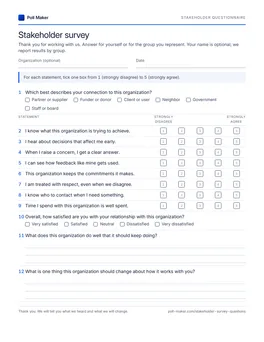
Stakeholder questionnaire
The shared core on the first sheet, ready for a pen, then every group set with a line saying who answers it.
Download PDF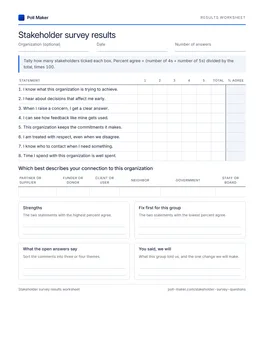
Results worksheet
One sheet per stakeholder group: tally the answers, turn them into percent agree statement by statement, and write down the change you will make.
Download PDFBetween annual rounds: a five-question pulse
Between annual surveys, after a big decision or when a project wraps up: who is answering, whether they heard early, whether their feedback shows, whether you kept your word, and the one change they want.
- 01Which best describes your connection to this organization?
- 02I hear about decisions that affect me early.
- 03I can see how feedback like mine gets used.
- 04This organization keeps the commitments it makes.
- 05What is one thing this organization should change about how it works with you?
Stakeholder questions in your words, not theirs
Four common stakeholder survey questions, each with a version people can answer quickly and honestly. For more on choosing and wording items, see how to pick survey questions.
How satisfied are you with our stakeholder engagement?
I hear about decisions that affect me early.
I can see how feedback like mine gets used.
"Stakeholder engagement" is your word, not theirs. Ask about moments they have lived through.
How would you rate the timeliness and transparency of our communication?
I hear about decisions that affect me early.
Two ideas in one question. Someone who got the news on time but found it vague has no honest answer.
How much do you value our long-standing partnership?
Time I spend with this organization is well spent.
The first version assumes the answer and flatters the asker, so partners pick the polite option.
Do you have any other feedback?
What is one thing this organization should change about how it works with you?
An open invitation gets short, empty replies. One change, about the relationship, gets answers you can sort.
For funders, partners and program staff: quick answers
For the person who has to send the survey and report what it found.
What is a stakeholder survey?
A questionnaire an organization sends to the groups that affect or are affected by its work, such as partners, funders, clients, neighbors, regulators and its own staff, to learn how each group sees the relationship. Most organizations repeat it yearly, word for word, to compare results over time.
Should internal and external stakeholders get different surveys?
Give them one shared core and a different add-on set. The core lets you compare groups; the set asks what only that group can tell you. Hon and Grunig also suggest putting the same questions to managers inside the organization, because both views together give a fuller picture of a relationship.3
How often should you survey stakeholders?
Once a year, or every six months while a lot is changing: that is the rhythm the IFC handbook describes for perception surveys.2 Between rounds, send the five-question pulse after a major decision or a project milestone.
Should a stakeholder survey be anonymous?
Make names optional. The group question is all you need to report results. Partners and funders tend to speak more freely when someone outside the team sends the survey and reads the raw answers; the IFC handbook describes an independently run perception survey,2 and the commission's research is carried out by an outside firm.1
How many questions should a stakeholder survey have?
The core 12 covers the relationship for any group and takes about five minutes. Add the one set that fits the group you are asking and stop there, so each person answers about 16 to 18 questions.
Put your stakeholder survey in the field
Load the shared core, pick a set for every group on your list, then send each group its own link, or print copies for the next meeting.