Partner satisfaction survey questions for channel partners, vendors and nonprofits
A partner satisfaction survey asks the organizations that sell, supply or deliver with you two things: whether the partnership pays, and whether you are good to work with. Partners judge those separately, so the 12 core questions score them apart. Then add a set for resellers, vendors or nonprofit partners.
- 37questions
- 12in the core
- 5 minto answer the core
- 4sets by partner type
By Michael Hodge, BSc Psychology Updated September 2026
All 37 partner satisfaction survey questions
The twelve partner questions come pre-selected. Add the reseller, vendor or nonprofit set, or tick individual questions one by one. Every line shows the choices partners pick from and what a partner or procurement manager can learn from them.
The core 1212 questions
One question on the kind of partner, two statements about the money, six about the working relationship, a look at the year ahead and two open questions. Every partner type can answer them.
-
What kind of partner is your organization?
Reseller or distributorReferral or agencyTechnology or allianceVendor or supplierNonprofit or communityRead every later answer by this one. A reseller and a vendor want different things from you, and one average hides both.
-
The partnership pays back what we put into it.
Strongly disagree12345Strongly agree1 = Strongly disagree, 5 = Strongly agreeEconomic satisfaction in one line: whether the returns justify the effort. Partners weigh the money apart from the working relationship.1
-
Our financial terms with this company are fair.
Strongly disagree12345Strongly agree1 = Strongly disagree, 5 = Strongly agreeMargins, prices, payment terms or grant terms, whichever applies. Read a low score next to the partner type before you change anything.
-
We hear news that affects us in time to act on it.
Strongly disagree12345Strongly agree1 = Strongly disagree, 5 = Strongly agreeCommunication quality, one of the traits linked to partnership success in research on manufacturers and their dealers. Asking about timing makes it something a partner can check.2
-
We can quickly reach someone who can fix a problem.
Strongly disagree12345Strongly agree1 = Strongly disagree, 5 = Strongly agreeResponsiveness as partners live it: a person who can act, not a ticket number or a shared inbox.
-
Problems between us are solved together.
Strongly disagree12345Strongly agree1 = Strongly disagree, 5 = Strongly agreeJoint problem solving, the way of handling conflict that research on manufacturers and dealers linked to partnership success.2
-
This company does what it says it will do.
Strongly disagree12345Strongly agree1 = Strongly disagree, 5 = Strongly agreeTrust that partners can check against events: shipments, payments, promised leads and deadlines.
-
We have a real say in plans that shape our work.
Strongly disagree12345Strongly agree1 = Strongly disagree, 5 = Strongly agreeParticipation. In a survey of 1,067 local partners of international NGOs, being involved in shaping strategy was one of the lowest-rated statements.3
-
Contracts, orders and payments run smoothly.
Strongly disagree12345Strongly agree1 = Strongly disagree, 5 = Strongly agreeEase of doing business: the paperwork and systems between you. Friction here wears a partner down long before anyone complains.
-
A year from now, where do you expect this partnership to be?
Doing more togetherAbout the sameDoing less togetherWinding downNot sureA forward look that turns the scores into a call list: partners who pick doing less or winding down need a conversation this month.
-
What does this company do that you would miss if it stopped?
Open answerNames what to protect when budgets, programs or people change on your side.
-
What one change would make this company easier to partner with?
Open answerOne change keeps the answers concrete. They usually fall into three or four themes you can own.
About your organization (optional)2 questions
Two questions to ask first if you will compare new and long-standing partners, or executives and day-to-day contacts. Leave them out if you will not.
-
How long has your organization worked with this company?
Under 1 year1 to 2 years3 to 5 yearsOver 5 yearsNew partners are still judging the onboarding; long-standing ones judge the relationship. Split by tenure before you compare.
-
What is your role?
ExecutivePartner managerSalesOperationsFinanceAn executive and the person who deals with you daily often score the same partnership differently. Ask both where you can.
Channel partners (resellers, distributors and agencies answer)6 questions
For partners who sell your products or refer customers to you. These are the money questions a channel manager needs next to the core.
-
Our margins here compare well with other lines.
Strongly disagree12345Strongly agree1 = Strongly disagree, 5 = Strongly agreeChannel research defines economic satisfaction by outcomes such as sales volume, margins and discounts. For a reseller, margin is the one to ask by name.1
-
Deals we register stay protected.
Strongly disagree12345Strongly agree1 = Strongly disagree, 5 = Strongly agreeDeal registration only works if partners believe in it. Low scores usually arrive with conflict stories in the open answers.
-
Leads we get from this company are worth chasing.
Strongly disagree12345Strongly agree1 = Strongly disagree, 5 = Strongly agreeLead quality judged by the people who work the leads. Sending more leads without better ones pushes this score down.
-
Direct sales staff do not chase our customers.
Strongly disagree12345Strongly agree1 = Strongly disagree, 5 = Strongly agreeChannel conflict asked as something partners notice in the field, not as an abstract rating of fairness.
-
About how much of your revenue comes from this company's products?
Under 10%10 to 24%25 to 49%50% or moreNot sureDependence. Partners who rely on you heavily may stay while unhappy, so read their scores apart from partners who carry you as a small line.
-
How likely are you to recommend this company to a similar business in another market?
0123456789100 = Not at all likely, 10 = Extremely likelyPartner NPS. "In another market" matters: few resellers will send a direct rival your way, so the plain version can read low.
Enablement and support (channel and technology partners answer)5 questions
Training, the partner portal, your partner managers and technical help: the support that decides whether a partner can sell and service what you make.
-
Training gets our staff ready to sell the products.
Strongly disagree12345Strongly agree1 = Strongly disagree, 5 = Strongly agreeEnablement judged by its result, sales readiness, rather than by the hours of content on offer.
-
We find what we need in the portal without asking.
Strongly disagree12345Strongly agree1 = Strongly disagree, 5 = Strongly agreePrices, product sheets and certifications are weekly tasks. If partners still email for them, the portal is not doing its job.
-
Our partner manager knows how we make money.
Strongly disagree12345Strongly agree1 = Strongly disagree, 5 = Strongly agreeOne relationship shapes most partners' view of you. A low score here tends to pull the whole core down with it.
-
Support for our customers comes fast enough.
Strongly disagree12345Strongly agree1 = Strongly disagree, 5 = Strongly agreePartners carry your support delays to their own customers, and those delays surface later as lost renewals.
-
Which would help you sell more with this company?
Higher marginsBetter leadsTrainingCo-op fundsDemosTick all that applyA ranked wish list. Set it beside the margin and lead scores to see whether partners want money or help.
Vendors and suppliers (they rate you as a customer)6 questions
For the vendors you buy from, rating you as a customer. This is what a vendor satisfaction survey usually means, and it shapes which customers a vendor treats as preferred.
-
This company pays our invoices on agreed terms.
Strongly disagree12345Strongly agree1 = Strongly disagree, 5 = Strongly agreeThe complaint vendors raise first, and the easiest to check against your own accounts payable records.
-
We can plan around the forecasts we are given.
Strongly disagree12345Strongly agree1 = Strongly disagree, 5 = Strongly agreeReliability, which supplier research names with growth opportunity and profitability as major drivers of vendor satisfaction.4
-
Orders and specs are clear the first time.
Strongly disagree12345Strongly agree1 = Strongly disagree, 5 = Strongly agreeOperational excellence as a vendor sees it. Rework, calls and changed orders cost them money they rarely bill you for.
-
This account gives our business room to grow.
Strongly disagree12345Strongly agree1 = Strongly disagree, 5 = Strongly agreeGrowth opportunity, another of those major drivers.4
-
Setting up as a new vendor was straightforward.
Strongly disagree12345Strongly agree1 = Strongly disagree, 5 = Strongly agreeOnboarding: forms, compliance checks and the first payment. Ask vendors who joined in the last year.
-
Compared with your other customers, how does this company rank for you?
One of our bestAbove averageAbout averageBelow averagePreferred customer status. Satisfied vendors are more likely to rank a buyer as preferred and give it preferential treatment.4
Nonprofit and community partners (local partners answer)6 questions
For foundations, charities and international NGOs asking the local organizations they fund or work beside. In the builder, swap "this company" for your organization's name.
-
Payments arrive on the dates we agreed.
Strongly disagree12345Strongly agree1 = Strongly disagree, 5 = Strongly agreeSmall organizations run on tight cash. One late payment can pause the work and the staff it pays for.
-
Budgets can change when the work on the ground does.
Strongly disagree12345Strongly agree1 = Strongly disagree, 5 = Strongly agreeFlexibility over spending tied for the lowest-rated statement in Keystone's partner survey: a median of +0.6 on a scale from -10 to +10.3
-
Required reports are worth the time they take.
Strongly disagree12345Strongly agree1 = Strongly disagree, 5 = Strongly agreeReporting is time partners spend on your needs rather than theirs. A low score is the case for shorter formats.
-
We know how long this partnership will last.
Strongly disagree12345Strongly agree1 = Strongly disagree, 5 = Strongly agreeExit plans were among the weakest areas in the same survey (median +1.5). Partners who know the end date can plan for it.3
-
We get public credit for the work we do together.
Strongly disagree12345Strongly agree1 = Strongly disagree, 5 = Strongly agreePromotion scored low for most NGOs (median +1.7), yet a stronger public presence was one of the partners' top requests.3
-
Beyond funding, which support would help your organization most?
Introductions to fundersRaising our profilePeer learningSkills trainingHelp with reportingTick all that applyKeystone's respondents asked first for help reaching other funders and raising their profile, not for technical training.3
Resellers, suppliers and NGOs each get their own set
Everyone answers the core, so partner types can be compared on the same eight statements. The set you add, and the timing, depend on who the partner is.
| Partner | Add this set | When to send |
|---|---|---|
| Resellers, distributors and dealers | Channel partners, plus enablement and support | A week before each quarterly review, or twice a year |
| Referral, agency and technology partners | Enablement and support | Twice a year, and after any change to the program |
| Vendors and suppliers | Vendors and suppliers | Once a year, well before contract talks |
| Nonprofit and community partners | Nonprofit and community partners | Every 12 to 24 months, collected by someone independent |
The nonprofit timing follows Keystone Accountability, which ran an independent survey of the local partners of 25 international NGOs and recommended repeating it every 12 to 24 months.3 Keystone also asked partners to discuss the questionnaire as a group instead of leaving it to one person, because a group gave better data. For a business partner, send it to the day-to-day contact and to an owner or executive, and keep their answers side by side.
Why partners answer politely, and how to get past it
Partners depend on you as much as you depend on them, and that can make their survey answers polite. Four habits get past the politeness.

Score the money and the relationship separately
Channel research splits partner satisfaction in two. Economic satisfaction is a partner's verdict on what the relationship earns, such as sales volume, margins and discounts. Social satisfaction is its verdict on the dealings themselves: whether contacts are respectful, easy and worth having.1 The two move together but are not the same thing: in two samples of butchers and bakers rating their main supplier, they correlated at .56 and .46.1 So the core asks two money statements and six relationship statements, and the table after the report reads them as a pair.
How 1,067 local partners rated 25 international NGOs
Look past the warm ratings
When Keystone Accountability surveyed 1,067 local partners of 25 international NGOs, two of the highest-rated statements were about people: staff were respectful and capable, and partners felt comfortable raising problems. The lowest were about power and plans: a say in the NGO's strategy (+0.6), a complaints route partners could actually use (+0.8) and an explanation of when support would end (+1.5).3 Keystone noted that politeness may lift ratings of individuals. So the core leans on follow-through and a real say in plans, which politeness cannot paper over.
Settle anonymity before the invitation goes out
Keystone collected answers itself and never showed an NGO who said what; 1,067 of the 2,733 partners it invited took part, a response rate of 39%.3 Where an NGO had six or fewer partners, Keystone could not promise anonymity, so it ran those surveys on a named basis and kept them out of the benchmarks. A small program should do the same: tell partners their answers carry their name and say who will read them. A large one can promise anonymity if a colleague outside the partner team, or an outside firm, holds the raw answers.

One core for every partner, then the set that fits
A reseller, a vendor and a local charity want different things from the same organization. Research on vendors points to growth opportunities, reliability and profitability as major drivers of their satisfaction,4 while resellers watch margins and leads, and nonprofit partners watch payment dates and reporting load. Keep the core identical for everyone so the eight statements compare across partner types, and put the differences in the sets.
At a partner summit or a webinar, one question gets the room talking. Project the year-ahead question as a live partner poll and let everyone see the spread of answers. Our poll walkthrough covers links, embeds and QR codes.
The partnership statement to work on first
Type in how many partners gave each rating on the eight partnership statements. Each bar shows how many agree, and your weakest statement is the one to work on first.
- 1Take each statement and divide the partners who chose 4 or 5 by all the partners who rated it. The panel on this page does that sum live.
- 2Average the first two bars for a money score and the other six for a relationship score, then find the pattern in the table below.
- 3Split the results by partner type before acting. A vendor's low score on terms means something different from a reseller's.
- 4Call every partner who expects to do less together within a month, and tell all partners the one change you are making.
Partner core results
Money or relationship: reading the two scores
The first two core statements measure the money and the next six measure the working relationship. Average each group and read the pair together.
| Pattern | What it usually means | First move |
|---|---|---|
| Money high, relationship high | A healthy partnership with room to grow | Ask for referrals, case studies and joint plans |
| Money high, relationship low | Partners stay for the returns but stop telling you about problems | Fix news, access and problem solving before the terms change |
| Money low, relationship high | They like working with you, but the numbers are thin | Review margins, prices or payment terms |
| Money low, relationship low | A partnership at risk | Call before the next renewal or funding round |
Why the relationship score matters
When 193 independent butchers rated their main supplier, satisfaction with the relationship went with raising problems openly, while satisfaction with the money went with patient loyalty and had no link to speaking up. Both went with less inclination to walk away, the relationship side more strongly.1 Partners who enjoy working with you are the ones who warn you early.
A worked example
Forty partners answer. On the two money statements, 32 and 30 of them agree: 62 agreeing answers out of a possible 80, a money score of 78. On the six relationship statements, in core order, the agree counts are 22, 26, 18, 30, 16 and 20: 132 of a possible 240, a relationship score of 55. Money high and relationship low: the second row. The weakest statement, a real say in plans that shape their work, gets 16 agreeing answers from 40 partners, so the first fix is to bring partners into planning before the next season, then ask again.
Send five ahead of the quarterly business review
Send these a week before each review so the meeting starts from the partner's view: whether it pays, whether news arrives in time, whether they have a say, where the partnership is heading, and what they would change first.
- 01The partnership pays back what we put into it.
- 02We hear news that affects us in time to act on it.
- 03We have a real say in plans that shape our work.
- 04A year from now, where do you expect this partnership to be?
- 05What one change would make this company easier to partner with?
Paper for the partner summit, PDF for the inbox
Hand out paper copies at a partner summit or a quarterly review, or attach the PDF for partners who prefer to reply offline. The layout fits letter and A4 paper.
Bringing questions to a partner summit? for the table.
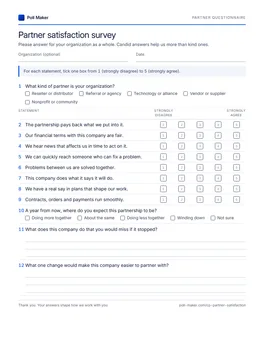
Partner questionnaire
Page one carries the twelve partner questions as boxes for a pen. The organization details come next, then the channel, support, vendor and nonprofit sets.
Download PDF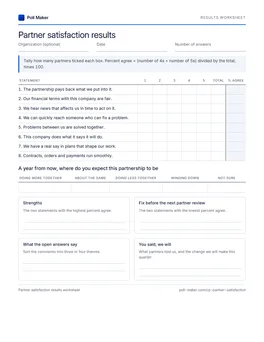
Partner scoring sheet
Add up the paper replies for the eight partnership statements, find what share agreed with every one, and total the year-ahead answers.
Download PDFPartner questions nobody can act on, sharpened
Partner survey questions that return answers nobody can act on, and a sharper line to use in their place. The survey questions by subject cover other topics.
How satisfied are you with our partnership?
The partnership pays back what we put into it.
Problems between us are solved together.
One overall rating blends the money with the working relationship, and partners judge those separately. Two statements show which one needs work.
How would you rate our communication and support?
We hear news that affects us in time to act on it.
We can quickly reach someone who can fix a problem.
It bundles news and support. A partner who gets news on time but cannot reach anyone has no honest single answer.
Do you see us as a strategic partner?
We have a real say in plans that shape our work.
"Strategic partner" is a label each partner reads its own way. The better version asks about something partners can check.
Would you recommend us?
How likely are you to recommend this company to a similar business in another market?
Recommend what, to whom? Resellers rarely send business to direct rivals, so name the kind of business and keep it out of their own patch.
Common worries before a partner survey goes out
Short answers for channel, alliance, procurement and nonprofit partnership teams.
What questions should a partner satisfaction survey include?
Two statements on whether the partnership pays, six on the working relationship (news, access to help, joint problem solving, follow-through, a say in plans, smooth transactions), one question on where the partnership is heading and two open questions. Add the set that matches the partner type.
How often should you survey channel partners?
Most channel programs do well with two rounds a year: once before a mid-year review and once before annual planning. Survey vendors once a year, before contract talks. Nonprofit partners suit a longer cycle; Keystone recommends every 12 to 24 months.3
Should a partner survey be anonymous?
Only if you can keep the promise. With dozens of partners, have someone outside the partner team hold the raw answers. With a handful, say plainly that answers carry the partner's name, as Keystone did for NGOs with six or fewer partners.3
What is a vendor satisfaction survey?
It is a survey your vendors answer about you as a customer: payment, forecasts, clear orders, onboarding and growth. It matters because satisfied vendors are more likely to treat a buyer as a preferred customer.4 Send the core plus the vendors and suppliers set.
How is a partner survey different from a customer satisfaction survey?
Partners sell, supply or deliver alongside you, so the survey asks about terms, information and shared plans. People who buy from you need a customer survey instead; there are sets for that among the satisfaction survey questions.
Ask partners before the next review cycle
Load the partner questions into the builder, attach the set that matches who you are asking, and put your own name wherever a question says this company.