What to ask students in an end of year survey
An end of year survey asks students to look back at the class and the year: what they learned, what helped, how they were treated and what the next class should know. The core 11 takes about six minutes in the last weeks of school, and every question comes with answer options you can use as they are.
- 33questions
- 11in the core set
- 6 minto answer the core
- Grade 2to grade 12
By Michael Hodge, BSc Psychology Updated September 2026
All 33 end of year survey questions
Ticks start on the core 11. Bolt on reflection, course planning, teacher feedback or the grades 2 to 5 set, or choose single questions. Under each question you will see its answer options and why a teacher would ask it.
The core 11: this class, this year11 questions
Six statements about learning, help and fairness, two quick choices, and three open questions that ask for something specific. Sent alone, they make a full end of year survey.
-
I learned a lot in this class this year.
Strongly disagree12345Strongly agree1 = Strongly disagree, 5 = Strongly agreeThe headline number. Read it next to question 2: a student can learn plenty and still feel unsure.
-
I got more confident in this subject this year.
Strongly disagree12345Strongly agree1 = Strongly disagree, 5 = Strongly agreeGrowth as the student feels it, which a final grade does not show.
-
When I fell behind, I got help to catch up.
Strongly disagree12345Strongly agree1 = Strongly disagree, 5 = Strongly agreeAsks about help that actually arrived, which is what students remember from a hard month.
-
Students in this class were kind to each other.
Strongly disagree12345Strongly agree1 = Strongly disagree, 5 = Strongly agreeClass climate from the desk. When it is low, the other scores often drop with it.
-
My teacher got to know me as a person.
Strongly disagree12345Strongly agree1 = Strongly disagree, 5 = Strongly agreeRelationships, asked about the student's own experience rather than the teacher's personality.
-
I was treated fairly in this class.
Strongly disagree12345Strongly agree1 = Strongly disagree, 5 = Strongly agreeThe fairness check. If it comes back low, the open answers usually name the moment.
-
Which kind of activity helped you learn the most this year?
LessonsDiscussionsGroup workHands-on projectsHomeworkTells you what to protect when you plan next year. Swap in your own activity names before you send it.
-
Compared with your other classes, how much effort did you put into this one?
Much lessLessAbout the sameMoreMuch moreStudents rate their own effort frankly, and it puts every other answer in context.
-
What is one thing you learned this year that you are proud of?
Open answerReflection, not a rating. You see what stuck, and students finish the year on a good note.
-
What is one thing your teacher should change for next year's class?
Open answerOne change per student. Sort the answers into piles and the two biggest piles become next year's plan.
-
What advice would you give a student starting this class next year?
Open answerStudents tell the next class what really works here. The best answers make a ready-made welcome letter.
Looking back on your own year5 questions
Add these when the survey doubles as a reflection activity, or when students will set goals for next year in the same lesson.
-
I reached a goal I set for myself this year.
Strongly disagree12345Strongly agree1 = Strongly disagree, 5 = Strongly agreeShows whether goal setting at the start of the year meant anything by the end.
-
I got better at keeping track of deadlines.
Strongly disagree12345Strongly agree1 = Strongly disagree, 5 = Strongly agreeOrganisation is a skill students grow into. This shows who feels they did.
-
How do you feel about starting next year?
ExcitedMostly excitedMixedMostly worriedWorriedFlags students who need a word before summer, especially before a move to a new school.
-
What was the hardest thing you worked through this year?
Open answerStudents name their own challenge. You often hear about a unit or a week you would not have guessed.
-
What is one goal you want to set for next year?
Open answerEnds the reflection facing forward. Pass the answers on to next year's teacher if students agree.
The class: work, homework and grades5 questions
For planning next year's course: what to keep, what to trim, and where grading felt unclear.
-
I knew what I needed to do to earn a good grade.
Strongly disagree12345Strongly agree1 = Strongly disagree, 5 = Strongly agreeUnclear grading is one of the easiest things to fix over the summer.
-
Homework helped me understand the lessons.
Strongly disagree12345Strongly agree1 = Strongly disagree, 5 = Strongly agreeTells you whether homework did its job, separate from how much there was.
-
Tests covered what we practiced in class.
Strongly disagree12345Strongly agree1 = Strongly disagree, 5 = Strongly agreeA low score points to a gap between lessons and assessment, not to lazy studying.
-
The amount of homework this year was:
Far too littleA little too littleAbout rightA little too muchFar too muchThe volume question. Read the spread, since an average of "about right" can hide two unhappy groups.
-
Which unit or project would you drop next year?
Open answerThe other side of the activity question. Ask students about the reasons in person if one unit keeps coming up.
Feedback for your teacher5 questions
For teachers who want direct feedback on their own teaching before the summer, on top of the core.
-
My teacher noticed when I worked hard.
Strongly disagree12345Strongly agree1 = Strongly disagree, 5 = Strongly agreeRecognition. Students who feel unseen here often score lower on effort too.
-
Making a mistake in this class felt OK.
Strongly disagree12345Strongly agree1 = Strongly disagree, 5 = Strongly agreeWhether students felt safe to try things out loud, which shapes how much they speak up.
-
I could follow lessons without getting lost.
Strongly disagree12345Strongly agree1 = Strongly disagree, 5 = Strongly agreeClarity, asked as the student's experience of a lesson rather than a judgement of the teacher.
-
The work challenged me in a good way.
Strongly disagree12345Strongly agree1 = Strongly disagree, 5 = Strongly agreeLow agreement can mean too easy or too hard. Read it next to the effort question in the core to see which.
-
If you were the teacher of this class next year, what would you do differently?
Open answerStudents put themselves in your seat, and the answers are practical and often generous.
Grades 2 to 5: the short version5 questions
Read each line aloud and let children circle yes, sometimes or no. Use it on its own, with the three open questions from the core if there is time.
-
I liked coming to class this year.
YesSometimesNoThe simplest wellbeing check. A cluster of "no" answers is worth a quiet follow-up.
-
I had friends to play with at recess.
YesSometimesNoYoung children judge the year by friendships. This spots lonely students before next year's class lists.
-
My teacher helped me when I was stuck.
YesSometimesNoThe young-student version of the help question in the core.
-
I got better at reading this year.
YesSometimesNoChildren notice their own reading progress. Swap in writing or math if that fits your class better.
-
Write or draw your favorite thing about this year.
Open answerDrawing lets every child answer, including those who do not write much yet.
About you (optional)2 questions
Only when you teach several grades or want to compare groups. Tiny groups can be recognised, so leave any grade with a handful of answers out of the summary.
-
What grade are you in?
Grade 2 to 5Grade 6 to 8Grade 9 to 10Grade 11 to 12Prefer not to sayUseful for a school-wide version or a teacher with mixed-grade classes.
-
About how many school days did you miss this year?
Almost noneA few daysOne to two weeksMore than two weeksNot sureShows whether students who missed a lot of school had a different year from everyone else.
End of year survey PDF for class
In the last week, paper is often faster than logins. Hand the sheet out, give students ten quiet minutes, and have a student volunteer collect the pages face down.
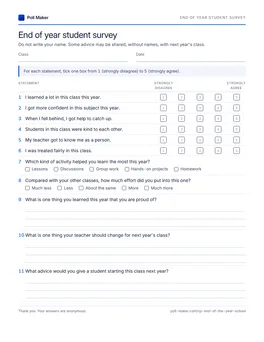
End of year student survey
The core 11 fills the first sheet, with a class and date line and room to write. The reflection, course, teacher and grades 2 to 5 sets follow, so print just the pages you need.
Download PDF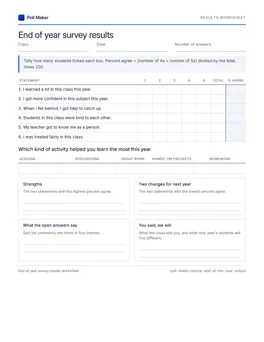
Results worksheet
A pencil tally for the six statements and the activity question, a percent agree for each, and two lines for the changes you will make.
Download PDFWhen to give it in the last weeks of school
Timing decides how honest the answers are. Teacher Roxanna Elden has students fold their pages, lets a trusted student collect them in a folder, staples it shut, and promises not to open it until school lets out and report cards are printed.4
| When | What to do | Why it helps |
|---|---|---|
| The last week or two | Give it in class and say the answers stay sealed until report cards are out | Nothing written can touch a grade, so students say what they think |
| The same lesson | A student volunteer collects the pages into a folder | Nobody wonders whether you read their page on the way out |
| The last few days | Put the activity question to a vote on phones, then discuss what won | Students see their answers counted before they leave |
| After report cards are out | Read everything in one sitting and sort the open answers | You have the quiet and the time to take in the hard comments |
| Before the first week back | Pick two changes and write the welcome letter | The plan is ready before the new class walks in |
Help students remember September in June
An end of year survey asks students to remember nine or ten months at once. Two habits help them answer well, and a third helps you read what they wrote.

Walk through the year before they answer
Memory does not keep a whole year. In a study of how people rate past experiences, Fredrickson and Kahneman found that the ratings "appear to be determined by a weighted average of 'snapshots'", with little weight given to how long anything lasted.1 For a class, those snapshots tend to be the last unit and one or two big moments. Spend two minutes listing the year's units, trips and projects on the board, then hand out the survey.

Keep it short so the writing stays good
Length costs you the answers you care most about. When Galesic and Bosnjak tested a web survey, answers to questions placed later were "faster, shorter, and more uniform" than answers near the start.2 The core puts its three open questions at 9, 10 and 11, about four minutes in. Add an extra set after them, never before.
Read for patterns, not for the one comment that stings
One unkind comment can drown out twenty helpful ones. The MET project, writing about student surveys, puts it well: "While one student might have a particular grudge, it's unlikely to be shared by most students in a class", and if it is shared, it may point to something real.3 Put every open answer into a pile first, and only then react. Say 26 students answer question 10: nine ask for more practice before tests, six want fewer worksheets, four want more choice in projects and seven say something different each. The first two piles are next year's changes.
Want the class to see results on the spot? Put the activity question up as a quick poll on the board, let students vote on their phones, and talk about the result as a warm-up for the longer survey.
One chart of what this class agreed on
Type in the counts for the six core statements, one box per answer point. The chart shows what this class agreed on and which two statements to plan around, ready to print for your own records or next year's planning meeting.
- 1Copy the counts off the survey dashboard, or off your pencil tally. Every 4 and 5 is treated as agree.
- 2Look for the two lowest statements, then read the answers to the change question with those two in mind.
- 3Check the effort question. If most students worked less hard here than elsewhere, low learning scores may be about engagement, not explanation.
- 4Write your two changes on the worksheet and keep it with next year's plans, so the first weeks of the new year reflect them.
End of year results
Turn their advice into a letter for next year's class
Question 11 asks what a new student should know. Those answers are the most reusable thing the survey gives you.
Next year's students hear it straight from students who sat in the same seats. It takes about half an hour:
- Read every answer to question 11 and mark the ones that are specific, kind or funny.
- Group the marked answers under three headings, such as how to do well, what to expect and what not to worry about.
- Type them up without names, fix spelling only, and keep the students' own voice.
- Read the letter aloud on the first day, or post it by the door for the first month.
Say, in the survey intro, that some anonymous advice may be shared with next year's class. Students write more carefully when they know a real reader is waiting.
Adjusting it for each grade
The same survey runs differently in a second grade room and a senior class.
| Grades | How to run it | Which questions |
|---|---|---|
| 2 to 5 | On paper, reading each line aloud while children circle an answer | The grades 2 to 5 set, plus questions 9 and 11 as write or draw boxes |
| 6 to 8 | In class on phones or on paper, with ten minutes set aside | The core 11 and one extra set, usually the reflection questions |
| 9 to 12 | A link sent in the last week works well, as long as class time is given | The core 11 with course planning or teacher feedback added |
Seniors who are leaving the school are better served by the senior exit survey, which asks about all four years instead of one class.
Only ten minutes left? Ask these five
For the last days, when schedules fall apart: how much students learned, whether help arrived, what worked, one change and one piece of advice for the next class.
- 01I learned a lot in this class this year.
- 02When I fell behind, I got help to catch up.
- 03Which kind of activity helped you learn the most this year?
- 04What is one thing your teacher should change for next year's class?
- 05What advice would you give a student starting this class next year?
End of year questions that fall flat, and what to ask instead
Four common questions that get thin answers in June. Our survey question library applies the same fixes to every other topic.
What was your favorite part of the year?
What is one thing you learned this year that you are proud of?
Favorite part gets "the field trip" and "the party". Asking about learning gets something you can teach again.
Did you like this class and your teacher?
I learned a lot in this class this year.
My teacher got to know me as a person.
Two questions in one, and liking is not the point. The better pair asks about learning and about being known.
Any other comments?
What advice would you give a student starting this class next year?
A blank last box gets blank answers. A real reader, next year's student, gets detail.
Rate this year from 1 to 10.
I got more confident in this subject this year.
One overall score mixes grades, friends and the last week. A specific statement tells you what changed.
End of year survey questions teachers ask
Quick answers for the last weeks of the school year.
What should I ask students on an end of year survey?
Ask what they learned, whether help came when they needed it, how they were treated, which activities worked, one change for next year and what advice they would give the next class. All six are in the core 11, which takes a class roughly six minutes.
When should I give an end of year survey?
In the last two weeks of school, during class time. Tell students you will not read the answers until report cards are out, so nothing they write can affect a grade. That still leaves a few days to poll the class on one question and show them the result.
Should an end of year student survey be anonymous?
Yes. Leave off names, let a student volunteer collect the paper copies, and keep the folder closed until grades are final. If you add the grade question, skip any grade with so few answers that a student could be recognised.
How many questions should an end of year survey have?
Ten to fifteen is plenty for most classes. More than that and the written answers at the end get short. Start with the core 11 and add one extra set only if you will use it.
Is there a version for parents or staff?
This survey is written for students. For families and school staff, the school improvement survey asks about how the school runs, communicates and plans.
Give this class the last word before summer
Send the core 11 out as a link students answer from their seats, or print a stack of paper copies for the final week of lessons.