PE survey questions: what students think of physical education
Ask students what they enjoy in PE, where they feel confident and how much of the lesson they spend moving. Students finish the core 12 in roughly five minutes, so it fits the tail of any lesson. Add a set for school sport, facilities or a short fitness quiz with its answers.
- 37questions
- 12in the core
- 5 minfor the core
- Grade 4to grade 12
By Michael Hodge, BSc Psychology Updated September 2026
All 37 physical education survey questions
We have ticked the core 12 for you. Pick the set that fits this unit, such as school sport, facilities or the knowledge check, then share it to phones, print it for the gym, or copy the text into another form tool.
The core 1212 questions
Ten statements about PE from the student side: enjoyment, choice, confidence, feedback, time moving, fair groups, comfort, changing and life after the lesson. Then the favourite kind of activity and one open question.
-
I enjoy most of my PE lessons.
Strongly disagree12345Strongly agree1 = Strongly disagree, 5 = Strongly agreeThe plainest enjoyment check. Compare it unit by unit to see which activities lift it.
-
I get some say in what we do in PE.
Strongly disagree12345Strongly agree1 = Strongly disagree, 5 = Strongly agreeChoice. Across PE research it goes with stronger motivation, and the teacher shapes it more than anyone else.6
-
I feel confident trying the skills we learn in PE.
Strongly disagree12345Strongly agree1 = Strongly disagree, 5 = Strongly agreeConfidence is the one to watch: students who felt more competent in grade 7 were more active six years later.4
-
My PE teacher's tips help me improve my skills.
Strongly disagree12345Strongly agree1 = Strongly disagree, 5 = Strongly agreeFeedback students can use. A low score means comments that do not say what to do next.
-
We spend most of PE moving, not waiting in line.
Strongly disagree12345Strongly agree1 = Strongly disagree, 5 = Strongly agreeActivity time. The CDC and the UK Association for Physical Education both recommend at least half of each lesson at moderate to vigorous effort.5
-
PE activities suit every skill level in my class.
Strongly disagree12345Strongly agree1 = Strongly disagree, 5 = Strongly agreeInclusion. Check who disagrees: students who find the tasks too hard and those who find them too easy both mark it down.
-
Teams and groups in PE are chosen fairly.
Strongly disagree12345Strongly agree1 = Strongly disagree, 5 = Strongly agreeTells you whether the way groups are made, by captains, by the teacher or at random, feels fair from the floor.
-
I feel comfortable in PE, even when I make mistakes.
Strongly disagree12345Strongly agree1 = Strongly disagree, 5 = Strongly agreeBelonging, which comes from classmates as much as from the teacher. A low score points at the class climate, not the activity.6
-
I feel OK about changing clothes for PE.
Strongly disagree12345Strongly agree1 = Strongly disagree, 5 = Strongly agreeChanging happens outside the lesson plan but colours the whole lesson. Keep this one anonymous.
-
PE helps me find activities I want to keep doing.
Strongly disagree12345Strongly agree1 = Strongly disagree, 5 = Strongly agreeThe long-term aim of PE in one line: movement that carries on after the bell and after graduation.
-
Which kind of PE activity do you enjoy most?
Team gamesRacket sportsFitness and runningDance or gymnasticsOutdoor activitiesCount the answers before you plan the next unit. It also works as a live vote in class.
-
What would make you enjoy PE more?
Open answerStudents name specific games, groups and rules. Sort the answers into a few piles and act on the biggest.
Fitness knowledge check (after a unit)6 questions
Six quiz questions with one right answer each, taken from the WHO and CDC activity guidance. The answer is in each line below and in the answer key further down the page.
-
On average, how many minutes of activity should young people get each day?
20 min30 min60 min120 minAnswer: 60 min of moderate to vigorous activity, averaged across the week (WHO, ages 5 to 17).1
-
On how many days a week should young people do muscle and bone strengthening activity?
1 day2 daysAt least 3 daysNone neededAnswer: at least 3 days a week, along with some vigorous activity.1
-
Which of these is a bone-strengthening activity?
SwimmingCyclingJumping ropeStretchingAnswer: jumping rope. Jumps, running and lifting weights load the bones; swimming and cycling count as aerobic.1
-
During moderate activity, what can you usually do?
Sing a songTalk but not singSay only a wordNothing at allAnswer: talk but not sing. That is the talk test for moderate effort.2
-
During vigorous activity, what can you usually do?
Sing a songChat easilyA few words, then a breathBreathe as normalAnswer: say a few words before pausing for breath.2
-
Which kind of sitting should young people cut down on most?
Sitting in classSitting at mealsScreen time for funReadingAnswer: screen time for fun. The guidelines single out recreational screen time.1
Skills, tactics and grading5 questions
Add these at the end of a unit with a skills test or a grade attached.
-
I know how my work in PE is graded.
Strongly disagree12345Strongly agree1 = Strongly disagree, 5 = Strongly agreeClear criteria. If this is low, show the rubric at the start of the next unit.
-
I understand the rules and tactics of our games.
Strongly disagree12345Strongly agree1 = Strongly disagree, 5 = Strongly agreeGame sense as well as skill. Low scores ask for more time on tactics before full games.
-
I know how to warm up on my own before exercise.
Strongly disagree12345Strongly agree1 = Strongly disagree, 5 = Strongly agreeA skill for life outside the gym, and a check on whether warm-ups are taught or only led.
-
I'm comfortable with how fitness tests are run.
Strongly disagree12345Strongly agree1 = Strongly disagree, 5 = Strongly agreeTesting in front of classmates can feel exposing. This shows whether your set-up works for the class.
-
Which skill or sport would you like to get better at?
Open answerGives you goals for the next unit in the students' own words.
Sport and activity outside PE6 questions
For planning teams, clubs and lunchtime leagues, or for a school activity report.
-
In the last 7 days, on how many days were you active for 60 minutes or more?
0 days1 to 23 to 45 to 6All 7Holds your class against the guideline of an hour a day for young people. Report the share who answer All 7.1
-
How many sports teams (school or club) have you played on in the last 12 months?
None123 or moreThe share with one or more compares with the national figure: 58% of US high school students played on a sports team in 2025.3
-
Which of these do you do outside school?
School teamClub sportGymDanceWalk or cycleNoneTick all that applyShows the activity you never see in the gym, and which units connect to it.
-
What stops you joining a school team or club?
Skill levelNo timeCostGetting thereNot interestedNothingTick all that applyEach barrier has its own fix: a beginners team, a lunchtime slot, a kit loan or a later bus.
-
Would you join a lunchtime or intramural sport if the school ran one?
YesMaybeNoCounts the demand for intramurals before anyone books a court.
-
Which sport or activity should the school add?
Open answerStudents suggest activities that are on no list. Count the repeats before you decide.
Facilities, kit and safety5 questions
For a department review or a budget request, when you need the student view of spaces and equipment.
-
There is enough equipment for everyone in PE.
Strongly disagree12345Strongly agree1 = Strongly disagree, 5 = Strongly agreeShort equipment turns into waiting time. Read it next to the core statement about moving, not waiting.
-
The changing rooms give me enough privacy.
Strongly disagree12345Strongly agree1 = Strongly disagree, 5 = Strongly agreePrivacy is something a school can change with cubicles, curtains or split changing times.
-
I feel safe using the PE equipment and spaces.
Strongly disagree12345Strongly agree1 = Strongly disagree, 5 = Strongly agreeSafety as students feel it. Follow a low score with a walk around the gym and the field.
-
The gym and fields are clean and in good repair.
Strongly disagree12345Strongly agree1 = Strongly disagree, 5 = Strongly agreeUpkeep of the spaces, kept apart from equipment and changing so each answer points to one fix.
-
Do you have the clothes and shoes you need for PE?
AlwaysMost weeksSometimesRarelyMissing kit keeps students on the bench. Those who answer Sometimes or Rarely may need a spare-kit box or a looser kit rule.
About you (optional)3 questions
Add these for a split by grade, sex or health needs, and publish only totals from groups too large for anyone to be recognised.
-
What grade are you in?
Grade 4 to 5Grade 6 to 8Grade 9 to 10Grade 11 to 12Prefer not to sayLets you compare grade bands, which usually take different PE courses.
-
Which best describes you?
GirlBoyAnother wayPrefer not to sayShows whether girls and boys experience PE differently, starting with the comfort and changing statements.
-
Does a health condition or injury limit what you can do in PE?
NoSometimesMost of the timePrefer not to sayRead the skill-level statement for this group to see whether adapted tasks are working.
Exit ticket for the final lesson of a unit
Five questions fit the last minutes of the final lesson in a unit: enjoyment, confidence, time moving, fair groups and one idea from each student. Ask them after every unit and the scores become a trend.
- 01I enjoy most of my PE lessons.
- 02I feel confident trying the skills we learn in PE.
- 03We spend most of PE moving, not waiting in line.
- 04Teams and groups in PE are chosen fairly.
- 05What would make you enjoy PE more?
Surveying in the gym without losing the lesson
Four habits for surveys in the gym, where students are on their feet and lesson time is precious.

Survey in the last lesson of a unit
A unit is freshest on its final day. Keep five minutes at the end, put a QR code on the gym wall or pass round paper copies, and collect the answers before students head to the changing rooms. Run the same core after every unit and single scores turn into a trend you can show your department.
Ask how confident students feel
Confidence earns its own question. A Finnish study followed 333 students from grade 7 to grade 12: those who felt more physically competent at the start were more active six years later.4 A review of 265 PE studies points the same way, tying motivation to three needs, namely choice, competence and belonging, with the teacher shaping the first two most.6 The core asks about all three.
US high school students who played on a sports team, 2025
Ask about sport beyond the lesson
Most teenagers play sport somewhere. In 2025, 58% of US high school students played on a sports team: 61% of boys and 55% of girls.3 The sport set shows who plays, who would join a lunchtime league and what keeps the rest away, the list you need before you plan intramurals.

Let the answers choose the next unit
Show the class the favourite-activity counts and let them pick between the top two for next term. Students who see their votes turn into a unit have every reason to answer the next survey with care.
The activity question makes a quick vote at the start of term. Project it in the gym and start a live poll that the class votes on from their phones. For warm-ups and discussions in other lessons, try these poll questions for students.
Turn the paper answers into a class chart
Type the tallies for the ten core statements into the panel, one number per answer point. Agreeing is the healthy answer throughout, so begin with the shortest bars. Print the chart for your department or the class noticeboard.
- 1Share agreeing means students at 4 or 5, divided by all who answered that statement. The chart does the division for you.
- 2Find the two shortest bars, then look them up in the table below for a change to try.
- 3Sort the paper sheets by grade band, or by girls and boys, and enter each stack separately to compare them.
- 4Tell the class which two things you are changing, then run the same core after the next unit.
PE class results
If a statement scores low, try this next unit
Every core statement points at something a PE teacher can change inside a single unit.
| Low score on | Try this next unit |
|---|---|
| 1. I enjoy most of my PE lessons | Open with a game students already like, and check the favourite-activity counts |
| 2. I get some say in what we do | Offer two activities, or roles such as captain, coach and referee, and let students pick |
| 3. I feel confident trying the skills | Break each skill into short steps and practise them before the full game |
| 4. My teacher's tips help me improve | Give each student one specific tip per lesson, tied to the unit's main skill |
| 5. We spend most of PE moving | Smaller teams, a ball each and stations instead of one long line |
| 6. Activities suit every skill level | Set an easier and a harder version of every task |
| 7. Teams are chosen fairly | Make the groups yourself or at random, never by captains picking in front of everyone |
| 8. Comfortable when I make mistakes | Praise effort and progress out loud, and practise in small groups before a whole-class game |
| 9. OK about changing clothes | More changing time, private cubicles, or PE kit worn to school on PE days |
| 10. Activities I want to keep doing | Name a local club, park or free app that continues each unit after school |
Work on the two lowest statements, not all ten. For statement 5, the benchmark is at least half of the lesson spent at moderate to vigorous effort, the target the CDC and the UK Association for Physical Education set.5 Surveys for other parts of the school day are in our education survey questions.
Knowledge check answer key
Mark the six quiz questions with this key. Each one also runs as a live poll, so the class can vote before you reveal the answer.
| Question | Right answer | Show it in the gym |
|---|---|---|
| Minutes a day | 60, on average across the week1 | Add up the active minutes of today's lesson |
| Strength days | At least 3 days a week1 | Put one muscle move and one jump in the warm-up |
| Bone strengthening | Jumping rope1 | A skipping station in the circuit |
| Moderate effort | Talk but not sing2 | Chat in pairs during an easy jog |
| Vigorous effort | A few words, then a breath2 | Sprint a length, then try to talk |
| Sitting to cut | Screen time for fun1 | Students log their own screen hours for a week |
Score it question by question: count how many students got each one right. The question most of the class missed is the first thing to reteach at the start of the next lesson.
PE questionnaire and results sheet to print
Keep a class set on a clipboard by the gym door and collect the sheets at the end of the lesson. Letter and A4 both print without resizing.
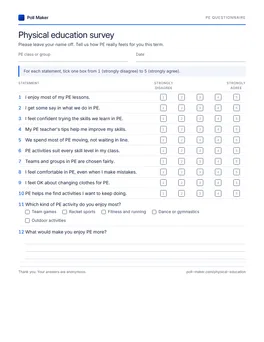
PE questionnaire
Sheet one is the core 12, ticked in pencil. The optional sets, from skills to the quiz, fill the sheets after it.
Download PDF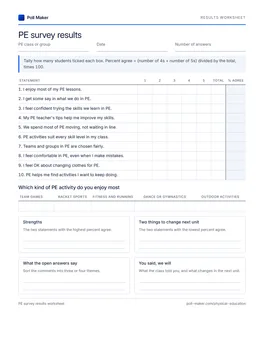
Results worksheet
Tally the ten statements, work out the share agreeing, count the favourite activities, and note which two changes the class will see next unit.
Download PDFUsing these questions for a PE research project
For a class project or a thesis on PE, choose the research question first, then the sets that answer it.
| Your question | Sets | Compare |
|---|---|---|
| Do girls and boys enjoy PE equally? | Core 12 and About you | Share agreeing with statement 1, by group |
| Does confidence go with activity outside school? | Core 12 and Sport | Statement 3 against active days |
| What keeps students out of school sport? | Sport and activity | Count of each barrier |
| Do students know the activity guidelines? | Knowledge check | Share correct on each question |
Get permission from the school, and from parents for younger students, before the survey goes out. Keep it anonymous and ask entire classes, not just your friends, so the answers stand for the year group. If your supervisor wants a published scale as well, PE studies often use the Physical Activity Enjoyment Scale8 or the newer Engagement in Physical Education scale,7 cited and used on their authors' terms. Our items are new wording and belong to neither scale.
PE survey questions worth rewriting
PE surveys often carry questions like these four. Each has a sharper version beside it. For examples on other subjects, browse our survey questions by topic.
Do you like PE?
I enjoy most of my PE lessons.
What would make you enjoy PE more?
Yes or no hides how much. A five-point statement shows degree, and the open follow-up tells you what to change.
How fit are you?
In the last 7 days, on how many days were you active for 60 minutes or more?
Fitness is hard to rate and awkward to admit. A count of active days is concrete and lines up with the guideline.
Are the gym, the equipment and the changing rooms good?
There is enough equipment for everyone in PE.
The changing rooms give me enough privacy.
Three places in one question. A student happy with the gym but not the changing room has no honest answer.
Don't you think PE should have more team sports?
Which kind of PE activity do you enjoy most?
The weak version steers students to one answer. A list of five kinds lets every preference count.
What PE teachers ask about student surveys
Quick answers for PE teachers and department heads.
What should a PE survey ask students?
Ask about the lesson from the student side: enjoyment, choice, confidence, useful feedback, time spent moving, fair groups, feeling comfortable, changing, and whether PE leads to activity outside school. Add the favourite kind of activity and one open question. The core 12 covers every one of these.
How long should a PE survey take?
About five minutes for the core 12. A longer survey eats into activity time, so add one optional set at a time and rotate the sets across the year.
Can elementary students answer it?
From grade 4, most students can read the statements on their own. With younger classes, read each one aloud and let students answer with a thumbs up, sideways or down. The favourite activity question also works as a picture vote.
Should a PE survey be anonymous?
Yes. Questions about changing, confidence and mistakes only get honest answers when nobody can tell who wrote what. Share a link that never asks for a name, or collect paper in a sealed box, and give back totals for a class or grade.
QR code up before the final lesson
Open the PE survey in the builder now, add the set this unit needs, and put the QR code up before your final lesson.