Survey questions on exercise habits, goals and the gym
The best fitness survey questions count a real week of training, name the goal and the barrier, and then ask about the gym. Start with the core 12: four minutes on how often people train, what they want, and what stops them. Add a set for gym members, classes, new joiners or leavers.
- 36questions
- 12in the core
- 4 minto answer the core
- 5optional sets
By Michael Hodge, BSc Psychology Updated September 2026
The 36 fitness and exercise survey questions
We have pre-selected the core 12. Tick the set for the moment you are surveying, drop anything you will not act on, then send the link, print it for the front desk, or paste the text into a different form tool.
The core 1212 questions
Three counts of a usual week, a goal, six agree statements about the habit itself, the main barrier and one open question. Any exerciser can answer it, inside a gym or not.
-
In a usual week, on how many days do you exercise?
None1 day2 days3 or 4 days5 or moreThe plainest habit measure. With session length it gives a rough weekly total to hold against the 150-minute guideline.1
-
How long does a usual workout last?
Under 20 min20 to 30 min30 to 45 min45 to 60 minOver an hourDays times length is the weekly estimate. The guideline check further down shows the sum.
-
On how many days a week do you do strength work?
None1 day2 days3 or moreTwo days or more meets the muscle-strengthening guideline, which far fewer adults reach than the cardio one.2
-
What is your main fitness goal for the next three months?
Get strongerLose weightMore staminaLess stressStay healthyA goal with a date on it. Count the answers and you know which classes, programs and progress checks to plan.
-
Exercise is a fixed part of my week.
Strongly disagree12345Strongly agree1 = Strongly disagree, 5 = Strongly agreeConsistency was the strongest of the four predictors of a new exercise habit in a 12-week study of new gym members.3
-
I enjoy most of my workouts.
Strongly disagree12345Strongly agree1 = Strongly disagree, 5 = Strongly agreeEnjoyment also predicted habit forming. A low score points at the workouts on offer, not at the member.3
-
I know what to do when I start a workout.
Strongly disagree12345Strongly agree1 = Strongly disagree, 5 = Strongly agreeSimple, familiar routines turned into habits more readily. A low score is a coaching gap that an intro session or a written plan closes.3
-
I can see progress toward my goal.
Strongly disagree12345Strongly agree1 = Strongly disagree, 5 = Strongly agreeProgress is what people train for. Read it next to the goal question to find which goals feel stuck.
-
I can fit my workouts into a busy week.
Strongly disagree12345Strongly agree1 = Strongly disagree, 5 = Strongly agreeConfidence that training survives a full diary. Low scores ask for shorter sessions and wider opening hours.
-
People around me encourage me to exercise.
Strongly disagree12345Strongly agree1 = Strongly disagree, 5 = Strongly agreeSupport from friends, family or a training partner. Where it is low, buddy passes and small-group sessions help.
-
What most often stops you exercising more?
TimeTirednessCostInjury or painMotivationNothingTick all that applyEach barrier has its own fix: time needs short sessions, cost a cheaper option, pain a coach or a physio referral.
-
What one change would help you exercise more often?
Open answerPeople name the change they would really use. Sort the answers into piles and start with the biggest.
Your gym or studio (members answer)7 questions
The member satisfaction set: equipment, cleanliness, staff, value, busy times and whether members would bring a friend.
-
The equipment I need is free when I want it.
Strongly disagree12345Strongly agree1 = Strongly disagree, 5 = Strongly agreeCrowding, asked the way members feel it. Pair it with the training-time question to see which hours are the problem.
-
Changing rooms and showers are kept clean.
Strongly disagree12345Strongly agree1 = Strongly disagree, 5 = Strongly agreeThe most visible upkeep question, and usually the quickest to put right.
-
Staff here are easy to approach.
Strongly disagree12345Strongly agree1 = Strongly disagree, 5 = Strongly agreeWhether members ask for help or train around a problem. Read it beside "I know what to do" in the core.
-
My membership is good value for what I pay.
Strongly disagree12345Strongly agree1 = Strongly disagree, 5 = Strongly agreeValue, not price. Track it round by round, and especially after a change in fees.
-
When do you usually train here?
Before 9 am9 am to noonNoon to 5 pm5 to 8 pmAfter 8 pmTells you when to staff the floor, run classes and schedule cleaning.
-
How likely are you to recommend this gym to a friend?
0123456789100 = Not at all likely, 10 = Extremely likelyThe standard 0 to 10 recommend question, so you can track one number from one survey round to the next.
-
What should we add or fix first?
Open answerOne priority per member. The most repeated answer is your next project.
Group classes (class members answer)5 questions
For studios and gyms with a timetable. Send it after a new timetable has run for a month.
-
Which classes have you taken in the past month?
SpinHIITYogaPilatesStrengthDanceNoneTick all that applyReal attendance by class type, which is more useful than asking what people like.
-
Class times fit my schedule.
Strongly disagree12345Strongly agree1 = Strongly disagree, 5 = Strongly agreeThe first thing to check before changing a class that is poorly attended.
-
The instructor shows easier and harder options.
Strongly disagree12345Strongly agree1 = Strongly disagree, 5 = Strongly agreeMixed-level classes work when every move has a version for beginners and one for regulars.
-
I can get a place in the classes I want.
Strongly disagree12345Strongly agree1 = Strongly disagree, 5 = Strongly agreeA low score on a full class is a case for adding a second slot.
-
Which class would you like us to add?
Open answerOpen, because members suggest formats you would not think to list.
Your first weeks (new members answer)5 questions
Send it three or four weeks after joining, early enough for a coach to step in before the habit sets.
-
In the past 7 days, how many times did you train?
01234 or moreNew gym members who trained at least four times a week for six weeks formed an exercise habit. Fewer than four is the group to call.3
-
I was shown how to use the equipment I need.
Strongly disagree12345Strongly agree1 = Strongly disagree, 5 = Strongly agreeChecks that the induction stuck. A low score is a gap in the welcome, and one of the easiest to fix.
-
I feel comfortable training here.
Strongly disagree12345Strongly agree1 = Strongly disagree, 5 = Strongly agreeThe setting mattered to habit forming too. Low scores often come from busy, crowded or unfamiliar spaces.3
-
What was the main reason you joined?
LocationPriceClassesA friendA health goalTells marketing what brought people in, and tells coaches what to follow up on.
-
Would a check-in session with a coach help you now?
YesMaybeNoTurns the survey into a booking list. Every yes gets a call this week.
Leaving or pausing (members who cancel answer)4 questions
Four short questions at the point of cancelling. Ask them kindly and keep them optional.
-
What is the main reason you are leaving?
CostMoving awayNo timeNo resultsInjury or healthThe gym itselfSeparates reasons you can fix (results, the gym) from ones you cannot (moving).
-
In your last month, how often did you train here?
Not at allOnce or twiceAbout weeklyTwice a week or moreShows whether the member had already stopped coming, which marks an earlier moment to reach out next time.
-
Would you come back if something changed?
YesMaybeNoFinds the members worth a win-back offer.
-
What would have made you stay?
Open answerThe most honest answer you will get about the gym. Read every one.
About you (optional)3 questions
Add these when you will split results by age or membership length, or for a research write-up. Keep every reported group to ten people or more.
-
Which age group are you in?
18 to 2930 to 4445 to 5960 or olderPrefer not to sayGoals and barriers shift with age, so compare age groups first.
-
How long have you trained with us?
Under 3 months3 to 12 months1 to 3 yearsOver 3 yearsI am not a memberNew and long-standing members want different things. The last option lets you use the core outside a gym.
-
Where else do you exercise?
At homeOutdoorsOnline classesAnother gymNowhere elseTick all that applyShows the training you never see, and whether online or outdoor sessions would find takers.
Matching a set to each moment in the member year
Gyms get the most from a survey tied to a moment in the member's year. Each moment below adds one set to the core 12.
| Moment | Send | Why then |
|---|---|---|
| Weeks 3 to 4 after joining | Core 12 and Your first weeks | Before the six-week mark, when the habit is still forming |
| Twice a year, all members | Core 12 and Your gym or studio | Same months each year, so scores compare |
| A month into a new timetable | Group classes | Long enough for regulars to try it |
| At cancellation or a freeze | Leaving or pausing | The reason is fresh |
| Class project or workplace challenge | Core 12 and About you | Works for people outside any gym |
The first row comes from a 12-week study of 111 new gym members: people who trained at least four times a week for six weeks built an exercise habit.3 A survey in week three or four finds the members below that pace while a coach can still help. Running a staff step challenge instead? The health and wellness survey adds the wellbeing side, and our healthcare survey questions list every other health topic.
What makes gym members bother to answer
Four habits that make gym and exercise surveys worth sending.

Survey new members before week six
The first six weeks are when a gym habit takes hold. In the new-member study, four sessions a week for six weeks was the minimum to establish an exercise habit, and consistency, simple routines, the setting and enjoyment each predicted how strongly the habit formed.3 So the core measures routine, enjoyment and knowing what to do, and the first-weeks set goes out in week three or four.
US adults meeting the physical activity guidelines, 2020
Ask about strength days on their own
Cardio and strength are separate habits. In the 2020 national survey, 46.9% of US adults met the aerobic guideline but only 24.2% met the aerobic and the strength guideline together.2 A single "how often do you work out" question hides that gap, so the core asks about strength work separately.

Count a usual week, in bands
Ask "in a usual week" and give answer bands like "3 or 4 days" instead of an open number. The usual-week frame steers people away from their best week, and bands make the answers quick to tally and easy to hold against the guideline check.
Show members what changed
Post the top three requests and what you did about each one on the gym floor, in the app and in the next newsletter. A new class slot, a fixed shower or a second squat rack tells members the survey was worth their four minutes, and the next round comes back fuller.
Fitness polls work well in a class group chat or on the studio's social feed. Pick the goal question and launch it as a live poll: members vote in seconds and the result makes a good post. For posting and sharing options, see how to make a poll.
See where your members stand
Type in how many members picked each point on the six core statements. A 5 is the healthy result on each of them, which puts the two shortest bars where you begin. Print the chart for the team meeting.
- 1For each of the six core statements, note how many members ticked each point. The chart turns those counts into the percent at 4 or 5.
- 2Read "I know what to do" beside "I enjoy most of my workouts". Low on both points to a coaching fix, a written plan and a first session together, rather than a pep talk.
- 3Split the results by membership length from About you, and see whether newer members score lower on routine.
- 4Pick two statements to work on, tell members, and send the same core 12 again in six months.
Member habit check
Check the answers against the activity guidelines
Three core answers line up with the adult guidelines. Score them per person, then report the share of your group that meets each one.
| From the core | Meets the guideline when | Source |
|---|---|---|
| Days a week times usual session length | About 150 minutes or more of moderate effort (or 75 of hard effort) | WHO1 |
| Days of strength work | 2 days a week or more | CDC2 |
| Both of the above | Cardio minutes and strength days both met | CDC2 |
To turn bands into minutes, use the middle of each band: "3 or 4 days" counts as 3.5, and "45 to 60 min" counts as 52. Priya answers 3 or 4 days, 45 to 60 minutes, and 1 day of strength work. That is 3.5 times 52, about 180 minutes a week: well inside the 150 to 300 minute range. Her one strength day falls short of two, so the coach adds a second strength session to her plan.
For a benchmark, compare your group with United States adults: in 2020, 24.2% met both guidelines.2 A gym where half the members meet both is doing something right, and the survey shows it.
Short enough for a class or a monthly email
Need something shorter for a class, a challenge kickoff or a monthly email? These five cover frequency, goal, progress, barriers and the one change members want.
- 01In a usual week, on how many days do you exercise?
- 02What is your main fitness goal for the next three months?
- 03I can see progress toward my goal.
- 04What most often stops you exercising more?
- 05What one change would help you exercise more often?
A stack for the front desk and the end of class
Leave a stack at the front desk or hand it out at the end of a class. Both PDFs print on letter and A4.
Put a pen and a drop box beside the stack at reception.
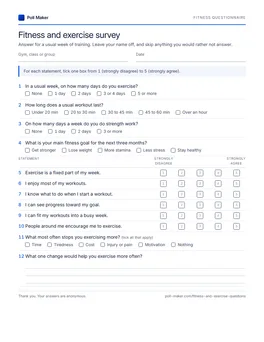
Fitness questionnaire
Page one carries the core 12 as boxes to tick in pen. The gym, class, first-weeks and leaving sets come after it.
Download PDF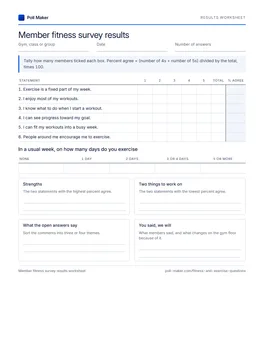
Results worksheet
Add up the paper answers for the six core statements, work out a percent agreeing for each, and note the two things the gym will change.
Download PDFGym survey questions with a sharper version
Four questions gym surveys often ask, and a sharper version of each. More fixes like these are in our survey question guide.
Do you work out regularly?
In a usual week, on how many days do you exercise?
"Regularly" can mean daily or monthly. A count of days can be compared between people and checked against the guidelines.
How satisfied are you with our equipment and classes?
The equipment I need is free when I want it.
Class times fit my schedule.
It bundles two topics. A member who loves the classes but cannot get a bench has no honest answer.
Why don't you come to the gym more often?
What most often stops you exercising more?
The weak version sounds like blame and gets defensive answers. The better one offers choices, including "Nothing".
What are your fitness goals?
What is your main fitness goal for the next three months?
An open goal question gets "get fit" a hundred times. One goal from a short list, with a time frame, gives counts you can plan around.
Questions from gym owners and trainers
For gym owners, trainers and students running an exercise survey.
What questions should I ask gym members?
Start with how often they train, how long a session lasts, their main goal and what stops them training more. Then ask about the gym itself: equipment at busy times, cleanliness, staff, value and whether they would recommend you. The core 12 and the gym set cover all of it in about seven minutes.
How often should a gym survey its members?
Twice a year for the full member survey, in the same months each year. Add a short survey three or four weeks after someone joins, and a four-question one when someone cancels.
Should a gym member survey be anonymous?
Yes for the satisfaction questions: members are more candid about staff and cleanliness when the answer cannot be traced back to them. The first-weeks set can ask for a name if you plan to book coaching calls, as long as the name is optional.
Can I use these questions for a school project on exercise habits?
Yes. Pair the core 12 with About you, where "I am not a member" is one of the answers. Ask classmates for consent, keep it anonymous and report group totals. For questions about PE lessons and school sport, the physical education survey fits better.
Is there a validated exercise questionnaire?
Researchers use published scales for activity levels and for exercise motivation; the BREQ-3 is a well-known motivation scale.4 These questions are original and practical rather than a validated scale, so for a thesis that needs one, use a published measure alongside them and follow its authors' terms.
Post the link in your member app today
Start the builder with the core 12, bolt on the set that fits this month, and post the link in your member app, newsletter or class chat today.