Survey questions to ask art students, in class or at a workshop
An art class survey asks students how the class is really going: the demos, room for their own ideas, critiques, materials and studio time. The 12-question class survey covers all of that, and a first-day, project, look-back or workshop set adds the rest.
- 40questions
- 12in the class survey
- 5 minto answer those 12
- 4sets for other moments
By Michael Hodge, BSc Psychology Updated September 2026
40 questions for the studio and the art room
The 12 class survey questions start out ticked. Add the set for day one, a project critique, the last week or a workshop, or choose individual lines from any set. Under each question: the choices on offer, then a note on what a teacher can do with the answers.
The class survey12 questions
Eight statements about demos, ideas, critique, materials and projects, one question about studio time, a vote on media and two open questions. Leave names off, and give it out halfway through a course or when a unit ends.
-
Demonstrations show me each step clearly.
Strongly disagree12345Strongly agree1 = Strongly disagree, 5 = Strongly agreeChecks the part of the lesson students watch before they pick up a brush. If this scores low, expect a room full of raised hands once studio time starts.
-
I get to use my own ideas in projects.
Strongly disagree12345Strongly agree1 = Strongly disagree, 5 = Strongly agreeMeasures how much room students feel they have for their own subject, style or story inside each brief.
-
I feel free to experiment, even if it fails.
Strongly disagree12345Strongly agree1 = Strongly disagree, 5 = Strongly agreeStretch and explore is one of the eight studio habits. A room where failed experiments cost too much produces safe, similar work.1
-
Critiques give me ideas for my next piece.
Strongly disagree12345Strongly agree1 = Strongly disagree, 5 = Strongly agreeAsks whether critique points forward. A critique students only sit through scores low here, however kind it was.6
-
My art skills have grown since the class began.
Strongly disagree12345Strongly agree1 = Strongly disagree, 5 = Strongly agreeGrowth as the student sees it. Read it beside their portfolio; a gap between the two is worth a quiet conversation.
-
I can get the materials and tools I need.
Strongly disagree12345Strongly agree1 = Strongly disagree, 5 = Strongly agreeSupplies, storage and sign-out in one line. A low score here can be fixed with a restocked cart or a clearer sign-out system.
-
I know what makes a project successful here.
Strongly disagree12345Strongly agree1 = Strongly disagree, 5 = Strongly agreeClarity of criteria. Art grading feels like taste to students until the teacher names what counts before they start.
-
Most of our projects interest me.
Strongly disagree12345Strongly agree1 = Strongly disagree, 5 = Strongly agreeInterest in the briefs themselves. Set it beside the media vote to see what to change in the next unit.
-
The time we get for each project is:
Far too shortA bit shortAbout rightA bit longFar too longThe spread tells you whether to stretch deadlines or tighten them, which an average would hide.
-
Which kinds of art would you like to do more of?
DrawingPaintingClaySculpturePrintmakingDigital artPhotographyTick all that applyA vote on the next units. Count the ticks for each medium and plan around the two at the top.
-
Which project did you enjoy most this term, and why?
Open answerNames the project worth repeating. The reasons (freedom, a new material, a real audience) tell you what to keep.
-
What one change would make art class better for you?
Open answerAsking for one change keeps answers concrete. Sort them into piles; the biggest pile is your next move.
First day: getting to know you as an artist7 questions
Students answer on day one with their names, so you can plan groups and first projects. Keep the sheets; they come back out in the last week.
-
How do you feel about art class right now?
I love itI like itIt is okayNot my favoriteA read of the room before the first project, and a starting point to compare with at the end.
-
Which of these have you tried before?
DrawingPaintingClayPrintmakingDigital artPhotographyTick all that applyShows who needs the basics of a material and who could help the person next to them.
-
How often do you make art outside school?
Most daysEvery weekNow and thenRarely or neverMany teenagers draw at home without anyone asking. This finds them in your class, along with the sketchbook keepers.2
-
Which material do you most want to try this year?
PaintClayPrintmakingDigital drawingPhotographyGives you something to build early excitement around. It also works as a live class poll.
-
How confident do you feel making art?
Not veryA littleFairlyVeryThe baseline for the look-back set. Each student can compare their own two answers in the last week.
-
Who is an artist, illustrator or designer you like?
Open answerA way into artists and art worlds that starts from the student, and a list of names for future examples.
-
What should your art teacher know to help you do your best work?
Open answerRoom for what the tick boxes miss: color blindness, a sore wrist, a family of potters, a phone full of drawings.
After a project and its critique5 questions
A two-minute exit ticket for the end of each project, ideally with the work still pinned up. Names are optional, since students write about their own piece.
-
How challenging was this project for you?
Too easyA bit easyAbout rightA bit hardToo hardThe right stretch differs by student. Several "too easy" answers from experienced students call for an extension option.
-
I had enough time to finish this piece well.
Strongly disagree12345Strongly agree1 = Strongly disagree, 5 = Strongly agreeTime for this project alone, so you can tell a rushed project from a rushed term.
-
I kept going when this piece got difficult.
Strongly disagree12345Strongly agree1 = Strongly disagree, 5 = Strongly agreeEngage and persist, another studio habit. Low scores next to "too hard" answers point to a missing step in the demo.1
-
Which part of this piece are you most pleased with?
Open answerStudents name their own strengths, which also shows you which part of the lesson landed.
-
If you made this piece again, what would you change?
Open answerReflection that faces forward. It turns a finished piece into a plan for the next one.
Last week: looking back on the course5 questions
Students answer in the final week, then get their first-day sheet back to set beside it.
-
Compared with the start, how confident do you feel making art?
Much moreA bit moreAbout the sameLessThe look-back partner of the day-one confidence question. Read the two side by side for each student.
-
I notice art and design around me more now.
Strongly disagree12345Strongly agree1 = Strongly disagree, 5 = Strongly agreeObserve is one of the eight studio habits. This shows whether looking closely has followed students out of the room.1
-
I learned about artists linked to our projects.
Strongly disagree12345Strongly agree1 = Strongly disagree, 5 = Strongly agreeUnderstanding art worlds. A low score suggests the projects taught technique without the artists behind it.
-
What can you do now that you could not do at the start?
Open answerGrowth in the student's own words, and quotes you can use when you make the case for your art program.
-
Would you take another art class?
Yes, definitelyProbablyNot sureProbably notWhere art is an elective, next year's enrollment in one line. Talk to the "not sure" group before course selection.
One-day or weekend workshop (adult participants answer)8 questions
For studios, community centers and artists who teach one-off sessions. Everything here is about today, so it works as a feedback form on its own or after a few class survey statements.
-
How much had you used this medium before today?
NeverOnce or twiceA few timesOftenLets you read the other answers by experience, since beginners and regulars judge pace differently.
-
The length of the workshop was:
Too shortAbout rightToo longSettles whether the next one should be a half day, a full day or two shorter sessions.
-
I left with a technique I can use on my own.
Strongly disagree12345Strongly agree1 = Strongly disagree, 5 = Strongly agreeThe promise most workshops make. If it scores low, cut content and give people more time with the materials.
-
The instructor gave me enough one-to-one help.
Strongly disagree12345Strongly agree1 = Strongly disagree, 5 = Strongly agreeLargely a group-size question. Compare it across sessions with different numbers of places.
-
The materials provided were enough for my piece.
Strongly disagree12345Strongly agree1 = Strongly disagree, 5 = Strongly agreeTells you whether the materials fee covers what people actually use.
-
How likely are you to recommend this workshop to a friend?
0123456789100 = Not at all likely, 10 = Extremely likelyThe 0 to 10 recommend question. Subtract the share answering 0 to 6 from the share answering 9 or 10 for one score to track.
-
Which workshops would you book next?
WatercolorPotteryPrintmakingLife drawingOil paintingDigital artTick all that applyA waiting list in disguise. Add an optional email line and you know who to tell when dates go up.
-
What would have made today even better?
Open answerSmall fixes (a second sink, a longer lunch, a printed handout) that regulars notice and never mention.
About you (optional)3 questions
Use these only if one survey spans several classes, or teens and adults together. Skip any you will not use to split the results.
-
Which best describes you?
Grades 6 to 8Grades 9 to 12College studentAdult learnerNeeded only when one survey spans age groups, such as a school program and an evening class.
-
Did you choose this art class?
Yes, I chose itNo, it is requiredNot sureCompares students who picked art with those taking it for a requirement, who may want different things from the same projects.
-
How many art classes have you taken before this one?
NoneOneTwo or threeFour or moreSeparates beginners from experienced students when you read the confidence and challenge answers.
While the supplies get sorted: a first-day sheet
A first-day sheet keeps a new class busy while you sort supplies, and tells you who just walked in. These five cover what students have tried, the art they make at home, the material they want to try, how confident they feel and what you should know. Let them write their names on it.
- 01Which of these have you tried before?
- 02How often do you make art outside school?
- 03Which material do you most want to try this year?
- 04How confident do you feel making art?
- 05What should your art teacher know to help you do your best work?
Which set to use, and when
An art course has natural stopping points. Match the set to the moment, and keep names on the sheets only where the survey is about the student.
| Moment | Who answers | What to send |
|---|---|---|
| First week of the course | Every student, with a name | The first-day set; file the sheets |
| End of each project | Students, with their piece in front of them | The project set as an exit ticket |
| Middle of the course or end of a unit | The whole class, no names | The 12 class survey questions |
| Final week | The whole class | The class survey and the look-back set, then return the day-one sheets |
| End of a one-day or weekend workshop | Adult participants | The workshop set, with the recommend question |
Teaching an Art Survey course, where each unit brings a new medium? Give out the project set when every unit ends. By the final week you have a record of which media each student took to, which is exactly what they need to choose next year's art class.
Running an art class survey through the year
Surveys in an art room work best when they follow the rhythm of the course: day one, each critique, the final week.
Ask on day one, return it in the final week
The ArtEdGuru blog describes a first-day survey kept all year and handed back on the last day, together with an exit survey about what students learned: "That too is illuminating."4 The first-day and look-back sets on this page are built for that pairing. Both ask about confidence, so each student sees how far they came, and you see which students moved most.
What US eighth-graders do with art outside school
Find out who draws at home
Plenty of the art your students make happens outside your room. In the 2016 national arts assessment, 56% of US eighth-graders said they made art on their own, not for school, and 43% kept a sketchbook or art journal outside school.2 Only 13% took art classes outside school.3 The first-day question about art at home finds those students early, and they are often the ones ready for an extension project or a sketchbook club.
Survey while the work is still on the wall
Studio Thinking describes art classes built from a few recurring structures: demonstration, students at work, critique and exhibition.1 The class survey covers the first three: the demos, time and materials for studio work, and critique. Hand out the project set straight after a critique, with the pieces still pinned up, and students answer about the piece in front of them instead of a blurred memory. A major review of feedback research found its effect depends on the type of feedback and how it is given,6 so the critique statement asks whether students left with an idea for the next piece, not whether the critique felt pleasant.
At a workshop, ask before the brushes are washed
Hand out the form before clean-up starts, while everyone is still seated. Put a copy on each table during the last ten minutes of work time, or prop a QR code on the instructor's easel, and gather the forms along with the finished pieces. The recommend question and the booking list give you the two numbers a studio plans around.
Planning the next unit? Put the material question up as a live class poll before the next unit: phones come out, and the winning medium is on the board within a minute. Making a poll covers the ways to share one with a class.
See which part of the art room needs work
Type the paper tallies for the eight class survey statements into the panel. It draws one bar per statement for the share of students who agree; start with whichever is lowest.
- 1For every statement, the 4s plus the 5s, over everyone who rated it, is its percent agree. Skip the arithmetic if you like; the panel handles it.
- 2Read the lowest statement next to the studio-time answers. If most students also chose "far too short", the fix may be time rather than teaching.
- 3Group the one-change answers under headings such as time, supplies, projects and critique, then count each heading.
- 4Tell the class what you found and what the next project will do differently, then run the survey again after it.
Art class results
The eight studio habits behind the questions
The Studio Habits of Mind describe what art classes teach beyond technique. Each habit has at least one question on this page, so a low score points to a habit the course may be teaching less than intended.
| Studio habit | In the art room | Questions that ask about it |
|---|---|---|
| Develop craft | Using tools, materials and techniques well | Demonstrations; materials and tools; skills have grown |
| Engage and persist | Sticking with a piece when it gets hard | Projects interest me; kept going (project set) |
| Envision | Picturing what a piece could become | Use my own ideas |
| Express | Making work that says something personal | Own ideas; project enjoyed most |
| Observe | Looking closely, past first impressions | Notice art and design (look-back set) |
| Reflect | Explaining and judging their own work | Critiques give me ideas; what would you change |
| Stretch and explore | Trying new things, learning from mistakes | Free to experiment; material to try |
| Understand art worlds | Knowing artists and how art is shown | Artists linked to projects; an artist you like |
The habits come from Studio Thinking. Lois Hetland, Ellen Winner and colleagues spent a year watching five teachers teach 28 projects at two Boston-area high schools with exemplary arts programs, and named eight habits those classes taught.1 The habit names are theirs. The survey statements are our own wording, written so students can answer from their seat.
Sheets for the drying rack and the clipboard
Paper suits an art room: sheets can sit on a drying rack or a clipboard until students wash up. They print at full size on A4 or US letter, and in black and white if the color printer is out of toner.
Using only the first-day set?
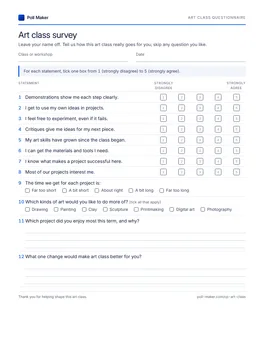
Art class questionnaire
Page one holds the 12 class survey questions, laid out for pencil marks. The first-day, project, workshop and other sets begin on page two; print just the sheets a given class needs.
Download PDF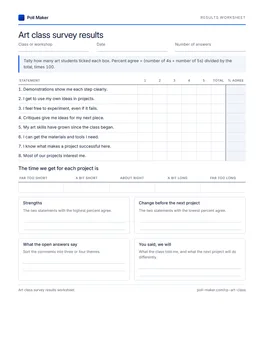
Results worksheet
Count up the paper answers to all eight statements and to the studio-time question. Each count becomes a percent agreeing, and the weakest statement becomes the brief for your next project.
Download PDFArt class questions that only get a yes
Art class surveys often carry these four questions, and the answers they bring back are hard to act on. Our survey questions library has sets for other subjects and settings.
Do you like art?
How often do you make art outside school?
Most of our projects interest me.
A room of art students will mostly say yes, which changes nothing. How often they make art, and whether the projects hold them, points to what to change.
Was this class fun and educational?
Most of our projects interest me.
My art skills have grown since the class began.
Fun and educational are separate verdicts. Someone who enjoyed every lesson but learned little cannot answer it honestly.
Rate your talent from 1 to 10.
If you made this piece again, what would you change?
A talent score measures confidence more than skill. A reflection question gives every student, confident or not, a next step.
Did the teacher explain things well?
Demonstrations show me each step clearly.
I know what makes a project successful here.
In an art room, explaining happens in the demo and in the criteria. Asking about each shows which one to fix.
What art teachers ask about class surveys
Short answers for art teachers, workshop instructors and students researching art education.
What is an art survey class in high school?
Art Survey can be the name of a course rather than a questionnaire: an introductory art class for students with little or no previous art experience. At Manatee School for the Arts in Florida, its projects use both 2D and 3D media and focus on the elements of art, greyscale and color theory.7 Here, survey means a broad tour of materials, not a questionnaire. The project set on this page suits that course well: run it after each medium.
What questions should I ask art students on the first day?
Ask what they have tried, how often they make art at home, which material they want to try, how confident they feel and what you should know about them. Those are the five first-day questions above. Let students put their names on this one, because its job is getting to know them.
Should an art class survey be anonymous?
The class survey, yes. Leave names off so students can be frank about demos, critiques and grading, and have them drop the sheets into a folder on the way out. The first-day and project sets are about the student and their own piece, so names help you follow up.
Can I use these questions as an art workshop feedback form?
Yes. Tick the workshop set, add two or three class survey statements if you want them, and open it in the builder, or print it and leave a copy at each place. Keep it to one side of paper so people finish before they pack up.
How can students research the value of art classes?
Start with a research question that asks how or why, such as "How does taking art change how students feel about school?", then pick survey questions that answer it. A survey on its own shows links, not causes. For causes, look at the first large-scale randomized trial of arts education, in Houston: 42 schools with 10,548 students in grades 3 to 8 were picked by lottery for more arts experiences, and their students had fewer disciplinary infractions and better writing scores.5 Asking the same students the first-day set and the look-back set shows change over one course.
Ask your art students before the next project
Open the class survey in the builder with any sets you ticked, or print the questionnaire and pass it round while the paint dries.