Healthy lifestyle survey questions on how adults move, sleep, eat and unwind
Good lifestyle questions ask about the week people actually live: how much they move and sit, how they sleep, what they eat, how they handle stress, and who they can lean on. The core 12 covers all six areas in about four minutes. Four modules go deeper when your program needs more.
- 32questions
- 12in the core
- 4 minto answer the core
- 6lifestyle areas
By Michael Hodge, BSc Psychology Updated September 2026
The 32 lifestyle questions and their answer choices
The core 12 is already selected. Add a module for the area your program covers and drop any question that does not fit. Then send it as an online survey, print it for a group session, or paste the text into your own form.
The core 1212 questions
Two questions for each lifestyle area, ending with one open question. Five are agree statements, so the results report can chart them.
-
In the past 7 days, on how many days were you active enough to breathe harder for 30 minutes or more?
None1 or 2 days3 or 4 days5 or 6 daysEvery dayFive days of 30 minutes reaches 150 minutes, the weekly minimum in the WHO guidelines.1
-
How many hours a day do you spend sitting, counting work, travel and screens?
Under 44 to 66 to 88 to 10Over 10Sitting is measured apart from exercise because someone can work out daily and still sit for ten hours.1
-
On a typical night, how many hours of sleep do you get?
Under 5 hours5 to 6 hours6 to 7 hours7 to 8 hoursOver 8 hoursAdults are advised to sleep 7 hours or more, so the top two answers meet the guideline.2
-
Most mornings I wake up feeling rested.
Strongly disagree12345Strongly agree1 = Strongly disagree, 5 = Strongly agreeSleep quality next to sleep hours. Seven hours of broken sleep scores low here.
-
How many portions of fruit and vegetables do you eat on a typical day? (A portion is about 80 g.)
None1 or 23 or 45 or moreFive portions of 80 g make the 400 g a day WHO recommends. Portions are easier to count than grams.3
-
I eat my meals at fairly regular times.
Strongly disagree12345Strongly agree1 = Strongly disagree, 5 = Strongly agreeA regular daily rhythm went with better mental health on every measure in a survey of 7,937 people in Germany.4
-
When stress builds up, I have ways to calm down that work for me.
Strongly disagree12345Strongly agree1 = Strongly disagree, 5 = Strongly agreeAsks whether coping works, not how stressed people are, so a low score points to something a program can teach.
-
Most weeks I make time for things I enjoy.
Strongly disagree12345Strongly agree1 = Strongly disagree, 5 = Strongly agreeTime for enjoyable things is part of recovering from a busy week. Hobbies and cultural activities went with better mental health.4
-
There are people I can count on when I need help.
Strongly disagree12345Strongly agree1 = Strongly disagree, 5 = Strongly agreeSocial connection is one of the six pillars of lifestyle medicine, and the easiest one to forget when writing a lifestyle survey.5
-
How often do you drink alcohol?
NeverUnder once a monthA few times a month1 or 2 times a week3 or more times a weekFrequency is easier to answer honestly than amounts. The food and drink module adds drinks per occasion.
-
Do you smoke or vape?
No, neverI used to, but I quitNow and thenEvery dayNot smoking was linked with better mental health on all four measures in the same survey.4
-
What one change to your daily routine would make the biggest difference to how you feel?
Open answerPeople name the change they are ready to make. Group the answers and you have the program's first topics.
Movement and sitting4 questions
For fitness programs and workplace step challenges. Shows what kind of activity people do and what stops them doing more.
-
Which of these did you do in the past 7 days?
Walked or cycled to get somewhereA sport or exercise classRunning or a gym workoutWeights or body-weight exercisesActive hobbies like gardening or dancingNone of theseTick all that applyShows where activity already happens, so a program can build on it instead of starting from zero.
-
On how many of the past 7 days did you do exercises that work your muscles, such as weights or push-ups?
None1 day2 days3 days or moreWHO adds muscle work on 2 or more days a week to the aerobic minutes.1
-
When you sit for a long stretch, how often do you get up and move?
Every half hour or soAbout every hourEvery two hours or soRarelyBreaking up sitting is the easiest change for desk workers, and this shows who already does it.
-
What gets in the way of being more active?
Not enough timeToo tiredCostNo safe or pleasant placeHealth or injuryNothing gets in the wayTick all that applyTells you which barrier to remove first. Time and tiredness need a different fix from cost.
Sleep and screens4 questions
Add this when the core shows short sleep or tired mornings. It finds the evening habits behind them.
-
On nights before work, when do you usually turn the light out?
Before 10 pmBetween 10 and 11 pmBetween 11 pm and midnightAfter midnightIt varies a lotA late or shifting bedtime often explains short sleep better than the hours question does.
-
I keep similar sleep times on weekends.
Strongly disagree12345Strongly agree1 = Strongly disagree, 5 = Strongly agreeA steady rhythm through the week went with better mental health.4
-
How often are you on a phone, tablet or TV in the hour before sleep?
NeverRarelySometimesOftenAlwaysThe screen habit people most often want to change once they see it written down.
-
Outside work or study, how many hours a day do you spend on screens?
Under 2 hours2 to 4 hours4 to 6 hoursOver 6 hoursLeisure screen time is usually sitting time too, so read it next to the sitting question.
Food and drink5 questions
For nutrition talks, coaching intake and canteen or menu changes. Every answer is a count people can check against their week.
-
On how many days a week do you eat a meal cooked at home?
0 or 12 or 34 or 56 or 7Home cooking is where people control what goes on the plate, and it is a habit a program can build.
-
How often do you have sugary drinks like soda, energy drinks or sweetened coffee?
Rarely or neverA few times a weekOnce a dayTwice a day or moreSweet drinks add free sugar fast. WHO advises keeping free sugars under 10% of daily energy.3
-
How many glasses of water do you drink on a typical day?
0 to 23 or 45 or 67 or moreA habit people can track with no app, and a good first goal for a group challenge.
-
How often do you eat takeout or fast food meals?
Rarely or neverOnce a week2 or 3 times a week4 or more times a weekRead it with the home cooking question: together they show how people really eat on busy days.
-
On a day when you drink alcohol, how many drinks do you usually have?
I do not drink123 or 45 or morePairs with the how-often question in the core to give a fuller picture of drinking.
Stress, rest and connection5 questions
For wellbeing programs and community groups. It covers the areas lifestyle surveys usually skip.
-
How often does stress get in the way of your day?
NeverRarelySometimesOftenAlwaysMeasures stress by its effect on the day, which people judge more easily than a stress level.
-
What do you usually do to unwind?
Walk or exerciseTime with friends or familyA hobbyTV or scrollingMeditation or breathingFood or a drinkSomething elseTick all that applyShows which habits people lean on, so a program can add options without judging the ones they have.
-
How often do you see friends or family in person?
Most daysA few times a weekAbout once a weekA few times a monthRarelyFace-to-face contact, counted in plain terms. The rarely group is the one to reach first.
-
Outside my home, I belong to a group I care about, such as a team, club or faith group.
Strongly disagree12345Strongly agree1 = Strongly disagree, 5 = Strongly agreeBelonging beyond family: neighbors, sports, volunteering, faith or interest groups.
-
My work leaves me energy for the rest of my life.
Strongly disagree12345Strongly agree1 = Strongly disagree, 5 = Strongly agreeWhere lifestyle meets workload. A low score here explains low scores on sleep, activity and time for fun.
About you (optional)2 questions
Only if you will compare groups. Keep each reported group large, so nobody can be singled out from the results.
-
Which age group are you in?
18 to 2930 to 4445 to 5960 to 7475 or olderHabits shift with age, so compare age groups before comparing anything else.
-
Which best describes what you do most days?
Work full timeWork part timeStudyCare for family at homeRetired or not workingDaily routine shapes sleep, sitting and meals more than most other background questions.
Pick the modules for your program
The core 12 suits every group. What you add depends on why you are asking.
| Your goal | Modules to add | Time |
|---|---|---|
| Workplace wellness program (anonymous) | Stress, rest and connection; Movement and sitting | 8 min |
| Coaching or clinic intake (named) | Food and drink; Sleep and screens | 8 min |
| Walking group or gym challenge | Movement and sitting | 6 min |
| College research project | Sleep and screens; About you | 7 min |
| Community group, before and after | Nothing: ask the core both times | 4 min |
Running it at work? Ask for no names, leave weight and medical questions out, and pair it with the work-life balance survey when workload is the real question. A gym or sports club gets more from the fitness survey questions for gyms, which ask about training, classes and facilities. When evenings on phones keep coming up, the screen time survey measures device habits in detail. Every other topic in this area is in our healthcare survey questions.
One minute at the start of a workshop
Opening a workshop, a coaching call or a staff meeting? These five take a minute and touch movement, sleep, food, stress and support.
- 01In the past 7 days, on how many days were you active enough to breathe harder for 30 minutes or more?
- 02On a typical night, how many hours of sleep do you get?
- 03How many portions of fruit and vegetables do you eat on a typical day? (A portion is about 80 g.)
- 04When stress builds up, I have ways to calm down that work for me.
- 05There are people I can count on when I need help.
Score each answer against the guidelines
Seven core questions have a clear healthy answer. Give one point for each, and every respondent gets a habit score from 0 to 7.
| Question | Scores a point | Source |
|---|---|---|
| Movement: days active | 5 days or more, so 150 minutes a week | WHO1 |
| Sleep: hours a night | 7 hours or more | AASM and SRS2 |
| Food: fruit and vegetables | 5 portions or more, about 400 g | WHO3, NHS6 |
| Rhythm: regular meals | Agree or strongly agree | Velten4 |
| Stress: ways to calm down | Agree or strongly agree | ACLM5 |
| Connection: people to count on | Agree or strongly agree | ACLM5 |
| Smoking: smoke or vape | Never smoked, or quit | Velten4 |
A worked example: Jordan is active on 3 days, sleeps 7 to 8 hours, eats 3 or 4 portions, agrees about regular meals and about having people to count on, is neutral on handling stress, and quit smoking last year. That is 4 points out of 7. The gaps are movement, food and stress, and Jordan's open answer ("walk at lunch") already names a first step for one of them.
Why add the points up? In a survey of 7,937 people in Germany, each extra healthy habit went with higher life satisfaction and lower distress, and the authors describe the effect as additive.4 A group average of the score is a simple number to track from one survey round to the next.
See the group's lifestyle profile
Enter the number of people who picked 1, 2, 3, 4 or 5 for the five agree statements in the core. Agreeing is always the healthy answer, so the lowest bar is where the group needs the most help. Print the chart for a wellness committee or a program kickoff.
- 1Tally the answers to the five agree statements. The report shows the share who chose 4 or 5 for each one.
- 2Read rested mornings and regular meals together. Low scores on both usually mean an irregular daily routine.
- 3Look at stress and support side by side. People who cope poorly and have few people to call are the group to reach first.
- 4Repeat the same core 12 after the program, eight to twelve weeks later, and compare the charts.
Lifestyle check
Four ways to get lifestyle answers you can use
The questions are half the work. The framing decides whether people describe the week they had or the week they meant to have.
Pin every question to last week
Ask "in the past 7 days" or "on a typical night", never "do you usually". A fixed, recent window gives people a real week to picture and count from, so answers from different people can be compared. The same window, used again on the next round, shows change.
Cover all six areas
Most lifestyle surveys stop at diet and exercise. Lifestyle medicine names six pillars: a whole-food, plant-predominant eating pattern, physical activity, restorative sleep, stress management, avoidance of risky substances and positive social connections.5 The core 12 gives each one at least a question, so a group that sleeps badly or feels alone shows up clearly.

Keep it private when an employer asks
People answer drinking, smoking and stress questions candidly when nobody can link the answers to them. At work, send an anonymous link, report only group results, and leave weight, medication and diagnosis questions out. A coach or clinic can ask for a name, because the answers go straight into a plan for that person.

Count habits, then pick one to change
A group average for each question is useful. A habit count is better: give one point per healthy answer, using the scorecard above. Physical activity, regular daily rhythms and not smoking each went with better mental health in a large population survey, and the benefits appeared to stack.4 Pick the one or two habits most people miss and build the program around those.
Opening a wellness talk? Ask the room one question before you start and turn it into a live poll on their phones. The sleep question works well: people see the answers appear and the talk starts from real numbers. Making a poll for a group takes about a minute.
Intake desks and health fairs run better on paper
Paper works well at intake desks, health fairs and group sessions where not everyone has a phone to hand. Both files fit letter and A4.
Only using a module or two?
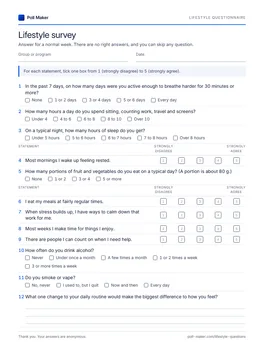
Lifestyle questionnaire
The core 12 fills the opening page as tick-box questions, and each optional module follows. Skip the module pages you do not need.
Download PDF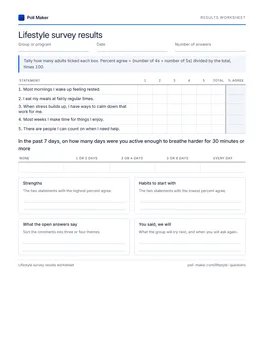
Results worksheet
Tally the five agree statements by hand, turn the counts into percentages and note the two habits the group will work on.
Download PDFFour vague lifestyle questions, made specific
Each weak version below invites a flattering guess. For the same fix on other topics, see our guide to survey questions.
Do you exercise regularly?
In the past 7 days, on how many days were you active enough to breathe harder for 30 minutes or more?
"Regularly" means daily to one person and monthly to another. A count of days lets you compare answers and check them against the guideline.
Do you eat a healthy diet?
On a typical day, how many portions of fruit and vegetables do you eat?
Almost everyone thinks their diet is fairly healthy. A portion count turns that belief into a number.
How much do you drink and smoke?
How often do you drink alcohol?
Do you smoke or vape?
Two habits in one question. A person who drinks but never smokes cannot answer it.
Do you sleep well?
On a typical night, how many hours of sleep do you get?
Most mornings I wake up feeling rested.
Hours and quality are separate problems with separate fixes, so ask about each.
Lifestyle survey FAQ
Short answers for wellness leads, coaches and researchers.
What are good lifestyle questions to ask?
Ask one or two specific questions about each area: how many days people are active, how long they sit, how many hours they sleep, how many portions of fruit and vegetables they eat, how they cope with stress, who they can count on, and whether they drink or smoke. Give every question answer choices so the answers can be counted.
Where should lifestyle questions go in a survey?
Start with easy counts like activity and sleep, move to feelings such as stress and support in the middle, and put alcohol and smoking after that, once people are comfortable. Background questions like age go last.
How long should a lifestyle questionnaire be?
Twelve questions, about four minutes, covers every area. Add a module only for the topic your program will act on; the full 32 take around ten minutes.
Can I use these lifestyle questions with students?
The set is written for adults, so it fits college students over 18 as it is. For school-age students, use the student health survey, which asks about school days, sports and wellbeing in words younger students understand.
Is this a validated lifestyle questionnaire?
No. The questions are original and built on WHO and sleep-medicine guidance, which suits programs and class projects. When a dissertation calls for a validated instrument, the Health-Promoting Lifestyle Profile II is one published option; it is copyrighted, so ask its authors for permission.
Send your lifestyle survey this week
Open the core 12 in the builder, add a module if you need one, and share the link with your group today. Prefer paper? Print copies for the next session.