A personal hygiene questionnaire to print, ask and tally
A personal hygiene questionnaire asks people how they wash their hands, clean their teeth, bathe and change their clothes, and what makes those habits hard to keep. Answering the core 12 fills four minutes of class or clinic time, and most habit questions count yesterday or the last 7 days.
- 37questions
- 12in the core
- 4 minfor the core
- Age 11and over
By Michael Hodge, BSc Psychology Updated September 2026
Hands, teeth, bathing and clothes, plus school and dental sets
Handwashing, teeth, bathing and clothes questions each list fixed answer options, plus a short hint on how to read what comes back. Hygiene basics come pre-selected as the core 12. Add the extra sets you need, then open your hygiene selection in the survey builder, or print or copy it.
The core 1212 questions
Six habit questions, most of them about yesterday or the last 7 days, five statements on soap and water, knowledge, belief, basics at home and time, then an open question about barriers. On their own they cover a class, a clinic group or a household study.
-
Yesterday, when did you wash your hands with soap?
After the toiletBefore eatingBefore cookingAfter a sneeze or coughAfter touching trashNone of theseTick all that applyEach option is a key time in CDC advice. One real day, moment by moment, gives people something concrete to recall instead of a general habit to describe.1
-
When you wash your hands, for how many seconds do you rub them with soap?
Under 1010 to 1920 or moreI rarely use soapThe CDC standard is at least 20 seconds of scrubbing, so only the third answer meets it. It is also the easiest habit to teach and check again a month later.1
-
On how many of the last 7 days did you have a shower or bath?
0 to 2 days3 or 4 days5 or 6 daysAll 7 daysA day count in one fixed week is easier to answer honestly than "how often". Needs differ with climate, sport and skin, so read it next to the barrier question at the end.
-
How many times did you brush your teeth yesterday?
NoneOnceTwice3 or moreThe ADA recommends brushing twice a day, so the last two answers meet it. Yesterday is short enough for people to remember exactly.5
-
On how many of the last 7 days did you put on clean underwear?
0 to 2 days3 or 4 days5 or 6 daysAll 7 daysClean clothes asked as a count. Low answers can point to laundry or money problems rather than habit, which is why the core also asks about basics at home.
-
When did you last cut or clean your fingernails?
Last 7 days1 to 2 weeks ago3 to 4 weeks agoLonger agoNail care is one of the six practice areas in the Cureus hygiene study. A recency band is quicker to answer than a frequency word.7
-
I can always get soap and water to wash my hands.
Strongly disagree12345Strongly agree1 = Strongly disagree, 5 = Strongly agreeAccess comes before advice. If this scores low, no lesson will change handwashing until the soap and water are there.
-
I know when it matters most to wash my hands.
Strongly disagree12345Strongly agree1 = Strongly disagree, 5 = Strongly agreeKnowledge, asked directly. Read it next to question 1: people who know the key times but skip them need reminders, not more facts.
-
Keeping myself clean helps me avoid getting sick.
Strongly disagree12345Strongly agree1 = Strongly disagree, 5 = Strongly agreeThe belief behind the habit. Handwashing education cuts colds and stomach illness in the CDC figures, and this shows whether your group already believes it pays off.2
-
I have the soap and toothpaste I need at home.
Strongly disagree12345Strongly agree1 = Strongly disagree, 5 = Strongly agreeHygiene products cost money. A low score is a supply problem that a school, clinic or food bank can solve directly.
-
Taking time to keep clean is worth it, even on busy days.
Strongly disagree12345Strongly agree1 = Strongly disagree, 5 = Strongly agreeJust over half of the young adults in the Cureus study named lack of time as a barrier to hygiene. People who agree here but report low habit counts need a routine that fits their day more than another reason to bother.7
-
What, if anything, makes it harder for you to keep clean?
Open answerThe question that explains the numbers. Sort the answers into water, products, time, privacy and knowledge; each pile has a different fix.
Hands, coughs and sneezes4 questions
For handwashing and flu-season lessons: what people use away from a sink, how they cover a sneeze, where washing is hardest, and which personal items get shared.
-
When you are out and cannot get to a sink, what do you clean your hands with?
Hand sanitizerWet wipesNothingI always find a sinkThe CDC backs a sanitizer with at least 60% alcohol when soap and water are not at hand. "Nothing" shows where a pocket bottle would help.3
-
When you cough or sneeze and have no tissue, what do you cover it with?
My elbow or sleeveMy handNothingSomething elseCDC advice is a tissue, or your elbow when there is none, not your hands. The answer shows whether the message has landed.4
-
Where is it hardest for you to wash your hands?
At schoolAt workPublic toiletsEating outNowhereTick all that applyPoints the fix at a place. If most people pick the same one, go and check it for soap, towels and time.
-
Which of these do you share with anyone else?
TowelsRazorsToothbrushesHairbrushesNone of theseTick all that applySome items should never be shared. The answers tell you whether the next lesson needs to cover it.
Teeth and mouth5 questions
For dental hygiene surveys, school dental days and oral health lessons. Four of the five questions line up with an ADA recommendation, so the answers can be scored.
-
How long do you usually brush your teeth each time?
Under 1 minute1 to 2 minutes2 minutes or moreNot sureThe ADA standard is two minutes. Count the "Not sure" answers too: that is the group a timer or a song helps most.5
-
Does the toothpaste you use contain fluoride?
YesNoNot sureThe ADA recommends a fluoride toothpaste. "Not sure" shows where a label-reading tip belongs in the lesson.5
-
When did you last get a new toothbrush or brush head?
Under 3 months ago3 or 4 months agoOver 4 months agoCan't rememberThe ADA says to replace a toothbrush every three to four months, or sooner when the bristles look frayed.5
-
On how many of the last 7 days did you clean between your teeth with floss, picks or small brushes?
None1 to 3 days4 to 6 daysAll 7 daysCleaning between the teeth is a separate habit from brushing, so it gets its own question instead of sharing one.
-
When did you last see a dentist or dental hygienist?
In the last 12 months1 to 2 years agoOver 2 years agoNeverA standard recency question that lets you compare groups. When the gap is long, the open question in the core is where people say why.
Help with personal care (health history)5 questions
For a nurse, carer or nursing student taking a health history. The client answers about their own personal care, so the set works on paper, on a tablet or read aloud.
-
Do you need help to wash yourself in the bath or shower?
No helpSome helpFull helpBathing is the first everyday self-care task to check. Nursing guidance is to let people do as much of their own care as they can, so "some help" matters as much as "full help".9
-
Do you need help to brush your teeth or clean dentures?
No helpSome helpFull helpMouth care is easy to leave out of a care plan. This puts it on the list next to bathing.
-
Do you need help with your hair, shaving or nails?
No helpSome helpFull helpGrooming needs grip and reach. The answer shows where a family member, an aide or a simple aid could step in.
-
Is anything making washing or grooming harder at the moment?
PainTirednessBreathingBalanceMemoryNothingTick all that applyNames the reason behind a "some help" answer, which is what the care plan has to address.
-
How do you like to wash and care for yourself, and at what time of day?
Open answerHygiene practices vary between people and cultures, and nursing guidance is to respect them. Record the answer in the client's own words.9
Hygiene knowledge check4 questions
The knowledge part of a KAP survey: four facts from CDC and ADA advice, each with a single correct option plus Not sure, so nobody has to guess. The answer key sits further down the page.
-
How long should you scrub your hands with soap?
5 seconds10 secondsAt least 20 secondsNot sureTests the one number in handwashing advice. Compare it with question 2, which asks what people actually do.
-
When is soap and water better than hand sanitizer?
Hands look dirty or greasyNeverOnly before mealsNot sureSanitizer is handy but has limits the CDC spells out. This shows whether people know the main one.
-
How long should you brush your teeth each time?
30 seconds1 minute2 minutesNot sureThe ADA two-minute rule. Next to question 17 it shows whether people need the facts or just a timer.
-
You need to sneeze and have no tissue. What should you use?
My handsMy elbowNothingNot sureA good one to run as a live poll in class, then reveal the answer and talk about why.
At school (students answer)4 questions
Students answer these about their own school. They show whether soap, time and usable toilets are in place before a lesson asks students to change anything.
-
The school toilets have soap when I need it.
Strongly disagree12345Strongly agree1 = Strongly disagree, 5 = Strongly agreeThe first thing to fix if it is low. A student cannot wash well without soap, whatever the poster on the wall says.
-
There is enough time to wash my hands before lunch.
Strongly disagree12345Strongly agree1 = Strongly disagree, 5 = Strongly agreeLunch queues and short breaks decide this one. It is a timetable fix, not a student one.
-
I am comfortable using the toilets at school.
Strongly disagree12345Strongly agree1 = Strongly disagree, 5 = Strongly agreeA student who avoids the toilets all day cannot wash there either. Low scores point to cleanliness, privacy or safety in those rooms.
-
This school year, has a lesson covered handwashing or hygiene?
YesNoNot sureTells the school whether the topic has reached this class, and marks the starting point for a before-and-after survey.
About you (optional)3 questions
Add these for research that splits results by age, stage or gender. Hygiene answers are private, so a group you report on should hold enough people that nobody in it can be identified.
-
How old are you?
Under 1313 to 1718 to 2930 to 5960 or overLets one survey compare age groups. Use it only if every band has enough people to stay anonymous.
-
Which describes you best?
School studentCollege studentWorkingNot workingRetiredSplits a mixed survey into school, college and adult answers.
-
What is your gender?
Girl or womanBoy or manAnother wayPrefer not to sayHygiene practice differed by gender in the Cureus study, so a research project will usually want to compare the two.7
Run it as a KAP hygiene survey
KAP stands for knowledge, attitude and practice: what people know, believe and do about a topic.8 Health programmes run one before a hygiene campaign as the baseline, then repeat it to measure the change.
| Part | Questions here | How to score |
|---|---|---|
| Knowledge | Q27 to Q30, the knowledge check | 1 for the right answer, 0 for a wrong answer or Not sure8 |
| Attitude | Q9 and Q11 | 1 for Agree or Strongly agree, 0 for anything else |
| Practice | Q1 to Q6, Q14 and Q17 to Q20 | The share who meet CDC or ADA advice where a standard exists, or 0, 1 or 2 points per answer (both in the scoring section) |
Q7 and Q10 ask about soap, water and products at home. Report them on their own: they are the conditions that make practice possible, and they often explain a low practice score better than knowledge does.
Answer key for the knowledge check
| Question | Right answer | Source |
|---|---|---|
| Q27 How long to scrub | At least 20 seconds | CDC handwashing steps1 |
| Q28 Soap or sanitizer | Hands look dirty or greasy | CDC sanitizer guidance3 |
| Q29 Brushing time | 2 minutes | American Dental Association5 |
| Q30 Sneeze with no tissue | My elbow | CDC cough and sneeze advice4 |
Keep the Not sure option in every knowledge question. It spares people from ticking an answer they do not really hold, so a lucky guess does not pass for knowledge.8
Private habits, honest answers: four choices
Hygiene is personal, so the way you ask decides how close the answers get to real life. Four choices make the difference.
Ask about yesterday, one moment at a time
Among the key times the CDC lists are after using the toilet, before eating, before and after preparing food, after coughing or sneezing, and after touching garbage.1 Question 1 names those five and asks which ones happened yesterday. A concrete day and a concrete list give people something to remember instead of an image of themselves to protect.
Handwashing at toilet-related key times, as reported and as observed
Why the wording matters so much
In one study, caregivers asked how often they usually wash with soap after the toilet gave answers that averaged 72 percent; observers in the same homes saw washing at 22 percent of those moments.6 When the team asked people instead to describe, step by step, how they carry out an everyday routine, the group average came closer to what the observers saw. A general "how often" invites a generous answer, so most habit questions here count real moments in a named day or week.

Survey before and after a hygiene lesson
A KAP survey works best when it comes before the programme, because the first round is the baseline for judging it later.8 The prize is worth measuring: in CDC figures, handwashing education cuts absences from stomach illness in schoolchildren by 29 to 57 percent and respiratory illnesses such as colds in the general population by 16 to 21 percent.2 Repeat the identical questions a month or so after the lesson and compare. For other topics to pair with it, see the wider set of health survey questions.
Keep names off the group survey
Questions about showers and underwear get honest answers when people know their own form cannot be picked out. Ask for no names, let people post paper forms through the slot of a sealed box, and publish results for whole classes or clinics, never for a handful of people. The one exception is a health history, which belongs in the client's own record.
One question is often all a class needs to start talking. Pick the sneeze question, or any other with a single answer, and make it a live class poll that students vote on from their phones. The five-step poll guide covers sharing it by link, email or Teams.
Score the habits against CDC and ADA advice
Seven practice questions have a published standard behind them. Count how many people meet each one, then watch that share climb as your campaign runs.
| Question | Meets the advice | Source |
|---|---|---|
| Q1 Handwashing moments | Report each moment on its own; the worksheet tallies them | CDC key times1 |
| Q2 Scrub time | 20 seconds or more | CDC1 |
| Q4 Brushing yesterday | Twice, or 3 or more | ADA5 |
| Q14 Covering a sneeze | My elbow or sleeve | CDC4 |
| Q17 Brushing time | 2 minutes or more | ADA5 |
| Q18 Fluoride toothpaste | Yes | ADA5 |
| Q19 New toothbrush | Under 3 months, or 3 or 4 months ago | ADA5 |
A worked example
Say 40 students answer Q2 and 14 choose 20 seconds or more: 35 percent meet the CDC standard. Four weeks after a handwashing lesson the same class answers again and 26 of the 40 choose it, so the share has risen to 65 percent. That 30-point gain is the headline for the lesson report.
A practice score for a research project
Singh and colleagues gave each practice answer 0 for never, 1 for sometimes and 2 for regularly, averaged the points per person, and called the bottom quarter of scores poor practice, the middle half moderate and the top quarter good.7 To do the same here, give each practice question 0, 1 or 2 points. For Q4 that is None 0, Once 1, Twice or more 2; for Q2, under 10 seconds or rarely using soap 0, 10 to 19 seconds 1, and 20 or more 2.
Find the barrier that holds habits back
Copy the paper counts into the panel, statement by statement. Soap and water, knowledge, belief, basics at home and time then sit side by side, and the weakest bar shows where to start.
- 1Agreement for a statement means its 4s plus its 5s over the total number of hygiene forms that rated it; the panel shows it as soon as the counts go in.
- 2If soap and water or basics at home (statements 1 and 4 in the chart) come out lowest, fix the supplies before planning any lesson.
- 3If knowledge (statement 2) is high but the habit questions look weak, people know what to do and need time, reminders or a sink closer to hand.
- 4Tell the group one result and one change, then repeat the survey once the change has had a few weeks to work.
Hygiene barriers
The two-minute hygiene check
Five questions for a busy lesson or a clinic waiting room: two on handwashing, one on teeth, one on soap and water, and the open question about what gets in the way.
- 01Yesterday, when did you wash your hands with soap?
- 02When you wash your hands, for how many seconds do you rub them with soap?
- 03How many times did you brush your teeth yesterday?
- 04I can always get soap and water to wash my hands.
- 05What, if anything, makes it harder for you to keep clean?
For lessons, waiting rooms and house-to-house visits
Paper suits a health lesson, a clinic waiting room or house-to-house fieldwork where phones are scarce. Hand out the core alone, or add whichever sets your audience needs.
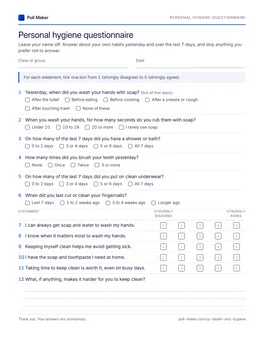
Personal hygiene questionnaire
Opens with the core 12, answer boxes ready to tick. The hands, teeth, health history, knowledge and school sets follow in that order.
Download PDF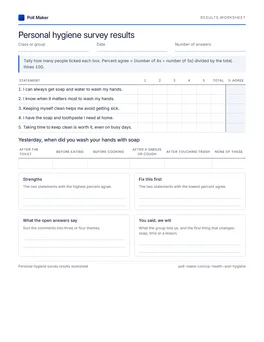
Results worksheet
Tally each paper form by hand, turn the agree counts into percentages, and add up how many people ticked each handwashing moment in question 1.
Download PDFWhen a hygiene question invites the polite answer
Four fixes that carry over to any question about a habit. For rating scales, multiple choice and open questions, browse the question-writing examples.
Do you have good personal hygiene?
How many times did you brush your teeth yesterday?
On how many of the last 7 days did you have a shower or bath?
Nobody answers no to being clean. Countable questions about a fixed time give numbers you can compare between groups and over time.
Do you wash your hands regularly?
Yesterday, when did you wash your hands with soap?
"Regularly" means something different to everyone and invites the flattering answer. Moments from yesterday are specific enough to recall.
Do you brush and floss every day?
How many times did you brush your teeth yesterday?
On how many of the last 7 days did you clean between your teeth with floss, picks or small brushes?
That is two habits packed together. A person who brushes but skips flossing cannot answer it truthfully.
Why don't you wash your hands after using the toilet?
What, if anything, makes it harder for you to keep clean?
The first version accuses, so people defend themselves or skip it. The second asks about obstacles, which are the part you can fix.
Questions teachers and health workers ask about hygiene surveys
Short answers to what nurses, teachers and student researchers ask before using this set.
What should a nurse ask about personal hygiene in a health history?
Ask what the person does (bathing, teeth or dentures, hair and nails), whether they need help with any of it, what makes it harder, and how they prefer to do it. The core covers the habits, and the personal care set adds help, obstacles and preferences. Nursing guidance is to respect those preferences and let people do as much of their own care as they can.9
What are good hygiene questions for students?
The core 12 works for students from about age 11, answering on their own. Add the school set so the results cover soap, time and toilets as well as habits. For younger classes, read the questions aloud and run the knowledge check as a class quiz.
How do you score a personal hygiene questionnaire?
Two ways. Check practice answers against CDC and ADA advice and report the share who meet each standard, or give each answer 0, 1 or 2 points and total them, as research studies do. Knowledge questions score 1 for right and 0 for wrong or Not sure. The scoring and KAP sections above show both.
Should a hygiene survey be anonymous?
For a group, yes. People give the flattering answer about private habits when they can be identified. Leave names off, collect forms in a closed box, and only report groups big enough that nobody stands out. A health history is different: it is part of the client's record.
Take the hygiene core to a lesson or a home visit
Load the hygiene core into the builder and share the link, or take the printed form to a lesson, a clinic or a home visit.