Employee attendance survey questions on lateness, absence and leave
An attendance survey asks employees what makes it hard to be at work, and on time, and whether absence is handled fairly. The core 12 asks for about four minutes of each person's time, and it closes by asking which fix would make the biggest difference. Optional sets cover the journey in, shifts, sick leave, return-to-work talks and office days.
- 36questions
- 12in the core set
- 4 minfor the core 12
- 6sets to add
By Michael Hodge, BSc Psychology Updated September 2026
36 attendance questions, from lateness to hybrid days
The core 12 is in your survey already. Add a set for shift teams, sick leave or office days, or tick single questions. Each row shows the answers on offer, and the note beneath says how to read a weak result.
The core 1212 questions
Two questions on how often people are late or off, a tick list of causes, seven statements on the policy, reporting, leave, managers, schedules and sickness, then the fix people want first and one open question.
-
In the last three months, how often have you arrived late for work?
NeverOnce or twice3 to 5 times6 or more timesLateness has different causes from absence. Read these bands next to the journey and rota answers before you think about individuals.
-
In the last three months, how many workdays have you missed without planning to?
None1 or 23 to 56 to 10More than 10Bands are enough to compare groups. Self-reports rank people much as records do, though most people report fewer days than they took, so keep records for exact counts.3
-
Which of these have made you late or kept you off work in the last three months?
Own illnessCaring dutiesThe journeyRota changesStress or workloadPersonal mattersNone of theseTick all that applyStarts from the reasons the US Bureau of Labor Statistics counts (own illness, child care, family obligations) and adds the journey and the rota, which an employer can change. The most ticked option is where to start.1
-
I understand what our attendance policy expects of me.
Strongly disagree12345Strongly agree1 = Strongly disagree, 5 = Strongly agreeClarity first. People cannot follow rules on notice, reporting and sick notes that nobody has explained to them.
-
Attendance rules are applied the same way to everyone here.
Strongly disagree12345Strongly agree1 = Strongly disagree, 5 = Strongly agreeConsistency. When the rules bend for some people, others stop trusting the whole policy. Compare this score across teams and shifts.
-
I know exactly who to tell, and how, if I cannot come in.
Strongly disagree12345Strongly agree1 = Strongly disagree, 5 = Strongly agreeA quick win when it scores low: one number or channel, posted where everyone will see it.
-
Getting planned time off approved is straightforward.
Strongly disagree12345Strongly agree1 = Strongly disagree, 5 = Strongly agreeWhen booking leave is a struggle, people take unplanned days instead. A low score often explains part of the absence tally.
-
When I come back after being off, my manager is supportive.
Strongly disagree12345Strongly agree1 = Strongly disagree, 5 = Strongly agreeIn most organisations line managers take the lead on short-term absence, so this is where people feel the policy. Low scores point to manager training.2
-
My shifts or working hours fit around my life outside work.
Strongly disagree12345Strongly agree1 = Strongly disagree, 5 = Strongly agreeSchedule fit. Low scores here usually sit beside ticks for caring duties or rota changes.
-
I feel able to stay home when I am too unwell to work.
Strongly disagree12345Strongly agree1 = Strongly disagree, 5 = Strongly agreeThe presenteeism check. Absence shows up in your records and people working while ill do not. Most employers in the CIPD survey had seen it in the past year.2
-
Which change would help you most to be at work, on time?
Rotas set further aheadFlexible start timesEasier shift swapsHelp with the journeySupport with caringOne pick each, so the results rank the fixes. It also works as a quick poll at a team briefing.
-
What makes it harder than it should be to get to work, or to get here on time?
Open answerFinds the local problem no tick list covers: a car park that fills at 8:50, a bus that changed its times, a queue at the badge reader.
Getting to work on time4 questions
Add these when lateness is the bigger problem, or when many people ticked the journey.
-
How long does your usual journey to work take?
Under 15 min15 to 30 min31 to 60 minOver 60 minLong journeys leave little slack for delays. Compare the lateness bands by journey time before you move any start times.
-
How do you usually get to work?
CarBus or trainWalk or cycleLift or car shareOtherShows who depends on timetables nobody here controls, and who a car-share list or a parking change would help.
-
How often does your journey take longer than you planned for?
NeverRarelySometimesOftenAlwaysSeparates unreliable journeys from long ones. Many "often" answers from bus and train users point to a start time that clashes with the timetable.
-
Our start time fits school runs and my transport.
Strongly disagree12345Strongly agree1 = Strongly disagree, 5 = Strongly agreeStart-time fit. If this is low while journeys are short, a later or flexible start may do more than any other change.
Shifts and rotas4 questions
For shift, retail, care and warehouse teams, where the rota shapes attendance more than anything else.
-
How much notice do you usually get of your shifts?
Under 1 week1 to 2 weeks2 to 4 weeksOver 4 weeksShort notice makes childcare and travel hard to arrange. Track this before and after you change how rotas are published.
-
How often do your shifts change after the rota is published?
NeverRarelySometimesOftenAlwaysAmong hourly service workers, unstable schedules go with psychological distress and poor sleep, more strongly than low pay does.4
-
Swapping a shift with a colleague is easy.
Strongly disagree12345Strongly agree1 = Strongly disagree, 5 = Strongly agreeAn easy swap turns a would-be absence into a covered shift. A low score points to an approval step you can remove.
-
I get enough rest between one shift and the next.
Strongly disagree12345Strongly agree1 = Strongly disagree, 5 = Strongly agreeA late finish followed by an early start leaves people tired for the next shift. Check low scores against the rota pattern.
Sick leave and working while ill5 questions
Add these to see how people use leave and sick days, including the illness that never shows up as absence.
-
I can take time off at once for a family emergency.
Strongly disagree12345Strongly agree1 = Strongly disagree, 5 = Strongly agreeEmergency leave that people know about stops a crisis at home from becoming an unexplained absence.
-
I can check my leave balance without asking anyone.
Strongly disagree12345Strongly agree1 = Strongly disagree, 5 = Strongly agreeSimple to fix, and it cuts the requests that arrive after a balance has already run out.
-
In the last three months, how often did you work when you were too ill to do your job properly?
NeverOnce2 or 3 times4 or more timesPresenteeism in numbers. Report it beside the absence bands: low absence with high counts here means illness is being worked through.
-
In the last three months, did you use holiday or leave days because you were ill?
NoOnceMore than onceThe CIPD calls this leaveism. It hides sickness inside booked leave, so absence figures look better than the reality.2
-
Which of these would make it easier to stay home when you are ill?
Sick pay from day oneNo penalty pointsCover for my workEasier way to report itNone of theseTick all that applyShows which rule or habit pushes people in when ill. The CIPD warns that trigger systems can penalise people who need sick leave for a health condition.2
Office days and hybrid attendance4 questions
For hybrid teams asking why office days are missed, and what would make the trip worth it.
-
How many days a week are you expected on site?
None1 day2 days3 days4 or 5 daysThe expectation as people understand it. If answers differ inside one team, the policy has not landed.
-
In a typical week, how many days do you actually go in?
None1 day2 days3 days4 or 5 daysSet against the expected days, the gap for each team shows where office attendance is slipping.
-
The reasons for our office days have been explained well.
Strongly disagree12345Strongly agree1 = Strongly disagree, 5 = Strongly agreeRules without a reason feel arbitrary. A low score says explain the purpose before you enforce the days.
-
What would make your office days more worth the trip?
Team in on the same daysQuiet space to focusHelp with travel costsBetter meeting roomsNothing, it works nowTick all that applyTurns a rule into a question about value. The top pick tells you what to fix before you ask for more days.
About you (optional)3 questions
Use these to compare shift patterns and tenure, never to spot people. Leave out any that would narrow a small team to one person.
-
Which best describes your working pattern?
Fixed day hoursRotating shiftsNightsPart timePrefer not to sayNight and rotating shifts often meet different barriers from day staff. This is the split that shows them.
-
How long have you worked here?
Under 1 year1 to 3 years4 to 10 yearsOver 10 yearsPrefer not to sayNew starters may not know the policy yet. Low policy scores in the first year point to induction, not to the rules.
-
Do you look after a child or an adult outside work?
YesNoPrefer not to sayCaring duties shape start times and emergency leave needs. Only ask it if you will act on the answer.
Back after an absence (named check-in)4 questions
Not for the anonymous survey. A manager uses these one to one on the first day back, as a separate named form.
-
How ready do you feel to be back at work?
Fully readyMostly readyPartly readyNot ready yetOpens the talk on the person, not the paperwork, and shows whether a phased return is worth discussing.
-
Would any short-term changes help you settle back in?
Phased hoursLighter dutiesDifferent tasksCatch-up on newsNone neededTick all that applyA list makes it easy to ask for an adjustment, and gives the manager something specific to agree to.
-
While you were off, how was the contact from work?
Too muchAbout rightToo littleKeeping in touch is a balance. The answer tells the manager how to handle contact next time.
-
Is anything at work making this more likely to happen again?
Open answerTurns the talk from a check into a fix: a workload, a task, a rota pattern or a health condition the job could make room for.
Honest answers about absence start with trust
Attendance is a touchy subject at work. Four habits keep the answers frank and the results worth acting on.

Keep the survey out of anyone's attendance file
People worry that an honest answer will turn into a warning. Say in the invitation that answers go to a survey tool, not to HR records, and that results are read by team only. Then keep that promise: the only named questions on this page are the return-to-work set, and they belong in a one-to-one, never in the survey.

Ask what gets in the way, and let records do the counting
A meta-analysis of self-reported absence found that answers rank people much as records do, but that people have "a decided tendency to underreport their absenteeism."3 So the core asks for rough bands, not exact days, and spends most of its questions on causes you can change: the journey, the rota, caring duties, the policy and the manager.
Count the illness that never shows up as absence
In the CIPD's survey of 918 UK organisations, 76% had seen people working while ill in the workplace over the past year, and 78% among people working from home. The report advises using employee survey data to find it.2 Q10 and the sick leave set measure both sides: working while too ill, and using holiday to recover.
Hold return-to-work talks one to one
Return-to-work interviews are the most used way to manage absence in the UK: 81% of organisations use them for short-term absence and 87% for long-term absence.2 The named set on this page gives that talk four questions that look for a fix, not a culprit. Use it on the first morning back; it never goes inside the anonymous survey.
Need a quick attendance check rather than a survey? For a roll call at the start of a video meeting, or a head count for Friday's team day, run a one-question poll that everyone answers from their phone. Q11 works the same way at a shift briefing. For Teams, WhatsApp, email or an intranet page, see how to share a poll.
From the answers to a fix
Each pattern in the results points to a change you can make. Start with the row that matches your two lowest statements or your biggest tick.
| If the answers show | Try this first |
|---|---|
| Many ticks for the journey (Q3), with long or unreliable journeys (Q13, Q15) | Stagger or flex start times, move shift starts away from timetable clashes, and set up a car-share list |
| Rota changes ticked, low schedule fit (Q9), or under two weeks of notice (Q17) | Publish rotas further ahead, let people swap shifts without a manager in the middle, and collect availability first with a scheduling poll |
| Caring duties ticked, with low scores for schedule fit (Q9) or emergency leave (Q21) | Flexible start and finish times, and emergency leave that everyone knows how to use |
| A low score for staying home when unwell (Q10), plus working while ill (Q23) or leave used when ill (Q24) | Review sick pay and trigger points (Q25 shows which rule pushes people in), and have leaders stay home when they are ill |
| Low scores for a clear policy (Q4) or the same rules for everyone (Q5) | Put the policy on one page, brief every manager at the same session, then ask again next quarter |
| Stress or workload ticked by many | Measure the load itself with the employee workload survey |
When the ticks point past logistics to how people feel about the job, send an engagement pulse next. In Gallup's 2024 analysis of 183,806 business and work units, the most engaged quarter of units had a median 78% less absenteeism than the least engaged quarter.5 Pay, recognition and career questions each have a page in the employee survey question collection.
The seven attendance statements on one page
Key the paper or online counts for the seven statements into the panel. The chart shows which parts of your attendance system work for people and which do not.
- 1The panel scores every statement as percent agree: how many answered 4 or 5, out of everyone who rated that statement.
- 2The first four statements cover the system: the policy, fair rules, reporting an absence and booking leave. Low scores there are fixed by rewriting and briefing.
- 3The last three cover people: managers on return, schedule fit and staying home when ill. Low scores there need a change in how teams are run.
- 4Put the two lowest bars next to the cause tally and the most picked change, choose one fix for each team, and set a date to ask again.
Attendance survey results
Absence rate and lost time: two numbers to track
The survey explains why people are off. Your records say how much. These two measures, as the US Bureau of Labor Statistics defines them, let you compare a team with its sector.
Full-time workers with an absence in an average week, 2025
The two formulas
- Absence rate: people who had an absence in a week, divided by everyone employed full time.
- Lost worktime rate: hours missed, divided by the hours people usually work.
BLS counts an absence when someone who usually works full time works under 35 hours in the week because of their own illness, child care, other family or personal obligations, civic or military duty, or parental leave. Booked vacation and holidays do not count.1
A worked example
A warehouse team has 50 full-time staff on 40-hour weeks. Over four weeks, 9 person-weeks included an absence and 152 hours were missed.
| Measure | This team | Transportation and warehousing, 20251 |
|---|---|---|
| Absence rate | 9 / 200 person-weeks = 4.5% | 3.1% |
| Lost worktime rate | 152 / 8,000 hours = 1.9% | 1.7% |
More people than usual are missing time, but each absence is short. That points to lateness, rota changes or the journey rather than long-term sickness, so the cause tally in Q3 is the next place to look. For UK teams, the CIPD's 2023 survey of 918 organisations put average sickness absence at 7.8 days per employee a year, or 3.4% of working time.2
Attendance questionnaire and tally sheet to print
On a factory floor or a hospital ward, paper often gets more replies than a link. Leave copies beside the clock-in point with a locked return box, and merge the paper tallies into the online results before you score.
Leaving copies by the clock-in point?
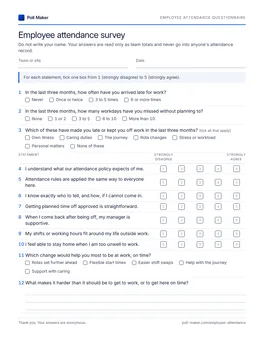
Employee attendance questionnaire
The core 12 with pencil tick boxes on sheet one, then the optional sets. The named return-to-work check-in prints alone on the last sheet, so leave it off the anonymous copies.
Download PDF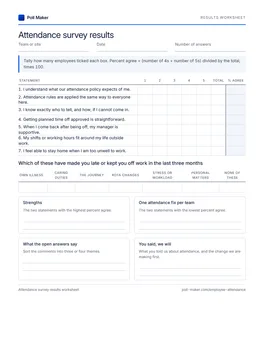
Attendance results tally sheet
Tally each paper form, score the seven statements, add up the ticks for every cause, and write down one fix per team.
Download PDFAn attendance pulse in five questions
Once a quarter, in the gap between full surveys, these five tell you whether the causes are shifting and whether your last change made a difference.
- 01Which of these have made you late or kept you off work in the last three months?
- 02Attendance rules are applied the same way to everyone here.
- 03My shifts or working hours fit around my life outside work.
- 04I feel able to stay home when I am too unwell to work.
- 05Which change would help you most to be at work, on time?
Attendance questions that put people on the defensive, rewritten
Questions shaped like blame get polite, empty answers. For more neutral wording, browse survey questions for every topic.
Why were you absent last month?
Which of these have made you late or kept you off work in the last three months? (tick list)
In a survey, "why were you absent" reads as an accusation and gets a vague reply. A tick list of causes is easier to answer honestly and adds up across the team.
Is the attendance policy clear and fair?
I understand what our attendance policy expects of me.
Attendance rules are applied the same way to everyone here.
Clear and fair are different problems with different fixes. Two statements show which one you have.
How many days were you absent this year?
In the last three months, how many workdays have you missed without planning to? (None, 1 or 2, 3 to 5, 6 to 10, More than 10)
A year is too long to recall, and an exact count invites rounding down. Three months and bands give answers you can compare, and your records hold the exact number.
Would an attendance bonus make you come in more?
Which change would help you most to be at work, on time? (five options)
Asking about a bonus plants the answer and tests just one idea. Offering five changes lets people rank the ones they would really use.
Before you send an attendance survey
Short answers to what HR and shift managers ask first.
What questions should an employee attendance survey include?
Ask how often people are late or miss work, in rough bands; what gets in the way; whether the policy is clear and applied fairly; how easy it is to report an absence and book leave; whether managers are supportive on return; whether hours fit life outside work; and whether people can stay home when ill. Then ask which change would help, and close with an open question. Together that is the core 12 at the top of the question list.
Should an attendance survey be anonymous?
Yes. It only works if people can name the real reasons, and few will while a warning feels possible. Keep the survey anonymous, report by team, and use the named return-to-work questions only in one-to-ones.
How do you calculate an employee absence rate?
Take the people who had an absence in a period and divide by headcount. For the lost worktime rate, divide hours missed by hours usually worked. In 2025, 3.2% of US full-time workers had an absence in an average week, and 1.7% of usual hours were lost.1
How do I take attendance with a poll?
Ask one question, such as "Are you here today?" or "Will you be at Friday's team day?", and share it as a live poll. For an event with a guest list and plus-ones, an RSVP form collects names and numbers.
Can I use these questions for a school attendance survey?
They are written for employees. For pupils and students, our student engagement survey asks about effort, interest and belonging at school, and it runs the same way.
Find out what keeps people from work
Pilot the core 12 at one site or with one team this month, or pass the printed questionnaire round at shift change. Within a week you will know which fix to start with.