Ask employees how far your digital transformation has really got
Ask the people who use the new tools every day whether the digital plan is working. The core 12 covers strategy, leadership, tools, data, skills and culture in about five minutes, and a matching leadership set shows where the two views part.
- 37questions
- 12in the staff core
- 5 minto answer the core
- 0 to 10maturity rating
By Michael Hodge, BSc Psychology Updated September 2026
All 37 digital transformation survey questions
The staff core is ticked. Add the skills, systems, culture or automation set for whatever your program is working on now, and send the leadership set to executives on the same day. Each row shows the options exactly as respondents meet them, plus a one-line reading of a weak result for a digital rollout.
The staff core 1212 questions
Nine statements about the program as it shows up in daily work, a 0 to 10 rating of overall progress, a vote on what needs the most work and one open question.
-
I could explain our digital plan to a new colleague in two sentences.
Strongly disagree12345Strongly agree1 = Strongly disagree, 5 = Strongly agreeWhether the plan has reached the people who carry it out. People in maturing firms were more likely to say they knew what their company was doing in digital.2
-
Our digital projects are aimed at problems we really have.
Strongly disagree12345Strongly agree1 = Strongly disagree, 5 = Strongly agreeSeparates transformation from buying technology for its own sake. Less mature firms tend to focus on single technologies instead of the business.2
-
Senior leaders here use the new digital tools themselves.
Strongly disagree12345Strongly agree1 = Strongly disagree, 5 = Strongly agreeStaff copy what leaders do, not what they announce. A low score means the tools look optional.
-
The digital tools I use match the way my work is really done.
Strongly disagree12345Strongly agree1 = Strongly disagree, 5 = Strongly agreeFit with the real workflow. Low scores point to tools bought for the process on paper, not the one people run.
-
I rarely have to enter the same information into two systems.
Strongly disagree12345Strongly agree1 = Strongly disagree, 5 = Strongly agreeDouble entry is the everyday sign that systems do not connect. Every disagree is time you can win back.
-
I can get the numbers I need for my job without asking someone to pull them.
Strongly disagree12345Strongly agree1 = Strongly disagree, 5 = Strongly agreeData access from the desk. The EU maturity questionnaire counts analytics staff can use without expert help, such as dashboards, as a sign of good data management.1
-
When a task moves online here, the steps are redesigned, not just copied.
Strongly disagree12345Strongly agree1 = Strongly disagree, 5 = Strongly agreePutting a clumsy process on a screen gives you a faster clumsy process. This asks whether anyone rethought the work.
-
I have had enough training for the digital tools my job depends on.
Strongly disagree12345Strongly agree1 = Strongly disagree, 5 = Strongly agreeSkills are where maturing firms pull ahead of early ones. Read this by role before you book any course.2
-
It is safe to try a new digital way of working here, even if it fails.
Strongly disagree12345Strongly agree1 = Strongly disagree, 5 = Strongly agreeRoom to experiment. Maturing organizations are more comfortable taking risks, and staff can be as risk averse as their managers. Where this is low, people wait to be told.2
-
From 0 to 10, how far has our organization come in working digitally?
0123456789100 = Not started, 10 = Fully transformedOne number for the whole program. Ask the leadership team the same question and the gap between the two medians is your headline.2
-
Where does our digital transformation need the most work?
A clear planTools that fitLinked systemsTrainingData accessStaff priorities in one count. If the top answer points the same way as the lowest statement above, you have found your first project.
-
Which digital task in your week wastes the most time?
Open answerA list of concrete fixes in staff words. Group the answers by system and the worst offenders stand out.
Your digital skills4 questions
Add these before you plan training, so the budget goes to the skills and formats people ask for.
-
How confident are you with the digital tools your job needs today?
Not confidentGetting thereConfidentVery confidentI help othersSelf-rated skill. Read it by role and age group, and recruit the people who help others as champions.
-
What would help you most with new digital tools?
Hands-on workshopShort videosA colleague to askTime set asideA practice areaWritten guidesTick all that applyShows which training format to fund first, team by team.
-
I know who to contact when a digital tool stops me working.
Strongly disagree12345Strongly agree1 = Strongly disagree, 5 = Strongly agreeSupport you can find. When nobody knows who to ask, problems turn into workarounds.
-
Which digital skill would make the biggest difference to your job next year?
Open answerA training plan written by the people who need it. Count the skills named more than once in each team.
Tools, systems and data, day to day5 questions
For programs that are joining up systems or replacing old ones. These find the logins, paper trackers and retyping that slow people down.
-
How many different apps or logins do you use on a normal working day?
1 to 34 to 67 to 10More than 10Not sureApp sprawl. High counts in one team show where joining systems up would pay first.
-
Which of these do you still track on paper or in your own spreadsheet?
TasksApprovalsClient recordsRosters or timesheetsTeam numbersNone of theseTick all that applyThe shadow systems. Every ticked box is a gap between the official tools and the real work.
-
I trust the figures in our dashboards and reports.
Strongly disagree12345Strongly agree1 = Strongly disagree, 5 = Strongly agreeData trust. People stop using a report after one wrong number and go back to their own spreadsheet.
-
I can reach the systems I need from wherever I am working.
Strongly disagree12345Strongly agree1 = Strongly disagree, 5 = Strongly agreeAccess on site, at home or on a phone. The EU questionnaire looks for data that can be reached in real time from different devices and locations.1
-
Which two systems should share information but do not?
Open answerIntegration priorities from the people doing the retyping. A pair named by several teams is your next project.
Culture and ways of working4 questions
Add these when the tools are in place but habits have not changed, or when the open answers sound frustrated.
-
Ideas from staff about better digital ways of working get a real hearing.
Strongly disagree12345Strongly agree1 = Strongly disagree, 5 = Strongly agreeVoice. Staff spot the fixes first; this shows whether they still bother to say so.
-
My team was asked what it needed before new tools were chosen.
Strongly disagree12345Strongly agree1 = Strongly disagree, 5 = Strongly agreeInvolving staff in the design of digital changes is one of the human-centric practices in the EU questionnaire.1
-
Teams here share what they learn from digital projects, including failures.
Strongly disagree12345Strongly agree1 = Strongly disagree, 5 = Strongly agreeLearning across teams. Without it, each team repeats the mistakes of the last one.
-
Compared with a year ago, has digital change made your work easier or harder?
Much easierA bit easierNo differentA bit harderMuch harderThe net effect on each job. A team that says harder deserves a conversation before the next rollout reaches it.
Automation and AI in your job3 questions
Three questions for programs that include automation or AI tools. Staff name the tasks they would hand over, which is a safer place to start than a list from above.
-
Which parts of your job would you most like to see automated?
Data entrySchedulingReportsRoutine questionsChecking documentsNoneTick all that applyDemand for automation from the ground up. Tasks many people name are low-risk places to start.
-
Is it clear which AI tools you may use for work?
Yes, clear rulesSome guidanceNo guidanceNot sureAI rules as staff understand them. Many "Not sure" answers mean the policy exists on paper only.
-
I understand how automation will change my own role.
Strongly disagree12345Strongly agree1 = Strongly disagree, 5 = Strongly agreePeople who cannot picture their own job after the change hold back. A low score calls for role-by-role briefings.
About you (optional)3 questions
Role, area and age let you break the results down. Fold any group too small to stay anonymous into its nearest neighbor.
-
Which best describes your role?
Front-line or specialistSupervisorManagerExecutiveRather not sayThe split to read every result by. When the plan has not traveled, scores fall with each level down.
-
Which area do you mainly work in?
OperationsCustomer facingFinance or adminIT or digitalOtherLets you compare IT and digital teams with the areas they build for.
-
What is your age group?
Under 3030 to 4445 to 5960 or overRather not sayFor training plans and research projects. In the MIT Sloan and Deloitte survey, most respondents in every age group from 22 to 60 wanted to work for digitally enabled organizations.2
For the leadership team (leaders answer)6 questions
Send this short set to executives and senior managers on the same day as the staff survey. The first question matches the staff rating, so the two can be compared.
-
On the same 0 to 10 scale, how far do you think the organization has come in working digitally?
0123456789100 = Not started, 10 = Fully transformedThe leadership half of the gap. Set its median beside the staff median before anyone reads the rest.
-
Each digital initiative has written goals and one named owner.
Strongly disagree12345Strongly agree1 = Strongly disagree, 5 = Strongly agreeGoals someone answers for. The first of BCG's six success factors is a strategy with clear transformation goals.3
-
We review a measure for each initiative at least every quarter.
Strongly disagree12345Strongly agree1 = Strongly disagree, 5 = Strongly agreeMonitoring progress. Winning programs did this far more often than the rest.3
-
Funding for digital work is agreed for at least the next 12 months.
Strongly disagree12345Strongly agree1 = Strongly disagree, 5 = Strongly agreeBudget certainty. The EU questionnaire asks whether funding has been found to keep digital work going for at least one year.1
-
Middle managers can explain the digital plan to their own teams.
Strongly disagree12345Strongly agree1 = Strongly disagree, 5 = Strongly agreeCommitment has to run from the top through middle management. Read it next to the first staff statement.3
-
What is most likely to stall our digital plan in the next year?
Open answerA one-line pre-mortem. Put the answers beside the staff priorities and see whether both groups name the same risks.
Which questions cover each part of the program
Maturity models use different labels for the same few areas. The EU assessment for small firms scores six dimensions, from digital strategy to green digitalisation,1 and a review of the employee side adds skills, attitudes toward change, teamwork and culture.4 This is where each area sits in the survey.
| Area | In the core | Go deeper with |
|---|---|---|
| Strategy and purpose | 1, 2 | Leadership set |
| Leadership | 3 | Leadership set |
| Tools and systems | 4, 5 | Tools, systems and data |
| Data | 6 | Tools, systems and data |
| Process redesign | 7 | Tools, systems and data |
| Skills and support | 8 | Your digital skills |
| Culture | 9 | Culture and ways of working |
| Automation and AI | None | Automation and AI in your job |
| Overall progress | 10, 11, 12 | The quarterly check |
Green digitalisation, the sixth EU dimension, is left out on purpose. It is a company-level question that most staff cannot judge from their own work, so it belongs in a leadership review rather than a staff survey.
Getting straight answers about digital change
Four habits turn a digital transformation survey from a morale check into a list of things to fix.
Agree their organization has a clear and coherent digital strategy
Check the plan reached the front line
In the MIT Sloan Management Review and Deloitte study, 15% of people in early-stage firms agreed their organization had a clear and coherent digital strategy, against 81% in maturing firms.2 A plan that lives in a slide deck does not count. So the first core statement asks whether staff could explain the plan to a new colleague, not whether a plan exists.

Put the same questions to the leadership team
A maturity questionnaire like the EU one for small firms takes a single set of answers per company, from one named contact person,1 and research on digital transformation has mostly looked at business strategy, with only modest attention to employees.4 Send the leadership set on the day the staff survey goes out. Wherever the two groups rate the same thing differently, you have found the part of the plan that has not landed.
Count the retyping and the side spreadsheets
Transformation shows up in small daily frictions long before it shows up in a strategy review: two logins for one task, a figure copied from one screen into another, a personal spreadsheet that tracks what the system should. The core asks about double entry and data access, and the systems set counts apps, paper trackers and the pairs of systems that ought to share information. Those answers become a list of fixes with owners.
Ask again every quarter
BCG found that 70% of digital transformations fall short of their objectives.3 Tracking progress was one of six factors that separated the winners: 90% of winning programs handled it well, against two in five organizations in the study.3 Run the five-question check each quarter with identical wording, and the full core once a year or at each new phase, so every round can be compared with the one before.
At a town hall, ask the room where the program needs the most work before the leadership team presents its own view. Launch it as a live phone poll people answer without leaving their chairs, and set the staff survey figures beside the result. If nobody on the team has run one before, creating a poll walks through the share link and the results page that fills as votes land.
Which parts of the program staff feel least
Type in the counts for each answer, 1 to 5, across the nine staff statements. The rows with the most red are the parts of the program staff feel least, and the report flags the lowest two as where to start.
- 1Each bar is one statement: disagreement in red on the left, agreement in blue on the right, and the percent agreeing at the end.
- 2Read the bars in pairs of related areas: the plan and its purpose, tools and systems, data and process, training and room to experiment.
- 3Split the results by role. When supervisors and front-line staff sit well below managers, the plan has not traveled down.
- 4Put one person and a deadline against each of the two lowest digital areas, then rerun the core after a year to see if they climbed.
Staff core statements
Reading the 0 to 10 rating, and the gap with leaders
The MIT Sloan and Deloitte study sorted its 1 to 10 ratings into three stages and asked what held each stage back.2 On this survey's 0 to 10 scale, count a 0 with the early group.
| Stage (rating) | Share of respondents | Top barriers they reported |
|---|---|---|
| Early (0 to 3) | 26% | No strategy, too many priorities, managers who do not understand digital |
| Developing (4 to 6) | 45% | Too many priorities, no strategy, too few tech skills |
| Maturing (7 to 10) | 29% | Too many priorities, security worries, too few tech skills |
A worked example
Say 140 employees and 8 members of the leadership team answer. Leaders put the organization at a median of 7, which reads as maturing. Staff put it at 4, developing. Six of the eight leaders agree that middle managers can explain the plan, yet only 45 of the 140 employees agree they could explain it to a new colleague. The two lowest staff statements are double entry and training.
The finding: leaders are judging the plan, and staff are judging their week. The actions are a short briefing on the plan in every team, led by its own manager, and one integration project aimed at the pair of systems employees named most often. Send the quarterly check three months later and watch whether the staff median moves.
The quarterly check-in, cut to five questions
Each quarter between full rounds, these five keep the program honest: the 0 to 10 rating, whether staff know the plan, double entry, training, and the task that wastes the most time. Change no words between rounds, or the quarters stop being comparable.
- 01From 0 to 10, how far has our organization come in working digitally?
- 02I could explain our digital plan to a new colleague in two sentences.
- 03I rarely have to enter the same information into two systems.
- 04I have had enough training for the digital tools my job depends on.
- 05Which digital task in your week wastes the most time?
Reaching warehouse, clinic and store teams on paper
Warehouse, clinic, site and store teams spend much of the day away from a screen, so an emailed link can miss exactly the people a new system changes most. Leave printed copies with a team member who is not a manager, plus a slotted box for finished forms. The layout suits letter or A4 paper without any resizing.
Leaving copies at a site? Keep the leadership sheet back for executives.
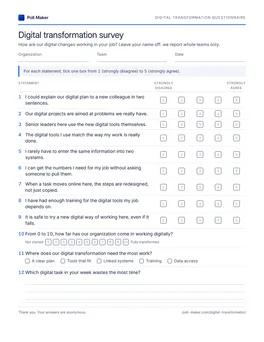
Staff questionnaire
Blank lines for organization, team and date, the staff core 12 with its 0 to 10 row, then the optional staff sets. The leadership set fills the last sheet alone, so it can go straight to executives.
Download PDF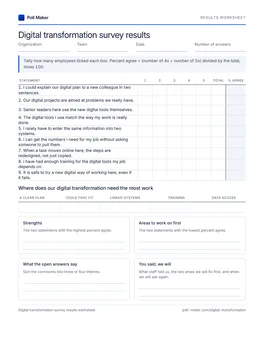
Maturity tally sheet
Add up the priority vote, total the nine staff statements from 1 to 5, and list the two digital areas scoring lowest.
Download PDFWriting a dissertation questionnaire on digital transformation
Writing a dissertation or coursework questionnaire on digital transformation at work? The staff set drops into the usual lettered sections with little change, and the 0 to 10 rating gives you an outcome to test them against.
| Section | What it measures | Questions |
|---|---|---|
| A. Respondent profile | Role, area, age group | About you |
| B. Digital transformation adoption | Plan, leaders, tools, systems, data, process | Core 1 to 7 |
| C. Skills and readiness | Training, confidence, support | Core 8 and the skills set |
| D. Culture and ways of working | Trying new ways, voice, shared learning | Core 9 and the culture set |
| E. Outcome | Perceived digital maturity | Core 10, the 0 to 10 rating |
Open with a consent line in your own words, for example: "Taking part is voluntary. Please do not write your name. Results are published as group totals only and serve this study alone." Keep every statement in a section on the same agree scale. Some supervisors ask for four points with no middle option; if yours does, remove Neutral from every statement, never from just a few.
Check reliability for the agree statements in each section rather than across the whole questionnaire, and leave the 0 to 10 rating out of it. Tavakol and Dennick note that published advice puts an acceptable Cronbach alpha somewhere between 0.70 and 0.95, and that a very high alpha may mean some items ask the same thing twice.5 With a small sample, report the share agreeing for each statement, and compare roles or areas with a chi-square test on agree versus the rest.
Home-made digital survey items, rewritten to point at a fix
Four items that keep appearing on home-made digital surveys, each rewritten so the answer points to a fix. Wording rules for any topic are in our guide to survey questions.
Do you support our digital transformation?
I could explain our digital plan to a new colleague in two sentences.
Our digital projects are aimed at problems we really have.
Support for a slogan is easy to give. Asking whether people know the plan and see its purpose shows whether it has landed.
How would you rate our technology and training?
The digital tools I use match the way my work is really done.
I have had enough training for the digital tools my job depends on.
Technology and training are separate problems with separate owners. Bundled together, a low score cannot be handed to either.
What percentage of our processes are automated?
Which of these do you still track on paper or in your own spreadsheet?
Staff cannot know a company-wide figure, so they guess. They do know what they still track by hand.
Is our organization digitally mature?
From 0 to 10, how far has our organization come in working digitally?
A yes or no hides the distance still to go. A 0 to 10 rating can be compared between staff and leaders and tracked over time.
Before you measure digital maturity
For HR, IT and transformation leads, and for students writing a questionnaire on the topic.
What questions should a digital transformation survey ask employees?
Ask about things staff meet in their own work: whether they know the plan and its purpose, whether leaders use the tools, whether tools fit the job and systems connect, whether they can get at data, whether they had training, and whether trying new ways is safe. Add a 0 to 10 rating of overall progress and one open question about wasted time.
How do you measure digital maturity with a survey?
Ask everyone to rate the organization from 0 to 10 against a fully digital version of itself, then group the answers into early, developing and maturing, as the MIT Sloan and Deloitte study did on its 1 to 10 scale.2 The core statements show which areas hold the rating down.
Should employees or leaders answer it?
Both, separately. Employees answer the core and any sets you need; the leadership team answers its own set on the same day. Reporting the two side by side shows where the plan has not reached the front line.
Should a digital transformation survey be anonymous?
Yes, for staff. A side spreadsheet or a skipped course is easier to admit on a form with no name. Show team-level results only for teams large enough that a single answer cannot be traced.
How often should we run it?
The five-question check every quarter, and the full core once a year or at each major phase of the program. Keep the wording the same so the results line up.
Put the staff core in front of every team
Add the organization's name to the survey title, choose which optional sets fit the current phase of the program, and share the link with every team. Executives get the leadership set the same day.