Home delivery survey questions that show what went wrong at the door
Ask the customer who took the delivery three facts first: when it came, whether it was all there and how it was handed over. Then have them rate the condition, the updates and the care at the door. Below are 38 questions with answer choices, led by an 11-question core you can send by text, email or a card in the box.
- 38questions
- 11in the core set
- 3 minto answer the core
- 7optional sets
By Michael Hodge, BSc Psychology Updated September 2026
The 38 delivery questions, from doorstep to repeat order
The 11 core questions come ticked. Add a set for large items, groceries or problem orders, or tick individual questions. Each row lists the answers customers choose from and why the question earns its place.
After the drop-off11 questions
Three facts about the drop-off, five ratings from Very poor to Excellent, the reorder question and two open answers. Together they cover one delivery from the time slot to the doorstep.
-
When did your order arrive, compared with the time we gave you?
EarlyIn the time slotUp to an hour lateOver an hour lateA later dayTiming as a fact, not a feeling. The share of "Early" and "In the time slot" answers is your on-time rate as customers saw it.
-
Did your whole order arrive?
Yes, all of itSome items missingA wrong item cameNothing arrivedCompleteness, kept apart from timing and damage so each problem points to its own fix: picking, packing or the route.
-
How was your order handed over?
Handed to meLeft where I askedLeft somewhere elseDriver did not waitMissed, card leftThe doorstep moment, where many parcel problems happen. A rising share of the last three answers is a route or training issue, not a product one.1
-
How would you rate the condition it arrived in?
Very poor12345Excellent1 = Very poor, 5 = ExcellentCrushed boxes, leaks and breakage in one rating. Read the open answers of anyone who picks 1 or 2 the same day.
-
How would you rate the updates about this delivery?
Very poor12345Excellent1 = Very poor, 5 = ExcellentTexts, emails and tracking together. A low score beside an on-time arrival means the delivery went fine but nobody said so.
-
How would you rate the choice of delivery times?
Very poor12345Excellent1 = Very poor, 5 = ExcellentWhether customers could get a slot that suited them. Low scores often trace back to one missing option, such as evenings.
-
How would you rate the care taken at your door?
Very poor12345Excellent1 = Very poor, 5 = ExcellentHow the order was carried, placed and left. It works whether or not the customer was home.
-
Overall, how would you rate this delivery?
Very poor12345Excellent1 = Very poor, 5 = ExcellentThe headline rating. Track the share of Good and Excellent each month, and set it beside the facts in questions 1 to 3.
-
Would you choose delivery from us again?
Yes, for sureProbablyNot sureProbably notNoTies the delivery to the next order. After an order was held up, loyal online shoppers have been found to order less often and place smaller orders.2
-
If you ran our deliveries, what would you fix first?
Open answerPutting the customer in charge brings concrete answers: a slot, a text, a place to leave parcels. Sort them into three or four piles.
-
What did we get right this time?
Open answerTells you what to protect when you change routes, carriers or packaging.
Ordering, tracking and updates4 questions
Add these when "where is my order" messages fill your inbox. They separate a checkout promise, a tracking fault and a missing warning.
-
How would you rate the delivery details at checkout?
Very poor12345Excellent1 = Very poor, 5 = ExcellentWhether the date, fee and slot were clear before paying. Surprises here come back later as calls and chat messages.
-
How accurate was the tracking?
Always rightMostly rightOften wrongDid not checkSeparates a tracking problem from a delivery problem. "Often wrong" answers show where scans and the doorstep disagree.
-
If the delivery time moved, when did you hear?
Well beforeOn the dayAfter it was dueNever toldIt did not moveA late delivery with a warning and one without feel very different to wait for. This shows which one the customer had.
-
Which updates would you like from us?
Order confirmedOut for deliveryDriver nearbyPhoto when leftDelay alertTick all that applyShows which messages customers actually want, so you can drop the rest.
At the door3 questions
For deliveries where the customer met the driver, gave instructions, or needed something at the door.
-
How would you rate the courtesy of the driver?
Very poor12345Excellent1 = Very poor, 5 = ExcellentOnly for customers who met the driver. Look at it by route or time of day, where a pattern usually points to workload.
-
Did the driver follow your delivery instructions?
YesPartlyNoI gave noneGate codes, dogs and safe places are easy promises to break. Read the open answers of everyone who says "Partly" or "No".
-
Did you need extra time or help at the door?
NoYes, and I got itYes, but I did notCustomers who need longer to reach the door or a hand with heavy items can say so here. Follow up each "did not" answer in person.
Furniture, appliances and large items5 questions
For sofas, fridges, mattresses and anything a two-person crew carries in. Send it once the crew has left.
-
Did the team contact you before arriving?
Yes, with a timeYes, no timeNoA call ahead is what lets someone be home for a two-person delivery. "Yes, no time" answers point to a missing step.
-
How would you rate the care taken inside your home?
Very poor12345Excellent1 = Very poor, 5 = ExcellentFloors, walls and door frames. Ask for a photo in the follow-up when anyone picks 1 or 2.
-
Was it placed where you wanted it?
YesIn the wrong roomLeft at the doorRoom of choice is usually part of what the customer paid for. This checks it happened.
-
Was it set up and checked before the team left?
Yes, it worksYes, with a faultNoNot neededInstallation faults turn up days later as service calls. Catch them while the order is fresh.
-
Did the team take away what was agreed?
YesOnly some of itNoNothing agreedPackaging and old appliances. A missed pickup leaves the customer with the problem and a reason to call.
Grocery and fresh food orders3 questions
For grocery orders, where swaps, temperature and dates decide how the delivery is rated.
-
Were any items swapped for something else?
No swapsSwaps I likedSwaps I did not wantMissing, no swapSubstitutions are the grocery version of a wrong item. Unwanted swaps and gaps point to stock, not to the driver.
-
How would you rate how cold your chilled items were?
Very poor12345Excellent1 = Very poor, 5 = ExcellentTemperature on arrival for chilled and frozen food. Split it by time slot to find where the cold chain slips.
-
How long was left on your fresh items' dates?
PlentyJust enoughToo littleShort dates on arrival cost the customer food. The answers tell your pickers which aisles to check.
When something went wrong4 questions
Show these only to customers who said something went wrong. They measure how the problem was put right.
-
How did you first report the problem?
Chat or appPhoneEmailAt the doorI did not report itShows which channel carries your delivery complaints, and how many customers never tell you at all.
-
How many times did you have to get in touch?
OnceTwiceThree or moreStill waitingNearly half of UK parcel customers with a problem hit a further hurdle getting it sorted. This counts how often it happens to yours.1
-
How would you rate how we put it right?
Very poor12345Excellent1 = Very poor, 5 = ExcellentThe recovery rating, read only for customers who reported a problem. Compare it with their overall rating.
-
What did we offer to put it right?
RefundReplacementNew deliveryCredit or voucherNothing yetPair it with the recovery rating to see which remedy customers value.
Delivery preferences (for planning)5 questions
Questions about deliveries in general rather than this one. Use them before changing fees, speeds or slots, or in a research project.
-
For most orders, what matters most to you?
Lowest costFastest arrivalA slot I chooseGreener deliveryThe trade-off question. It tells you whether to spend on speed, on slots or on keeping delivery cheap.
-
How soon should free delivery arrive?
Next dayWithin 2 days3 to 5 daysWithin a weekA standard to design against, set in your customers' own terms.
-
When you are out, where should we leave your order?
A safe place I pickWith a neighborLocker or pickup pointTry again laterGives drivers a default the customer chose, instead of a guess at the door.
-
What would you pay for same-day delivery?
NothingUp to $3$3 to $6More than $6Price sensitivity for a faster option, asked as concrete amounts. Change the bands to your own currency and prices.
-
Which delivery times suit you?
Weekday morningsWeekday afternoonsWeekday eveningsWeekendsTick all that applyShows which slots to add before you add more vans.
About you3 questions
Optional. Ask only what you will use to split the results.
-
How many deliveries have you had from us?
This was my first2 to 56 or moreLets you compare first-time customers with regulars, whose repeat orders are most at stake after a bad delivery.
-
Which best describes where you live?
CitySuburbSmall townRural areaDelivery times and handover options differ by area. This shows whether a problem belongs to one kind of route.
-
Which age group are you in?
Under 2525 to 4445 to 6465 or overPrefer not to sayOnly when you will compare age groups; otherwise leave it out and keep the survey shorter.
One number for the whole delivery: the perfect-delivery rate
Questions 1, 2 and 4 each check one promise. Count the deliveries that kept all three and you get the strictest score on this page, and the easiest one to explain to a team.
How to count it
A delivery is perfect when the customer answered "Early" or "In the time slot" to question 1, "Yes, all of it" to question 2, and Good or Excellent to question 4. Divide the perfect deliveries by everyone who answered all three. Logistics research treats timeliness, order accuracy and order condition as separate parts of delivery quality, so each one is also worth reporting alone.4
A worked example
Say 60 customers answered last month:
| Measure | Customers | Share |
|---|---|---|
| On time or early (question 1) | 51 of 60 | 85% |
| Everything arrived (question 2) | 55 of 60 | 92% |
| Good or Excellent condition (question 4) | 54 of 60 | 90% |
| All three: a perfect delivery | 44 of 60 | 73% |
Each promise looks healthy on its own, yet 16 of these 60 customers had at least one thing go wrong. That is the figure to track and push down month by month. Then read those 16 answers one by one: question 3 and the open answers usually show whether the fix belongs in the warehouse, on the route or at the door.
Keep the overall rating beside it
Question 8 says how the delivery felt; the perfect-delivery rate says what happened. When the rating slips while the rate holds steady, look at the updates (question 5) and the care at the door (question 7) before anything else.
What makes delivery feedback worth reading
Four habits turn a delivery survey from a formality into a weekly list of fixes.
Most common problems with the last parcel delivery
Ask about the doorstep as well as the clock
Late arrivals are only part of the story. In a 2025 survey of 8,000 UK adults, the most common problems with their last parcel were the driver leaving before they got to the door (29%), the parcel being left somewhere insecure (24%) and late arrival (24%).1 That is why question 3 asks how the order was handed over, and question 7 rates the care taken at the door.
Send it the same day it arrives
Put the survey link in the delivered text or email, or print a QR code on the packing slip. The customer still has the box in front of them and remembers the doorstep. For large items, the crew can leave the printed form behind, which also reaches customers who ignore texts.
Follow up every low answer within a day
Among UK parcel customers who had a problem, 47% then hit a further issue trying to sort it out, such as slow replies, chat bots or contacting the firm several times.1 The cost shows up in later orders: in one online retailer's records, previously loyal customers ordered less often and placed smaller orders after a delay in filling one of their orders.2 Send every 1 or 2 rating, and every missing-item answer, to someone who can put it right the same day.
Read the results by delivery type and route
A sofa and a parcel go wrong in different ways. Split every result by the set a customer answered, by route or depot, and by question 36, first delivery or regular. A problem that sits on one route is a local fix; one that shows up everywhere belongs to the process.
Thinking about changing your delivery options? Ask your customers first. Post the speed or cost question in a newsletter or on social media and launch a one-question poll, and see which way your customers lean. The guide to setting up a poll walks through sharing it by text, email, social media or on your website.
Short enough for the delivered message
A link in the "your order has been delivered" message gets opened on a phone, often at the door. These five fit one screen: when it came, whether it was all there, how it was handed over, the overall rating and the one fix.
- 01When did your order arrive, compared with the time we gave you?
- 02Did your whole order arrive?
- 03How was your order handed over?
- 04Overall, how would you rate this delivery?
- 05If you ran our deliveries, what would you fix first?
Sample delivery feedback, and what each comment tells you
Customers look for delivery feedback examples when they want words to write; owners want to know what to do with the comments they get. These examples were written for this page and work for both.
| Example comment | What it tells you | What to do |
|---|---|---|
| "Arrived in the slot, and I got a text when the driver was five minutes away." | Timing and updates both worked. | Keep the driver-nearby text. |
| "Box crushed on one corner, but the lamp inside was fine." | Packing held; handling did not. | Check the depot and route, not the box. |
| "Tracking said delivered at 2pm. It turned up at 6." | The scan and the doorstep disagree. | Find where drivers scan early. |
| "Left behind the bins in the rain, though I asked for the porch." | Instructions were not seen or not followed. | Show notes on the driver's screen at the stop. |
| "I was home but only heard the van pulling away." | The driver did not wait. | Look at stop times on that route. |
| "The crew covered the stairs and took the old fridge away." | The large-item service went well. | Thank the crew and copy their routine. |
Writing useful feedback about a delivery
If you are the customer, say what happened, when, and what you would like done. "Parcel left on the step at 3pm, box soaked, the book inside is ruined; please send a replacement" gets a faster fix than "terrible service". Praise works the same way: "Came inside the slot and put it in the porch as I asked" tells a business exactly what to keep doing.
A form the crew leaves on the counter
For two-person deliveries and installs, a paper form the crew leaves on the counter reaches customers who skip emails and texts. Each PDF prints on letter or A4 paper.
Install crews can carry a shorter form.
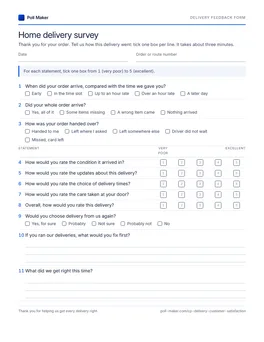
Delivery feedback form
The 11 core questions on page one, with room for an order number and date. The optional sets follow, each under its own heading, so you can print just the pages that fit your deliveries.
Download PDF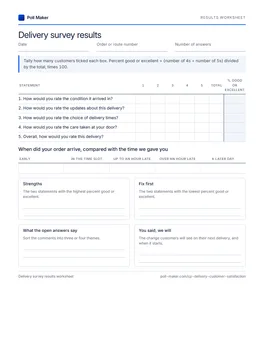
Delivery results tally
Count the ticks for each rating and for the arrival time question, work out the share rated Good or Excellent, and note the one fix for next month.
Download PDFA delivery service questionnaire for your research project
Students writing a survey questionnaire about delivery service need two things a business survey skips: a map from each question to what it measures, and a clear population and sample.
| Dimension | Questions | Source |
|---|---|---|
| Timeliness | 1, 14 | Mentzer 2001; Ngo 2025 |
| Order accuracy | 2, 24 | Mentzer 2001; Ngo 2025 |
| Order condition | 4, 25 | Mentzer 2001; Ngo 2025 |
| Contact with staff | 7, 16, 17 | Mentzer 2001; Ngo 2025 |
| Handling of problems | 27 to 30 | Mentzer 2001; Ngo 2025 |
| Delivery information and tracking | 5, 12, 13 | Added for home delivery |
| Satisfaction and reorder intention | 8, 9 | Outcomes; Rao 2011 |
Logistics service quality was set out as a group of related constructs, validated across different customer segments, by Mentzer, Flint and Hult.3 A 2025 study of 495 young online shoppers in Vietnam measured timeliness, contact with staff, order accuracy, order condition, the handling of problems and return convenience, and found that accuracy, condition and problem handling fed into satisfaction.4 Name those sources in your methods chapter, and say that the wording here is original.
Population and sample
The population is every customer the delivery service serves in the period you study. The sample is the customers you actually survey. Sending the survey to every delivery, or to a random draw from the delivery list, stops you from hand-picking the happiest or angriest customers. Report how many were asked and how many answered, since the people who reply choose themselves.
Coding the answers
Code Very poor as 1 up to Excellent as 5. The ratings are ordered categories, so report the share at each point and the median; ordinal and interval scales explains why a mean can mislead. Questions 1 to 3 are categories: report counts and shares.
Delivery questions that need a second draft
Four slips that turn up on delivery surveys, each with a better version. More fixes, for every kind of question, are in the question-writing guide.
Was your delivery fast and friendly?
When did your order arrive, compared with the time we gave you?
How would you rate the courtesy of the driver?
It bundles speed and manner. A customer whose parcel came late from a polite driver has no honest answer.
Did your order arrive on time?
When did your order arrive, compared with the time we gave you?
On time can mean the promised slot to you and the end of the day to the customer. Naming the time you gave removes the guess, and the five answers show how late.
How happy were you with our amazing delivery team?
How would you rate the care taken at your door?
Praise inside the question steers the reply. A plain question lets a disappointed customer say so.
Rate your delivery experience from 1 to 10.
Overall, how would you rate this delivery? (Very poor
Poor
Fair
Good
Excellent)
A bare number line leaves each customer to decide what a 6 means. A word on every point makes the answers comparable.
Delivery feedback: short answers to common questions
Short answers for owners, delivery managers and students.
What questions should a delivery survey ask?
Start with three facts: when the order arrived against the time you gave, whether everything arrived, and how it was handed over. Then ask for ratings of the condition, the updates, the choice of times and the care at the door, an overall rating, whether they would order delivery again, and one open question on the first thing to fix.
When should you send a delivery satisfaction survey?
The same day the order arrives, as a link in the delivered message or a QR code on the packing slip. For furniture and appliance deliveries, have the crew leave a paper form before they go.
How do you measure customer satisfaction with delivery?
Track two numbers each month: the share of Good or Excellent overall ratings, and the perfect-delivery rate, the share of deliveries customers say were on time, complete and in good condition. Read both beside the open answers.
In a delivery survey, what are the population and the sample?
The population is all the customers the delivery service serves. The sample is the customers who are surveyed. If a food delivery owner randomly surveys 100 customers about delivery time, the population is all of the service's customers and the sample is those 100 customers.
What is good feedback for a delivery service?
Specific and fair: what happened, when, and what you would like done. "Arrived inside the slot, driver put it in the porch as asked" helps a business more than "great service", and a problem report with the order number and a photo gets fixed faster.
Can I use these questions as a delivery service feedback form?
Yes. Open the core questions in the builder and they become an online form you share by link or QR code; add any set you need first. The printable PDF works as a paper form crews can leave behind.
Send your first delivery survey this week
Put the 11 core questions in the builder, add the link to your delivered message, and read the first answers tomorrow. For crews and installers, print the feedback form instead.