Volunteer Sign-Up Form and Interest Survey
Sign up more helpers in about a minute, then keep them with 38 tested questions for every moment from the first shift to the yearly check.
- Form Builder
- Volunteer sign-up form
What is a volunteer sign-up form?
A volunteer sign-up form is how people offer to help your cause, club or event, so you can match them to a role and a shift. A good one asks for a name and email, the roles they would enjoy, when they are free, how often, and whether they are 18 or over.
This is the real sign-up form. Fill it in to see what volunteers will see. Nothing you type here is sent.
11 questions, about 2 minutes to fill in. Free to publish, with no sign-up and no limit on responses.
Volunteer with us
Thank you for offering your time! Tell us what you would enjoy and when you are free, and we will match you with something that fits.
1. Your name
2. Email address
name@example.com
3. Mobile number (optional)
4. What would you like to help with?
- Setting up and packing down
- Welcoming people and registration
- Food and drinks
- Fundraising
- 2 more
5. When are you usually free?
- Weekday mornings
- Weekday afternoons
- Weekday evenings
- Weekends
Next
What questions should a volunteer sign-up form ask?
Ask for a name, an email, the roles someone would like, when they are usually free and whether they are 18 or over. A phone number, how often they can help, skills and access needs can all be optional.
This template asks 11 questions, 7 of them required. 2 appear only when an earlier answer calls for them. Change any of them in the editor.
By Michael Hodge, BSc Psychology. Updated 25 November 2026.
Your name
NameRequired
Email address
EmailRequired
Mobile number (optional)
Phone numberOptional
What would you like to help with?
Pick anySetting up and packing down, Welcoming people and registration, Food and drinks, Fundraising, Admin and office help and 2 moreRequired
When are you usually free?
Pick anyWeekday mornings, Weekday afternoons, Weekday evenings, WeekendsRequired
How often would you like to help? (optional)
Pick oneNow and then, for one-off events, About once a month, Every weekOptional
Are you 18 or over?
Yes or noRequired
Parent or guardian's name
NameRequired
Shown only when the answer to "Are you 18 or over?" is No
Parent or guardian's email
EmailRequired
Shown only when the answer to "Are you 18 or over?" is No
Any skills or experience you would like to share? (optional)
Long answerOptional
Anything that would help us make it work for you? (optional)
Long answerOptional
What makes a good volunteer sign-up form?
A good volunteer form asks the three things a coordinator matches on (roles, times and how often) and leaves address, date of birth and gender for later.
Built for matching.
Roles, weekday and weekend availability, and how often someone wants to help are the three things you need to place a volunteer well, and good matches keep volunteers coming back.
Under-18s handled.
Say "No" to "Are you 18 or over?" and the form asks for a parent or guardian's name and email. Adults never see those questions.
"Wherever you need me" is a real answer.
It clears the other roles, so you get one clear reply.
No paperwork at the door.
No home address, date of birth, gender or emergency contact at sign-up. Collect those later, only if a role needs them.
Easy to make yours.
Rename the roles for your charity, school, club or event in the editor.
How does this volunteer sign-up form compare with Tally, Jotform and Fillout?
Tally has no volunteer template. Against Jotform and Fillout it asks a field fewer, is quicker to fill in and is the only one that handles volunteers under 18, with a parent or guardian's details asked only when they are needed.
| Poll MakerThis template | TallyNo such template | JotformVolunteer Sign up Form | FilloutVolunteer Signup Form | |
|---|---|---|---|---|
| Questions | 119 for adults, 2 more only for under-18s | No template | 12The address takes 5 boxes | 122 of them by answers |
| Required answers | 57 for an under-18 | No template | None | 3 |
| Time to fill in | About 1 to 2 minAbout 35 s for the required answers | No template | About 3 min | About 3 min |
| When people are free | 4 windows, such as weekday eveningsThey map onto shifts | No template | Not asked | A date range |
| Age | Are you 18 or over?Guardian details only for a No | No template | Not asked | Age bands that skip 18"Younger than 18" then "19-30" |
| Also asks | Roles, how often, skills, access needsNo address, date of birth or gender | No template | Full postal address, a group photoRoles written for one fundraiser | Skills, a picture choice of roles |
Free form builder facts
Every Poll Maker form is free to build, publish and fill in, with no account for you or the people who answer. Poll Maker has been online since 2003. Checked 25 November 2026.
- No sign-up, even to publish
- Unlimited responses
- No ads on your form
- No account to respond
- 32 block types
- File uploads and signatures
- Logic rules and endings
- Themes, light or dark
- Share by link or QR code
- Embed on your site
- Results with charts
- CSV and Excel downloads
What does research say about volunteer forms?
Volunteers stay when the role and the hours fit them, and every field you add at sign-up costs you some of them.
Two in five volunteers have stopped volunteering for an organisation at some point because of poor management, such as not making good use of their time or talents.
Measured studyCorporation for National and Community Service
About one in three volunteers stop sooner than expected; mismatched roles, time limits and inflexible schedules are top reasons they quit.
Expert opinionVolunteerHub
Across more than 40,000 landing pages, pages that asked for age, a phone number or a location converted lower than pages that did not.
Measured studyHubSpot
Know why you ask every question and how you will use the answer, and ask only what you need.
Expert opinionGOV.UK Service Manual
Only ask for a phone number if you need it, and give people a choice.
Expert opinionGOV.UK Design System
From sign-up to goodbye: 38 volunteer survey questions
The form above signs people up in about a minute. These 38 questions go further, in six sets: a fuller interest form, scheduling, the first shift, a yearly check and the day someone steps back.
Opens the form builder with the first set loaded, ready to edit.
The sign-up form 10 questions
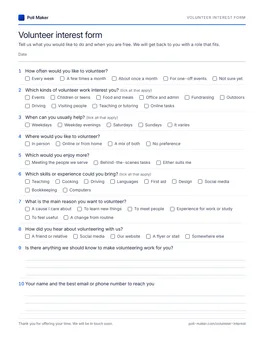
Ten questions a new volunteer answers in about three minutes: how often and when, what kind of work, where, front line or behind the scenes, skills, the main reason for helping, how they found you, and how to reach them.
How often would you like to volunteer?
Pick oneEvery week, A few times a month, About once a month, For one-off events, Not sure yet
Which kinds of volunteer work interest you?
Pick anyEvents, Children or teens, Food and meals, Office and admin, Fundraising, Outdoors and more
When can you usually help?
Pick anyWeekdays, Weekday evenings, Saturdays, Sundays, It varies
Where would you like to volunteer?
Pick oneIn person, Online or from home, A mix of both, No preference
Which would you enjoy more?
Pick oneMeeting the people we serve, Behind-the-scenes tasks, Either suits me
Which skills or experience could you bring?
Pick anyTeaching, Cooking, Driving, Languages, First aid, Design and more
What is the main reason you want to volunteer?
Pick oneA cause I care about, To learn new things, To meet people, Experience for work or study, To feel useful, A change from routine
How did you hear about volunteering with us?
Pick oneA friend or relative, Social media, Our website, A flyer or stall, Somewhere else
Is there anything we should know to make volunteering work for you?
Long answer
Your name and the best email or phone number to reach you
Short answer
Scheduling details 5 questions
For coordinators who run a weekly rota: who people want to work beside, when they can start, how much notice they need and who can cover a gap. For a one-off event, an availability poll shows which dates and times each volunteer can do.
Who would you like to volunteer with?
Pick oneA team, On my own, A friend or family member, Any of these
How soon could you start?
Pick oneThis week, Within a month, In a few months, Just exploring for now
How much notice do you need before a shift?
Pick oneA day or less, Two or three days, A week, Two weeks or more
Could we call you when a shift needs last-minute cover?
Pick oneYes, Sometimes, No
Do you hold a current background check for work with children or vulnerable adults?
Pick oneYes, No, Not sure
After a first shift 5 questions
Send these within a few days of someone's first shift, while the details are fresh. Early problems are cheap to fix and expensive to ignore.
On my first shift I knew where to go and who to ask.
Scale 1 to 5Strongly disagree to Strongly agree
The task I did matched what I signed up for.
Scale 1 to 5Strongly disagree to Strongly agree
Someone on the team made me feel welcome.
Scale 1 to 5Strongly disagree to Strongly agree
Will you sign up for another shift?
Pick oneYes, soon, Yes, later on, Not sure, No
What would have made your first shift easier?
Long answer
Once a year for regular volunteers 12 questions
For people who have volunteered with you for a few months or more. The first three statements cover the two things most closely tied to volunteers staying: seeing the difference they make and feeling part of the group.
How long have you volunteered with us?
Pick oneUnder 6 months, 6 to 12 months, 1 to 3 years, More than 3 years
I can see the difference my volunteering makes.
Scale 1 to 5Strongly disagree to Strongly agree
My role makes good use of my skills.
Scale 1 to 5Strongly disagree to Strongly agree
I feel connected to the other volunteers.
Scale 1 to 5Strongly disagree to Strongly agree
I get the training I need for my role.
Scale 1 to 5Strongly disagree to Strongly agree
I hear about schedule changes in good time.
Scale 1 to 5Strongly disagree to Strongly agree
Staff treat volunteers as part of the team.
Scale 1 to 5Strongly disagree to Strongly agree
When I suggest an idea, someone follows up.
Scale 1 to 5Strongly disagree to Strongly agree
I feel thanked for what I do.
Scale 1 to 5Strongly disagree to Strongly agree
Do you expect to be volunteering with us a year from now?
Pick oneYes, definitely, Probably, Not sure, Probably not
How likely are you to recommend volunteering here to a friend?
0 to 10
What is one change that would make volunteering here better?
Long answer
When someone steps back 3 questions
A short, friendly note for volunteers who stop or pause. The answers tell you which departures were preventable.
What is the main reason you are stepping back?
Pick oneLess free time, Moving away, Health or family, The role did not suit me, I did not feel valued, Something else
Would you help at a one-off event in future?
Pick oneYes, Maybe, No
What would have kept you volunteering with us?
Long answer
About you (optional) 3 questions
Useful only if you plan to split results, for instance students against retirees. Report only on groups with enough volunteers in them that no answer can be traced.
What is your age group?
Pick oneUnder 18, 18 to 24, 25 to 44, 45 to 64, 65 or older
Which best describes you right now?
Pick oneWorking, Studying, Retired, Something else
Have you volunteered before?
Pick oneYes, with us, Yes, elsewhere, No, this is my first time
From a completed form to a role offer
Read every form in three passes: when (times and how often), what (kinds of work, skills, setting) and why (the main reason). Then offer the one role that fits all three.
Weekdays, food, front line
Tuesday pantry shift
Right hours, face to face
Saturdays, outdoors, a team
Park cleanup crew
Weekend slot, group work
Online, social media, career
Social posts from home
Uses a skill, builds a portfolio
One-off events, meet people
Festival steward with a buddy
Short and sociable
Driving, weekdays
Meal delivery route
Skill and time in one role
Across a batch of forms, set the tick counts for each kind of work beside the places you have open. Charities that screen volunteers and match them to suitable jobs keep more of them,3 so this sorting is worth an hour a week. More audience research surveys sit in the marketing survey questions category.
A volunteer drive built around the form
Where you put the form, how fast you answer it and when you ask again matter as much as the questions.
Put the form where people already say yes
Most offers of help happen in a moment: at a fundraiser, after a talk, at the end of a service or a game. Stand a table card with a scannable code for the form by the door, keep paper copies on a clipboard beside it, and add the link to every thank-you email. Interest is on the rise: 28.3% of Americans aged 16 and over volunteered through an organization in the year to September 2023, up from 23.2% in 2021.1
Offer at least one role people can do from home
Almost one in five formal volunteers now serves partly or fully online, and those volunteers give more time: 95 hours a year on average, compared with 64 for people who only volunteer in person.1 A newsletter, phone calls, social posts or data entry can all run from a kitchen table. Question 4 finds the people who want them.
Reply the same week with one named role
A form that vanishes into an inbox teaches people not to bother. Sort the week's forms with the matching table above, then phone or email each person with one specific role, a date and a contact name. Screening and matching volunteers to suitable jobs, training them and recognizing their work are the practices linked to higher retention in a survey of 1,354 charities.3
Ask again after the first shift and every year
The first-shift set catches problems while they are small. The yearly set leads with the two things that predicted whether volunteers intended to stay in the Volunteer Satisfaction Index study: feeling that their work makes a difference, and feeling part of the group.4 Share what you learned at the next volunteer meeting and name one thing that will be different next month.
Hosting a volunteer info night? Warm the room up with one question everyone can answer from their seat, sent to their phones as a quick poll with live results. The bars double as a check on which recruitment channel is working. Our page on how to make a poll lists other ways to share one.
Six reasons people volunteer, and what to offer each
The Volunteer Functions Inventory, developed by Clary and colleagues, sorts the reasons people give their time into six motives. Question 7 asks for the main one in everyday words.
A cause I care about
Values
Impact news: people served, a story from each shift
To learn new things
Understanding
Training, rotating tasks, a behind-the-scenes tour
To meet people
Social
Team shifts, a buddy, a seasonal social
Experience for work or study
Career
A skills role, logged hours, a reference
To feel useful
Enhancement
A named job and thanks that says what they did
A change from routine
Protective
A regular slot with the same friendly crew
Matching pays twice. In the original studies, recruitment messages aimed at a person's main motive persuaded more than mismatched ones, and volunteers whose experience fit their motives were more satisfied and more likely to keep volunteering.2 Use the answer in your welcome message and again when you offer a second role.
A minute at the festival stall
At a fair, a festival stall or the back of a meeting you get a minute, not four. These five capture what people want to do, when, how often, what they can bring and how to reach them.
01Which kinds of volunteer work interest you?
02When can you usually help?
03How often would you like to volunteer?
04Which skills or experience could you bring?
05Your name and the best email or phone number to reach you
A clipboard for outdoor events
At an outdoor event a clipboard often beats a code on a card: no signal needed, no phone to dig out. Print a stack, clip them to a board with a pen on a string, and type them up the same evening.
Volunteer interest form
Page one is the 10-question sign-up form with space for a name and a phone number or email. Later pages hold the optional sets: scheduling, first shift, yearly check, stepping back and a few details about the volunteer.
Volunteer form questions to rewrite
Each of these turns up on real sign-up forms, and each better version gives you something you can put on a rota. For rewrites of every other kind of question, open the survey question guide.
Volunteer form questions
How do I handle volunteers under 18?
Ask "Are you 18 or over?" If the answer is No, this template asks for a parent or guardian's name and email so you can get their permission before the first shift.
Should I ask for an address or date of birth?
Not at sign-up. You rarely need them to say yes to a volunteer. If a role needs checks, ask later, only for that role.
How do I turn sign-ups into a rota?
Download your responses as a spreadsheet, filter by role and availability, and slot people into shifts. For named shifts with limited places, use a sign-up sheet.
What is the difference between a volunteer sign-up form and a volunteer application?
A sign-up is quick and gets people interested and placed. An application goes deeper, with references or checks, for roles that need them.
Is this volunteer sign-up form free?
Yes. The volunteer sign-up form template and the form builder are free: build the form, publish it and collect responses with no account, no limit on responses and no ads on your form. Downloading every response as a CSV or Excel file is free too.
What are the six motivations for volunteering?
Values, understanding, social, career, enhancement and protective. They come from the Volunteer Functions Inventory by Clary and colleagues (1998). The motive table above shows what to offer a volunteer whose main reason falls under each one.
How do you measure volunteer satisfaction?
Run the yearly set once a year with your regular volunteers. For every statement, count the volunteers who picked 4 or 5 and turn that into a percent of all replies. Rank the statements by that percent and start work on the bottom two. The recommend-to-a-friend score, from 0 to 10, gives you one number to follow from year to year.
Should a volunteer survey be anonymous?
The sign-up form cannot be, because you need to contact people. The yearly and stepping-back sets work best without names: send them as a separate survey, tell people who sees the replies, and keep every group you report on big enough that no single volunteer stands out.
- Schlachter, L. H., and Marshall, T. (2024, November 19). New U.S. Census Bureau and AmeriCorps research tracks virtual volunteering for first time. America Counts, U.S. Census Bureau. www.census.gov/library/stories/2024/11/civic-engagement-and-volunteerism.html
- Clary, E. G., Snyder, M., Ridge, R. D., Copeland, J., Stukas, A. A., Haugen, J., and Miene, P. (1998). Understanding and assessing the motivations of volunteers: A functional approach. Journal of Personality and Social Psychology, 74(6), 1516-1530. doi.org/10.1037/0022-3514.74.6.1516
- Hager, M. A., and Brudney, J. L. (2004). Volunteer Management Practices and Retention of Volunteers. Washington, DC: The Urban Institute. www.urban.org/research/publication/volunteer-management-practices-and-retention-volunteers
- Galindo-Kuhn, R., and Guzley, R. M. (2001). The Volunteer Satisfaction Index: Construct definition, measurement, development, and validation. Journal of Social Service Research, 28(1), 45-68. doi.org/10.1300/J079v28n01_03
More form templates
To let people pick a slot, a shift or a dish to bring, use the sign-up sheet; to take registrations and ticket choices for an event, the event registration form; and to take applications for a club or an association, the membership application form. Each one opens in the free form builder, ready to change.
Sign-up sheet
6 questionsabout 1 min
Use templateEvent registration form
10 questionsabout 1 min
Use templateMembership application form
14 questionsabout 2 min
Use template
Need people to pick a shift with a limit on places? Use a sign-up sheet
Want to start from scratch? Open the free form builder
Make this form yours in a minute
Change any question, add your own words and colours, then share one link. Free, with no sign-up to publish and no limit on responses.