Activity interest survey for seniors: build the calendar around what members want
An activity interest survey asks older adults what they would like to do, when, with whom, and what keeps them away, so the calendar fills with things people actually come to. Begin with the core 12 and add questions on fitness, trips, learning or life story as you need them. Run it online, on paper or read aloud.
- 36questions
- 12in the core
- 6 minfor the core 12
- 6add-on sets
By Michael Hodge, BSc Psychology Updated September 2026
Pick from 36 activity interest questions
The twelve core questions come pre-selected. Tick a set when you need it: moving more, trips, classes and screens, life story, helping out, or a few details about the person. Beneath each one you will see the choices on offer and how the activity team can put the result to work.
The core 1212 questions
How often people want to take part, a checklist of activities, a past-hobby question, three about timing, group size and what holds people back, five statements about the program you run today, and room for one new idea.
-
How often would you like to join an activity?
DailyA few times a weekWeeklyNow and thenRarelyTells you how full to make the calendar, and which people want a lighter week rather than more choice.
-
Which of these would you like to do more often?
MusicExerciseCard gamesCraftsGardeningClassesDay tripsWorshipFilmsCookingPet visitsVolunteeringTick all that applyThe heart of the survey: count the ticks for each activity. Expect several per person. Nursing home residents in one study rated 21 of 34 kinds of recreation as important on average.6
-
Is there a hobby you gave up that you would like to take up again?
YesNoNot sureEvery yes is a conversation to have in person. Ask what the hobby was and what stopped it, because the fix is often small: large-print cards, a seat in the garden, a lift to the club.
-
What time of day suits you best for activities?
MorningMiddayAfternoonEveningAny timeOften the cheapest change you can make. A well-liked activity held at the wrong hour still draws a thin crowd.
-
How do you most like to spend activity time?
Big groupSmall groupOne-on-oneOn my ownA mixSeparates the people who want a party from the ones who want a quiet table of four, and flags who would welcome a visit in their room or home.
-
What makes it hard for you to join in?
TimesGetting therePain or tirednessHearing or eyesightNot knowing anyoneCostNothing appealsNothing stops meTick all that applyEach answer has its own fix: new times, transport, seating and sound, a buddy, a free session, new ideas. The counts show which fix helps the most people.
-
There are activities here that I look forward to.
Strongly disagree12345Strongly agree1 = Strongly disagree, 5 = Strongly agreeThe overall read on the program. A low score next to a busy calendar means the offer does not match the people.
-
The activities here suit what I am able to do.
Strongly disagree12345Strongly agree1 = Strongly disagree, 5 = Strongly agreeAbility fit. A low score points to activities that need a seated version, bigger print or a slower pace.
-
The activity calendar is easy to read and follow.
Strongly disagree12345Strongly agree1 = Strongly disagree, 5 = Strongly agreeA calendar people cannot read keeps them away as surely as a dull one. Check the print size, where it hangs and how changes are announced.
-
I feel welcome at activities, even when I come on my own.
Strongly disagree12345Strongly agree1 = Strongly disagree, 5 = Strongly agreeNewcomers and people who live alone often stay away because of who is in the room, not what is on. A greeter or a buddy answers a low score.
-
I have a say in which activities are planned.
Strongly disagree12345Strongly agree1 = Strongly disagree, 5 = Strongly agreeWhether people feel the calendar is theirs. A members' planning group or a monthly vote is a quick answer to a low score.
-
What is one new activity you would love to see here?
Open answerOne idea per person, in their own words. Group the answers, and the idea that comes up most is an easy first addition.
Moving more5 questions
For wellness staff planning classes. These keep what people would enjoy apart from what their health allows, so nobody is steered away from a class they could do with a chair or a rail.
-
Which kinds of movement would you feel comfortable trying?
Chair exerciseWalking groupStretching or yogaBalance classWater exerciseDancingStrength trainingTai chiTick all that applyComfort first. People tick what they would really try, which gives you class numbers to plan around.
-
On how many days a week are you active for 30 minutes or more?
5 or more3 or 41 or 2None right nowCDC guidance for older adults is 150 minutes of moderate activity a week, such as 30 minutes on 5 days. This shows who is close and who is just starting.9
-
I would join a class that helps with my balance.
Strongly disagree12345Strongly agree1 = Strongly disagree, 5 = Strongly agreeBalance work is part of the CDC guidance for older adults, alongside strength on two days a week. Agreement here tells you whether a class would fill.9
-
Where would you most like to exercise?
Indoor classOutdoorsAt home with a videoIn a poolI would rather notRoom bookings, pool time or a video library: the answers show where the budget should go.
-
Would you need a seat, a rail or a helper to take part?
NoSometimesYesPlans the setup, not the guest list. Everyone who answers yes can still join once the chair or the helper is there.
Trips and outings4 questions
Ask these before you book a bus. The destination, the length of the day and how people get around decide the vehicle, the staff who go along and the day you choose.
-
Where would you like to go on a trip?
A restaurantShoppingA museum or showA park or gardenA scenic driveA sports gameA local festivalTick all that applyYour trip list for the season, ranked by ticks.
-
How long an outing suits you?
Up to 2 hoursHalf a dayA full dayOvernightA long trip delights some people and wears others out. When the answers split, offer both lengths.
-
What help do you use to get about on an outing?
On my ownWith a cane or walkerIn a wheelchairWith a helperDecides the vehicle, the ramp and how many staff go along. Ask it in private if the group is small.
-
I would like more trips outside the building.
Strongly disagree12345Strongly agree1 = Strongly disagree, 5 = Strongly agreeDemand for outings in one line. Read it with the destination ticks before you add a second trip day.
Classes, clubs and screens3 questions
For learning programs and technology help. Many programs now serve people from their early sixties to their late nineties, and these show what each age group wants to learn.
-
Which topics would bring you to a talk or class?
HistoryHealthMoney and scamsTravelNatureCurrent eventsLanguagesArt or musicTick all that applyA speaker list for the year, starting with the topics that draw the most ticks.
-
Would you like help using a phone, tablet or computer?
Yes, video callsYes, other usesNo, I manageNo, thanksTech help is easy to run with one patient volunteer. Splitting video calls from other uses tells you what the first session should teach.
-
Would you join some activities by video from home?
YesMaybeNoFor people who cannot always come in. A handful of yes answers is reason enough to stream one talk a week.
Your story: a first-week conversation6 questions
Read these aloud with a new member or resident, over a cup of tea in the first week. The answers give the activity team things to talk about and ideas the checklist misses.
-
What hobby have you given up that you miss the most?
Open answerThe open version of the core hobby question. Write the answer down in the person's own words; it often names something nobody has put on the calendar.
-
What work did you do for most of your life?
Open answerPast roles make strong activity ideas: a retired teacher may love reading to a group, a mechanic fixing things in a workshop. Activities tied to someone's past roles can draw them in.3
-
What kinds of music do you enjoy most?
Big bandRock and rollCountryClassicalGospelShow tunesFolkMotownTick all that applyPicks the playlist for a sing-along or a quiet afternoon. Ask for favorite singers too, and write the names down.
-
Would you like help to keep up a faith or spiritual practice here?
YesNoI would rather not sayServices, visits from clergy, prayer groups or a quiet room. Follow up every yes in person.
-
Would you enjoy visits from animals?
Yes, I love animalsMaybeNo, thank youIn one study, residents who had loved pets stayed with a visiting dog about twice as long as residents who had not.3
-
What makes a good day for you?
Open answerThe question people remember being asked. The answers show routines to protect as well as activities to add.
Helping out and sharing a skill3 questions
Plenty of members have skills to share. These find the volunteers, group leaders and greeters who let a small activity team offer much more.
-
Would you like to help run an activity?
Yes, every weekNow and thenNo, thank youYour volunteer list, ready before you need it.
-
Which of these could you help with?
Greeting newcomersLeading a gameTeaching a skillReading aloudGardeningPlanning eventsVisiting peopleTick all that applyMatches each volunteer to a job. Greeters and visitors also answer the "not knowing anyone" barrier in the core.
-
What skill or hobby could you teach others?
Open answerTurns members into class leaders. One answer can become next month's class.
About you (optional)3 questions
Age, time with the program and who held the pen: enough to compare groups and spot forms filled in with help.
-
What is your age?
Under 6565 to 7475 to 8485 or olderA program that serves people from their sixties to their nineties needs to know whether the youngest and oldest want different things.
-
How long have you been coming here or living here?
Under 6 months6 to 12 months1 to 5 yearsOver 5 yearsNewcomers often answer differently. Compare them before you drop a long-running favorite.
-
How was this form filled in?
On my ownSomeone read or wrote for meA relative answered for meKeep answers a relative gave apart from the person's own. CMS asks for the resident's own voice first and turns to family only when the resident cannot answer.1
Forms to leave by the sign-in sheet
Plenty of members would sooner tick boxes with a pen than tap a link. Put a pile of forms by the sign-in sheet for a week with a return box beside it, and have a volunteer on hand to read them out.
Reading the form aloud to a group? so your copy matches what members hear.
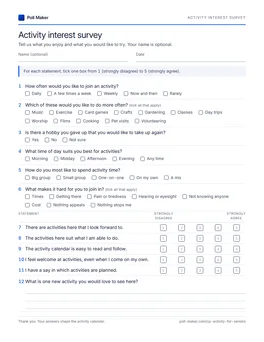
Activity interest questionnaire
The opening sheet holds the core checklist and ratings plus a space for a name, which people can leave blank. Pages for exercise, outings, classes, life story, volunteering and background come next; hand out only the ones your program needs.
Download PDF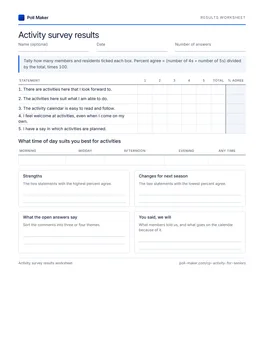
Results tally sheet
Tally the five program statements, count the time-of-day answers, and write down the changes you will make next season.
Download PDFFrom tick marks to next month's calendar
The checklist tells you what to offer. The time, group-size and barrier answers tell you how to offer it.

Count, then read the counts against the clock
Add up the ticks for each activity on the checklist. Then look at the time-of-day and group-size answers from the people who ticked it. Activities with many fans earn a regular slot at the hour those fans chose. Activities with a handful of fans become a small club, a one-on-one visit or a kit people can borrow.
A worked example
Say 40 members hand in the form. The counts are made up for illustration.
| Activity | Ticks (of 40) | What goes on the calendar |
|---|---|---|
| Music | 26 | A weekly morning sing-along, when most of its fans said they were free, plus live music once a month |
| Day trips | 19 | Two outings a month. Six of the nineteen use a walker or wheelchair, so book the bus with a lift |
| Gardening | 8 | A small club around two raised beds, led by the member who offered to teach it |
| Pet visits | 5 | A monthly therapy dog visit, with stops at the rooms of anyone who cannot come down |
Check the match three months later
The survey is the plan; attendance is the test. In a pilot at one nursing home, staff tracked week by week how many activities each resident attended that matched the preferences they had rated important, then used color-coded reports to spot gaps and add new activities.5 A paper version works anywhere: next to each activity on the calendar, note how many of the people who ticked it came along.
Asking so every member can answer
Four habits bring in the people a mailed form misses and keep the answers worth comparing year after year.
Seconds residents stayed engaged with a music activity
Ask what people enjoy now
Present interests predict who will join in. In a study of 193 nursing home residents with dementia, residents whose relatives said they currently enjoyed music stayed engaged with a music activity for 147 seconds on average, against 52 seconds for residents with no interest in music. Present preferences generally predicted engagement better than past ones.3 So the checklist asks what people would like to do now, and a separate question covers earlier hobbies.

Give a lost hobby a way back
The federal interview nursing homes use for activity preferences has an answer for things that matter to a resident who cannot do them, because it points staff at a problem they can solve.1 The past-hobby question and the barrier checklist do that job here. The fix is often an adapted version. Researchers who piloted a preference tracker give cooking as an example: a resident with mild memory loss can prepare a meal alongside others, while one with advanced dementia can enjoy the smell of food simmering and talk about baking with a volunteer.5
Read it aloud for anyone who struggles with print
Find a private spot, sit where the person can see your face, and keep the light out of their eyes. Check they can hear you, show the answer choices on a large card, and let them answer by speaking, pointing or writing.1 Ask the person first. In one study, answers from people with dementia were less steady over time than others', yet the researchers concluded that dementia alone is no reason to assume someone cannot report their preferences, and some spouses guessed their partner's wrong.4 Turn to a relative only when the person cannot answer, and mark that form.
Ask in the first week, then once a year
Interests shift with health, seasons and friendships, which is why CMS treats the preference interview as a first step in an ongoing conversation.1 Use the welcome five when someone joins, repeat the whole survey every twelve months, a few weeks before the new calendar is drawn up, and in between put one question to the room when you need a quick answer.
At a residents' council or a members' meeting, one question on the lounge TV gets the whole room voting in a minute. Start a live poll from any question above and people vote from their own phones. First time running one? The how to make a poll page covers the setup.
Score the five program statements
For the five statements about today's activity program, enter the tally for every answer, from strongly disagree up to strongly agree. A high score always means things are going well here, so the stubby bars mark where the program falls short. Bring the printout to the activity planning meeting or clip it into the members' newsletter.
- 1Combine the paper forms with the online replies before you type anything in; the bars then show what share of members and residents agreed.
- 2Look at the shortest bar first, then at the barrier ticks on the same forms, which usually explain it.
- 3Leave forms that a relative filled in out of this chart and read them on their own.
- 4Pin the chart to the activity board, next to one promised change and the month it starts.
Activity program results
The welcome five for a newcomer's first week
Five questions for the first chat with a new member or resident. They take a few minutes, give the activity team a starting list, and tell the person their interests count before the yearly survey comes round.
- 01Which of these would you like to do more often?
- 02What hobby have you given up that you miss the most?
- 03What time of day suits you best for activities?
- 04How do you most like to spend activity time?
- 05What makes a good day for you?
Senior center, senior living or nursing home: fitting it to your setting
The questions stay the same. Who you ask, when you ask, and what sits beside the survey change from one setting to the next.
| Setting | When and how to ask | What to pair it with |
|---|---|---|
| Senior center | Most participants come one to three times a week,10 so leave paper forms out for a full week and send the link to members with an email address. | The age question. Centers now serve three generations of older adults,10 so it shows whether the youngest and oldest members want different things. |
| Senior living | Every resident each year, in the month before the next calendar is planned, plus the welcome five at move-in. | The assisted living resident survey, for how residents rate care, meals and daily life. |
| Nursing home | At admission and once a year, read aloud where needed. Federal rules require an ongoing activity program built on each resident's assessment, care plan and preferences.2 | The MDS Section F interview, which rates eight activity preferences by importance.1 This survey adds the times, group sizes and barriers you plan around. |
Why asking pays off
Homes that ask properly see the difference. Ohio nursing homes that fully put a resident preference inventory into practice were 11.5 percentage points less likely to receive a substantiated complaint than homes that used it only in part.8 Surveys for other care settings, from pharmacies to fitness classes, are collected in our healthcare survey questions.
Activity questions that fall flat, and better versions
Four fixes that suit any activity or program survey for older adults. For more, see our survey question library.
Do you like bingo?
Which of these would you like to do more often?
A yes or no about one game says nothing about everything else people enjoy. A checklist shows the whole spread in a single question.
What activities would you like?
Which of these would you like to do more often?
What is one new activity you would love to see here?
A blank line gets blank answers or "anything is fine". A list jogs the memory, and one open line catches the ideas it missed.
Do you enjoy and feel safe in our exercise classes?
Which kinds of movement would you feel comfortable trying?
Would you need a seat, a rail or a helper to take part?
Enjoyment and safety share one answer, so a person who loves the class but needs a rail has no honest reply.
Why don't you come to activities?
What makes it hard for you to join in?
"Why don't you" sounds like blame. The better version treats the obstacle as yours to fix and offers answers to tick.
What activity directors ask about this survey
Short answers for activity, recreation and senior center staff getting a survey ready.
What questions should an activity interest survey for seniors include?
Start with a checklist of activities people would like to do, one question about past hobbies, how often and at what time of day they want activities, whether they prefer groups or one-on-one time, and what stops them joining in. Add a few statements about the current program and one open question for new ideas. Together those form the core 12 here, and the optional sets add fitness, trips, learning and volunteering.
How do you do an activity assessment for a new resident?
Sit down in the first week with the welcome five: the activity checklist, past hobbies, the best time of day, group size and what makes a good day. In a US nursing home, the MDS assessment already includes an activity preference interview in Section F;1 the welcome five adds the planning detail around it.
Can people with dementia answer an activity survey?
Many can, one question at a time, read aloud, with the answers on a card. In one study their answers were less consistent than other people's, yet the researchers concluded that dementia alone is no reason to assume someone cannot report their preferences.4 When a person cannot answer, CMS allows a relative who knows them well to answer instead.1 Mark those forms so you can read them apart.
Should an activity survey be anonymous?
Split it. The interest questions are most useful with a name, because staff can then invite people to the activities they ticked, so the name line on the paper form is optional. The five statements about the current program draw franker answers without a name; to get both, collect names on the interest questions and send the statements as a separate anonymous link.
How do I get more seniors to join activities?
Work through the barrier question. Move a popular activity to the hour its fans chose, arrange transport or a bus with a lift, fix the seating and the sound, and pair newcomers with a greeter so nobody walks in alone. The effort pays: in a study of 586 nursing home residents, going to recreational activities was linked with less pain and less loss of function over time.7
Plan next season from what members tell you
Send the core checklist to the survey builder, add whichever extra sets suit your program, and print copies for members who like paper.