An operations survey for the floor, the team leads and the office
An operations survey asks the people who make, move and deliver the work how the operation really runs. The core 12 rates quality, speed, delivery dates, flexibility and waste from the floor, and a priorities set checks that frontline staff and managers are aiming at the same target.
- 38questions
- 12in the core set
- 4 minto answer the core
- 5performance objectives
By Michael Hodge, BSc Psychology Updated September 2026
The full operations question bank, by topic
Q1 to Q12 are pre-selected and fit any operation, from a factory floor to a claims office. The sets below go deeper on priorities, stoppages, handoffs, quality, standard work and the team leads' view. Each row shows the answers people choose from, plus a line on what a weak result is telling you.
The core 1212 questions
Ten statements cover the results customers notice and the conditions behind them. A vote names the first thing to fix, and a single comment box asks where work stalls. Together they make a complete operations check.
-
I know what our customers need from my team's work.
Strongly disagree12345Strongly agree1 = Strongly disagree, 5 = Strongly agreePeople who can picture the customer make better calls when a job goes off plan. A low score means targets have replaced the customer as the reason for the work.
-
Materials and information are ready when a job starts.
Strongly disagree12345Strongly agree1 = Strongly disagree, 5 = Strongly agreeIn studies of frontline work, most stoppages traced back to materials and information supplied by other teams. A low score sends you to those teams, not to the people doing the job.5
-
Work moves on to the next step without waiting.
Strongly disagree12345Strongly agree1 = Strongly disagree, 5 = Strongly agreeSpeed as the floor sees it. Queues between steps usually add more time than the steps themselves.
-
We get work right the first time, with no redoing.
Strongly disagree12345Strongly agree1 = Strongly disagree, 5 = Strongly agreeQuality measured by rework. Every job done twice costs time, material and a delivery date somewhere else.
-
We deliver on the dates we promise.
Strongly disagree12345Strongly agree1 = Strongly disagree, 5 = Strongly agreeDependability. Staff often know a date will slip days before the customer does, so a low score here is an early warning.
-
We cope well when plans change at short notice.
Strongly disagree12345Strongly agree1 = Strongly disagree, 5 = Strongly agreeFlexibility. A rush order or a missing crew member should bend the day, not break it.
-
Little time or material is wasted in my area.
Strongly disagree12345Strongly agree1 = Strongly disagree, 5 = Strongly agreeCost from the floor: scrap, idle time, overproduction and searching. The people nearest the waste see it first.
-
Equipment is maintained before it breaks down.
Strongly disagree12345Strongly agree1 = Strongly disagree, 5 = Strongly agreeSeparates planned care from firefighting. A low score here usually sits behind low scores on speed and delivery dates.
-
I can see each day whether my team is on track.
Strongly disagree12345Strongly agree1 = Strongly disagree, 5 = Strongly agreeDaily visibility: a board, a screen or a huddle that shows the plan against what is done, while there is still time to act.
-
Ideas from the people doing the work get tried.
Strongly disagree12345Strongly agree1 = Strongly disagree, 5 = Strongly agreeThe engine of any improvement program. If ideas vanish, people stop offering them and the same problems return.
-
Which should our operation get better at first?
QualitySpeedDelivering on timeFlexibilityCostOne vote per person across the five performance objectives. The biggest pile is the floor's own priority, and it makes a quick vote at a shift meeting.
-
Where does work most often stall or get redone, and why?
Open answerNames the place and the reason in one answer. Sort the replies by area and the first project usually picks itself.
Priorities: is everyone aiming at the same thing?5 questions
Everyone answers, from the floor to the manager's office. Split the answers by role in Q36 to see whether the operation shares one set of priorities.
-
Which matters most to our customers?
QualitySpeedDelivering on timeFlexibilityLow costThe heart of an operations strategy check. Compare managers with frontline staff: a split means people will make different calls under pressure.3
-
Which do we do best today?
QualitySpeedDelivering on timeFlexibilityCostRead it beside the question above. If the operation is best at something customers rank low, effort is going to the wrong place.
-
I could explain our top priority to a new starter.
Strongly disagree12345Strongly agree1 = Strongly disagree, 5 = Strongly agreeA strategy that people cannot put into words cannot guide what they do on a busy day.
-
I know which wins when speed and quality clash.
Strongly disagree12345Strongly agree1 = Strongly disagree, 5 = Strongly agreeThe moment strategy gets tested: the truck is waiting and a batch needs checking. Low scores mean each person decides alone.
-
My team's targets match what customers value.
Strongly disagree12345Strongly agree1 = Strongly disagree, 5 = Strongly agreeTargets steer behaviour. If they reward output while customers want reliability, people will chase the target.
Stoppages and missing inputs4 questions
Four questions about the small breakdowns that stop work: how often they happen, what causes them, and what people do next.
-
On your last shift, how many times did something missing stop your work?
NoneOnce2 or 3 times4 or 5 times6 or moreA count over one shift is easier to recall than an average, and gives a number you can track from survey to survey.4
-
What stopped your work at least once last week?
MaterialsInformationEquipmentToo few peopleAnother teamNothingTick all that applyShows which supply line fails most often. Total the ticks by area to find where to start.
-
When something you need is missing, what do you usually do?
Work around itAsk a colleagueTell my supervisorLog it to be fixedWaitQuick workarounds keep the shift going but hide the problem from anyone who could remove it. Many "work around it" answers mean the same failure will be back tomorrow.5
-
Problems that stop work get fixed at the cause.
Strongly disagree12345Strongly agree1 = Strongly disagree, 5 = Strongly agreeWhether stoppages lead to a lasting fix or just a patch. Read it next to the workaround question.
Handoffs between teams and shifts3 questions
For operations where work passes from team to team, or from one shift to the next.
-
Work handed to us by other teams arrives complete.
Strongly disagree12345Strongly agree1 = Strongly disagree, 5 = Strongly agreeIncomplete handoffs turn into waiting, phone calls and guesswork. Ask each area about the team upstream of it.
-
I start each shift knowing what was left unfinished.
Strongly disagree12345Strongly agree1 = Strongly disagree, 5 = Strongly agreeTests the shift handover. A low score means the first hour of each shift goes on finding out where things stand.
-
How often does your work wait on another team?
NeverRarelySometimesOftenAlwaysFrequent waiting points to a handoff that needs a clear owner or an agreed time, not to slow individuals.
Quality and rework4 questions
Add these when Q4 is weak, or when comments keep describing jobs that bounce back for fixing.
-
How often does work you pass on come back to be fixed?
NeverRarelySometimesOftenAlwaysRework seen from the sender's side. Compare it with the next team's view of what arrives.
-
I can stop the work when I spot a quality problem.
Strongly disagree12345Strongly agree1 = Strongly disagree, 5 = Strongly agreeIf people feel they must keep going, defects travel downstream and cost more to fix at every step.
-
Checks happen at each step, not just at the end.
Strongly disagree12345Strongly agree1 = Strongly disagree, 5 = Strongly agreeA final inspection finds errors after the cost is spent. Checks built into each step catch them while they are cheap.
-
What causes most rework in your area?
Unclear instructionsLate or wrong inputsEquipment faultsRushed deadlinesTraining gapsTick all that applyTurns a quality score into a cause you can work on. Two or three ticked causes usually cover most of the rework.
Standard work and improvement ideas4 questions
For sites running lean, continuous improvement or operational excellence programs, and for any site that wants to know whether ideas from the floor go anywhere.
-
Written procedures match how the work is really done.
Strongly disagree12345Strongly agree1 = Strongly disagree, 5 = Strongly agreeWhen the document and the practice drift apart, training teaches one method and the floor uses another.
-
After a mistake we look for causes, not culprits.
Strongly disagree12345Strongly agree1 = Strongly disagree, 5 = Strongly agreeBlame makes people hide problems, which starves every improvement effort of the facts it needs.
-
Have you suggested an improvement in the last 3 months?
Yes, and it was usedYes, still being looked atYes, heard nothing backNoShows how many ideas are offered and what happens to them. "Heard nothing back" is the answer to fix first.
-
Which step in your work adds nothing a customer would pay for?
Open answerThe people doing a step know best whether it matters. These answers are a ready-made list of steps to cut or simplify.
Team leads and supervisors (leads answer)3 questions
Send these only to people who run a shift, line or team. They show whether the plan is realistic before it reaches the floor.
-
I have enough people to cover the plan most days.
Strongly disagree12345Strongly agree1 = Strongly disagree, 5 = Strongly agreeShort crews force leads to choose between speed and quality every day. Compare it with the staffing ticks in Q19.
-
Daily targets fit the people and equipment I have.
Strongly disagree12345Strongly agree1 = Strongly disagree, 5 = Strongly agreeTargets set above capacity get missed or met by cutting corners. Either way the plan stops meaning anything.
-
I spend enough time where the work happens.
Strongly disagree12345Strongly agree1 = Strongly disagree, 5 = Strongly agreeLeads buried in reports cannot spot problems early. A low score is a case for trimming their admin.
About you (optional)3 questions
Use these only to split the results. Keep any role, area or shift with fewer than ten answers inside the site total.
-
Which best describes your role?
FrontlineTeam lead or supervisorManagerSupport teamPrefer not to sayThe split that powers the priorities check. Without it you cannot tell whether managers and the floor agree.
-
Which area do you mostly work in?
Production or serviceWarehouse or logisticsQuality or maintenancePlanning or purchasingPrefer not to sayShows where stoppages and rework cluster, so each area gets its own fix.
-
Which shift do you usually work?
DaysEveningsNightsRotatingPrefer not to sayNight and weekend crews often see a different operation. This also tells you if any shift barely answered.
The five results every operation is judged on
Customers judge an operation on a handful of results. Q3 to Q7 ask the floor about each one; the rest of the core covers what makes them possible.
| Objective | What the floor sees when it works | Core question |
|---|---|---|
| Quality | Work leaves each step right, with nothing sent back | Q4 |
| Speed | Jobs move between steps without sitting in a queue | Q3 |
| Dependability | Promised dates hold, week after week | Q5 |
| Flexibility | A rush order or a changed plan bends the day without breaking it | Q6 |
| Cost | Little time, material or money goes to waste | Q7 |
Operations strategy research has tracked these priorities for decades. Ferdows and De Meyer's sand cone model argued that lasting gains build in layers: quality first, then dependability, then flexibility and reaction speed, and cost efficiency last.1 A later test across 189 plants found that some follow that sequence and others do not,2 so treat it as a sensible default: when quality and cost both score low, start with quality.
Q1, Q2 and Q8 to Q10 cover the foundations: knowing the customer, inputs that arrive ready, equipment cared for, a daily view of the plan and ideas that get tried. For planning, finance and other workplace topics, browse the full list of business survey questions.
From floor answers to fixes people can see
Four habits that get honest answers from the floor and turn them into fixes people can see.

Reach nights and weekends too
The night shift, the weekend crew and the second site see the operation when fewer managers are around, and theirs is the view most often missing. Keep the survey open for at least one full rotation so every crew gets a turn, put a QR code by the time clock, and give paper copies to anyone without a work email during the shift briefing. Q38 shows afterwards whether any shift is missing from the results.
Work system failures per 8-hour nursing shift, by cause
Count stoppages on the last shift
People fix small breakdowns so fast that nobody writes them down. When researchers shadowed hospital nurses minute by minute, they counted 8.4 work system failures in an average 8-hour shift: missing medications, orders and supplies, faulty equipment and too few staff.4 Most began in other departments that supply materials and information, and staff worked around most of them on the spot, which made them hard for the organization to see and learn from.5 Q18 to Q20 ask your operation the same thing: how often work stopped on the last shift, what stopped it, and what people did next.
Rate the system, not the people
An operations survey asks whether inputs arrive, whether checks catch errors and whether plans hold. Say so in the invitation, collect answers without names, and fold any crew smaller than ten into the site total. When staff trust that a low score on Q8 brings a maintenance plan rather than a search for whoever broke the machine, the counts in Q18 become honest.
Post the results where the shift meets
Pin the chart from this page to the board where the crew gathers, circle the two lowest statements, and write the planned change and its date beside them. Run the core 12 again three to six months later: if the fix worked, those two bars move. The Q11 vote settles it when two statements tie.
Holding a start-of-shift huddle this week? Put Q11 to the crew as a free live poll and see what they want fixed first. The full survey can follow a week later. Never set one up? Our page on making a poll walks through it.
Ten statements, ranked from healthy to short
Enter how many people picked each point for Q1 to Q10. All ten are phrased so that agreeing is a sign of a healthy operation, which puts your first fixes at the short end of the chart.
- 1A bar stands for one statement. Its length is agreement as a percentage of all answers to that statement, and it redraws with every count you type.
- 2Q3 to Q7 are the five performance objectives seen from the floor. Read them as a group before the rest.
- 3Line up the two weakest statements with the Q11 vote and the causes ticked in Q19. Where the three line up, you have found the first project.
- 4Split by shift and role where each group has ten or more people, then take the chart to the next shift meeting along with the two fixes you chose.
Operations results
Do the floor and the office chase the same priority?
An operations strategy only works when the people doing the work know what it is. The priorities set, Q13 to Q17, puts that to the test.

Boyer and McDermott compared an operations strategy that works like a compass, clear and widely understood, with one that works like a roadmap: detailed, but poorly shared. Surveying operators and managers in seven metalworking plants, they found that operators rated investment in technology higher than managers did, and that in some plants the two levels disagreed sharply on manufacturing priorities.3
Q13 asks what matters most to customers and Q14 what the operation does best. Compare the answers by role using Q36. Where managers and the floor pick different priorities, Q16 shows whether people know which one wins when speed and quality pull apart.
One site, two views of the customer
Made-up counts from a 97-person site, showing how to read the priorities set.
| Q13: matters most to customers | Managers (12) | Frontline staff (85) |
|---|---|---|
| Delivering on time | 7 | 18 |
| Quality | 3 | 41 |
| Speed | 1 | 12 |
| Low cost | 1 | 9 |
| Flexibility | 0 | 5 |
Most managers put delivery dates first, while the largest group on the floor, 41 people, put quality first. Neither answer is wrong, but the two groups will make different calls late on a Friday, when finishing a rework job means missing the truck. Show the table to both groups, agree which priority wins in that moment, and add it to the start-of-shift briefing. Q15 and Q16 should climb the next time you run the survey.
The monthly five: inputs, flow, quality, dates and one idea
Ask these five every month, or after a big change on the floor. They track ready inputs, flow, first-time quality and delivery dates, and the open question catches whatever the numbers miss.
- 01Materials and information are ready when a job starts.
- 02Work moves on to the next step without waiting.
- 03We get work right the first time, with no redoing.
- 04We deliver on the dates we promise.
- 05Where does work most often stall or get redone, and why?
Copies for the break room and the time clock
Plenty of operations staff never sit at a desk. Leave printed copies in the break room or hand them round at shift change, with a closed return box near the time clock.
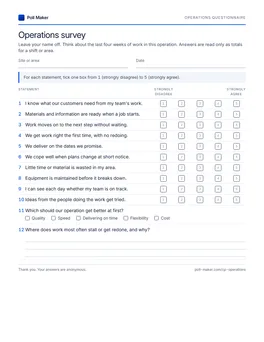
Operations questionnaire
Sheet one carries Q1 to Q12 as tick-box items; every optional set prints after it, so a site can hand out all 38.
Download PDF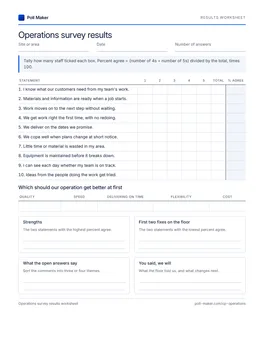
Operations results worksheet
A tally grid for Q1 to Q10, a line to total the agreement for each statement, space for the Q11 vote count and two boxes for the fixes you commit to.
Download PDFUsing these questions for an operations strategy study
For students and researchers building an operations strategy questionnaire for a dissertation or course assignment.
- Ask several people at each site. Boyer and McDermott pointed out that most operations strategy studies relied on one respondent per company, and surveyed more than one level of each plant instead.3
- Treat Q13 and Q14 as the priority measures and Q3 to Q7 as performance, then test whether sites strong on quality are also strong on the other four: the sand cone question,1 which Schroeder and colleagues retested in 189 plants.2
- Plan the study from question to analysis before you send anything. Forza's guide to survey research in operations management walks through the design and execution of theory-testing surveys stage by stage.6
- Try the questionnaire on five to ten people from the floor first, then put your consent statement and your contact details on the opening screen.
Operations questions that need rewording
Three items we see in almost every homemade operations survey, each rewritten so the result names something you can change. For other topics, browse survey question examples by topic.
How efficient are our operations?
Work moves on to the next step without waiting.
We get work right the first time, with no redoing.
Efficient is a verdict, and everyone defines it differently. Two concrete statements show whether the loss is waiting time or rework.
Do you have the tools, materials and support you need?
Materials and information are ready when a job starts.
Equipment is maintained before it breaks down.
It bundles three separate things. A "no" could mean missing stock, a broken machine or an absent supervisor, and you cannot tell which.
Are there bottlenecks in our process?
On your last shift, how many times did something missing stop your work?
Almost everyone says yes to a yes-or-no bottleneck question. A count over one shift gives a number to track between surveys.
What operations managers ask before sending it
Short answers for the person sending the survey.
What is an operations survey?
A set of questions put to the staff who carry out an organization's daily work, asking how well that work runs: whether materials and information arrive on time, whether jobs flow without queues, whether work is right first time and whether promised dates are met. It rates the system, not individual people.
What questions should an operations survey include?
Cover the results customers notice (quality, speed, delivery dates, flexibility and cost) and what drives them: ready inputs, working equipment, a daily view of the plan and a route for ideas to reach people who can act on them. Add one improve-first vote and one open question. Q1 to Q12 above follow that pattern.
Who should answer an operations survey?
Everyone in the operation, at every level. Research on operations strategy found that operators and managers in the same plant can hold quite different priorities, and asking a single manager hides that.3 Send it to frontline staff, team leads and managers, and use Q36 to compare their answers.
How often should you run an operations survey?
Twice a year suits most sites, with the five-question check run monthly and after any major shift in how work is done: a new line, a new system, a new shift pattern. Hold the core wording steady between rounds so the trend is real.
Is an operations survey the same as a process improvement survey?
No. This survey looks across the whole operation. To study one workflow stage by stage, SuperSurvey, our sister site, has a process improvement survey built for that job.
Ask every shift before you change the line
Put the core 12 and the priorities set into the builder, then share the link at every shift meeting this week. Print copies for crews who rarely see a screen.