Warehouse survey questions every shift can answer on paper or by phone
A warehouse survey asks the people who receive, pick, pack and load where the job is unsafe, slow or hard to stay in. The core 12 fits inside a pre-shift huddle: five minutes with a pen or a phone. Add a set for truck operators, stock accuracy or shift patterns when you need one.
- 36questions
- 12in the core set
- 5 minat a shift huddle
- Paperor phone
By Michael Hodge, BSc Psychology Updated September 2026
Safety, stock and shift questions for the floor
Every core question starts selected. Add the operator set for anyone who drives a truck, the stock set when counts keep drifting, and the shift set before you change schedules. Each row lists the answer choices and the meaning of a low or high score.
The core 1212 questions
Eight agree-or-disagree statements about the floor, the biggest slowdown on the last shift, a year-from-now question, then two write-in questions. It stands as a full site survey without the extra sets.
-
I can report a near miss without getting in trouble.
Strongly disagree12345Strongly agree1 = Strongly disagree, 5 = Strongly agreeNear misses are the cheapest warning you will ever get. A low score means they go unreported, and you hear about the hazard only after someone is hurt.
-
Aisles and walkways in my area are kept clear.
Strongly disagree12345Strongly agree1 = Strongly disagree, 5 = Strongly agreePallets, wrap and returns left in walkways cause trips and force drivers to swerve. Sort the answer by area and you know which aisle to walk first.
-
The equipment I use works when I need it.
Strongly disagree12345Strongly agree1 = Strongly disagree, 5 = Strongly agreeCovers trucks, pallet jacks, scanners and printers in one line. Low scores come with names in the open answers, which tells maintenance where to start.
-
When I am sent to a location, the stock is there.
Strongly disagree12345Strongly agree1 = Strongly disagree, 5 = Strongly agreeThe floor view of inventory record accuracy. Pickers find a wrong record before any report does, so a low score points at the data, not at the pickers.4
-
I can hit my targets without cutting corners.
Strongly disagree12345Strongly agree1 = Strongly disagree, 5 = Strongly agreeTells you whether pick and pack rates are set at a pace people can keep safely. Read it next to the injury log and overtime hours.
-
I was trained on every machine I am asked to use.
Strongly disagree12345Strongly agree1 = Strongly disagree, 5 = Strongly agreeCatches the new starter who was shown a machine once and then left to it, often during a peak.
-
My supervisor treats everyone on my shift fairly.
Strongly disagree12345Strongly agree1 = Strongly disagree, 5 = Strongly agreeFair task and overtime allocation is what staff notice first. Compare shifts: one low shift usually means one lead to support.
-
When I report a problem, something is done about it.
Strongly disagree12345Strongly agree1 = Strongly disagree, 5 = Strongly agreeIf this one is low, every other answer is at risk, because staff stop reporting. It is also the statement that rises fastest when you post what you fixed.
-
What slowed you down most on your last shift?
Waiting for workFaulty equipmentStock not in placeBlocked aislesNothingOne answer per person, so the tally ranks the slowdowns. It also works as a one-question poll at the start of a shift.
-
Do you see yourself working here a year from now?
Yes, for sureProbablyNot sureProbably notNoAn early read on turnover before it shows in your hiring bill. Split it by time on site to see whether new starters or long-timers are wavering.
-
What should we fix first on your shift, and where is it?
Open answerAsking for one fix and its place keeps answers short and specific. Expect named aisles, trucks and tasks you can act on.
-
What works well here that we should keep?
Open answerTells you what not to break when you fix everything else, such as a good lead, a fair rota or a tidy zone.
Safety on the floor5 questions
A closer look at the floor itself: truck traffic, protective gear, heavy loads, and the hazards staff walked past in the last month.
-
Drivers and people on foot are kept apart where they cross.
Strongly disagree12345Strongly agree1 = Strongly disagree, 5 = Strongly agreeWhere trucks and people on foot share space, one lapse can mean a serious injury. A low score calls for barriers, marked walkways or speed limits at that spot.
-
I have safety gear that fits me properly.
Strongly disagree12345Strongly agree1 = Strongly disagree, 5 = Strongly agreeGloves, boots and vests that do not fit get left off. This finds the sizes and items you are short of.
-
There is help or a lift aid for heavy loads.
Strongly disagree12345Strongly agree1 = Strongly disagree, 5 = Strongly agreeManual handling strains are a daily risk on a pick line. A low score in one area usually means one product or one task to redesign.
-
Which of these did you see in the last month?
Blocked exitsDamaged rackingSpeeding trucksWet or slippery floorsOverloaded palletsNone of theseTick all that applyA hazard check done by everyone on every shift. Any tick for blocked exits or damaged racking is a job for today, not for the report.3
-
In the last month, did you see a near miss nobody reported?
YesNoNot sureMeasures the gap between what happens and what gets written down. Read it next to the core statement on reporting without getting in trouble.
Forklifts and powered trucks (operators answer)3 questions
Hand this set to anyone who drives a forklift, reach truck or powered pallet jack. Each question lines up with a check the federal truck rule already requires.
-
The truck I drive is checked before each shift.
Strongly disagree12345Strongly agree1 = Strongly disagree, 5 = Strongly agreeTrucks must be examined before use, at least daily, and after each shift where they run round the clock. A low score means the check sheet exists on paper only.2
-
A faulty truck is taken out of use until it is fixed.
Strongly disagree12345Strongly agree1 = Strongly disagree, 5 = Strongly agreeA truck that is not in safe operating condition has to come out of service. Operators know whether that happens or whether faulty trucks stay in the queue.2
-
When were you last assessed driving the truck you use?
This year1 to 3 years agoOver 3 years agoNeverNot sureEvery operator needs a performance evaluation at least once every three years. Any answer past three years, or never, is a booking to make.2
Stock and picking accuracy4 questions
For sites where counts drift or pickers keep finding empty locations. The people who pick and count see a wrong record long before a report does.
-
How often is stock missing at the location you are sent to?
NeverRarelySometimesOftenAlwaysAdds a frequency to the core statement about stock being there. Sort it by area to find the zones where records and shelves part company.
-
I know what to do when a count does not match.
Strongly disagree12345Strongly agree1 = Strongly disagree, 5 = Strongly agreeIf staff do not know the steps for a mismatch, errors get worked around and never corrected in the system.
-
When you find stock in the wrong place, what do you usually do?
Log it on the scannerTell my leadMove it myselfLeave itNot sureShows whether misplaced stock is fixed in the system or only on the shelf. Moving it quietly keeps the record wrong.
-
What causes most picking mistakes in your area?
Look-alike productsWorn labelsWrong system dataRushingPoor lightingNew staffTick all that applyPoints to the fix: slotting look-alikes apart, relabelling, cleaning up data, easing the pace or better training.
Shifts, hours and breaks4 questions
Ask the people who work the rota before you change schedules, overtime or break times.
-
I get my schedule early enough to plan my week.
Strongly disagree12345Strongly agree1 = Strongly disagree, 5 = Strongly agreeTells you whether posting rotas earlier would help staff who juggle childcare, study or a second job.
-
I can take my full breaks, even at busy times.
Strongly disagree12345Strongly agree1 = Strongly disagree, 5 = Strongly agreeBreaks that shrink at peak are a fatigue risk and a fairness complaint in one. Compare the shifts that run the peak.
-
How do you feel about the overtime you work?
I want moreAbout rightA bit too muchFar too muchI do noneSome staff want every extra hour and some are worn out. The split shows who to offer it to first.
-
In the last month, how often was it too hot or cold to work well?
NeverRarelySometimesOftenAlwaysDock doors, mezzanines and freezer edges run hot or cold. Sort by area to see where fans, heaters or rest breaks are needed.
Handover, fairness and staying4 questions
How information passes from shift to shift, whether agency and direct staff are treated alike, and what would keep people on the team.
-
Shift handover tells me what I need to know.
Strongly disagree12345Strongly agree1 = Strongly disagree, 5 = Strongly agreePoor handover is where half-finished orders and unreported damage get lost between shifts.
-
I hear about changes before they affect my work.
Strongly disagree12345Strongly agree1 = Strongly disagree, 5 = Strongly agreeNew layouts, systems and targets land badly when the floor hears about them on the day.
-
Agency and direct staff are treated the same here.
Strongly disagree12345Strongly agree1 = Strongly disagree, 5 = Strongly agreeMixed teams split fast when one group gets the worst tasks or the last overtime. Compare the answers of both groups.
-
What would most make you stay longer?
Better paySteadier hoursBetter equipmentChance to move upBetter supervisorsRanks the retention levers from the people you want to keep. Read it next to the core question about a year from now.
About you and your shift (optional)4 questions
Four splits for reading the results by shift, area, time on site and employer. Leave a shift or zone out of the results if so few people share it that you could guess who wrote what.
-
Which shift do you usually work?
DaysEveningsNightsWeekendsRotatingThe most useful split in a warehouse. Nights and weekends often answer very differently from days.
-
Where do you spend most of your shift?
ReceivingStoragePickingPackingShippingOtherTurns every score into a place on the floor, so fixes go to the right zone.
-
How long have you worked at this site?
Under 3 months3 to 12 months1 to 3 yearsOver 3 yearsNew starters and long-timers see different problems. The first months are when training and equipment gaps show.
-
Are you employed directly or through an agency?
DirectlyThrough an agencyPrefer not to sayLets you check whether agency staff get the same training, gear and treatment.
Forms for pickers, drivers and night crews
Paper reaches the people an emailed link misses: pickers, drivers and night crews with no work inbox. Hand it round, gather the forms in a locked box, and enter them into the online copy afterwards.
The forklift set only needs to go to operators, so print it separately.
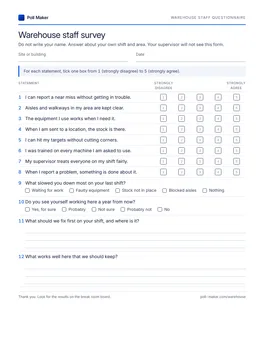
Staff questionnaire
Sheet one carries the core 12 and a line for site and date. The six extra sets follow on later sheets; print only the ones your operators or a single shift will use.
Download PDF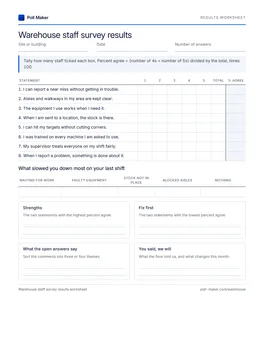
Results worksheet
Tally the ticks for each statement by hand, compare shifts side by side, and choose what to fix first on one sheet.
Download PDFDays, nights and weekends: getting forms back
Most of the people you want to hear from have no desk, no work email and a phone in a locker. Four habits get forms back from days, nights and weekends alike.

Hand it out at the pre-shift huddle
Give each shift five paid minutes at the start of its huddle, with pens and a sealed box by the door, and put a QR code poster in the break room for anyone who missed it. The UK Health and Safety Executive builds its survey tools the same way: paper copies, a survey link and a QR code for posters in shared areas, and paper forms keyed in through that same link so paper and phone answers are counted together.5 Mark each form once it has been entered.
Cases with days away, restricted duty or a job transfer, per 100 full-time workers, 2024
Lead with safety
Warehouse work is hard on the body. In 2024, warehousing and storage recorded 4.1 cases per 100 full-time workers serious enough to mean days away, restricted duty or a job transfer, nearly three times the 1.4 across private industry.1 That is why four of the eight core statements cover hazards, equipment and pace, and why the first thing staff read is a question about reporting a near miss.

Ask where the trouble is
A score says something is wrong; the floor plan says where. Add the area question from the last set, then sort the slowdown answers and the hazard tick list by zone. The worst spots show up quickly, and they are where your next walk-through starts.
Post what changed within a week
Pin the results to the break room board with a short list of what you did about them: the truck that went for repair, the aisle that is now kept clear, the rota that now goes up on Thursdays. When staff can see that their answers changed something, they fill in the next form, and the statement about problems getting fixed climbs with it.
At a huddle, one question beats a form. Show the slowdown question on a screen as a live poll; the shift votes from their phones and sees the result before the first pick. For more quick questions to open a shift with, see these poll questions for meetings.
Answers to act on before the next shift
Most answers can wait for the report. A few describe a hazard that is on the floor right now, so read the forms the day you collect them and look for these first.
| If a form says | Do this | The rule behind it |
|---|---|---|
| A faulty truck is still in use | Tag it out and book the repair | A truck not in safe operating condition must be removed from service2 |
| Trucks are not checked before shifts | Start a written pre-use check | Examined before use, at least daily, and after each shift on round-the-clock sites2 |
| An operator was last assessed over 3 years ago, or never | Book a driving evaluation | Each operator is evaluated at least once every three years2 |
| Blocked exits were ticked | Walk every exit route on that shift | Exit routes stay free and unobstructed, even temporarily3 |
| A near miss went unreported | Remind the shift how to report one, and thank the next person who does | For drivers, a near miss is a trigger for refresher training2 |
Log each of these like a maintenance request, with the date you acted, and mention the fix at the next huddle. Nothing else on the form builds trust as quickly.
A results report for each shift
Key in the count of forms at each score for every one of the eight statements. You get a ranked chart with the weakest marked, ready to print for the break room board.
- 1Run the report for the whole site, then once for each shift. A statement that looks fine overall can still be the weakest on nights.
- 2Agreement means a 4 or a 5. Divide those answers by the number of people who rated the statement; the report works it out for you.
- 3Start with the lowest safety statement, even when another statement scores lower. Fix it and say so at the next huddle.
- 4Read the open answers last, sorted by area. They usually name the truck, the aisle or the task behind a low score.
Shift results
Put the answers next to the numbers you track
Your warehouse already counts mis-picks, stock adjustments, downtime and injuries. The survey tells you why those numbers move.
| Survey answer | Number to set beside it | What the pair tells you |
|---|---|---|
| Stock is at the location; how often it is missing | Stock adjustments and count variances by zone | Low agreement where adjustments run high: fix the records before blaming the pickers |
| Causes of picking mistakes | Mis-picks and returns by zone | Which fix to try first: labels, slotting, data or pace |
| Equipment works when I need it | Truck and scanner downtime log | Whether faults are caught at the pre-use check or on the floor mid-shift |
| Targets without cutting corners | Injury log and overtime hours | Pressure on pace shows up in all three |
| A year from now; what would make you stay | Leavers in their first months | The reason to tackle ahead of the next hiring wave |
Wrong records are common, and they respond to care. In a study of nearly 370,000 inventory records from 37 stores of one retailer, 65% did not match what was really there, and auditing practices were among the things that cut the error rate.4 A picker sent to an empty slot is the first to know, which is why that statement sits in the core.
A worked example
A site collects 84 forms. On days, 31 of 44 agree that the stock is at the location; on nights, only 14 of 40 do, and the night shift names "Stock not in place" as its biggest slowdown. The count variance report shows the same two zones the night pickers named. The site moves a weekly cycle count onto nights in those zones and asks the stock statement again eight weeks later.
Read these out before the shift starts
When all you get is the first ten minutes of a shift: reporting near misses, equipment, stock at the location, the biggest slowdown and one change. Read them out, or hand round the paper version.
- 01I can report a near miss without getting in trouble.
- 02The equipment I use works when I need it.
- 03When I am sent to a location, the stock is there.
- 04What slowed you down most on your last shift?
- 05What should we fix first on your shift, and where is it?
Warehouse questions that fail, and what to ask
Each fix gives the floor something concrete to answer. The question writing guide applies the same rules to every question type.
Is the warehouse a safe place to work?
I can report a near miss without getting in trouble.
Aisles and walkways in my area are kept clear.
"Safe" is a verdict staff give out of loyalty or anger. Conditions they can see point you at something to fix.
How satisfied are you with the WMS and equipment?
When I am sent to a location, the stock is there.
The equipment I use works when I need it.
Two subjects in one, and many staff do not call the system the WMS. Ask about what happens at the shelf and at the truck.
Do you always follow safety rules?
Which of these did you see in the last month?
Nobody admits breaking rules on a work form. Asking what they saw is safer to answer and still finds the hazard.
Do you work hard to meet your targets?
I can hit my targets without cutting corners.
Almost anyone answers yes to the first. The second tells you whether the rate itself is the problem.
What warehouse managers ask before the first survey
How do you survey warehouse staff who have no work email?
Hand out paper at the pre-shift huddle, put a QR code poster in the break room, and leave a shared tablet by the time clock for a week. Enter the paper forms through the same online survey link so all shifts end up in one set of results.
Should a warehouse staff survey be anonymous?
Yes. Leave names off, let someone who does not manage that shift collect the forms, and fold tiny shifts or zones into a bigger group before results go up on the board. Agency staff hoping to be taken on are the least likely to criticise a site under their own name.
How often should you survey warehouse staff?
Run the full survey twice a year, once before peak season and once after it, so you can see what the peak did. In between, put one core question to the shift as a quick poll every week or two.
Is this the same as a warehouse site survey?
No. A site survey is a facility assessment, usually by a consultant or an equipment supplier, of layout, racking and traffic flow. This is a questionnaire for the people who work there. The two go well together: staff answers tell the walk-through where to look.
Can agency and temporary staff take part?
They should, because they often work the hardest shifts and see the most problems. Add the employer question from the last set so you can compare their answers with those of direct staff.
Hand it out at the next huddle
Send the phone version from the builder, and print the paper questionnaire for the rest of the team.