A crisis management questionnaire staff can answer online or on paper
A crisis management questionnaire checks whether staff know their role, can find the plan, would get an alert in time and could keep working if a site closed. Start with the readiness core of 12, about four minutes, and switch to the seven-question check-in once a crisis is under way.
- 35questions
- 12in the readiness core
- 7for a mid-crisis check-in
- 4 minto answer the core
By Michael Hodge, BSc Psychology Updated September 2026
Every crisis management question, in six sets
Under each question are the choices staff see and a note on what their answers reveal to your crisis team. The twelve readiness questions come pre-selected; tick any crisis set you want on top, and the buttons beside the list build, print or copy exactly that mix.
The readiness core12 questions
Eight statements about what a person knows, can reach and has talked through, then their last drill, a vote on the scenario the organization is least ready for, and two open questions.
-
If a crisis hit today, I would know my own part in it.
Strongly disagree12345Strongly agree1 = Strongly disagree, 5 = Strongly agreeThe starting point of readiness. Someone unsure of their own part waits for instructions that may be slow to arrive.
-
I could find our emergency plan within five minutes.
Strongly disagree12345Strongly agree1 = Strongly disagree, 5 = Strongly agreeA plan kept on one laptop or in a locked office is no help on the day. Low scores point to where the plan is stored, not to what it says.
-
I know who takes charge when a crisis starts.
Strongly disagree12345Strongly agree1 = Strongly disagree, 5 = Strongly agreeStaff who cannot name the decision maker either wait or improvise. Compare sites: the ones far from head office often score lowest.
-
I know who to tell if I spot an early warning sign.
Strongly disagree12345Strongly agree1 = Strongly disagree, 5 = Strongly agreeMost crises send signals first: a complaint, a near miss, an odd system alert. This shows whether those signals reach someone who can act on them.
-
An alert from us would reach me quickly, day or night.
Strongly disagree12345Strongly agree1 = Strongly disagree, 5 = Strongly agreeTests the contact list and the channels in one statement. Ready.gov asks businesses to gather contact details before an incident and keep them updated.1
-
Leaders would tell us the truth quickly in a crisis.
Strongly disagree12345Strongly agree1 = Strongly disagree, 5 = Strongly agreeTrust in the messenger. Where it is low, people turn to rumor and outside news first, and official updates land on a skeptical audience.
-
I could keep my essential work going if our site closed.
Strongly disagree12345Strongly agree1 = Strongly disagree, 5 = Strongly agreeContinuity in one line. When it scores low, the Keeping work going set shows what is in the way.
-
My team has discussed what we would do in a crisis.
Strongly disagree12345Strongly agree1 = Strongly disagree, 5 = Strongly agreeA plan read once at induction fades. Ten minutes on it in a team meeting is the cheapest readiness step an organization can take.
-
When did you last take part in a drill or crisis exercise?
In the last 6 months6 to 12 months agoOver a year agoNeverNot sureReviews after real incidents often find that practice in exercises was the best preparation a team had. This shows how many staff have had any.2
-
Which kind of crisis are we least ready for?
Severe weather or natural disasterIT outage or cyber attackFire, injury or violence on siteHealth emergency or outbreakBad press or public criticismStaff see weak spots that leaders miss. Across the whole team, the vote ranks which scenario to practise next.
-
If a crisis started tomorrow, what would slow us down most?
Open answerA one-line pre-mortem. The answers name concrete blockers: an old phone list, one person holding the keys, a system nobody else can run.
-
What one thing would help you feel more prepared?
Open answerOne thing, not a wish list. The answers fall into a few themes you can act on before the next drill.
Check-in while a crisis is running7 questions
Send these seven on the first day of a disruption and again every few days. They take about two minutes on a phone. Only question 14 asks for contact details, and only from people who need help.
-
Are you safe and able to work right now?
Safe and workingSafe, but unable to workI need help nowAlways first. Read every I need help now answer before anything else and call each person back the same day.
-
If you need help, how can we reach you?
Open answerOptional, and only for people asking for help. The rest of the check-in can stay anonymous.
-
When did you last get an update from us?
TodayYesterdayTwo or more days agoNot had one yetShows whether updates are landing, not just going out. A cluster of Not had one yet usually traces back to one site, shift or contact list.
-
I know what to do after reading each update.
Strongly disagree12345Strongly agree1 = Strongly disagree, 5 = Strongly agreeThe information side. Updates that only describe what happened leave people guessing at their next step.4
-
My questions and worries get a real answer.
Strongly disagree12345Strongly agree1 = Strongly disagree, 5 = Strongly agreeThe relationship side. In a study of 1,033 employees, communication that showed appreciation and invited people in did more for commitment than information alone.4
-
Which channel reaches you fastest right now?
Text messagePhone callEmailTeam chat appIntranetChannels fail in a crisis: email goes down, the building shuts, the chat app sits on a laptop left at the office. Send the next update where people say they are.
-
What do you need from us this week?
Open answerTurns the check-in into a to-do list: equipment, a clearer rota, cover for caring duties, someone to talk to.
Crisis communication5 questions
Add these when you are writing or testing the crisis communication plan. They show whether staff would hear the news from you, know who speaks for you, and know what they may say.
-
I would hear bad news from us before the media.
Strongly disagree12345Strongly agree1 = Strongly disagree, 5 = Strongly agreeStaff who learn about a crisis from the news or social media feel left out, and they start sharing what they read. A low score means the internal alert must go out before the public statement.
-
I know who speaks to the media for us.
Strongly disagree12345Strongly agree1 = Strongly disagree, 5 = Strongly agreeReady.gov advises choosing the spokesperson in advance and preparing their talking points. Staff who know who it is can pass every call straight on.1
-
I know what I may tell customers in a crisis.
Strongly disagree12345Strongly agree1 = Strongly disagree, 5 = Strongly agreeFront-line staff get the first questions. Short approved lines, written before anything happens, stop them from guessing.1
-
Updates would say what is known and what is not.
Strongly disagree12345Strongly agree1 = Strongly disagree, 5 = Strongly agreeEarly in an incident the facts are thin. Staff accept "we do not know yet" far more readily than silence, or guesses that later change.1
-
Where would you look first for news in a crisis?
ManagerEmailTeam chatIntranetNews or social mediaShows which channel people trust by habit. If many pick News or social media, your own channel is not where they look.
Drills and practice4 questions
Send these after a drill or tabletop exercise, or when you are planning the year of practice.
-
Our training covers what I would do in my own job.
Strongly disagree12345Strongly agree1 = Strongly disagree, 5 = Strongly agreeAwareness sessions are easy to run and easy to forget. This asks whether training reached the tasks this person would actually carry out.
-
After a drill, we hear what will change.
Strongly disagree12345Strongly agree1 = Strongly disagree, 5 = Strongly agreeA good exercise ends with a hot wash, evaluation forms and an after-action report that goes to management. A low score means drills feel like a box being ticked.2
-
Which kind of practice would help you most?
A walkthrough of the planA tabletop discussionA hands-on drillA short online moduleThe first three follow the exercise types Ready.gov describes, from a plan walkthrough to a scenario talked through around a table to a hands-on run.2
-
How often should we practise our crisis plan?
Every 3 monthsEvery 6 monthsYearlyAfter plan changesSets a rhythm staff will accept. Split by site or team, it shows where practice feels too rare or too frequent.
Keeping work going4 questions
Add these when question 7 scores low, or before a known risk such as a storm season, a system migration or building work.
-
I know which of my tasks must continue in a crisis.
Strongly disagree12345Strongly agree1 = Strongly disagree, 5 = Strongly agreeContinuity starts with each person knowing their essential work. People who cannot name it tend to stop everything, or try to carry on with everything.
-
Someone could cover my essential tasks if I was off.
Strongly disagree12345Strongly agree1 = Strongly disagree, 5 = Strongly agreeFinds the single points of failure: the one person who runs payroll or holds the supplier contacts.
-
I can reach the files and systems I need from home.
Strongly disagree12345Strongly agree1 = Strongly disagree, 5 = Strongly agreeRemote access is the continuity plan for most office work. Low scores point to missing laptops, access limits or files kept on one machine.
-
What would stop you working if our main site closed?
Nothing, I could work elsewhereNo laptop or equipmentNo access to systemsMy work needs the siteCaring duties at homeTick all that applyTurns a low continuity score into a list of fixes, and shows which ones need money or a second site.
About you (optional)3 questions
Background questions for splitting results by crisis role, work base and length of service. Skip any split where a small team would make individuals identifiable.
-
Do you have a named role in the crisis plan?
Crisis teamDeputyWarden or first aiderNoneNot sureCompares people with a job in the plan against everyone else. Not sure from someone who does have a role is a finding in itself.
-
Where are you based most of the time?
On siteHybridRemoteOn the road or at client sitesAlerts, exits and access differ by work pattern, and remote staff are the ones most often missing from the phone tree.
-
How long have you worked here?
Under 1 year1 to 3 yearsOver 3 yearsNew starters often join after the last drill. Low readiness in the first year points to induction, not to the plan.
Readiness in five questions, for a team meeting
When a full questionnaire is too much, these five cover a person's own part, who takes charge, whether an alert would reach them, the scenario they fear most and the blocker they expect.
- 01If a crisis hit today, I would know my own part in it.
- 02I know who takes charge when a crisis starts.
- 03An alert from us would reach me quickly, day or night.
- 04Which kind of crisis are we least ready for?
- 05If a crisis started tomorrow, what would slow us down most?
Seven questions your crisis plan has to answer
These are the questions to ask about crisis management at the planning table. Staff answers show whether the plan's answer has reached the people who would carry it out.
| The question for the plan | A weak answer shows up as | Staff questions that test it |
|---|---|---|
| 1. Who takes charge, and who stands in when they are away? | Staff cannot say who is in charge, or answer Not sure about their own role | 3, 33 |
| 2. How will every employee hear about it, day or night? | Low scores on alerts reaching people, and updates that never arrived | 5, 15, 18 |
| 3. Who speaks for us, and what may everyone else say? | Nobody knows the spokesperson, or what to tell a customer | 21, 22 |
| 4. How does an early warning reach someone who can act? | People would not know who to tell about a warning sign | 4 |
| 5. Which work must carry on, and from where? | Staff cannot name their essential tasks, or cannot reach files from home | 7, 29 to 32 |
| 6. When did we last practise, and what changed afterwards? | Many have never taken part in a drill, and drills end with no news | 9, 26 |
| 7. How will we check that everyone is safe? | No check-in ready to send, and no way to call back anyone who asks for help | 13, 14 |
Write the plan's answer to each question in a line or two at the front of the plan. Where the staff results contradict that line, the plan works on paper only. Ready.gov builds a crisis communications plan from the same parts: know each audience, gather contact details in advance, name a spokesperson, prepare message templates, and give people a way to ask questions back.1
For risk, site security and the rest of running an organization, see the business survey questions hub.
Making the answers change the plan
Four habits that turn a readiness questionnaire into fixes you can see before the next drill.

Ask before the alarm, not after it
Readiness is cheapest to fix while nothing is burning. Send the core once a year, again whenever the plan changes, and to new starters after their first month. Each statement asks about something a person knows or can reach today, such as the plan or the files they need, so every low score points to a fix: a missing contact list, an old phone tree, a team that has never talked it through. Ready.gov asks businesses to gather contact details for every audience, employees included, before an incident, and to keep those lists up to date.1

Keep the mid-crisis check-in short
People in the middle of a disruption have little time and less patience. In a web survey experiment, the longer the stated length, the fewer people started and finished, and the questions placed near the end got quicker, briefer and more alike answers.5 That is why the check-in stops at seven questions and about two minutes. Put the safety question first, and let anyone who picks I need help now leave a way to reach them.
Rise in employees who strongly agreed, over two weeks in March 2020
Send the check-in again while the crisis lasts
Staff views move within days. In Gallup's panel of US employees, the share who strongly agreed their employer had communicated a clear plan of action rose 15 percentage points in two weeks of March 2020, to 52%.3 Repeat the check-in every few days in the first weeks, then weekly, with the same wording each round so the numbers can be compared.
Ask about the facts and about being heard
Staff need two things from crisis messages. A survey of 1,033 employees in Austria during the pandemic found that fast, reliable information made people more willing to accept management's decisions, while communication that showed appreciation and invited participation did more for their commitment, the strongest driver of engagement in that study.4 So the check-in pairs a question on whether updates say what to do with one on whether questions get a real answer. The second is fixed by leaders replying in person, not by sending more email.
Want the least-ready vote without a survey? Put question 10 on the screen at your next team meeting as a live poll: everyone taps an answer on their phone, and the result names the scenario to practise first. Crews new to live polls can rehearse with our poll setup walkthrough first.
Before, during and after: timing each set
The readiness core belongs to calm weeks. The check-in belongs to the first days of a disruption. Each moment gets its own length.
| Moment | Which questions | Next step with the results |
|---|---|---|
| Once a year, and whenever the plan changes | The readiness core plus Crisis communication: 17 questions | Close the two lowest gaps before the next exercise |
| A month after new starters join | The readiness core: 12 questions | Fix induction if first-year staff score lower than everyone else |
| Straight after a drill or tabletop exercise | Drills and practice, plus questions 1 to 3: 7 questions | Add the results to the after-action report and its list of corrective actions |
| Day one of a disruption, then every few days | Check-in while a crisis is running: 7 questions | Call back everyone who needs help, and send the next update on the channel they chose |
| Before a storm season, a move or a system change | Keeping work going, plus question 7: 5 questions | Fix access and cover while there is still time |
| Within two weeks after an incident | A review of that one event: 16 questions | Run an after-incident review survey with the people who were involved |
Ready.gov recommends ending every exercise with a facilitated hot wash, collecting evaluation forms, and sending an after-action report to management, with the fixes tracked through a corrective action program.2 The drill row above feeds that report. Keep each set's wording fixed from one round to the next, because a single changed word breaks the comparison.
Score the readiness core on one page
Type in the answer counts from your staff, statement by statement. The bars show where readiness holds and where it is thin, and flag the two gaps to close first. Print the page for the crisis team.
- 1For each statement, key in the tally for each of the five boxes. The tool works out percent agree (4s plus 5s over all answers) as you go.
- 2Begin with the two lowest bars. Those statements are the gaps to close before the next drill, and the plan table above names the part of the plan each one tests.
- 3Where groups are big enough, split the results by the About you answers. Sites, work patterns and first-year staff often differ most.
- 4Tell staff what the questionnaire found and what will change. Then ask the core again after the next exercise and see which bars moved.
Crisis readiness results
For sites without email: forms and a tally sheet
Warehouse floors, clinics and field crews often have no work inbox. Bring printed copies to a toolbox talk or shift handover, let a colleague from outside the reporting line collect them, and count the ticks on the tally sheet.
Print the check-in set on its own and keep it with the crisis plan, ready for the first day of a disruption.
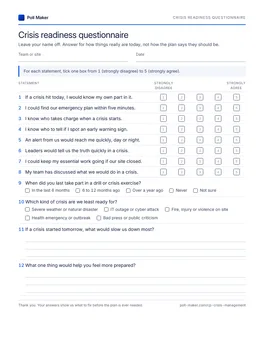
Crisis readiness questionnaire
Page one: the readiness core, ready for a pen. After it come the check-in, communication, practice, continuity and about-you sets, their numbering running on from 13.
Download PDF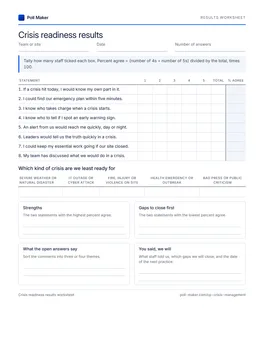
Readiness tally sheet
Count the ticks for the eight statements, work out the share who agreed with each, add up the least-ready votes, and list the gaps to close first.
Download PDFCrisis questions that get a shrug, and sharper versions
Vague readiness questions collect polite yes answers. Each fix below asks about one thing a person knows or can do. The survey question library has repairs for every question type.
Is our organization prepared for a crisis?
If a crisis hit today, I would know my own part in it.
I could find our emergency plan within five minutes.
Prepared is a guess about everyone else. The better pair asks what this one person knows and can reach today.
Was our crisis communication clear and timely?
When did you last get an update from us?
I know what to do after reading each update.
It bundles two questions. A person whose clear updates arrived two days late cannot pick a side.
Do you understand the emergency procedures?
I know who to tell if I spot an early warning sign.
Nobody admits to not understanding procedures. A specific action shows the gap without making anyone feel tested.
What people ask before surveying staff about a crisis
What questions should a crisis management questionnaire include?
Start with what each person knows and can do: their own part, where the plan is, who takes charge, who to warn, whether an alert would reach them and whether their work could continue. Add the date of their last drill, a vote on the least-ready scenario and two open questions. The readiness core above covers all of it in 12.
What are the three phases of crisis management?
Most plans split the work into before, during and after: prepare and practise, respond and communicate, then review and recover. The readiness core and the practice set serve the first phase, the check-in serves the second, and the timing table shows what to send for the third.
Should a crisis readiness questionnaire be anonymous?
Yes, for every set but one: people admit gaps more readily when nobody can trace them. The exception is the check-in during a crisis, where anyone who asks for help needs a way to be reached, so question 14 asks for contact details from those people only.
How often should you check in with staff during a crisis?
Every few days in the first two weeks, then weekly while the disruption lasts. Views move fast: in March 2020 the share of US employees who strongly agreed their employer had a clear plan rose 15 points in two weeks.3 Keep the wording identical each round.
Is this a crisis management test with answers?
No. There are no right answers to learn: every question asks what a person knows, can reach or has seen, so the results show gaps in the plan, not anyone's score. For training, walk staff through the plan first, then send the core a month later to see what stuck.
Check your readiness before the next drill
Open the readiness core as an online survey staff answer on any phone, or print the questionnaire for sites without email.