Video game survey questions about where, how long and what players play
A video game survey asks players which devices they game on, how often and how long they play, what they play and why. Start with the core 12: about four minutes, with a check of the hours the console logged and four statements on how gaming fits into the rest of the week.
- 37questions
- 12in the core
- 4 minto answer the core
- Age 13and up
By Michael Hodge, BSc Psychology Updated September 2026
Core questions, plus sets for one game, spending and online play
The first twelve arrive pre-selected. Each question comes with its answer choices and a short note on what the result reveals about your players. Switch on the one-game, spending, online or balance sets as needed, then share your version online, on paper, or as plain text for another tool.
The core 1212 questions
Devices, how often, hours estimated and hours logged, genres, who people play with, the main reason they play, four statements about gaming and the rest of life, and the game they keep going back to.
-
Which devices do you play video games on?
Phone or tabletGames consolePC or laptopHandheld PCVR headsetTick all that applyCounts phone players in from the first question. Set the shares beside the national device figures lower on this page.1
-
How often do you play?
Every dayMost daysA few times a weekAbout once a weekLess than once a weekSeparates daily players from weekend ones, which splits almost every other answer in the survey.
-
About how many hours did you play in the past 7 days?
Under 22 to 56 to 1011 to 20Over 20A fixed seven-day window, so everyone answers the same question. Bands are quicker and more honest than an exact figure.
-
What play time does your console, PC or phone show for the past 7 days?
Under 22 to 56 to 1011 to 20Over 20No recordPlayers tend to guess high. The bands match question three, so you can count how many people moved up or down a band.2
-
Which kinds of games do you play most?
Action or adventureShooterRole-playing (RPG)Sports or racingPuzzle or wordStrategy or simulationBuilding or sandboxParty or fightingTick all that applyGenre sorts players into groups without asking anyone to label themselves.
-
Who do you usually play with?
On my ownFriends onlinePeople in the same roomPlayers I meet in gamesA mixShows whether gaming is a social hobby in your group, and which kind of social: online, on the couch or with strangers.
-
What is the main reason you play?
To relaxFor funFor a challengeFor friendsTo stay sharpFor the storyWhy people play says more about what gaming does for them than hours do. The first two options match the top national reasons.1
-
Playing games helps me unwind.
Strongly disagree12345Strongly agree1 = Strongly disagree, 5 = Strongly agreeThe benefit most players name. A low score here from heavy players is worth a closer look.
-
Gaming has helped me make or keep friends.
Strongly disagree12345Strongly agree1 = Strongly disagree, 5 = Strongly agreeThe social side of play, asked as something the player has seen happen rather than an opinion about games in general.
-
I usually stop playing at the time I planned to.
Strongly disagree12345Strongly agree1 = Strongly disagree, 5 = Strongly agreeSelf-control asked in plain, everyday terms. Read it next to the hours bands.
-
Gaming leaves me time for sleep and school or work.
Strongly disagree12345Strongly agree1 = Strongly disagree, 5 = Strongly agreeWhether gaming sits alongside the rest of life or crowds it out, in the player's own view.
-
Which game are you playing most right now, and what keeps you coming back to it?
Open answerNames the games that matter to this group and, in their words, the hook. Game makers read this one first.
Feedback on one game8 questions
For game makers, modders and server admins who want a verdict on one title. Swap "this game" for its name before you send it.
-
How long have you been playing this game?
Under a week1 to 4 weeks1 to 6 months6 to 12 monthsOver a yearNew and long-time players want different things. Split every other answer in this set by it.
-
How likely are you to recommend this game to a friend?
0123456789100 = Not at all likely, 10 = Extremely likelyOne number to track from patch to patch. Read the open answers below for the reasons behind it.
-
The controls in this game feel responsive.
Strongly disagree12345Strongly agree1 = Strongly disagree, 5 = Strongly agreeInput lag and awkward mapping show up here before they show up in reviews.
-
The first hour showed me what to do without slowing me down.
Strongly disagree12345Strongly agree1 = Strongly disagree, 5 = Strongly agreeOnboarding in one statement. Low scores from new players point at the tutorial.
-
How does the difficulty feel?
Much too easyA little easyAbout rightA little hardMuch too hardSays which way to tune, which a rating cannot. Look at the spread, not the average.
-
Which part of this game do you enjoy most?
The storyThe core gameplayExploring the worldPlaying with other peopleBuilding or creatingEarning and collecting itemsTells you what to protect when you change things.
-
Where did you last feel stuck, bored or lost?
Open answerPoints at the exact level, menu or system where players drop off.
-
What one change would make you play more?
Open answerOne change, so answers stay short and sort into a few clear themes.
Spending and in-game purchases4 questions
For class projects on money, for monetisation checks, or whenever prices come up in the open answers.
-
In the past 3 months, about how much have you spent on games, including in-game purchases?
NothingUnder $20$20 to $50$51 to $100Over $100Wide bands people can answer without checking a bank app. Change the currency before you send it abroad.
-
What have you paid for in the past 3 months?
Full gamesA subscription (Game Pass, PlayStation Plus, Switch Online)In-game currencySkins or cosmeticsA battle pass or season passLoot boxes or card packsNothingTick all that applyShows where the money goes. Loot box answers matter for younger groups.
-
Are most of the games you play free to play?
Mostly free to playAbout half and halfMostly games I paid forFree-to-play players spend in a different way, so read the spending answers inside each group.
-
What I spend on games is good value.
Strongly disagree12345Strongly agree1 = Strongly disagree, 5 = Strongly agreeValue in the player's own eyes. Low agreement alongside high spend is the answer to follow up.
Online play and community5 questions
For Discord servers, clans, guilds and anyone running an online community around a game.
-
How do you talk to other players while you play?
Text chat in the gameVoice chat in the gameDiscordA call app (FaceTime, WhatsApp, Zoom)I do not talk to other playersTick all that applyTells a community where to post news and where to run events.1
-
I feel welcome in the online games I play.
Strongly disagree12345Strongly agree1 = Strongly disagree, 5 = Strongly agreeThe health check for a community. Split it by age and by how long people have played.
-
In the past month, how often has another player been rude or abusive to you?
NeverOnceA few timesMost times I playedA behaviour count over a set period, which is easier to act on than a rating of "toxicity".
-
Have you met a good friend through a game?
YesNoNot sureA simple, concrete measure of what online play gives people.
-
How often do you watch other people play, on streams or videos?
Most daysEvery weekNow and thenNeverShows how much of this group's gaming happens as viewers, and whether a stream would reach them.
Gaming, sleep and everyday life4 questions
For health lessons, parent evenings and research projects on how gaming fits around school, work and rest.
-
On a school or work night, when do you usually stop playing?
Before 9 pm9 to 10 pm10 to 11 pm11 pm to midnightAfter midnightI do not play on those nightsLate sessions are where gaming meets sleep. Compare it with the time-for-sleep statement in the core.
-
How often do you play for longer than you meant to?
NeverRarelySometimesOftenAlwaysA frequency, not a label, so players answer it straight.
-
How often do you skip something you had planned so you can keep playing?
NeverRarelySometimesOftenAlwaysA concrete cost players can recall. Read it with question two above for the full picture.
-
Gaming has taught me a skill I use outside games.
Strongly disagree12345Strongly agree1 = Strongly disagree, 5 = Strongly agreeThe upside question. Ask people which skill in a follow-up if the score is high.
About you (optional)4 questions
Add these only to compare groups, and keep each group large enough that no single player can be singled out.
-
How old are you?
13 to 1718 to 2425 to 3435 to 4950 or olderPrefer not to sayThe bands keep 50 and over together, the way the national player survey reports age.1
-
How would you describe yourself as a player?
Casual: I play now and thenRegular: I play most weeksDedicated: gaming is my main hobbyCompetitive: I play ranked or in tournamentsA self-description to set against the hours. The gap between the two is often interesting.
-
How many years have you been playing video games?
Under 2 years2 to 5 years6 to 10 years11 to 20 yearsMore than 20 yearsExperience changes what players expect, especially from controls and difficulty.
-
Which of these describes you?
FemaleMaleAnother wayPrefer not to sayOnly when a comparison needs it. Keep the answer optional.
Only a minute with each player? Ask these five
Only a minute of anyone's time? Devices, hours, the reason they play, stopping on time and the game they love give you a full sketch of a group of players.
- 01Which devices do you play video games on?
- 02About how many hours did you play in the past 7 days?
- 03What is the main reason you play?
- 04I usually stop playing at the time I planned to.
- 05Which game are you playing most right now, and what keeps you coming back to it?
How your players compare with the national picture
Several core questions line up with the largest yearly survey of US players, so any class, club or server can set its own results beside the national ones.
| Question here | National figure (ESA 2025) | How to compare |
|---|---|---|
| 1. Devices | Mobile 82%, console 47%, PC 45%, VR 10% of players aged 8 and up1 | Share of your group ticking each device |
| 6. Who they play with | 55% of players play with others every week1 | Share who did not answer "On my own" |
| 7. Main reason | Relax or pass the time 68%, have fun 62%, keep the mind sharp 35% (players 18 and up)1 | Compare the order of reasons, not the sizes |
| Age and years playing | Average player age 36; players have been gaming for 18 years on average1 | Median band of your group in the About you set |
Why reasons compare by rank
The national survey let adults pick several reasons, which is why its figures add up to more than 100. Question 7 asks for one main reason, so its shares will be smaller. Compare the ranking instead: if relaxing and fun lead in your group too, you match the national pattern; if challenge or friends come first, you have found something about your players.
A worked example
A class of 30 students returns the core 12. Twenty-seven tick phone or tablet (90%), 21 tick a console (70%) and 9 tick PC (30%). Against the national figures, this class plays on consoles far more and on PCs less. Spending time with friends comes second in their reasons, ahead of relaxing, which fits a group where the open answers keep naming the same two multiplayer games. The national data covers Americans aged 5 to 90 from a YouGov survey of 4,000 players in February 2025,1 so a gap for a teenage class is expected, and it is the finding worth writing up.
Four ways gaming answers go wrong, and the fix
Gaming questions look easy, and the answers go wrong in the same four ways. Here is how this question set steers around each one.

Let the console count the hours
Guesses about play time drift. When researchers matched players' own estimates for the past two weeks with the play time logged by Electronic Arts and Nintendo, players had overestimated by 0.5 to 1.6 hours on average, and the match between guess and log was far from perfect.2 Steam, PlayStation and Nintendo Switch all show play time per game, so question 4 asks players to read it off. Keep the estimate in question 3 as well: the gap is a result in itself.
Devices US players use for video games
Count phone players in
Mobile is the most common way to play by a wide margin: 82% of US players aged 8 and up game on a phone or tablet, against 47% on a console and 45% on a PC.1 A survey that opens with "which console do you own?" loses a large part of its players at question one. Question 1 lists every device, and the word "video games" in each question includes the puzzle game on the bus.

Ask why they play as well as how much
In the same study that logged play time, how satisfying play felt and why people played were each linked to well-being on their own, whatever the hours.2 So the core pairs the hours with the main reason for playing and four statements on unwinding, friends, stopping on time and time for everything else. Nationally, the top reasons adults give are relaxing (68%) and having fun (62%).1
Tie feedback to one game and one moment
Ask about "games in general" and players average everything they have ever played. The feedback set names one game and works best sent right after the session it describes, while the level, the menu or the boss fight is still fresh. Give every question the game's real name before you send it.
Curious what a class or a Discord server thinks before sending all 37? Put the play-partner question up as a live gaming poll and see votes land as people tap. Our page on creating a poll covers sharing through a link, a QR code or a chat.
Offline copies for a stats class, club night or LAN event
Useful for a statistics class, a club night or a LAN event where every screen is busy running a game. Prints on letter or A4.
Running a playtest with just a few questions?
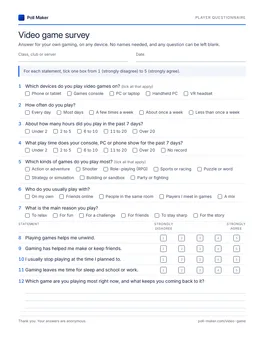
Player questionnaire
Page one: the core 12, with boxes to tick in pencil. Then come the sets on one game, money, online play, balance and background.
Download PDF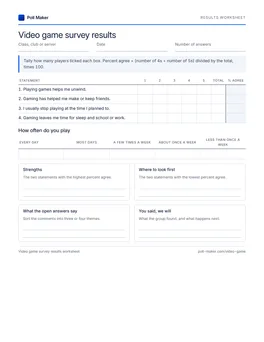
Results worksheet
Count up the paper answers, work out agreement for all four statements, and circle the weakest for your write-up.
Download PDFTiming it around a playtest, patch or season
Game makers get the clearest answers when each survey follows one moment in the game. Pick the row that matches yours.
| Moment | Questions to send | When |
|---|---|---|
| Playtest session | Feedback on one game, plus question 12 | Before players leave, or within the hour |
| A new player's first week | How long playing, the first hour, difficulty, where they got stuck | Day three to seven |
| After a patch or balance change | Controls, difficulty, one change that would help | A week after release |
| End of a season or event | Recommend score, spending set, feeling welcome | The last days of the season |
| Community check-in | The core 12 plus the online play set | Twice a year |
Keep the recommend score comparable
Ask the 0 to 10 recommend question in the same words every time, and report it by how long people have played. A drop among new players after a patch means something different from a drop among veterans.
Testing a build before release?
Closed tests need bug, crash and device questions this page leaves out. Use the beta tester survey questions for the build itself, then this set once the game is in players' hands.
Chart how your players feel about gaming
Key in how many players chose each point on the four core statements. The chart ranks them and flags the weakest one, ready to print for a class, a club or a dev team.
- 1Percent agree is the 4s plus the 5s on a statement, over everyone who rated it. The panel redraws with each number.
- 2Put the statements side by side. A group that agrees it unwinds through games but disagrees that it stops on time has a different story from one that agrees on both.
- 3Read the weakest statement against the hours bands. If the heaviest players disagree most, that is the finding to present.
- 4Share the chart with the people who answered, then run the core again next term or next season and compare the bars.
Player survey results
Video game survey FAQ
Short answers for students, teachers, game makers and community leads.
What questions should a video game survey ask?
Start with devices, how often and how long people play, the genres they choose, who they play with and why they play. Add a few statements about how gaming fits into the week and one open question about the game they play most. Then add a set for your purpose: feedback on one game, spending or online play.
How do I run a gaming survey for a school project?
Pick one comparison first, such as estimated against logged hours or reasons by age. Hand it to whole classes instead of sharing a link online, keep it anonymous, and check with your teacher before anyone under 18 takes part. The table on this page lets you set your results against national figures.
How many people play video games?
In the US, 205.1 million people aged 5 to 90 play, and 64% of the population plays at least an hour a week, according to the ESA's 2025 survey.1 The average player is 36.
What should game developers ask playtesters?
Ask about one session of one game: how the controls feel, whether the first hour made sense, how the difficulty felt, where they got stuck and the one change that would bring them back. Send it before they leave the session, and track a 0 to 10 recommend question across builds.
Is there a validated questionnaire for problem gaming?
Researchers most often use the nine-item Internet Gaming Disorder Scale Short Form (IGDS9-SF), which a 2021 review of 21 studies rated among the strongest measures of its kind.3 Use it as published when you need a screening score. The balance set on this page asks about habits instead, in new wording that is free to edit.
Gaming survey questions that backfire, and better versions
Four slips that turn up in student projects and studio surveys alike. For other subjects, our guide to good survey questions walks through many more.
Are you a gamer?
Which devices do you play video games on?
Plenty of people who play every day reject the label. Ask what they do, and everyone who plays gets counted.
How many hours do you play video games?
About how many hours did you play in the past 7 days?
How many hours does your console show for the past 7 days?
Without a time window, one person answers for yesterday and another for a typical month. Fix the window, then check it against the log.
Do you like the graphics and the story?
Which part of this game do you enjoy most?
Two things in one question. A player who loves the story and dislikes the art has no honest answer.
Are you addicted to video games?
How often do you play for longer than you meant to?
Almost nobody says yes to the first version. A how-often question about a specific moment gets a real spread of answers.
Ask your players how they really play
Share the twelve core questions as a link players open on the phones they already game on, or hand out paper copies at your next class, club night or playtest.