Veterinary client survey questions, sorted by type of appointment
Ask pet owners what they can judge from the exam room: booking, the wait, gentle handling, being listened to, the cost and the plan they took home. The core 12 fits any appointment; add a set for surgery, estimates, nervous pets or new clients.
- 37questions
- 12in the core set
- 5 minto answer the core
- 6optional sets
By Michael Hodge, BSc Psychology Updated September 2026
The post-visit core plus surgery, estimate and new-client sets
Each question shows the answers a pet owner picks from and what the clinic learns from it. Keep the core 12 for every visit, tick the sets that fit the appointment, then open your pick as a survey, print the questionnaire, or drop the wording into your practice management software.
Any appointment: the core 1212 questions
What the visit was for, eight statements an owner can judge first hand, the one thing that could have gone better, a 0 to 10 recommend rating and an open question.
-
What did your pet come in for?
Wellness exam or vaccinesSick or injuredSurgery or dentalRecheck or follow-upSomething elseLets you read every other answer by appointment type. A vaccine visit and a sick visit are judged on different things.
-
Booking this appointment was easy.
Strongly disagree12345Strongly agree1 = Strongly disagree, 5 = Strongly agreeThe first contact with the clinic. Low scores point at the phone line, the online booking page or the wait for a slot.
-
We were seen close to our appointment time.
Strongly disagree12345Strongly agree1 = Strongly disagree, 5 = Strongly agreeWaiting in a lobby with an anxious dog or a crying cat feels longer than the clock says. This catches it.
-
The team handled my pet gently.
Strongly disagree12345Strongly agree1 = Strongly disagree, 5 = Strongly agreeOwners watch the handling closely. It is the part of the exam they can judge best.
-
The vet listened to my worries about my pet.
Strongly disagree12345Strongly agree1 = Strongly disagree, 5 = Strongly agreeIn a study of 1,270 pet owners, vets who took up worries and fears left owners needing less information from elsewhere.4
-
The vet explained what they found in words I understood.
Strongly disagree12345Strongly agree1 = Strongly disagree, 5 = Strongly agreeTells you whether the findings landed, not whether they were said. Jargon shows up here first.
-
I knew the likely cost before treatment started.
Strongly disagree12345Strongly agree1 = Strongly disagree, 5 = Strongly agreeOwners expect the vet to raise cost before treatment, and say that is uncommon. This shows whether yours does.2
-
I left with a clear plan for my pet's care.
Strongly disagree12345Strongly agree1 = Strongly disagree, 5 = Strongly agreeClients who get a clear recommendation are far more likely to follow it, so this is the statement to watch.3
-
The reception team made us feel welcome.
Strongly disagree12345Strongly agree1 = Strongly disagree, 5 = Strongly agreeCheck-in and checkout bookend every visit. This separates the front desk from the exam room.
-
If one thing could have gone better, what was it?
Nothing, it all went wellThe waitThe costHow my pet was handledThe explanationsSomething elseThe problem tally. Check it before the statements: one common problem can pull several scores down at once.
-
How likely are you to recommend our clinic to a friend with a pet?
0123456789100 = Not at all likely, 10 = Extremely likelyThe 0 to 10 recommend question. Track the share who choose 9 or 10 from month to month.
-
What is one thing we could do to make your pet's next visit better?
Open answerOne change in the owner's own words. Answers group into a handful of themes you can act on.
Estimates and cost4 questions
For sick visits, tests and anything with a treatment plan. Money talk is where owners and vets see a visit most differently.
-
Before treatment, were you given an estimate?
Yes, in writingYes, spoken onlyNoNo treatment was neededA fact, not an opinion. Compare it with the cost statement in the core to see what a written estimate is worth.
-
The vet talked me through more than one option.
Strongly disagree12345Strongly agree1 = Strongly disagree, 5 = Strongly agreeOwners want a range of options and a say in the choice. This tells you whether they got one.7
-
The final bill matched what I expected.
Strongly disagree12345Strongly agree1 = Strongly disagree, 5 = Strongly agreeThe gap between estimate and invoice. A low score with a written estimate means the estimate needs updating mid-visit.
-
Did cost change any decision about your pet's care today?
NoYes, we chose another optionYes, we put something offPrefer not to sayShows how often money shapes care. Put-off answers are owners to follow up with a payment plan or a later date.
Cats and nervous pets4 questions
For cats, anxious dogs and any pet that dreads the car. The answers tell you which small changes make the next visit easier.
-
How did your pet seem during the visit?
RelaxedA little nervousVery nervousHard to sayThe owner knows the pet's normal. Read the other answers in this set by this one.
-
The team asked how my pet copes with vet visits.
Strongly disagree12345Strongly agree1 = Strongly disagree, 5 = Strongly agreeAsking first costs nothing and tells the team what to change. A low score means the question is being skipped.
-
The waiting area felt calm for my pet.
Strongly disagree12345Strongly agree1 = Strongly disagree, 5 = Strongly agreeBarking, smells and other animals start the stress before the exam begins.
-
Which one change would make vet visits easiest for your pet?
Going straight to a roomA quieter time of dayTips for the carrier or carA home visitNothing, visits go finePlanning data from the owners who know. It also works as a live poll on the clinic's social page.
New clients3 questions
Add these for a first visit. They show which channels bring people in and what made them pick you.
-
How did you first hear about us?
A friend or family memberOnline searchOnline reviewsSocial mediaWe moved nearbyAnother vetWhere new clients come from, in their own words, which tells you where the marketing budget earns its keep.
-
What mattered most when you chose us?
LocationA recommendationReviewsAn appointment soonServices we neededPriceThe reason they picked you, which is the reason to protect.
-
Registering as a new client was quick.
Strongly disagree12345Strongly agree1 = Strongly disagree, 5 = Strongly agreeForms, records transfer and the first call. A slow start colours the whole first visit.
After surgery or a dental6 questions
Send these two or three days after the pet goes home, when the owner can judge the recovery as well as the day itself.
-
Before the procedure, I knew what would happen and why.
Strongly disagree12345Strongly agree1 = Strongly disagree, 5 = Strongly agreeConsent that was understood, asked of the person who signed it. Low scores mean the admit talk needs time.
-
Someone updated me on the day of the procedure.
Strongly disagree12345Strongly agree1 = Strongly disagree, 5 = Strongly agreeOwners wait by the phone on surgery days. This shows whether the promised call happened.
-
The home care instructions were easy to follow.
Strongly disagree12345Strongly agree1 = Strongly disagree, 5 = Strongly agreeMedicines, the cone, feeding and stitches all happen at home. Confusing sheets become calls and rechecks.
-
How is your pet recovering so far?
Better than I expectedAs I expectedSlower than I expectedI am worriedAnyone who picks the last answer gets a call from a nurse the same day. That makes the survey part of the care.
-
Since coming home, have you needed to call us with a question?
NoYes, and got a quick answerYes, and had to waitI wanted to but did notShows whether the discharge talk covered the real questions. The last answer is the one to design out.
-
How has giving the take-home medicine gone?
EasySome troubleWe could not give itNo medicine was sent homePilling a cat or a sore dog is harder than it sounds. Anyone who could not give a dose needs a call and another way to give it.
About you and your pet3 questions
Enough to split the results by pet and by client. Skip a split whenever one group would hold just a few owners.
-
Which pet is this visit about?
DogCatRabbit or small petBird or reptileOtherA cat and a large dog meet the same lobby very differently. Split handling and waiting answers by species.
-
How old is your pet?
Under 1 year1 to 6 years7 to 10 years11 years or olderNot surePuppy and kitten owners, and owners of senior pets, need different things from the same visit.
-
How long have you been bringing pets here?
This was our first visitUnder a year1 to 5 yearsOver 5 yearsClients who have known their vet for longer tend to rate a little higher, so compare like with like.1
After a pet's death5 questions
Never send these through the automatic post-visit survey. Send them by hand, two to four weeks later, only to families you know would welcome the chance to say how it went.
-
The team explained each step before it happened.
Strongly disagree12345Strongly agree1 = Strongly disagree, 5 = Strongly agreeFamilies rarely ask questions in that moment. A low score means the steps were rushed or skipped.
-
We had as much time with our pet as we needed.
Strongly disagree12345Strongly agree1 = Strongly disagree, 5 = Strongly agreeTime is the one thing the family cannot get back. This shows whether the booking allowed for it.
-
Our pet was treated with dignity.
Strongly disagree12345Strongly agree1 = Strongly disagree, 5 = Strongly agreeThe family watches how their pet is handled to the very end, and remembers it.
-
When would you have preferred to settle the bill?
Before, so we could focusAfterwardsIt did not matterNot sureA practical choice clinics make for every family. Let the families who lived it decide your default.
-
Is there anything that would have made that day easier?
Open answerInvites the small, specific changes a family notices: a side door, a quieter room, a paw print to take home.
Surgery, vaccines or a first visit: the set for each
Every appointment type has its own moment to ask. Match the set to the visit and the owner answers about something they just lived through.
| Appointment | Send | When |
|---|---|---|
| Wellness exam or vaccines | The core 12, or the texting five | At checkout, or by text the same day |
| Sick or injured pet | Core 12 plus Estimates and cost | The same day, while the bill is fresh |
| Surgery or dental | After surgery or a dental, plus the recommend question | Two or three days after going home |
| A first visit | Core 12 plus New clients | At checkout |
| A cat or a nervous pet | Core 12 plus Cats and nervous pets | The same day |
| Euthanasia | No automatic survey. The After a pet's death set only by hand | Two to four weeks later, with a card |
Keep the first core question in every version: it tells you which kind of visit each answer describes, so one survey link can serve the whole clinic. Switch the automatic survey off for euthanasia appointments in your practice software before you start. For other patient-facing sets, see the healthcare survey questions.
A short text survey after the appointment
A survey sent by text works best when it is short. These five cover gentle handling, the cost, the plan the owner took home, the recommend rating and one thing to change: enough to act on every week.
- 01The team handled my pet gently.
- 02I knew the likely cost before treatment started.
- 03I left with a clear plan for my pet's care.
- 04How likely are you to recommend our clinic to a friend with a pet?
- 05What is one thing we could do to make your pet's next visit better?
Changes clients notice on the next visit
Three habits that turn a survey into changes clients notice on their next visit.
Ask before they leave the clinic
Owners answer when you ask them in person. In an Ontario study, 84.1% of the 1,183 clients invited at the clinic completed a satisfaction survey, and 85.1% of those finished it before they left.1 Hand over a tablet or a card at checkout, or text the link as the invoice prints. Save the surgery set for two or three days later on purpose. In human medicine, satisfaction measured straight after an appointment mostly reflects the conversation, while later surveys also take in how the patient is doing.1

Measure the plan and the price, not only the welcome
Two core statements do most of the work. Owners in focus groups expected the vet to open the conversation about cost before treatment, and said such talks were uncommon.2 And a clear plan pays off: in a study of dental and surgery recommendations, clients who heard a clear recommendation had 7 times the odds of going ahead compared with clients who heard an ambiguous one.3 The plan statement asks owners about that same clarity, from their side of the exam table.
Compare vets only once each has plenty of answers
Satisfaction scores bunch near the top of the scale, so a single unhappy client can swing one vet's average. Analysis of the 15-item Client Satisfaction Questionnaire suggests that as many as 61 clients per veterinarian may be needed to estimate satisfaction with that vet accurately.15 Read the whole clinic every month, and look at individual vets once a quarter, when each has a full set of responses. Because most answers sit at the top, watch the share who choose Strongly agree as well as the share who agree.
For one quick question to your followers, such as the calm-visit question below, make a free live poll and post the link. Native Facebook polls only work inside groups, not on a clinic Page, which the poll guide's Facebook section walks through.
The practice meeting page: two strengths, two fixes
Enter the owner counts per answer for all eight core statements. The report tags the two weakest as work to do next and the two strongest as strengths, and the finished page is ready to print for the staff room.
- 1Split the cards or the export by appointment type first. A vaccine visit and an emergency are judged on different things, so a blended total can bury a problem with either.
- 2Type the tallies in. Every statement gets its percent of owners choosing 4 or 5, and the two lowest are tagged as work to do next.
- 3Read the problem tally next to it. If the cost answer leads the tally and the estimate statement is low, the fix is an estimate before treatment, not a friendlier front desk.
- 4Share one result and one change with the whole team, then post the change in the lobby. Clients who see a comment acted on have good reason to fill in the next one.
This month at the clinic
Four clinic survey traps and plainer wording
Four patterns cause most of the trouble in clinic surveys. The survey question library applies these fixes across many other topics.
How satisfied were you with your visit today?
The vet listened to my worries about my pet.
I left with a clear plan for my pet's care.
A single satisfaction number blurs a rushed exam and a confusing discharge into one. Two specific statements pull them apart.
Were our vets and nurses friendly and knowledgeable?
The team handled my pet gently.
The vet explained what they found in words I understood.
It asks about two groups of people and two qualities at once, so a "no" could mean any of four things.
Don't you agree Dr. Lee took great care of Max?
The team handled my pet gently.
The question tells the owner what to think, and naming the vet makes an honest low score feel personal.
Were our prices reasonable?
I knew the likely cost before treatment started.
The final bill matched what I expected.
Owners judge surprise more than price. These ask whether the cost was expected, which the clinic can fix.
Tick-box cards for the counter by the card reader
Some owners would rather tick a card at the counter than open a link later. Keep a small pile by the card reader and a drop box near the exit. US letter and A4 printers handle the files equally well.
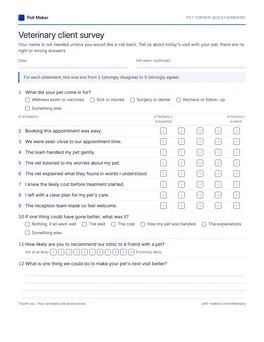
Pet owner questionnaire
Page one is the post-visit card: twelve questions to tick and a space to name the vet. Cost, calm-visit, surgery and the other sets follow, and the after-a-death set has a sheet to itself so it can be printed on its own.
Download PDF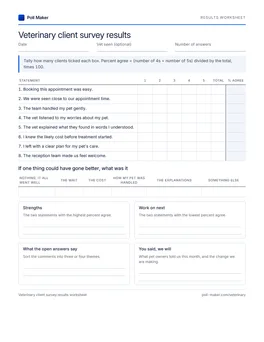
Monthly tally sheet
Add up the cards one statement at a time, count the answers to the what-could-be-better question, and choose two priorities for next month.
Download PDFPractice managers ask about client surveys
What practice managers ask before the first survey goes out.
What questions should a veterinary client survey ask?
Ask about what owners can judge first hand: booking, the wait, how gently their pet was handled, whether the vet listened, whether the findings made sense, the cost before treatment and the plan they took home. With a 0 to 10 recommend rating and one open question on top, that is the full core set shown above.
When should a vet clinic send a post-visit survey?
Before the owner leaves, or by text the same day, for most visits. For surgery and dentals, wait two or three days so the owner can judge the recovery too.
Should we survey clients after euthanasia?
Not with the automatic post-visit survey: switch it off for those appointments. For feedback on end-of-life care, send a few gentle questions by hand, weeks later, with a condolence card. The set above is written for that, and one validated veterinary questionnaire includes a whole scale on the death of a pet.6
Can a mobile vet or an exotics practice use these questions?
Yes. For house calls, drop the waiting-room statement and ask whether the vet arrived in the time window. For exotics, change the pet types in the last set. Everything opens in the builder, so each change takes a few seconds.
Hear from the next pet owner through your door
Text the twelve once the invoice is paid, load them on a checkout tablet, or print a stack of cards for the front desk this afternoon.