Pharmacy customer satisfaction survey questions for every visit
Ask customers what they can judge from their side of the counter: whether the order was ready, the wait, privacy, time with the pharmacist and the cost. Start with a core 12 for any visit, then add sets for refills, new medicines, vaccines or delivery.
- 39questions
- 12in the core set
- 5 minto answer the core
- 7optional sets
By Michael Hodge, BSc Psychology Updated September 2026
Counter core, then refills, new medicines, vaccines and cost
Refill alerts, counselling, vaccines, delivery, cost: every question here shows the choices a customer taps and why a pharmacy wants that answer. Begin with the twelve that suit any visit, tick the sets for services you offer, then send the selection to the survey builder or the printer.
Every visit: the core 1212 questions
Why they came, seven statements about the visit, the minutes they waited, what went wrong, a recommend rating from 0 to 10 and an open question. Hand it out as the bag goes over the counter.
-
What did you come in for today?
New prescriptionRefillVaccine or health checkAdvice or a productSomething elseLets you split every other answer by visit type. A first fill and a quick refill are different visits and score differently.
-
My prescription was ready when promised.
Strongly disagree12345Strongly agree1 = Strongly disagree, 5 = Strongly agreeReliability: the promise customers remember longest. Leave it blank on visits with no prescription.
-
The wait was reasonable for what I came in for.
Strongly disagree12345Strongly agree1 = Strongly disagree, 5 = Strongly agreeA fair wait depends on the visit. Read it next to the minutes question to see where waiting starts to grate.
-
Staff were friendly and treated me with respect.
Strongly disagree12345Strongly agree1 = Strongly disagree, 5 = Strongly agreeThe people side of the counter, asked about the whole team rather than one named person.
-
I could speak without being overheard.
Strongly disagree12345Strongly agree1 = Strongly disagree, 5 = Strongly agreePrivacy. Pharmacy talk is health talk, and people hold back questions when the queue can hear them.
-
The pharmacist had time for my questions.
Strongly disagree12345Strongly agree1 = Strongly disagree, 5 = Strongly agreeAccess to the pharmacist, not the till. Read it beside the wait answers to see whether a rushed counter is the cause.
-
I left knowing how and when to take my medicine.
Strongly disagree12345Strongly agree1 = Strongly disagree, 5 = Strongly agreeThe result of the advice, in the customer's own terms. Low scores send you to the new-medicine set.
-
The cost of my medicine was explained clearly.
Strongly disagree12345Strongly agree1 = Strongly disagree, 5 = Strongly agreePerceived value is where store pharmacies lost ground in J.D. Power's 2026 study, so ask about cost plainly.2
-
About how long did you wait at the pharmacy today?
Under 5 min5 to 10 min11 to 20 min21 to 30 minOver 30 minMinutes rather than feelings. Paired with the wait statement it shows the point where a wait stops feeling fair.
-
Did anything go wrong on this visit?
No, nothingNot ready on timeOut of stockInsurance or price issueSomething elseThe problem tally. Check it first: a single common problem can pull several statement scores down at once.
-
How likely are you to recommend this pharmacy to a friend or family member?
0123456789100 = Not at all likely, 10 = Extremely likelyThe 0 to 10 recommend question. Track the share choosing 9 or 10 from one round to the next, branch by branch.
-
What is one thing we could do to make your next visit better?
Open answerOne change in the customer's words. The answers cluster into a few themes you can act on this month.
Prescriptions and refills4 questions
For regular customers. These show whether ready alerts, refill ordering and delay messages work before anyone reaches the counter.
-
How did you find out your prescription was ready?
Text messagePhone callApp alertI just came inOtherShows which alerts reach people, and how many still turn up with no alert at all.
-
In the last 3 months, how often was an order not ready on arrival?
NeverOnce2 or 3 times4 or more timesNot sureA count over three months, which one bad afternoon cannot swing the way a single visit can.
-
Ordering a refill here is easy.
Strongly disagree12345Strongly agree1 = Strongly disagree, 5 = Strongly agreeRefill effort on its own. A low score points at whichever route most customers use: the app, the phone line or the counter.
-
If an order is delayed, I hear before I come in.
Strongly disagree12345Strongly agree1 = Strongly disagree, 5 = Strongly agreeWhether a delay reaches the customer as a message or as a wasted trip.
A new medicine5 questions
For customers collecting a medicine for the first time. The checklist asks what they were told, which is a fact they can report, rather than how good the advice was.
-
Did the pharmacist offer to talk with you about the new medicine?
Yes, we talkedYes, I said noNo offer madeNot sureSeparates advice that was declined from advice that never happened. Only the second is yours to fix.
-
Before you left, which of these did someone explain?
What it is forHow much and whenSide effects to watchWhat if I miss a doseHow to store itNone of theseTick all that applyA checklist of facts, not an opinion. The scoring section below turns it into a coverage score from 0 to 5.
-
I was asked what other medicines I take.
Strongly disagree12345Strongly agree1 = Strongly disagree, 5 = Strongly agreeThe interaction check, seen from the customer side. If they cannot recall being asked, it may not have happened.
-
I felt comfortable asking a question.
Strongly disagree12345Strongly agree1 = Strongly disagree, 5 = Strongly agreeWhen this is low the checklist is usually thin too: people skip questions they feel awkward asking.
-
The printed leaflet was easy to read.
Strongly disagree12345Strongly agree1 = Strongly disagree, 5 = Strongly agreeThe paper that goes home is the advice most people reread. A low score means the print needs work, not the pharmacist.
Cost and insurance3 questions
For any customer who pays for prescriptions. Keep it on an anonymous form: money and missed medicine are hard things to admit face to face.
-
In the past year, did cost make you skip doses, take less or fill late?
NoYes, onceYes, more than oncePrefer not to sayIn 2021, 8.2% of US adults aged 18 to 64 who took prescription medicine did not take it as prescribed because of cost. A yes is a customer to help with a cheaper option.3
-
I was told about lower-cost options.
Strongly disagree12345Strongly agree1 = Strongly disagree, 5 = Strongly agreeGeneric swaps and discount programs are value customers cannot see unless someone mentions them.
-
Prices here are fair for the service I get.
Strongly disagree12345Strongly agree1 = Strongly disagree, 5 = Strongly agreeValue in one line. Read it by visit type: refill customers and vaccine customers pay for different things.
Vaccines and health services4 questions
For customers who had a vaccine, a health check or a review in the pharmacy. Hand it over while they sit out the wait after a shot.
-
Which of these have you had at this pharmacy in the past year?
Flu shotCOVID-19 vaccineAnother vaccineBlood pressure checkMedicines reviewNone of theseTick all that applyShows who used which service, so the two ratings below can be read service by service.
-
Booking my vaccine or check was easy.
Strongly disagree12345Strongly agree1 = Strongly disagree, 5 = Strongly agreeBooking is where most service visits go wrong first: online slots, walk-in rules, phone calls.
-
The room or booth felt private.
Strongly disagree12345Strongly agree1 = Strongly disagree, 5 = Strongly agreeSleeves go up and health questions come out. Privacy matters more here than at the till.
-
Which service would you most like us to add?
Blood pressure checksBlood sugar checksTravel vaccinesHelp to quit smokingMedicines reviewsPlanning data from the people who already use your services. It also works well as a live poll in the waiting area.
Before a medicines check5 questions
The same customer, about their own medicines. Hand this set out at a refill pickup to decide who to offer a medicines review first, and to give the pharmacist their questions in advance.
-
How many prescription medicines do you take regularly?
None1 or 23 or 45 to 910 or moreCounts, not names, so nothing identifies anyone. In a Canadian study, a short form filled in at refill pickup closely matched a full assessment by a clinical pharmacist.5
-
Do you also take any of these?
Pain relieversVitaminsHerbal remediesSleep aidsAntacidsNoneTick all that applyProducts bought without a prescription never appear on the prescription record, so asking is the only way to know.
-
In the past 7 days, on how many days did you miss a dose?
None1 day2 or 3 days4 or more daysNot sureA short, fixed window and a count. Both make an honest answer easier than a yes or no about taking medicine as prescribed.
-
Have you noticed a side effect you think a medicine may cause?
NoYes, and I told someoneYes, but not yet mentionedNot sureFlags who to talk with first. The not-yet-mentioned answers are the reason to run this set at all.
-
What would you like to ask the pharmacist about your medicines?
Open answerTurns the review into the customer's agenda, and gives the pharmacist a minute to prepare.
Delivery, mail order and the app4 questions
For customers who get medicines delivered or by mail, or who order through your app or website. Send it by text or email, since they may never visit the counter.
-
How do you get most of your prescriptions now?
In storeDrive-thruLocal deliveryBy mailA mixTells you which channel each customer is judging. Mail-order and store satisfaction moved in opposite directions in 2026.2
-
My delivery arrived on the day I was told.
Strongly disagree12345Strongly agree1 = Strongly disagree, 5 = Strongly agreeThe delivery version of ready when promised.
-
The app shows me where my order is.
Strongly disagree12345Strongly agree1 = Strongly disagree, 5 = Strongly agreeTracking stops the calls that ask where an order is, which frees the phone for real problems.
-
When I call, I reach a person who can help.
Strongly disagree12345Strongly agree1 = Strongly disagree, 5 = Strongly agreeJ.D. Power credits live phone support for mail-order gains in 2026 and names problem solving as the weak spot.2
About you2 questions
Age and how long someone has shopped here are enough to split results. Keep any group you report big enough that no single customer stands out.
-
How old are you?
Under 3030 to 4950 to 6465 to 7475 or olderShows whether older and younger customers rate the same counter differently.
-
How long have you used this pharmacy?
First visitUnder a year1 to 5 yearsOver 5 yearsNew customers notice what regulars have stopped seeing, good and bad.
One set for each pause in a pharmacy visit
Every pharmacy visit has a natural pause. Hand out the set that fits it, and the customer answers about something that happened minutes ago.
| Moment | Hand out | Why then |
|---|---|---|
| Bag goes over the counter | The core 12, on a card or behind a receipt QR code | Every customer passes this point, and the visit is fresh. |
| First fill of a new medicine | Core 12 plus A new medicine | The advice was given moments ago, so the checklist is easy to answer. |
| The wait after a vaccine | Vaccines and health services | Patients may be asked to sit for 15 minutes anyway.4 |
| Refill of a long-term medicine | Before a medicines check | Refills are regular and predictable, a good time to offer a review.5 |
| After a delivery or mail order | Core 12 plus Delivery, mail order and the app, by text or email | These customers never reach the counter, so the survey has to go to them. |
Mixing moments in one survey is fine as long as the first core question is kept: it tells you which visit each answer describes.
Short, personal visits: four habits that fit them
Pharmacy visits are short and personal. Four habits make the most of both.
Keep names and prescriptions out of it
Customers are franker about staff and privacy when nothing ties the form to their record. Ask for no name, date of birth or prescription number, leave diagnoses out, and put the collection box by the exit rather than at the till, where staff can see who drops a form in. Add a separate, optional line for anyone who wants a call back.
Counselling quality, percent of the maximum score
Ask the customer, not the pharmacist
Staff and customers can remember the same conversation very differently. In a study of 122 pharmacists and 566 pharmacy customers, pharmacists rated the quality of their own counselling at 75% of the maximum score, while customers rated the counselling they received at 54.8%.1 The new-medicine set asks customers what they were actually told, so any gap in your pharmacy shows up in your own results.
Use the quarter hour after a vaccine
CDC advises vaccine providers to consider keeping patients seated for 15 minutes after a shot, because most fainting happens in that window.4 That is a ready-made survey slot: hand over a clipboard or a tablet with the vaccine set while they sit, and collect it before they stand up to leave.
Read results by visit type, not as one total
A refill customer in and out in five minutes and a first-time patient learning a new inhaler are judging different visits. The first core question records why each person came, so split every result by it before you compare weeks. Keep delivery and store customers apart too: in J.D. Power's 2026 study, satisfaction with mail-order pharmacies rose while satisfaction with store pharmacies fell.2
Want a quick read on one idea between customers? Put a single question on a tablet by the waiting chairs, make it a quick live poll, and let people tap an answer while they wait. The five steps to a live poll include sending one by text message and closing it on a schedule.
A one-page report for the team huddle
Enter the tallies for all seven core statements. Bars sort them from strongest to weakest, the weakest is marked as the focus, and the report prints on one page.
- 1Sort the forms or the online export by visit type first. Refills and new prescriptions rarely score alike, and a mixed total hides both.
- 2Key in the counts per statement. Agreement means a 4 or 5 on the scale, and whichever statement has the smallest agreeing share becomes the focus.
- 3Check the problem tally before planning anything. If "Not ready on time" leads it, the ready-when-promised and wait statements are usually low for the same reason.
- 4Post one result and one change where customers queue. A note by the counter shows the forms were read, and next month more come back.
Counter results
Scoring the new-medicine checklist
The checklist question turns advice at the counter into something you can count.
Give each customer one point for every topic they tick, from what the medicine is for to how to store it. Ticking "None of these" scores zero, so every customer with a new medicine gets a coverage score from 0 to 5. Report two things: the average score, and the topic ticked least often, which is the one to add to the handover routine.
Worked example: 20 customers with a new medicine
| Topic explained | Customers who ticked it | Share |
|---|---|---|
| What it is for | 18 | 90% |
| How much and when | 19 | 95% |
| Side effects to watch | 9 | 45% |
| What if I miss a dose | 6 | 30% |
| How to store it | 11 | 55% |
The ticks add up to 63, so the average coverage score is 63 divided by 20, or 3.15 on the 0 to 5 scale. In this example the gaps are missed doses and side effects: two lines for the pharmacist to add to every first fill, then run the set again next month to see whether the score moves.
Read the offer question alongside it. Customers who answered "No offer made" and ticked "None of these" are the clearest sign that the handover is being skipped at busy times.
A card for the prescription bag
No room for twelve? These five fit on a card slipped into the prescription bag: ready on time, the wait, knowing how to take the medicine, likelihood to recommend, and one thing to change.
- 01My prescription was ready when promised.
- 02The wait was reasonable for what I came in for.
- 03I left knowing how and when to take my medicine.
- 04How likely are you to recommend this pharmacy to a friend or family member?
- 05What is one thing we could do to make your next visit better?
Counter copies and a weekly tally sheet
Paper suits a pharmacy: a stack by the till, a pen, and a closed box by the exit. Nothing gets cut off whether your printer takes US letter or A4.
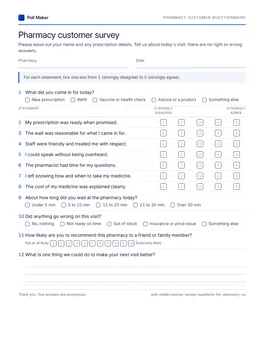
Customer questionnaire
The core 12 prints on the first sheet, one tick per answer. The optional sets follow on three more sheets, none split across a page, so you print only what you need.
Download PDF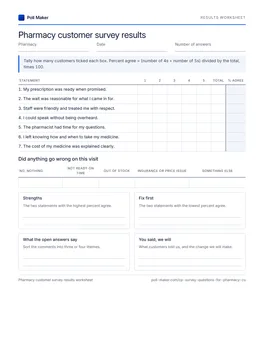
Weekly tally sheet
Add up the forms statement by statement, total the problem tally, and choose one fix for the week ahead.
Download PDFPublished scales for a pharmacy thesis
Pharmacy students often need a published instrument for a thesis or class study. Three are widely used for patient satisfaction and counselling.
| Scale | Items | What it covers |
|---|---|---|
| Pharmacy Services Questionnaire (PSQ), Larson, Rovers and MacKeigan6 | 20 | Friendly explanation (11 items) and managing therapy (9 items) |
| PSPSQ 2.0, Sakharkar and colleagues7 | 20, four-point scale | Quality of care (10), the pharmacist-patient relationship (6), overall satisfaction (4) |
| USP Medication Counseling Behavior Guidelines scale1 | 35 | Needs assessment, precautions and warnings, managing treatment, communication |
Contact the authors before you reproduce any of their items, and cite the version you used. The questions on this page were written fresh for pharmacy customers, so they can sit alongside a validated scale as practical items of your own.
A sample from one or two pharmacies is a convenience sample, so say so in your methods. Invite every adult customer during fixed hours, for example weekday mornings for two weeks, instead of choosing who to ask, and record how many you approached next to the number who took part.
Pharmacy wording fixes you can reuse anywhere
The same habits fix questions for any service; browse the survey question library for other topics.
How satisfied are you with our pharmacy?
My prescription was ready when promised.
The wait was reasonable for what I came in for.
One overall score cannot tell a slow counter from an unfriendly one. Two specific statements can.
Did the pharmacist provide adequate counseling?
Before you left, which of these did someone explain?
"Adequate" is the pharmacist's word, not the customer's. A checklist of facts shows exactly which part of the talk went missing.
Were our prices and staff helpful?
The cost of my medicine was explained clearly.
Staff were friendly and treated me with respect.
This asks about price and staff at once. A customer unhappy with only the price has no clean way to answer.
Do you always take your medication as prescribed?
In the past 7 days, on how many days did you miss a dose?
"Always" invites a polite yes. A short window and a count make the true answer the easy one.
Common questions from pharmacy teams
What owners and pharmacy students ask before the first forms go out.
What questions should a pharmacy customer survey ask?
Start with what customers can judge from their side of the counter: whether the order was ready when promised, the wait, privacy, time with the pharmacist, whether they left knowing how to take the medicine, and cost. Add a recommend question and a single open question, and you have the core 12 above.
How do you measure patient satisfaction in a pharmacy?
Ask the same statements after real visits and report, for each one, the percent of customers agreeing. Keep the wording fixed between rounds so a change means something. For a research study, a validated scale such as the PSQ lets you compare with published work.
Should a pharmacy survey be anonymous?
Yes. Ask for no name, date of birth or prescription number, and keep diagnoses out of it. Collect paper forms in a closed box away from the till, and offer a separate, optional call-back line for anyone who wants a reply.
What is a good pharmacy satisfaction score?
Your own last round is the best benchmark, because it used the same questions with the same customers. For a national picture, J.D. Power's 2026 U.S. Pharmacy Study put mail-order pharmacies at 699 and store pharmacies at 669 on its own 1,000-point index.2 Those scores come from a different questionnaire, so read them as context, not as a target for your percentages.
Can I use these questions in a hospital outpatient pharmacy?
Yes. Swap "this pharmacy" for the name of your outpatient pharmacy, leave out the delivery set if you do not deliver, and keep the new-medicine set, since discharge prescriptions are often new. More patient-facing sets are among the healthcare survey questions.
Set out the box by the exit today
Send the core 12 out as an online survey behind a QR code on the bag, or print the counter copies and set out the box today.