Auto repair customer survey: automotive questions to send with the keys
An auto repair survey asks the customer who just picked up their vehicle three things they can check: was it ready on time, did the bill match the estimate, and is the problem fixed. Then it asks how the visit felt. Below are 34 questions, each with its answer choices, starting from a 12-question core you can text along with the invoice.
- 34questions
- 12in the core
- 4 minto answer the core
- 5optional sets
By Michael Hodge, BSc Psychology Updated September 2026
All 34 automotive survey questions, with answer choices
The 12 core questions start ticked. Add whole sets (estimates, updates, waiting, the two-week follow-up) or choose individual questions. Each row gives its answer choices and why a service manager wants the answer.
After the visit12 questions
Four facts about the job, six statements about how it went, whether they will be back, and one open question. Sent on its own, this is a complete post-visit survey for any shop or service department.
-
What did we do on this visit?
MaintenanceA repairTiresInspectionBody or glassSorts every other answer by the kind of job. A tire swap and a two-day engine repair test a shop in different ways.
-
Was your vehicle ready when we said it would be?
EarlyOn timeSame day, lateDays lateNo time givenTimeliness as a fact the customer can check against the promise. "No time given" is a finding of its own: nobody made the promise.
-
How did the final bill compare with your estimate?
LessSameMore, I agreedMore, I was not askedNo estimateThe price question customers can answer exactly. A written estimate should say the shop will call before going over it, so every "not asked" answer deserves a call from the manager.3
-
Did we fix what you brought it in for?
Yes, fullyPartlyNoToo soon to tellMaintenance onlyFixed first time, in the customer's own words. Anyone who picks "Too soon to tell" gets the two-week follow-up.
-
The advisor explained the work in words I understood.
Strongly disagree12345Strongly agree1 = Strongly disagree, 5 = Strongly agreeCustomers cannot see inside an engine, so the explanation is most of what they judge. A low score here often drags the price score down with it.
-
The price was fair for the work done.
Strongly disagree12345Strongly agree1 = Strongly disagree, 5 = Strongly agreeFairness counts most when the job is complex and the customer knows little about cars. Read it next to question 3.4
-
I got updates without having to call and ask.
Strongly disagree12345Strongly agree1 = Strongly disagree, 5 = Strongly agreeResponsiveness from the customer's side of the counter. Low scores usually point to one missing step, such as a text when the vehicle is ready.
-
My vehicle came back as clean as I left it.
Strongly disagree12345Strongly agree1 = Strongly disagree, 5 = Strongly agreeGrease on a seat or a moved mirror is small to the shop and large to the owner. It is also the quickest score to raise.
-
I trust this shop to recommend only needed work.
Strongly disagree12345Strongly agree1 = Strongly disagree, 5 = Strongly agreeThe trust question. Drivers who distrust repair shops most often name unnecessary work as the reason, so this is the statement to watch.2
-
Booking and dropping off my vehicle was easy.
Strongly disagree12345Strongly agree1 = Strongly disagree, 5 = Strongly agreeThe start of the visit in one line: the call or online booking, the drop-off and the paperwork.
-
Will you bring your vehicle back to us for its next service?
DefinitelyProbablyNot sureProbably notDefinitely notReturn intent, the outcome that pays the bills. Track the share of "Definitely": J.D. Power found 86% of mass market dealer customers said they definitely will return once satisfaction reached 950 out of 1,000.1
-
What is one thing we should do differently on your next visit?
Open answerOne change keeps the answers concrete. They usually explain the lowest-scoring statement above.
Estimates, approvals and the bill6 questions
Add these when price comes up in the open answers, or when you change how quotes and approvals work.
-
The estimate listed parts and labor before work began.
Strongly disagree12345Strongly agree1 = Strongly disagree, 5 = Strongly agreeA written estimate should name the problem, the parts and the labor charge. This checks the customer actually saw one.3
-
When more work was needed, how did we ask you?
Phone callText with photosIn personDid not askNone neededShows which approval route customers really get, and catches extra work done without a yes.
-
I could say no to extra work without any pressure.
Strongly disagree12345Strongly agree1 = Strongly disagree, 5 = Strongly agreePressure to approve work is what makes drivers wary of repair shops. A high score here is a reason to come back.
-
I understood every line on my invoice.
Strongly disagree12345Strongly agree1 = Strongly disagree, 5 = Strongly agreeA repair order should list each repair, each part and its cost, and the labor. Confusion here turns into calls to the front desk.3
-
Did we offer to show you or return the old parts?
Showed meGave them backOffered, I said noNot offeredOld parts are proof the work was done. The FTC tells drivers to ask for them, and state law may require shops to hand them back.3
-
Did we explain the warranty on this work?
Yes, in writingYes, only verballyNoNot sureThere is no standard warranty on repairs, so customers need the terms in writing. This checks they left with them.3
Updates, photos and the inspection report4 questions
For visits that ran longer than a few hours, or where a multi-point inspection turned up extra work.
-
How did you hear from us while your vehicle was here?
Text messagePhone callEmailApp or linkI had to callYour update channels as customers met them. The share who had to call should fall every month.
-
Did you get photos or video of what the technician found?
Yes, it helpedYes, not neededNo, I wanted themNo, not neededMost dealer service customers want pictures with their inspection results, and far fewer get them. This counts how many of yours do.1
-
I could tell which inspection items were urgent.
Strongly disagree12345Strongly agree1 = Strongly disagree, 5 = Strongly agreeA useful inspection report sorts items into now, soon and later. This checks the customer could tell them apart.
-
How would you like updates on your next visit?
TextPhone callEmailPhotos or videoOnline status pageTick all that applyLets you drop the channels nobody wants and add the one customers ask for.
Waiting, rides and loaner cars4 questions
For dealer service departments and busy shops where customers wait on site or need a way to get around.
-
Did you wait at the shop or leave your vehicle?
Waited hereDropped it offTook a shuttleHad a loanerValet pickupSplits the rest of this set by what the customer actually did, so waiting-room scores come only from people who waited.
-
If you waited, how long was it?
Under 30 minutes30 to 60 minutes1 to 2 hoursOver 2 hoursI did not waitWait time in bands customers can recall. In 2025, mass market dealer customers waited 1.61 hours on average for maintenance, while 62% of similar aftermarket visits took under an hour.1
-
The waiting area was clean and comfortable.
Strongly disagree12345Strongly agree1 = Strongly disagree, 5 = Strongly agreeOnly for customers who waited. Seats, Wi-Fi, coffee and a clean restroom are cheap fixes when this score slips.
-
Which one change would make your next visit easiest?
Online bookingEarly drop-offEvening pickupA loaner carPickup and deliveryOne choice forces a priority. It also works as a one-question poll for customers who never fill in surveys.
Two weeks later4 questions
A short follow-up for repair visits, sent 10 to 14 days after pick-up. It catches the problems a pick-up survey is too early to see.
-
Since your visit, has the problem come back?
No, it is fixedYes, the same oneA different problemNot a repair visitYour comeback count, the one number the pick-up survey cannot give. Every "same one" answer gets a call and a booked recheck.
-
Has anything seemed different since the visit?
No, all normalA warning lightA new noiseA leak or smellA setting changedCatches side effects, like a reset radio or a loose trim clip, before they turn into a complaint or a bad review.
-
My vehicle runs the way I expected after the work.
Strongly disagree12345Strongly agree1 = Strongly disagree, 5 = Strongly agreeHow the repair holds up in daily driving, which nobody can judge at the counter.
-
If something is not right, how should we reach you?
Call meText meEmail meNo needTurns the follow-up into a call list, sorted by how each customer wants to hear from you.
About you and your vehicle4 questions
Optional. Keep only the ones you will actually sort the results by.
-
What do you drive?
CarSUVPickup truckVanMotorcycle or scooterLets a shop that works on bikes and trucks as well as cars read each group apart.
-
How old is the vehicle we worked on?
Under 3 years3 to 6 years7 to 12 yearsOver 12 yearsOwners of older vehicles face bigger repair-or-replace decisions. Read their price and trust answers as a group.
-
How many times have you used our shop?
This was the first2 to 5 timesMore than 5 timesFirst-time customers are still deciding whether to come back. Compare their scores with your regulars.
-
How did you choose us for this visit?
Been here beforeFriend or familyOnline search or reviewsDealer for my brandClose to home or workShows which sources bring customers in, and which of those customers come back.
Pick the sets by the job on the repair order
A tire rotation and a transmission rebuild need different surveys. Match the survey to the job, and send the follow-up only where a repair could come back.
| The job | Send it | Sets to include |
|---|---|---|
| Oil change, tires, wipers or other quick service | Text at pick-up | The five for a text at pick-up |
| Warning light, noise, leak or breakdown repair | At pick-up, then 10 to 14 days later | Core, plus Estimates, then Two weeks later |
| Big repair that keeps the vehicle overnight | At pick-up | Core, plus Updates and photos, plus Estimates |
| Dealer service with a loaner, shuttle or waiting room | At pick-up | Core, plus Waiting, rides and loaner cars |
| Warranty or recall work at no charge | At pick-up | Core without questions 3 and 6, plus Updates and photos |
| A class or research project on service quality | Paper or link, over two weeks | Core, plus About you and your vehicle |
Want to hear about the vehicle itself rather than one visit, such as what broke this year or what the owner will buy next? That is the car owner survey. Running a fleet? Ask its drivers with the driver satisfaction survey.
Oil change or tire swap? Text just these
Quick jobs deserve a quick survey. Oil changes, tire swaps and inspections need only the promised time, the bill, the fix, the next visit and one change, which a customer can answer in the parking lot.
- 01Was your vehicle ready when we said it would be?
- 02How did the final bill compare with your estimate?
- 03Did we fix what you brought it in for?
- 04Will you bring your vehicle back to us for its next service?
- 05What is one thing we should do differently on your next visit?
From courtesy survey to the shop's to-do list
Four habits turn a survey from a courtesy into next month's to-do list for the shop.

Send it when the keys go back
Text the link with the invoice, or stick a QR code on the key tag, so the customer answers while the visit is fresh. Ask for the repair order number (the paper card has a box for it), so every answer lines up with the job, the advisor and the technician without asking anyone to remember names.
Photo or video with inspection results
Show customers what the technician saw
Photos close the gap between what the technician sees under the vehicle and what the customer is asked to approve. J.D. Power's 2026 dealer service study found that 64% of customers wanted photo or video evidence with their inspection results, while 26% of mass market customers and 44% of premium customers received it.1 Send a photo of the worn part with every approval request, then watch question 20 climb.
Make fairness easy to judge
Many repairs are complex, and few customers are mechanics. That is exactly when fairness outweighs empathy, responsiveness, reliability and convenience in how customers rate a shop.4 Trust is there to be won: in a 2016 AAA survey, 64% of US drivers had a repair shop they trust, and drivers who distrust shops in general most often cited recommendations for unnecessary services (76%) and overcharging (73%).2 The core asks about both in plain words, and the estimates set checks the written estimate, approvals and old parts the FTC tells drivers to ask for.3

Check back two weeks later
A pick-up survey cannot tell you whether a repair held. The four follow-up questions go out 10 to 14 days later, by the same route as the first survey. Each "Yes, the same one" is a comeback: call the customer, book a recheck and log the job, and within a few months you will see which repairs come back most.
Weighing Saturday hours or a loaner car? Let customers vote first. Put question 26 up as a free one-question poll on your shop page or in your newsletter and see which change wins. Making a poll step by step covers sharing it by link, QR code or social post.
Scoring a visit: on time, on the estimate, fixed first time
Questions 2, 3 and 4 are facts, not opinions. Count them every month and you have three numbers a whole shop can rally around, plus a fourth from the follow-up.
How to count each one
- Ready when promised: "Early" or "On time" on question 2, out of everyone who was given a time.
- Billed as agreed: "Less", "Same" or "More, I agreed" on question 3, out of everyone who had an estimate.
- Fixed first time: "Yes, fully" on question 4, out of repair visits only. Leave out maintenance and "Too soon to tell".
- Comebacks: "Yes, the same one" on question 27, out of repair customers who answered the follow-up.
A worked month
Say 120 customers answered in March, 50 of them after a repair:
| Measure | Count | Share |
|---|---|---|
| Ready when promised | 98 of 112 given a time | 88% |
| Billed as agreed | 112 of 115 with an estimate | 97% |
| Fixed first time | 42 of 46 repairs that could tell | 91% |
| Comebacks two weeks later | 2 of 38 who answered | 5% |
The headline shares look strong, and the detail is where the month's work is. Eight customers were never given a time, five had no estimate and three were billed more without being asked. Those 16 are process fixes: make a promised time and a written estimate part of every write-up, and have the manager call the three this week. The two comebacks go on the technician meeting agenda with their repair orders.
Read the statements beside the counts
A shop can hit every promised time and still score low on updates (question 7) if customers spent the day wondering. When a count holds steady but a statement slips, the problem is how the visit felt, not what was done.
Turn a month of answers into a shop report
Type in how many customers picked each number for the six core statements. The chart ranks the shop's strengths and flags the two weakest statements for next month. Print it for the team huddle.
- 1Percent agree for a statement is its Agree plus Strongly agree answers over all answers to it. The report builder works it out.
- 2Rank the six statements. The bottom two are next month's focus; the top two are what the team should keep doing.
- 3Break results out by advisor or job type once a group has a decent number of answers; a handful of replies is too few to judge a person by.
- 4Read the open answers from customers who scored the bottom two statements low. They usually name exactly what went wrong.
- 5Share the report at the next team meeting with one change and the person who owns it.
Service survey results
A service survey card for the counter
Some customers never open a text. Hand them the card with the invoice, or leave it on the seat beside the keys, with a drop slot at the counter. The PDFs are ready for any shop printer.
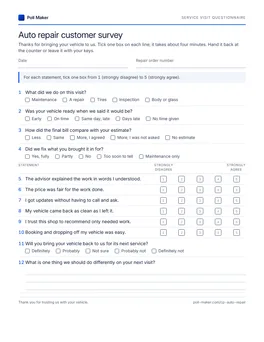
Service visit questionnaire
Page one holds the 12 core questions and a box for the repair order number. Optional sets follow on later pages, grouped by topic; skip any your shop does not need.
Download PDF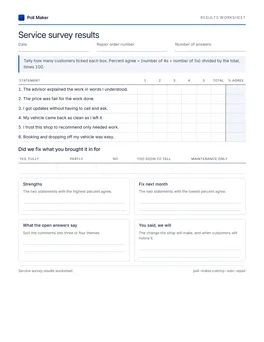
Monthly results sheet
Hand-count the paper cards: six agree statements plus the fixed-first-time question, turn them into percent agree, then note next month's two priorities.
Download PDFFour repair survey questions worth rewriting
You will find all four on real shop comment cards. For the same repairs on any kind of question, read our survey question writing guide.
Were you satisfied with our fast, friendly service?
Was your vehicle ready when we said it would be?
The advisor explained the work in words I understood.
It asks about speed and manner at once, and the praise words lean on the answer. Two plain questions give two answers you can use.
Were our prices reasonable?
How did the final bill compare with your estimate?
Reasonable compared with what? The estimate is a promise the customer can check, so the answer points at a specific fix.
Did our certified technicians do quality work?
Did we fix what you brought it in for?
Customers cannot judge workmanship, and the credential turns the question into an ad. They can tell whether the noise is gone.
How would you rate our multi-point inspection?
I could tell which inspection items were urgent.
Plenty of customers do not know the trade term. Ask what the inspection did for them instead.
Using the questionnaire for a service quality project
Students studying customer satisfaction at a car or two-wheeler service center need to show what each question measures. This map links the questions to two published studies of auto service quality.
| Factor | Questions | What it covers |
|---|---|---|
| Fairness | 3, 6, 9, 15, 17, 18 | Price against the estimate, pressure, honesty about needed work, terms in writing |
| Empathy | 5, 8, 16 | Explaining in plain words, care for the vehicle |
| Responsiveness | 7, 19, 20, 21 | Updates and inspection findings |
| Reliability | 2, 4, 27, 29 | On time, fixed, still fixed two weeks later |
| Convenience | 10, 23, 24, 26 | Booking, drop-off, waiting and getting around |
| Outcomes | 11, 12 | Return intention and the one change |
The five factors come from Andaleeb and Basu, who tested them with auto service customers and found fairness mattered most when the repair was complex and the customer knew little about cars.4 A Dutch study that adapted SERVQUAL for garages found customers used three dimensions instead: customer kindness, tangibles and faith, with customer kindness feeding straight into their quality rating.5 The grouping of our questions is ours; cite the papers for the factors and say the wording is original.
Sampling at a service center
Ask every customer who collects a vehicle over two full weeks, weekdays and Saturdays, rather than only the ones the advisor chooses. Keep a tally of customers approached next to the number of completed surveys. Enter Strongly disagree as a 1 and Strongly agree as a 5, then give the percentage choosing each point; levels of measurement explains why a median suits these answers better than a mean.
What shop owners ask about service surveys
Short answers for independent shops, dealer service departments and students.
What questions should an auto repair customer survey include?
Start with three facts the customer can check: whether the vehicle was ready when promised, how the bill compared with the estimate, and whether the problem was fixed. Add statements about the explanation, the price, updates, the vehicle's condition and trust, then ask whether they will come back and what one thing to change.
When should a repair shop send its survey?
The day the vehicle is picked up, by text or email with the invoice, or on a card handed over with the keys. For repairs, send the four-question follow-up 10 to 14 days later to catch problems that come back.
How do you measure customer satisfaction at an auto repair shop?
Track percent agree on the six core statements each month, plus three counts from the fact questions: ready on time, billed as agreed, and fixed first time. The follow-up adds a fourth, the comeback count.
Should the survey ask customers to name the advisor or technician?
Ask for the repair order number instead. It links each answer to the advisor, the technician and the job without relying on memory. Compare people only when each has enough answers to be fair.
Can I use these questions for a motorcycle or two-wheeler service center?
Yes. Every question says vehicle rather than car, and the About you set has a motorcycle option. For a student project on service quality, the 12 core questions with the About you and your vehicle set make a full questionnaire.
Can I turn this into an online auto repair feedback form?
Yes. Open the questions in the builder and share the survey by link or QR code, adding or removing any set first. The printable card is the paper version.
Add it to tomorrow's invoices
Load the 12 core questions into the builder, paste the survey link into the text that says the vehicle is ready, and read the first answers by Friday. For the counter, print the service card.