Social work feedback form and client assessment questions
A good social work feedback form asks clients whether they were listened to, respected and involved in the plan, and whether life is better now than when the work began. Start with a 12-question form clients finish in about five minutes, then add questions for the first meeting, a quick check after each visit, the ending and a follow-up.
- 35questions
- 12in the feedback form
- 5 minto answer the form
- 5sets for other stages
By Michael Hodge, BSc Psychology Updated September 2026
The feedback form plus assessment, visit and closing sets
Every item lists the choices a client ticks, plus a line on what their answer tells a caseworker. The feedback form starts ticked. Add whichever stage sets your team uses; your picks then open together in the online builder, go to print, or copy out as text for another tool.
The feedback form: core 1212 questions
Nine statements about how the work went, one question that ranks what to change, and two open questions. Use it when a case closes, or every six months on long cases.
-
I knew what my social worker could and could not do.
Strongly disagree12345Strongly agree1 = Strongly disagree, 5 = Strongly agreeRole clarity. A client who expected help the service cannot give will rate everything lower; this statement shows when that is the cause.
-
My social worker listened to what I had to say.
Strongly disagree12345Strongly agree1 = Strongly disagree, 5 = Strongly agreeThe basic check on being heard. The open answers usually say where listening broke down.
-
I was treated with respect, even when we disagreed.
Strongly disagree12345Strongly agree1 = Strongly disagree, 5 = Strongly agreeRespect is easy when things go well. The second half asks about the harder moments, such as a decision the client did not want.
-
We worked on the problems that mattered most to me.
Strongly disagree12345Strongly agree1 = Strongly disagree, 5 = Strongly agreeWhether the work followed the client's priorities or the agency's. A low score here often sits behind a low score on the outcome statement.
-
I had a real say in the plan we made.
Strongly disagree12345Strongly agree1 = Strongly disagree, 5 = Strongly agreeParticipation. A low score points at plans written for clients rather than with them.
-
I could reach my social worker when I needed to.
Strongly disagree12345Strongly agree1 = Strongly disagree, 5 = Strongly agreeAccess between meetings: returned calls, answered messages and cover when the worker is away.
-
My social worker did what they said they would do.
Strongly disagree12345Strongly agree1 = Strongly disagree, 5 = Strongly agreeReliability: forms sent, referrals made, calls returned. Clients can judge this one precisely.
-
I was told who could see the information I shared.
Strongly disagree12345Strongly agree1 = Strongly disagree, 5 = Strongly agreeConfidentiality and its limits. A low score means the explanation did not land, whatever was said at the start.
-
Things are better for me now than when we started.
Strongly disagree12345Strongly agree1 = Strongly disagree, 5 = Strongly agreeThe outcome statement. Clients tend to rate how they were treated more highly than what changed, so a form without this one measures only the first.3
-
What one change would have helped you most?
Quicker repliesMore time togetherClearer informationKeeping the same workerNothing, it went wellThe tally question. One pick per client turns scattered complaints into a ranked list the team can act on.
-
What did your social worker do that helped you the most?
Open answerNames what to keep. Clients often point to small things, like a returned call or a ride to a hearing, that no statement asks about.
-
What should we do differently for the next person who comes to us?
Open answerFramed as advice for someone else, it lets clients criticise the service without criticising a worker they may still need.
Your first meeting8 questions
Assessment questions in plain words. Clients can fill them in before you meet, or you can ask them aloud and write the answers down together.
-
What would you most like help with first?
Open answerThe problem in the client's own words, before any form narrows it. It often differs from the reason on the referral.
-
Whose idea was it to contact us?
MineFamily or friendsA doctor or schoolA court or agencyClients who chose to come and clients who were sent start in different places. Split later answers by this one.
-
Which of these are you dealing with right now?
HousingMoney or debtFoodFamilyHealth or disabilityMental healthAlcohol or drugsSafety at homeLegal mattersTick all that applyA quick scan across the areas an assessment covers. It shows where to start the conversation, not what to conclude.6
-
Who do you turn to when things get hard?
Open answerThe start of a support map: the people to bring in, and sometimes the ones to plan around.
-
What has helped you get through a hard time before?
Open answerStrengths in the client's own words, which give the plan something real to build on.
-
If our work goes well, what will be different in three months?
Open answerThe client's own goal. It becomes the yardstick for the outcome statement and the closing questions.
-
Would any of these help you take part?
An interpreterEasy-read formsLarge printSomeone with meStep-free accessNone of theseTick all that applyAccess needs, asked before they turn into a missed appointment or a form nobody could read.
-
Is it safe for us to send letters or texts to your home?
YesOnly by textOnly by phoneNo, ask me firstSome clients live with the person they need help about. One question here keeps a letter from landing in the wrong hands.
After a meeting4 questions
Four questions to hand over at the door or send by text the same day. Watch the trend from visit to visit rather than any single score.
-
This meeting covered what I came in to talk about.
Strongly disagree12345Strongly agree1 = Strongly disagree, 5 = Strongly agreeAgenda fit, the first thing to slip when a visit is taken over by paperwork or a crisis.
-
I left knowing what happens next.
Strongly disagree12345Strongly agree1 = Strongly disagree, 5 = Strongly agreeClarity on the next step, in a line clients can answer on the way out.
-
I could say what I really thought today.
Strongly disagree12345Strongly agree1 = Strongly disagree, 5 = Strongly agreeWhether the client held back. A drop here is a cue to talk about how the two of you work together.
-
Since our last meeting, have things been:
Much worseA bit worseSameA bit betterMuch betterThe early warning. Practitioners miss many clients who are getting worse; a rating at every visit brings them to light.5
When our work ends5 questions
Add these to the feedback form at the closing visit. The first question tells you how to read every other answer.
-
How did our work together end?
I reached my goalsI decided to stopI moved or changed servicesIt ended before I was readyNot surePlanned and unplanned endings read very differently. Separate them before you look at anything else.
-
I know where to go if I need help again.
Strongly disagree12345Strongly agree1 = Strongly disagree, 5 = Strongly agreeA good ending leaves a way back. Low scores mean closing letters need a clearer route in.
-
I was told about other services that could help me.
Strongly disagree12345Strongly agree1 = Strongly disagree, 5 = Strongly agreeReferral and signposting, a core part of the job that clients can judge for themselves.
-
Do you know how to make a complaint if you ever need to?
YesNoNot sureKnowing the complaints route is part of fair treatment. Each "No" is fixed with a line in your leaflet or closing letter.
-
What difference has our work made to your life?
Open answerThe outcome in the client's words. With permission, one sentence from here says more in a funding report than any average.
A few months later2 questions
Send these two by text, phone or post between three and six months after closing, to see whether the change held.
-
Since we closed your case, have things for you:
Got worseStayed about the sameGot betterGot much betterWhether the change lasted once support stopped, which a closing form cannot tell you.
-
Have you needed help from a service again since then?
Yes, from youYes, from another serviceNoRead it with the answer above. Coming back can be the plan working, when the client knew where to go.
About you4 questions
Save these for when you mean to compare client groups, and never publish a group so small that a client could be recognised.
-
How old are you?
Under 1818 to 2425 to 4445 to 6465 or olderPrefer not to sayLets you see whether younger and older clients experience the service differently.
-
How long have you been working with us?
Under 3 months3 to 12 monthsOver a yearShort and long cases call for different fixes; read the core statements by this split.
-
How did you fill in this form?
On my ownWith family or friendsWith staff helpRead to meAnswers given with a staff member beside the client may be kinder. This lets you check whether they differ.
-
What language do you speak at home?
EnglishSpanishAnother languagePrefer not to sayShows who the service reaches and which languages the next form needs. Swap in the languages spoken locally.
Different questions for each point in a case
Clients can tell you different things at different points in a case. Ask each set at the moment it fits, and keep every form short.
| Moment | What you learn | Set to use |
|---|---|---|
| First contact and assessment | What the client wants help with, the pressures in their life, who supports them, their own goal, and how to reach them safely | Your first meeting |
| After a visit or session | Whether the meeting fit, and whether things are getting better or worse | After a meeting |
| Every six months on a long case | How the work is going, while it can still be adjusted | The core 12 |
| When the case closes | How the client was treated, what changed, and what they would improve | The core 12 plus When our work ends |
| Three to six months after closing | Whether the change lasted without support | A few months later |
Public agencies use the same idea. California's welfare-to-work program sends its client satisfaction survey at three milestones in a client's first six months: orientation, the welfare-to-work plan and the first semi-annual report. The state social services department runs it, and answers are anonymous, sent by text or email.9
Honest answers from people who still rely on you
A client may be waiting on a housing referral or a court report when the form arrives. Four habits make it safe to be honest, and make the answers worth reading.

Keep feedback away from the case file
Tell clients, on the form and out loud, that answering is optional and changes nothing about their help. The NASW Code of Ethics asks for consent "without any implied or actual deprivation or penalty for refusal to participate," and for the anonymity or confidentiality of what people share.1 Have an admin colleague or a sealed box collect paper forms, keep them out of case records, and share results only in groups too large for any one client to be identified.
Ohio clients rating each area positively, five-year average
Ask what changed, not only how it felt
Clients tend to rate how they were treated more kindly than what changed. In Ohio's statewide survey of adults using public mental health services, an average of 81.4% rated general satisfaction positively across five years, against 51.7% for their quality of life as a result of treatment.3 That is why the core 12 carries an outcome statement, and why the ending and follow-up sets ask about change directly.

Check in after every meeting
A closing form comes too late to help a client who is getting worse. In counselling and therapy, 5% to 14% of clients worsen during treatment and practitioners fail to spot many of them; feedback systems that track progress session by session can cut that deterioration in half.5 A review of 24 studies found that session feedback nearly doubled the rate of real improvement among clients predicted to do poorly.4 The after-a-meeting set takes about a minute at the door.
Offer more than one way to answer
Posted surveys reach few people: Ohio's statewide mail survey came back from 10.9% of the clients who received it.3 Hand the form over at the closing visit, send a link by text, or read the questions aloud over the phone, and note which route each answer came back by. The NASW code asks anyone who evaluates through technology to offer reasonable alternatives to clients who cannot use it.1 BASW's feedback tool for autistic adults also comes in an easy-read version, a model worth copying for any client group.8
Running a group session, a parents' group or a service user forum? Show the question about what would help most as a live poll during the session: everyone votes from their own phone, and no names are attached. Our poll walkthrough explains each way to share it.
Read the nine statements as one chart
Type in how many clients gave each statement each score from 1 to 5. The nine bars then line up by agree share, flag your strongest pair and the pair needing attention, and fit one printed page for a team meeting.
- 1Tally each statement from 1 to 5. Clients who chose 4 or 5 make up its agree share, worked out live in the panel.
- 2Set the outcome statement beside the others. A team rated well on respect but low on change needs a different fix from one rated low on both.
- 3Hold the lowest two statements up against the one-change tally. If quicker replies top the tally and reaching the worker scores low, that is your first action.
- 4Close the loop with clients: a poster in the waiting area or a line in the next letter, naming what you heard and what changes now.
Client feedback
Opening the assessment with a new client
Starting with a new client? These five open the assessment conversation: what they want help with, what is weighing on them, who they lean on, what has worked before and what a good result would look like.
- 01What would you most like help with first?
- 02Which of these are you dealing with right now?
- 03Who do you turn to when things get hard?
- 04What has helped you get through a hard time before?
- 05If our work goes well, what will be different in three months?
What a social work assessment covers, in questions clients can answer
A psychosocial assessment is the social worker's written summary of a client's situation, strengths and the plan.6 The questions below give it the client's side; the judgement stays with you.
All six questions sit in the first-meeting set above.
| Assessment area | Ask the client | What to listen for |
|---|---|---|
| Presenting problem | What would you most like help with first? | Their words for it, next to the wording on the referral |
| Referral | Whose idea was it to contact us? | Whether they chose to come or were sent |
| Basic needs, health, mental health, legal matters | Which of these are you dealing with right now? | Where to start, and anything that cannot wait |
| Family and social supports | Who do you turn to when things get hard? | Who can help, and who to plan around |
| Strengths and resources | What has helped you get through a hard time before? | What already works for this client |
| Goals | If our work goes well, what will be different in three months? | The yardstick you will close the case against |
A form or a conversation, both work
Some clients would rather write a first answer than say it to a stranger; others need the questions read to them. Offer the set either way, and record answers in the client's own words, which is what the written assessment should quote. The York College guide to psychosocial assessments also lists education, work, faith, environmental factors and legal concerns as areas to cover in the conversation that follows.6
Follow up a tick next to safety at home first
If a client ticks safety at home, talk about it in private before anything else, and use your agency's own safety screening from there. The same goes for alcohol or drugs and mental health: the tick tells you where to look, and your agency's standard screening tools do the measuring.
Paper for a closing visit or a home with no signal
Paper suits a closing visit, a waiting room or a home visit with no signal. The files are set for US letter and print on A4 too.
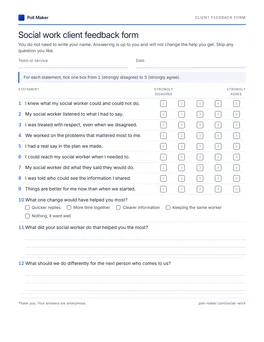
Client feedback form
Sheet one is the 12-question form with tick boxes. The first-meeting set gets a sheet to itself; the after-a-meeting, ending and follow-up sets share the third, and About you sits on the fourth.
Download PDF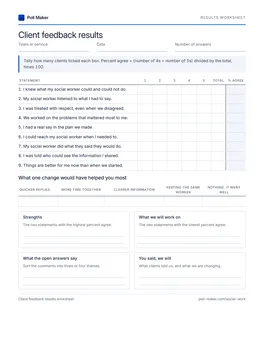
Feedback tally sheet
Count the ticks for all nine statements, turn each count into an agree share, total the one-change answers and note the next steps for the team.
Download PDFBlended, bundled, leading or jargon: client questions fixed
Weak client questions usually fail in one of four ways: they blend, bundle, lead or use jargon. The survey question guide covers each question type with its own examples.
How satisfied are you with your social worker?
My social worker listened to what I had to say.
My social worker did what they said they would do.
Satisfaction blends the person, the outcome and the system. Specific statements show the worker which habits to keep and which to drop.
Was your social worker helpful and easy to reach?
I could reach my social worker when I needed to.
What did your social worker do that helped you the most?
Two questions in one. A client whose worker helped but never returned calls has no honest answer.
Do you agree that our service has improved your life?
Things are better for me now than when we started.
The weak version credits the service before the client answers. A neutral statement about change lets people disagree without contradicting you.
Were you involved in care planning and goal setting?
I had a real say in the plan we made.
Agency terms mean little to many clients, and the question asks about two processes. Plain words and one idea get a clear answer.
Service user feedback for a social work placement
Social work students and apprentices gather feedback from the people they work with for their placement portfolio. In England it is written into the professional standards: social workers incorporate feedback from a range of sources, including people with lived experience of their practice.2
Four questions are plenty
From the feedback form, take the statements on knowing what the worker could do, being listened to and the worker doing what they said, plus the open question on what helped most. Change "social worker" to "student social worker" or use your first name, and print them on one side of paper.
Say who will read it
Placement forms usually go to your practice educator, and some ask for the person's name, so they are not anonymous. Explain that before you ask, and make it clear that saying no changes nothing about their support. The NASW code sets the same bar for any evaluation: consent without penalty for refusing.1
Let someone else hand it over
Ask your practice educator or a team colleague to give out and collect the form, or leave a stamped envelope addressed to them. People write more freely when the student is not standing there.
Bring it to supervision
For each comment, note what you did differently afterwards. That is the reflection the standards ask for: using supervision and feedback to identify your learning needs.2
What caseworkers and students ask about client feedback
Short answers for social workers, team managers and students on placement.
What should a social work feedback form include?
Statements about how the client was treated (listened to, respected, involved in the plan, able to reach the worker), one about whether things are better, a question that names the one change that would help most, and an open question or two. The 12-question form on this page does all of that in roughly five minutes.
What questions are asked in a social work assessment?
What the client wants help with, how they came to the service, the pressures in their life (housing, money, health, family, safety), who supports them, what has helped before and what they want to be different. The social worker then writes the assessment as a summary of the situation, strengths and plan.6
Should client feedback be anonymous?
For feedback on the service, yes. Clients answer more freely when no name is attached and the form stays out of their file, and the NASW code asks evaluators to protect anonymity or confidentiality.1 Placement feedback for a student's portfolio often carries a name, so say who will read it before the client agrees.
How often should social workers ask clients for feedback?
A short check after each meeting, the full form when the work ends (or every six months on long cases), and two questions a few months after closing. The quick check flags problems early enough to act on; the later forms show what the work achieved.
Can children and teenagers answer these questions?
Teenagers can, from about 12, with "social worker" swapped for the worker's first name and the statements read aloud where needed. For younger children, cut the scale to yes, sometimes and no, and ask parents or carers to fill in their own copy for the family.
Text the form to clients whose cases closed this month
Text the 12-question form to clients whose cases closed this month, or bring paper copies to a closing visit.