Office space survey questions employees answer before a floor plan changes
An office space survey asks the people who use the building how often they come in, what they come in for, and whether the space lets them do it: focus, take a private call, find a desk, get a room. Answering the core 12 takes staff about four minutes, and seven optional sets cover meetings, hybrid desk booking, a move and coworking spaces.
- 38questions
- 12in the core
- 4 minto answer the core
- 7optional sets
By Michael Hodge, BSc Psychology Updated September 2026
Days in, desks, noise and rooms: the full question set
Beside every question: the options people choose between, and the decision the answers feed. Tick what fits your building and the builder opens with exactly those, or print your picks for a floor meeting, or paste them into your usual survey tool.
The core 1212 questions
Attendance and purpose first, then seven statements about working in the space, a forced choice and an open question: a complete office check on its own.
-
In a typical week, how many days do you work in this office?
Under 11 day2 days3 days4 or 5 daysThe number your space plan rests on. Set it beside badge or booking counts for the same weeks before you act on it.
-
Which days do you usually work here?
MondayTuesdayWednesdayThursdayFridayTick all that applyDesks are sized for the busiest day, not the average. The worked example further down turns these ticks into a desk count.
-
What do you mostly come into the office for?
MeetingsFocused workMy teamEquipment or filesSocial timeIt is requiredTick all that applyTells you what the space has to be good at. If most people come in for meetings, extra desks will not fix a room shortage.
-
Noise rarely breaks my concentration here.
Strongly disagree12345Strongly agree1 = Strongly disagree, 5 = Strongly agreeA low score is the case for quiet rooms, quiet hours or moving the loudest teams apart.1
-
My private calls stay private here.
Strongly disagree12345Strongly agree1 = Strongly disagree, 5 = Strongly agreeSound privacy draws more complaints than any other feature in the largest office occupant database. A low score points to booths and small rooms.1
-
I can get a desk that suits the day's work.
Strongly disagree12345Strongly agree1 = Strongly disagree, 5 = Strongly agreeShared desks stand or fall on this. Low scores only on the busiest day mean too few desks; low scores every day mean the wrong kind.
-
I can get a meeting room when I need one.
Strongly disagree12345Strongly agree1 = Strongly disagree, 5 = Strongly agreeBooking data misses the people who gave up trying to book. This statement catches them.
-
The temperature where I sit is comfortable.
Strongly disagree12345Strongly agree1 = Strongly disagree, 5 = Strongly agreeThe second most common complaint in the same database. Read it by floor or zone, where one fix covers everyone nearby.1
-
I have enough room for my work and my things.
Strongly disagree12345Strongly agree1 = Strongly disagree, 5 = Strongly agreeSatisfaction with space for work and storage mattered more to overall workspace satisfaction than any other feature, and it did not track square feet per person.3
-
Overall, this office helps me do my best work.
Strongly disagree12345Strongly agree1 = Strongly disagree, 5 = Strongly agreeThe summary statement to track over time. Ask it again after any change to see whether the change paid off.
-
Which one change would help you most?
Quiet spaceCall boothsMeeting roomsBetter desksTemperature controlA forced choice gives you a ranking instead of a wish list, and it makes a good live poll at an all-hands.
-
What would make coming into the office more worth your while?
Open answerThe reasons people stay home, in their own words, including things no rating covers, from parking to the lunch options.
Desk, light and air4 questions
For a refit or new furniture: the parts of the space people feel at their own desk all day.
-
My chair and desk adjust to fit me.
Strongly disagree12345Strongly agree1 = Strongly disagree, 5 = Strongly agreeCovers seat height, desk height and screen position. On shared desks, read it next to the hybrid set, since someone else's settings wait every morning.
-
The light at my desk suits screen and paper work.
Strongly disagree12345Strongly agree1 = Strongly disagree, 5 = Strongly agreeGlare and dimness need different fixes: blinds or a turned screen for one, a task lamp for the other. The open answers tell you which.
-
The air where I sit feels fresh, not stuffy.
Strongly disagree12345Strongly agree1 = Strongly disagree, 5 = Strongly agreeA quick read on ventilation. Low scores bunched in one zone point to the air supply there, not to the whole building.
-
Which of these do you need at a desk to do your job?
Second screenDockHeadsetStanding deskDesk phoneJust a laptopTick all that applyThe kit list for every shared desk. If most people need two screens, a desk with one is a desk nobody books.
Meetings, calls and focus4 questions
Add these when rooms are always full or always empty, before you build more of them or take walls down.
-
How many people are in most of your meetings?
Just me on a call2 to 45 to 89 to 15Over 15Room sizes should follow meeting sizes. If most meetings hold two to four people, a 12-seat room booked for four is the pattern to fix.
-
How many of your meetings have someone joining by video?
NoneA fewAbout halfMostAllTells you how many rooms need a camera, a microphone and a screen, not just a table and chairs.
-
When you need to focus, where do you go?
My deskA quiet roomA boothHomeNowhere worksIf Home wins, the office has no quiet place. If Nowhere works shows up at all, start there.
-
How many calls do you take at your desk on a typical day?
None1 or 23 to 56 or morePeople talking and phones lead the noise complaints in office occupant surveys. This count helps you size the number of call booths per floor.2
Hybrid days and desk booking4 questions
For shared desks and set office days. These show whether the policy works for the people living with it.
-
How do you get a desk when you come in?
My own deskBook aheadFirst comeTeam areaIt variesShows how the desk system really runs, which may differ from how the policy describes it.
-
Booking a desk or room here is quick.
Strongly disagree12345Strongly agree1 = Strongly disagree, 5 = Strongly agreeA slow tool makes people hold desks all day or skip booking, and either way your booking data gets less reliable.
-
On my office days, the people I need are here.
Strongly disagree12345Strongly agree1 = Strongly disagree, 5 = Strongly agreeThe main reason an office day can feel wasted. A low score points to a set team day rather than more space.
-
If it were up to you, how many days a week would you work here?
Under 11 day2 days3 days4 or 5 daysSet beside the days people work here now, it shows whether demand would rise or fall if the policy changed.
Kitchen, amenities and the trip in3 questions
For amenity budgets, and to see what getting to the office asks of people.
-
Shared areas like the kitchen are kept clean.
Strongly disagree12345Strongly agree1 = Strongly disagree, 5 = Strongly agreeCleaning is cheap to adjust. If low scores bunch on the busiest days, move the cleaning to match attendance.
-
Which of these would you use every week?
Quiet roomCall boothLockersBike storageShowersParkingTick all that applyWeekly use beats nice to have. Fund what people would actually use.
-
How long is your trip to the office, one way?
Under 15 min15 to 29 min30 to 44 min45 to 59 min1 hour or moreCompare days in the office by trip length before you blame the building for low attendance.
Planning a move or redesign (team leads answer)4 questions
Space planners need these from one person per team. Team leads answer them once, on top of the core.
-
How many people are on your team now?
1 to 56 to 1011 to 2021 to 50Over 50The head count each area has to hold today.
-
How will your team size change over the next two years?
SmallerAbout the sameA little biggerMuch biggerNot sureA new floor is planned for the team you will have. Several much-bigger answers mean leaving room to grow into.
-
Which special spaces does your team need?
Locked storageLab or workshopClient roomQuiet roomPrint roomNoneTick all that applyRooms that are hard to add once walls are up. Missing one in a new plan is the expensive kind of mistake.
-
Which teams do you need to sit near, and why?
Open answerThe adjacency map. Planners draw zones from it before they place a single desk.
Coworking and shared offices (members answer)5 questions
For a coworking space or serviced office. Members answer the core about the space they use, then these about their membership.
-
Which membership do you have?
Day passPart-timeHot deskDedicated deskPrivate officeLets you compare plans. Day-pass and private-office members come for different things.
-
My membership is good value for what I use.
Strongly disagree12345Strongly agree1 = Strongly disagree, 5 = Strongly agreeThe number to watch before renewals. Read it by plan: a low score on one plan points to its price or its perks.
-
Problems I report here get fixed quickly.
Strongly disagree12345Strongly agree1 = Strongly disagree, 5 = Strongly agreeWi-Fi, printers, heating: members judge the operator on how fast these get sorted.
-
I have met people here who help my work.
Strongly disagree12345Strongly agree1 = Strongly disagree, 5 = Strongly agreeThe community half of coworking. Low scores mean members rent a desk rather than join a place.
-
How likely are you to recommend this space to a friend or colleague?
0123456789100 = Not at all likely, 10 = Extremely likelyThe standard 0 to 10 recommend question, so you can track it each quarter and compare locations.
About you (optional)2 questions
Only for comparing parts of the office. Report a floor or team once at least five people from it have answered, and add a question naming your own floors in the builder.
-
Which best describes where you sit?
Private officeShared officeOpen planHot deskA mixPeople in open plan complain about their workspace far more often than people in private offices, so compare like with like.2
-
How close is your usual desk to a window?
Next to oneA few desks awayFar from anyDistance from a window shapes how people rate the space, so check it before you compare zones.2
What the survey tells you, and what counts tell you
An office space utilization survey is half of a utilization study. Badges, bookings and sensors count how the space is used; the survey explains why, and shows what is missing.
| What you need to know | Best source | Questions on this page |
|---|---|---|
| How many people are in on each day | Badge or booking counts | Days per week and which days, to check against the counts |
| Which rooms sit empty or overflow | Room bookings and sensors | Meeting size and video share, to see why |
| Why people come in, or stay away | The survey | What people come in for, and the open question |
| Whether people can work well once here | The survey | The seven core statements |
| How many desks a new plan needs | Both | Which days, then the counts (worked example below) |
Measured attendance can sit far below what a floor was built for. In a three-week sample in early 2023, the Government Accountability Office found that 17 of 24 federal agencies used an estimated 25 percent or less of their headquarters capacity, and the busiest used 39 to 49 percent.5 Counts like those tell you how much space is idle. Only the people using it can tell you whether the space that is used works.
Running the survey so the floor plan changes
Four habits separate an office survey that gets filed from one that moves desks, rooms and budgets.
Office occupants dissatisfied with each feature
Start with sound and temperature
Across 84,366 people in 897 buildings in the Center for the Built Environment database, sound privacy drew the most complaints: 54% were dissatisfied, ahead of temperature at 39% and noise level at 34%.1 That pattern is why the core leans on private calls, concentration and temperature, and why the one-change question offers quiet space and call booths. Ease of talking to colleagues scored best, with 11% unhappy.

Set the answers beside attendance counts
The survey tells you why; badge and booking records tell you how many. Look at both for the same weeks. Where they disagree, the open answers often explain it: a room nobody books may have no camera, and a floor people avoid may be the cold one. The survey and counts table shows which source answers which question.
Ask before the redesign, and again after
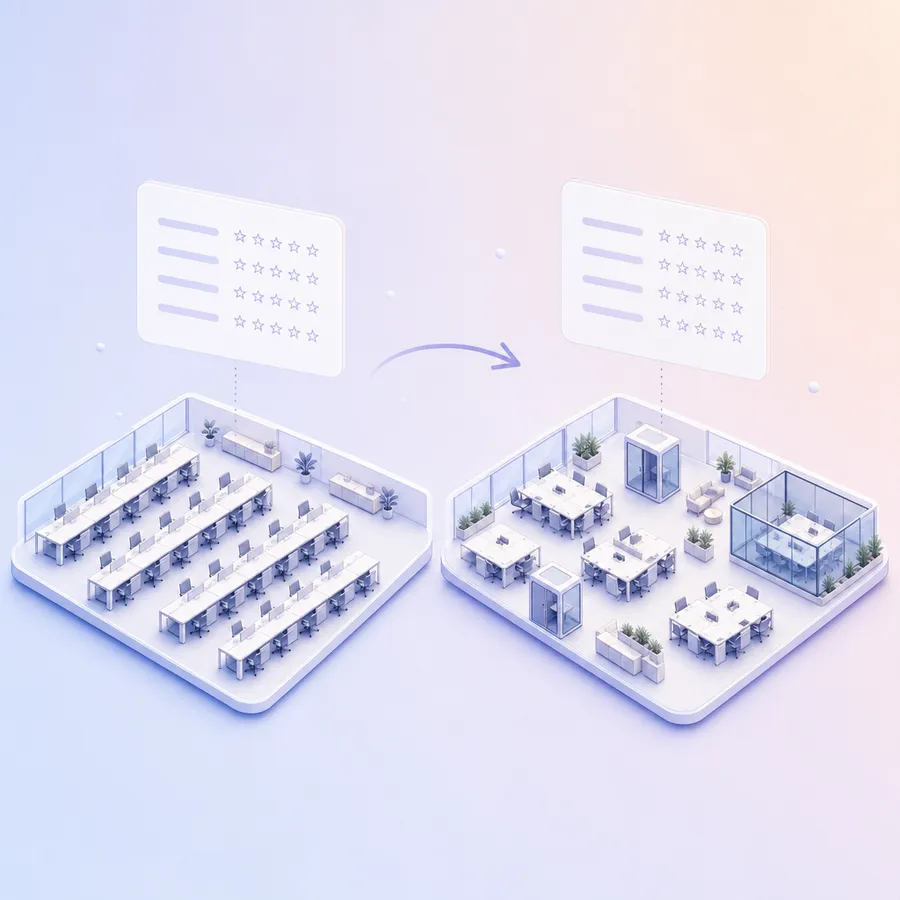
Layouts change behaviour in ways nobody planned. When two company headquarters moved to open plan to get people talking, face-to-face time fell by about 70 percent and email rose; at one of them, 52 staff went from 5.8 hours of face-to-face contact a day to 1.7.4 Run the core before the change and again once people have settled into the new layout, then compare statement by statement.
Compare results by where people sit
Averages hide the people a layout fails. In CBE data from more than 600 office buildings, people in open plan with low or no partitions were almost twice as likely to complain about their workspace as people in enclosed private offices, and sitting near a window lowered the odds of a complaint.2 The About you set asks both, so split the results before you act.
Presenting the results at an all-hands? Ask everyone the one-change question through a quick live poll first, and let the votes land before you reveal the survey chart. The poll set-up walkthrough covers sending one through Teams, Slack or email.
Turn the which-days answers into a desk count
Plan desks for the busiest day, not the weekly average. Here is the sum, with invented numbers for a team of 120.
The sum
Desks needed = people who plan to come in on the busiest day, plus a margin for visitors and changed plans. Count the ticks for each day in the which-days question. If only part of the team answered, scale each day up to the full head count before you compare.
A worked example
| Day | People who tick it | After a team-day rota |
|---|---|---|
| Monday | 46 | 52 |
| Tuesday | 78 | 63 |
| Wednesday | 71 | 66 |
| Thursday | 64 | 64 |
| Friday | 22 | 36 |
| Desks, with a margin of 8 | 86 | 74 |
All 120 people answered. Tuesday is the peak, so the plan needs 86 desks, roughly seven for every ten people. A rota that moves 20 office days off Tuesday and Wednesday onto Monday and Friday keeps the same 281 visits a week, but the peak drops to 66 and 74 desks cover it. Every figure here is invented to illustrate the steps; your own which-days totals go in the middle column.
Stated plans and actual visits can differ, so set this peak beside badge or booking counts for the same weeks before you sign a lease or order furniture.
Before anyone moves a desk: the short version
Got one minute of everyone's attention? These five tell you which days to plan for, what people come in to do, whether calls and meetings have a home, and what to fix, in their words.
- 01Which days do you usually work here?
- 02What do you mostly come into the office for?
- 03My private calls stay private here.
- 04I can get a meeting room when I need one.
- 05What would make coming into the office more worth your while?
Seven office statements on one chart
Enter the number of people behind each answer, for every rating statement you asked. Each bar shows the full spread, the weakest two get a Focus tag, and the page prints for your next team meeting.
- 1Type in the counts, and each bar shows the share who agree or strongly agree beside the share who do not.
- 2Pick the two weakest statements and hold them up against the one-change question. If they name the same problem, you have your first project.
- 3Split by where people sit before you decide. A low score on private calls may come from one open-plan floor, not the whole building.
- 4Post the chart where people work with the changes and a date, and repeat the core once those changes are in.
Office results
Office survey PDFs to print or pin up
A printed copy by the kitchen or at reception, with a box to drop it in, reaches people who never open survey emails. Both files suit Letter and A4 printers.
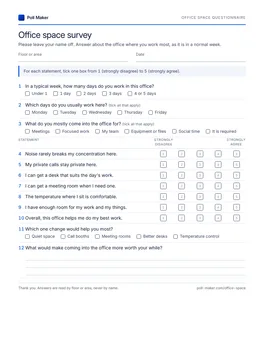
Office space questionnaire
Sheet one holds tick-box versions of the core 12; every optional set follows, ready to copy for one floor or the whole building.
Download PDF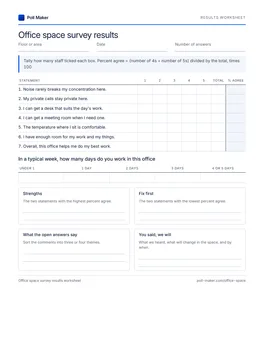
Results worksheet
Count the paper answers by hand, get percent agree per statement, then add up the days-in-office replies and pick the two fixes to start with.
Download PDFOffice managers' questions, answered
Short answers for planning the first round.
What questions should I ask employees about office space?
Start with how many days people come in, which days, and what they come in for. Then ask whether they can do that work: concentrate, take a private call, find a desk, get a room, stay comfortable and keep their things. Finish by asking for the single change they want most. The core 12 above does all of this. For engagement, workload or pay, browse the employee survey questions.
How do you measure office space utilization?
Count use with badge swipes, desk and room bookings or occupancy sensors, and survey the people using the space to learn why the numbers look the way they do. The table of sources shows which question each one answers.
How many desks do hybrid employees need?
Enough for the busiest day plus a small margin, not the weekly average. The desk count example works it through for a team of 120, before and after a team-day rota.
How often should you run an office space survey?
Before any move, redesign or new attendance policy, then again once people have settled into the change. Between changes, once a year suits most offices, with the one-change question as a quick poll in between.
Should an office space survey be anonymous?
Yes. Ask for a floor or area instead of a name, so you can still find the cold zone or the noisy corner. People say more about a space when nobody can trace the comment that the open-plan floor is unworkable.
Vague office questions, made specific
Vague questions about the office get vague answers. The survey question library has the same kind of fixes for every other topic.
Are you happy with the office?
Overall, this office helps me do my best work.
Happiness mixes the commute, the coffee and the colleagues. Asking about work gives you a number that moves when the space changes.
Is the office too noisy or too cold?
Noise rarely breaks my concentration here.
The temperature where I sit is comfortable.
Two problems in one question. Someone bothered by only one of them cannot answer honestly.
Would you like more meeting rooms?
I can get a meeting room when I need one.
How many people are in most of your meetings?
Everyone says yes to more. The pair tells you whether rooms really run short, and what size to build.
How often do you come to the office?
In a typical week, how many days do you work in this office?
Which days do you usually work here?
One person's often is another person's rarely. A count per week plus the days gives you a peak you can plan desks for.
Hear from the people who use the space
Send staff the core 12 online, about four minutes of their time, or leave printed questionnaires at reception.