What coordinators can ask mentees, from the first month to the final meeting
Ask the people being mentored whether it is working: help with their career, someone they can talk to, a mentor worth learning from, and goals that move. The core 12 fits the midpoint and the final meeting, while shorter sets check new pairs in their first month and give mentors a say.
- 35questions
- 12in the midpoint core
- 5 minto answer the core
- 5for mentors to answer
By Michael Hodge, BSc Psychology Updated September 2026
Questions for mentees and mentors, sorted by stage
Every question shows the choices a mentee picks from, followed by why a coordinator should care about the answer. Twelve boxes start checked; tick whole sets for your stage, and the builder, the printout and the copy button all follow your picks.
The core 1212 questions
Eight statements on the four things a mentee can judge, a meeting count, the main kind of help, and a pair of open questions. It suits the halfway point and the last meeting alike.
-
My mentor helps me plan my next career steps.
Strongly disagree12345Strongly agree1 = Strongly disagree, 5 = Strongly agreeCareer help, the first kind of mentoring support. A low score means meetings stay on this week's problems.5
-
My mentor has introduced me to people who can help.
Strongly disagree12345Strongly agree1 = Strongly disagree, 5 = Strongly agreeOpening doors is career help a mentee cannot get from a course. Track it apart from advice.
-
I can talk openly with my mentor about setbacks.
Strongly disagree12345Strongly agree1 = Strongly disagree, 5 = Strongly agreePersonal support. Without it, mentees bring only good news and the hard problems stay unsolved.5
-
My mentor listens before giving advice.
Strongly disagree12345Strongly agree1 = Strongly disagree, 5 = Strongly agreeSeparates a mentor who coaches from one who lectures. Read it next to question 3.
-
I have picked up good habits from my mentor.
Strongly disagree12345Strongly agree1 = Strongly disagree, 5 = Strongly agreeRole modeling, the third kind of support: learning by watching how the mentor works.5
-
My mentor and I agreed clear goals early on.
Strongly disagree12345Strongly agree1 = Strongly disagree, 5 = Strongly agreePairs without goals drift into friendly chats. A low score calls for a goal sheet, not a new mentor.
-
We meet often enough to keep things moving.
Strongly disagree12345Strongly agree1 = Strongly disagree, 5 = Strongly agreeAsks about rhythm rather than a number of meetings, because the right number differs from one program to the next.
-
I am making progress on my mentoring goals.
Strongly disagree12345Strongly agree1 = Strongly disagree, 5 = Strongly agreeThe mentee's own verdict on progress. Compare the midpoint and the end to see what the second half added.
-
How often did you meet your mentor in the past month?
Not at allOnceTwo or three timesFour or more timesA count is harder to shade than a rating. Mentees who answer Not at all are the first to call.
-
What has your mentor helped you with most?
Career directionSkillsConfidenceContactsSettling inShows where mentors actually spend their time. Compare it with the goals the program was set up to serve.
-
What is the most useful thing your mentor has done for you?
Open answerNames what to keep, and what to teach the next group of mentors. Answers are specific and often quotable.
-
What one change would make your mentoring more useful?
Open answerAsked for a single change, mentees name something the program can do. Group the answers into two or three themes.
The first month5 questions
Send these in week three or four of a new match. Ask for a name on this set, so the coordinator can help the pairs that have not got going.
-
How many times have you met your mentor so far?
Not yetOnceTwo or three timesFour or moreThe early-warning question. A mentee who has not met their mentor by week four needs a call this week.4
-
I feel at ease talking with my mentor.
Strongly disagree12345Strongly agree1 = Strongly disagree, 5 = Strongly agreeComfort comes first. If it is missing at week four, talk to both people before the match goes quiet.
-
We have agreed how and when we will meet.
Strongly disagree12345Strongly agree1 = Strongly disagree, 5 = Strongly agreeA standing time and a channel keep a busy pair meeting. Missing either one is the easiest thing to fix.
-
I had a say in who my mentor would be.
Strongly disagree12345Strongly agree1 = Strongly disagree, 5 = Strongly agreeParticipants' input into the mentoring process went with better mentoring in a study of formal programs.2
-
How is the match going so far?
Very wellWellToo early to sayNot wellGives mentees a quiet way to flag a poor match. Follow up every Not well in person.
After a session3 questions
Three questions a mentee can answer in a minute after any meeting. Use them for the first few sessions, or when a pair wants to track its own progress.
-
This session was worth the time it took.
Strongly disagree12345Strongly agree1 = Strongly disagree, 5 = Strongly agreeOne rating per meeting. A run of low scores shows a pair losing its way long before the midpoint.
-
What will you do before your next meeting?
Open answerTurns a good conversation into an action. A blank answer suggests the session had no clear point.
-
What should the next session focus on?
Same topicA new goalA problem at workCareer plansNot sureHands the mentor an agenda. Not sure, twice in a row, is worth a goal-setting conversation.
Growth by the final meeting5 questions
Add these to the core 12 for the closing survey. They ask about changes a mentee can already notice, and count a new role or a raise as a bonus.
-
I am clearer about where I want my career to go.
Strongly disagree12345Strongly agree1 = Strongly disagree, 5 = Strongly agreeCareer attitudes are among the outcomes most closely linked to having a mentor.1
-
I take on harder work more confidently than before.
Strongly disagree12345Strongly agree1 = Strongly disagree, 5 = Strongly agreeConfidence to take on stretch work, a change a mentee notices well before any promotion.
-
I know more people who can help my career than I did.
Strongly disagree12345Strongly agree1 = Strongly disagree, 5 = Strongly agreeChecks whether the introductions in question 2 turned into a wider network.
-
What has changed for you since the program began?
New skillNew projectNew rolePay riseJob offerNone yetTick all that applyResults in the mentee's own terms. Expect fewer role and pay changes than new skills: career success is the outcome least linked to mentoring.1
-
Will you keep in touch with your mentor after the program?
Yes, we have a planProbablyNot sureNoA plan to stay in touch says the match was worth something to the mentee. Read the Not sure answers with question 12.
The program itself5 questions
Questions about what the program provided around the pairs (training and a contact), whether mentees would come back, and how long they have been in it. Add them at the end.
-
The program's training prepared me to be a mentee.
Strongly disagree12345Strongly agree1 = Strongly disagree, 5 = Strongly agreeTraining rated as high quality went with better mentoring in formal programs, and mentee training counts too.2
-
I knew who to contact if the mentoring was not working.
Strongly disagree12345Strongly agree1 = Strongly disagree, 5 = Strongly agreeMentees stay in a stalled match when nobody told them where to go. A low score calls for a named contact.
-
How likely are you to recommend this mentoring program to a colleague?
0123456789100 = Not at all likely, 10 = Extremely likelyThe number to track from one cohort to the next. Read the open answers of low scorers for the reason.
-
Would you take part again?
Yes, as a menteeYes, as a mentorMaybeNoEveryone who ticks Yes, as a mentor belongs on your recruiting list for the next round.
-
How long have you been in this program?
Under 3 months3 to 6 months6 to 12 monthsOver a yearLonger matches have shown more benefit, so compare mentees by time in the program before judging it.3
Mentor version (mentors answer)5 questions
Five questions for the mentors, sent at the same points as the mentee survey so both views of each relationship line up. Keep it short: most mentors give this time on top of a full job.
-
I know what my mentee wants from our meetings.
Strongly disagree12345Strongly agree1 = Strongly disagree, 5 = Strongly agreeCompare it with the mentee's answer on goals (question 6). A gap means the pair has not talked it through.
-
My mentee comes to meetings with something to work on.
Strongly disagree12345Strongly agree1 = Strongly disagree, 5 = Strongly agreeThe mentor's view of engagement. A low score here and on goals points to a pair without a plan.
-
The program gives me the support I need as a mentor.
Strongly disagree12345Strongly agree1 = Strongly disagree, 5 = Strongly agreeMentors need backing too: guidance, a contact and time. A low score is for the program to fix, not the pair.
-
How much time does mentoring take you in a typical month?
Under 1 hour1 to 2 hours3 to 4 hoursOver 4 hoursTells you whether the program asks a realistic amount, and gives recruiters an honest number for new mentors.
-
What would help you mentor better next time?
Open answerThe best source of topics for the next mentor training session.
A survey for each stage of the mentoring cycle
Mentoring programs run in stages, and each stage needs a different question. Send the right set at the right time and each survey stays short.
| When | Send | What it catches |
|---|---|---|
| Week 3 or 4 of a match | The first month (5 questions, named) | Pairs that have not met, or started badly, while there is time to fix or re-pair them |
| After each meeting | After a session (3) | Sessions that drift; a minute on a phone |
| Midpoint | The core 12 | The kind of support that is missing, with half the program left to add it |
| Final meeting | Core 12, growth and program sets (22) | What changed for mentees, and what the next round should do differently |
| Midpoint and end | Mentor version (5), mentors only | The other side of the same relationships |
iMentor, which runs school-based mentoring, surveys its mentees and mentors three times each program year, and its mid-year survey is the shortest of the three.6 Pairing people before the program starts is a separate form with its own questions: SuperSurvey's mentor matching questionnaire covers that step.
Chart the cohort's answers in one report
Enter how many mentees chose each number for the eight statements. The chart turns the counts into percent agree, ranks the statements and marks the two to act on before the next round.
- 1Enter the numbers statement by statement. The report counts the two agree points together and divides by all the mentees who replied.
- 2Group the statements into the areas in the scoring table below: career help, personal support, role model and structure. A weak area points to one kind of mentor briefing.
- 3Read the answers to question 12 before you decide anything. Mentees usually name the fix themselves.
- 4Tell mentors and mentees what the cohort said and the one change the program will make, ideally at the next group session.
Cohort results
Score the three kinds of support a mentor gives
Mentoring research sorts what mentors do into three kinds of support: career help, personal support and being a role model.5 Allen, Eby and Lentz used the same three when they studied formal programs.2 The core 12 has statements for each of them, plus two on structure and one on progress.

To score an area, find the share of mentees who picked 4 or 5 for each of its statements, then average those shares. The example below is an invented cohort of 20 mentees at the midpoint.
| Area (questions) | Example cohort | If it comes out lowest |
|---|---|---|
| Career help (1, 2) | 11 and 7 agree: 45 percent | Ask each mentor for one introduction before the final meeting |
| Personal support (3, 4) | 17 and 18 agree: 88 percent | Cover listening and confidentiality in mentor training |
| Role model (5) | 13 agree: 65 percent | Invite mentees to sit in on part of the mentor's work |
| Structure (6, 7) | 12 and 10 agree: 55 percent | Give every pair a goal sheet and a standing meeting slot |
| Progress (8) | 12 agree: 60 percent | Read question 12 for what stands in the way |
This cohort feels well supported, yet only 7 of the 20 say their mentor has introduced them to anyone. The fix is specific: brief the mentors on introductions, then look for the change in question 2 at the end.
Survey habits that rescue a stalled pair
Four habits make the difference between results nobody reads and a survey that rescues a stalled pair and shapes the next cohort.

Start in the first month, not at the end
The early weeks decide whether a match lasts. In a study of 1,138 young people who applied to Big Brothers Big Sisters, those whose mentoring lasted a year or longer reported the most improvements, while those whose matches ended very early reported declines on several measures.3 MENTOR's standards ask programs to contact both mentor and mentee twice in the first month of a match and monthly after that.4 The first-month set does that check in writing: send it in week three or four, and phone any mentee who has not met their mentor yet.
How closely having a mentor is linked to each outcome (r)
Measure what mentoring changes first
A meta-analysis of youth, academic and workplace mentoring found mentoring linked to better outcomes of every kind. The links were small, and stronger for attitudes than for career results such as promotion and pay.1 So the growth set asks about career clarity, confidence and contacts, the changes a mentee can feel by the final meeting, and treats a new role or a raise as a welcome extra rather than the test of success.
Keep answers away from the mentor
Mentees rarely criticize someone who may later write their reference or sit on their promotion panel. Send the survey from the program coordinator, say in the first line that mentors never see individual answers, and report only on groups so large that no single pair stands out. At the first-month check a name helps, because the point is to rescue that pair; say so plainly and keep those answers with the coordinator.
Ask about training and a say in the pairing
In a study of formal mentoring programs, two design features stood out: participants' sense of having input into the mentoring process, and training they rated as high in quality. Both were consistently related to the career help, personal support and role modeling mentees received, and to the quality of the relationship.2 That is why the first-month set asks whether the mentee had a say, and the program set asks whether the training prepared them.
Mentees together for a cohort session? Project question 10 as a live poll; everyone votes from a phone: career direction, skills, confidence, contacts or settling in. The spread shows at a glance where your mentors spend their time. Never run one in a room before? This walkthrough for making a poll takes a few minutes.
A group session check-in in five questions
Only a few minutes at a group session? These five cover career help, openness, meeting rhythm and progress, and end with the change mentees want.
- 01My mentor helps me plan my next career steps.
- 02I can talk openly with my mentor about setbacks.
- 03We meet often enough to keep things moving.
- 04I am making progress on my mentoring goals.
- 05What one change would make your mentoring more useful?
Questions to ask your mentee face to face
The survey tells the program how pairs are doing. Inside the meetings, mentors need a different kind of question: open ones that get a mentee talking. These are grouped by the point in the relationship where they help most.
At the first meeting
- What made you want a mentor right now?
- What would make these meetings worth your time?
- What have you already tried on the goal you brought?
- How do you like to hear feedback: straight, or with some warm-up?
- How should we stay in touch between meetings?
At regular check-ins
- What has happened since we last spoke?
- Where did you get stuck, and what did you do next?
- What would you do if I were not here to ask?
- Who else should you talk to about this?
- What do you want to have done by next time?
When things feel stuck
- Is this still the goal you care about most?
- What is getting in the way of our meetings?
- What should I do more of, or less of?
At the last meeting
- What are you doing now that you were not doing at the start?
- What advice would you give the next mentee in this program?
- What do you still want to work on, and who can help?
- How would you like to keep in touch?
Mentors who want feedback on their own mentoring can answer the mentor version above; the mentee's side comes from the core 12. For a program built around new starters or interns, the employee survey questions page lists sets for the months that follow.
Hand out, leave the room, collect in an envelope
Many programs gather mentees as a group a few times a year, and paper suits that moment: hand out the forms, leave the room, and collect them in an envelope. Each file is sized to print on US letter and A4 sheets.
Only print the sets that match where your pairs are in the mentoring cycle.
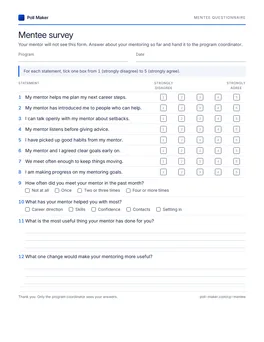
Mentee questionnaire
Page one: the core 12, ready for a pen, with room to write under questions 11 and 12. The pages after it hold the first-month, session, growth, program and mentor sets.
Download PDF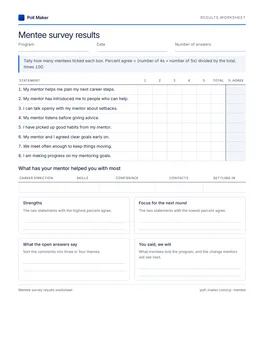
Cohort results worksheet
Tally the eight statements and question 10, work out percent agree with a pencil, then note the strengths, the focus and the change the next cohort will notice.
Download PDFMentoring form questions that need a second draft
Three questions that turn up on many mentoring forms, and what to ask instead. The survey question library covers every question type with examples.
Was your mentor helpful and available?
My mentor helps me plan my next career steps.
We meet often enough to keep things moving.
Two questions in one. A mentee with a helpful but busy mentor has no honest answer to give.
How would you rate your mentor?
My mentor listens before giving advice.
A rating of the person turns into a thank-you note. A statement about one behavior gives the mentor something to keep or change.
Has this program advanced your career?
I am clearer about where I want my career to go.
Promotions take longer than most programs run. Clarity about direction is a change mentees can already report.
What program coordinators ask
Short answers to the questions that come up before a mentee survey goes out.
What questions should be in a mentee survey?
Ask about the four things a mentee can judge: career help, personal support, whether the mentor is someone to learn from, and whether goals and meetings keep things moving. Then a count of meetings, the kind of help that mattered most, and room for comments on the best thing and one change. That is the core 12, about five minutes of a mentee's time.
How do you evaluate a mentoring program?
Survey mentees at the midpoint and the end, and mentors with their own short set. Put the answers next to the records you already keep, such as meetings held and pairs still active, then compare cohorts. The program evaluation questions help when you need to judge the program as a whole.
When should you survey mentees?
In week three or four with the first-month set, briefly after meetings if you want session feedback, at the midpoint with the core 12, and at the final meeting with the core plus the growth and program sets. The stage table lays it out.
Should a mentee survey be anonymous?
The midpoint and end surveys should be, or at least confidential: mentors never see individual answers, and results go out for groups only. The first-month check works better with names, because its job is to help a specific pair. Tell mentees which kind each survey is.
Can I use these questions in a youth mentoring program?
Yes, with lighter wording for younger mentees. Read the statements aloud to children under 12, offer three answers instead of five (yes, a bit, no) and swap the career questions for school and friendship ones. Programs that follow MENTOR's standards also check in with a parent or guardian.4
What should a mentor survey ask?
Whether the mentor knows what the mentee wants, whether the mentee comes prepared, whether the program backs the mentor, and how much time mentoring takes. The mentor version covers all four in five questions. Send it at the same points as the mentee survey so the two views line up.
Check on your pairs this month
Send the first-month questions to your newest pairs this week, or run the core 12 as a midpoint survey mentees finish on their phones.