Free church survey questions for members and regular attenders
Good church survey questions ask about things people live every week: whether they belong, whether worship helps them through the week, whether guests are made welcome and whether leaders listen. For most worshipers the core 12 is a six-minute job, pencil or phone. Then bolt on worship, online, groups, serving, guest or pastor search questions as needed.
- 38questions
- 12in the core
- 6 minfor the core
- 7sets to add
By Michael Hodge, BSc Psychology Updated September 2026
All 38 church survey questions
Your survey starts with the twelve core questions checked. Beside every question sit the choices a worshiper picks from and a note for the council on reading the result. Check more in any set below, or take a whole set, then send it out as a link, run off pew copies or paste the wording elsewhere.
The core 1212 questions
Eight statements about belonging, worship, preaching, faith, welcome, care, leadership and news, then how often people worship, how many friends they have invited, and two open questions. Twelve is a whole congregation survey by itself.
-
I feel I belong in this church family.
Strongly disagree12345Strongly agree1 = Strongly disagree, 5 = Strongly agreeThe heart of the survey. Low scores from people who have come for years point to a different problem than low scores from newcomers.
-
Worship here helps me face the week ahead.
Strongly disagree12345Strongly agree1 = Strongly disagree, 5 = Strongly agreeAsks what worship does for people on Monday, not whether they enjoyed Sunday.
-
The sermons help me apply my faith to daily life.
Strongly disagree12345Strongly agree1 = Strongly disagree, 5 = Strongly agreeThe relevance of the preaching, which is what people write about most in the open answers.
-
I am growing in my faith through this church.
Strongly disagree12345Strongly agree1 = Strongly disagree, 5 = Strongly agreeSeparates growth the church helps with from growth people find elsewhere. Read it by how long people have attended.
-
First-time visitors are made to feel welcome here.
Strongly disagree12345Strongly agree1 = Strongly disagree, 5 = Strongly agreeMembers watch how guests are treated every week. Compare it with the guest set, where visitors answer for themselves.
-
People here would help me through a hard time.
Strongly disagree12345Strongly agree1 = Strongly disagree, 5 = Strongly agreeCare, asked as something people can picture. It often scores lower among people who are not in a small group.
-
Leaders listen to members before big decisions.
Strongly disagree12345Strongly agree1 = Strongly disagree, 5 = Strongly agreeTrust in how decisions get made. Worth hearing before a building project or a change to the services.
-
I hear about church events in time to take part.
Strongly disagree12345Strongly agree1 = Strongly disagree, 5 = Strongly agreeCommunication judged by its result. A low score usually means news goes out through one channel that half the church never checks.
-
How often do you worship with us, in person or online?
Every week2-3 times a monthOnce a monthA few times a yearRarelyThe split that explains most other answers. Weekly worshipers and occasional ones seldom describe the church the same way.
-
In the last six months, how many people have you invited to a service here?
NoneOneTwoThree or moreNot sureA count of real invitations: the question Lifeway Research put to churchgoers in place of a would-you-recommend score.5
-
What does our church do well that we should never lose?
Open answerTells leaders what to protect when anything changes. People answer this one generously.
-
If you could change one thing about our church this year, what would it be?
Open answerOne change per person keeps the answers short enough to sort into a handful of themes.
Worship and preaching4 questions
For when the service itself is up for discussion: a new service time, a change of music, or a new preacher settling in.
-
The length of our main service is:
Too shortA little shortAbout rightA little longToo longShows which way to adjust. An average hides a church split between the two ends, so read the spread.
-
I can join in with the songs we sing.
Strongly disagree12345Strongly agree1 = Strongly disagree, 5 = Strongly agreeParticipation rather than taste. Arguments about style stall; songs nobody knows can be fixed.
-
A newcomer could follow our sermons easily.
Strongly disagree12345Strongly agree1 = Strongly disagree, 5 = Strongly agreeMembers judge the preaching through a guest's ears, which is kinder and more useful than rating the preacher.
-
Which parts of the service help you most?
SingingThe sermonPrayerCommunionBible readingsQuiet momentsTick all that applyShows where people meet God in the service, so any change protects the parts that matter most.
If you worship online4 questions
For people who mostly watch the livestream. Send it through the stream and your email list as well as handing it out in the building.
-
How do you usually join our services?
In person onlyMostly in personHalf and halfMostly onlineOnline onlySorts every other answer by how people take part. Show the rest of this set only to people who watch at least some of the time.
-
When I watch online, I feel part of this church.
Strongly disagree12345Strongly agree1 = Strongly disagree, 5 = Strongly agreeThe connection gap. Pew Research Center found online viewers feel far less connected to fellow worshipers than people in the room.4
-
What is the main reason you watch online?
ConvenienceHealthDistanceWork or familyOtherConvenience was the reason chosen most often in Pew Research Center's survey, and it needs a different response than health.4
-
What would help you take part more from home?
Live chatOnline prayer requestsOnline small groupA phone callNothingTick all that applyA shortlist your media team can actually add, ranked by the people who would use it.
Small groups and care4 questions
Whether people are known and looked after between Sundays, not only greeted on them.
-
Are you part of a small group, class or Bible study here?
Yes, regularlyNow and thenNot yet, but interestedNo, not interestedThe "not yet, but interested" answers are your next group, already waiting to start.
-
Someone gets in touch if I miss church for a while.
Strongly disagree12345Strongly agree1 = Strongly disagree, 5 = Strongly agreeFollow-up is where people quietly drift away. A low score is a job for a care team, not for the pastor alone.
-
I know who to call here if I need prayer or a visit.
Strongly disagree12345Strongly agree1 = Strongly disagree, 5 = Strongly agreeTells you whether pastoral care is visible to people who have not needed it yet.
-
What would make it easier for you to get to know people here?
Open answerNewer members answer in detail, and their ideas are usually cheap: name tags, a shared meal, a class for newcomers.
Serving and giving4 questions
Ask these before a ministry fair or a budget season. Keep the survey anonymous and give willing helpers a separate sign-up sheet.
-
Do you serve on a team or in a ministry here?
Every weekNow and thenI used toNot yet, but keenNoShows how much of the work rests on a few people, and how many are ready to start.
-
Which areas would you be willing to help with?
Kids and youthMusicWelcome teamTech and mediaOutreachMealsTick all that applyThe size of each pool of helpers before a ministry fair. A sign-up sheet then collects the names.
-
My skills are put to good use in this church.
Strongly disagree12345Strongly agree1 = Strongly disagree, 5 = Strongly agreeWhether serving fits people's gifts, not just the rota. Low scores tend to come before burnout and quiet exits.
-
Our budget and spending are reported clearly.
Strongly disagree12345Strongly agree1 = Strongly disagree, 5 = Strongly agreeAsks about openness, not about giving. A low score has a quick fix: one clear page in the annual report.
First-time guests (guests answer)4 questions
Visitors answer these, not members. Put them on a welcome card at the door, or send the link within two days of a first visit.
-
How did you first hear about us?
A friend invited mePassing byOnline searchSocial mediaOtherShows which way in actually brings people, so you know where to spend time and money.
-
Apart from the door greeter, did anyone talk with you?
YesNoNot sureThe simplest welcome test there is. Set it beside the members' own view of how visitors are treated.
-
How likely are you to come back?
Very likelyLikelyNot sureUnlikelyVery unlikelyAn early read on a first visit. Read it next to whether anyone spoke to them.
-
What should the next first-time guest know before they come?
Open answerGuests write your welcome page for you: parking, what to wear, where the children go.
Before a pastor search or new plan4 questions
Members answer these while the council drafts a plan or a search committee writes the church profile.
-
Which ministry should get more attention next year?
Children and youthSmall groupsCare for membersLocal outreachWorship and musicA priority vote the council can read at a glance. It also works as a live poll at a church meeting.
-
I know where our church is heading.
Strongly disagree12345Strongly agree1 = Strongly disagree, 5 = Strongly agreeTells leaders whether the vision has reached the pews or stayed in the minutes.
-
What matters most in our next pastor?
PreachingPastoral careTeachingLeading changeReaching new peopleYouth and familiesTick all that applyHands the search committee the congregation's priorities before anyone is interviewed.
-
What should a new pastor understand about our church in their first month?
Open answerThe answers become the heart of the church profile, written by the people who know the church best.
About you (optional)2 questions
Only for comparing groups. Two questions about the person are enough in most churches, and a group of fewer than about ten people should never appear in a report on its own.
-
Which age group are you in?
Under 2525 to 4445 to 6465 or olderPrefer not to sayAnswers about music and service times often split by age. Report a band only when enough people are in it.
-
How long have you been part of this church?
Under a year1 to 5 years6 to 15 yearsOver 15 yearsCompares newcomers with long-standing members, who often see welcome and change very differently.
Add the sets that fit the decision in front of you
The core 12 goes out every time. The sets you add depend on what the leadership has to decide next.
| When | Add | Leaders decide |
|---|---|---|
| Annual review | Worship and preaching; Serving and giving | Where time and money go next year |
| A pastor is leaving | Before a pastor search or new plan | The church profile and the search brief |
| Services went hybrid | If you worship online | What to add for people watching at home |
| A push to welcome newcomers | First-time guests, handed to visitors | What to fix at the door and after the service |
| Groups are relaunching | Small groups and care | How many groups to start, and who could lead them |
Keep each round under about 25 questions. Sending the same core every year gives you eight numbers to line up side by side, which is how you find out whether a change worked. For clubs, parish councils and other groups that want to hear from their people, the satisfaction survey questions collection has more sets to start from.
Reaching the whole congregation, not just the inbox
The people who open an emailed survey are rarely the whole church. These four habits reach everyone else.

Pass it along the pews during the service
When it ran in 2001, the U.S. Congregational Life Survey was the largest survey of American worshipers ever conducted: every worshiper aged 15 and older at services on one April weekend filled in a paper questionnaire, more than 300,000 people in over 2,000 congregations.1 Its successor, the U.S. Congregational Vitality Survey, still arrives as a box of paper surveys.2 Set aside eight minutes near the end of the service, put pencils in the pews, and show a scan code on the screen for anyone who would rather use a phone.
Worshipers who feel strongly connected to others at the service
Survey the people watching at home
About a quarter of U.S. adults (27%) watch religious services online or on TV, and they feel much less connected than the people in the room: 65% of regular in-person attenders feel a strong bond with fellow worshipers, against 28% of online viewers.4 Post the link in the livestream chat and the stream description, send it by email, and add the online set, which lets you set the two groups side by side rather than averaging them together.
Keep it open for a month, and remind people
One Sunday is not enough time. The Hartford Institute for Religion Research, which runs congregational surveys for churches of every size, recommends keeping a survey open for at least four to six weeks, with regular reminders.3 Announce it from the front on two Sundays, run it in the bulletin and the newsletter, and set out a table of paper copies after the service in the final two weeks.

Read it with the leaders, then tell the church
Presbyterian Church (U.S.A.) Research Services advises each congregation to give a whole leadership meeting to reviewing its results together, and its researcher's advice is to celebrate your strengths rather than dwell on the negative.2 Within a month, tell the congregation three things: what people value most, the one area you will work on, and the first change they will notice. Hearing back is what makes people willing to answer the next one.
At a congregational meeting, a single question on the screen gets everyone talking. Put the ministry priority question up as a live church poll, let the room answer from the pews, and reveal the result before the discussion starts. Our walk-through on making a poll explains links, scan codes and embedding.
Where the church is strong, and where to start
Once the pew sheets are counted, enter how many worshipers circled each number on the eight statements in the core. Every statement gets a bar showing the share who agree, with the strongest and the weakest marked, so the council can print one page and start from the same picture.
- 1Every 4 and 5 counts as agreement; give each statement as a share of the people who answered it. Shares are easier to talk through than averages.
- 2Compare the eight statements with each other, and next year with this year. Comparing your church with another one tells you very little.
- 3Split the results by how often people worship. If occasional worshipers score belonging far lower than weekly ones, the fix is connection, not the sermon.
- 4Before the meeting, group the written answers under a few headings such as worship, people, communication and buildings. The biggest heading usually explains the weakest bar.
Congregation survey results
Pew sheets for people who would rather use a pencil
Plenty of people would rather answer with a pencil than a phone. Print one copy per seat, set out pencils, and ask the ushers to collect the sheets in a box at the door.
Only want the core on the pew sheet? , one copy per seat.
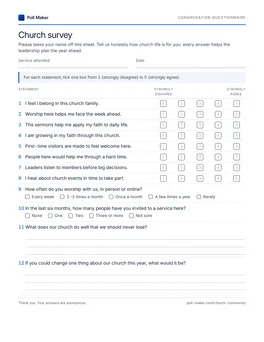
Congregation questionnaire
The twelve core questions take up sheet one, ready for a pencil. The worship, online, groups, serving, guest, planning and personal sets run on after it.
Download PDF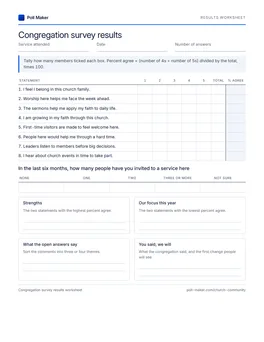
Council results worksheet
A tally sheet for the council: add up the eight statements and the invitations question from the pew copies, work out a percent for each, and settle on one focus for the year.
Download PDFA half-sheet version for the Sunday bulletin
Want a quick reading between full surveys? Print these five on a half sheet in the bulletin, or put them on the screen after the service. A minute is enough to answer them, and they cover belonging, worship, welcome and trust, with room for one idea.
- 01I feel I belong in this church family.
- 02Worship here helps me face the week ahead.
- 03First-time visitors are made to feel welcome here.
- 04Leaders listen to members before big decisions.
- 05If you could change one thing about our church this year, what would it be?
Four familiar church questions, asked more clearly
Four questions found on many church surveys, each with a clearer replacement. Our page on writing survey questions covers every question type.
How satisfied are you with our church?
I feel I belong in this church family.
Worship here helps me face the week ahead.
One overall score gives leaders nothing to change. Statements about belonging and worship point to a part of church life someone can work on.
Would you recommend our church to a friend?
In the last six months, how many people have you invited to a service here?
A recommendation is a guess about the future. An invitation either happened or it did not, so the count is honest and easy to compare next year.
Are the sermons and the music meaningful to you?
The sermons help me apply my faith to daily life.
I can join in with the songs we sing.
Two subjects in one question. Someone who loves the preaching but struggles with the songs cannot answer it truthfully.
How is your relationship with God?
I am growing in my faith through this church.
A private question gets a polite answer or a skipped page. The better version asks what the church adds, which is the part leaders can change.
Church survey questions people ask first
Quick answers for pastors, church councils and planning teams.
What questions should be on a church survey?
Start with belonging, worship, preaching, faith, welcome, care, leadership and communication: the eight statements in the core 12. Add how often people worship, one question about invitations and two open questions. Then add only the sets that match a decision you are about to make.
How many questions should a church survey have?
About 12 to 25. The core 12 takes around six minutes, and one or two added sets keep the whole survey under ten. Longer surveys get fewer finished answers, especially on paper.
Should a church survey be anonymous?
Yes. Ask for no names on the survey itself, say in the announcement who will read the answers, and keep every reported group too big for any one person to be spotted. If you want volunteers or prayer requests, collect names on a separate card.
How often should a church survey its members?
Once a year for the core 12 suits most churches. Pick a Sunday in the same season each year, say early autumn, so the numbers line up. In between, run a short set when a decision comes up, such as a new service time or a pastor search.
How do we get more people to fill it in?
Give it time in the service, keep it open for four to six weeks with reminders, and offer paper and a link side by side.3 Above all, report back on the last survey before you ask for the next one.
Can we use these questions for a pastor search?
Yes. Add the pastor search set to the core 12. The priorities question and the open question about a new pastor's first month give the search committee the congregation's view in its own words, ready for the church profile.
Put it in the bulletin this Sunday
Put the church survey in front of your congregation this Sunday: load it into the builder and print the link in the bulletin, or run off a stack of pew copies.