A youth group questionnaire on belonging, leaders and faith
Good youth ministry survey questions ask teens things they can answer from their own week: whether they feel welcome, whether a leader knows them, and whether the talks connect to real life. Start with the core 12, which takes about five minutes on a phone, then add a set for leaders, faith, a retreat or next term's plans.
- 35questions
- 12in the core
- 5 minon a phone
- Grade 6+can answer it
By Michael Hodge, BSc Psychology Updated September 2026
All 35 youth group survey questions
The core 12 is ticked already. Add a whole set with one button, or tick individual questions across the sets. Each one lists the answers teens choose from and what those answers mean for your ministry. Send your selection to phones, print it for youth night or copy the wording elsewhere.
The core 1212 questions
Seven statements about belonging, leaders, honesty and faith, then how often they come, what gets in the way, the part of the night they care about, and two open questions. Run it as it is at any point in the year.
-
I feel welcome at youth group, even without my friends.
Strongly disagree12345Strongly agree1 = Strongly disagree, 5 = Strongly agreeThe newcomer test. Regulars who only feel welcome inside their own circle score this lower than you expect.
-
I have at least one close friend in this group.
Strongly disagree12345Strongly agree1 = Strongly disagree, 5 = Strongly agreePeer friendship is what keeps teens coming. A low score points to cliques or a group that never mixes.
-
A leader here knows what is going on in my life.
Strongly disagree12345Strongly agree1 = Strongly disagree, 5 = Strongly agreeTells you whether every teen has an adult who knows them, or only the ones who stay late to talk.
-
I can be honest here about my doubts and questions.
Strongly disagree12345Strongly agree1 = Strongly disagree, 5 = Strongly agreeShows whether the room feels safe for real questions or only for the right answers.
-
What we talk about helps me in my everyday life.
Strongly disagree12345Strongly agree1 = Strongly disagree, 5 = Strongly agreeRelevance of the teaching. Low scores mean the talks feel like church content, not help for school, home and friends.1
-
Youth group is helping my faith grow.
Strongly disagree12345Strongly agree1 = Strongly disagree, 5 = Strongly agreeThe ministry question itself. Read it by grade: younger and older teens often answer it very differently.
-
I would bring a friend to youth group.
Strongly disagree12345Strongly agree1 = Strongly disagree, 5 = Strongly agreeWhether teens are proud of the group. A low score here with high scores elsewhere often means the night is fine but not something they would show a friend.
-
How often do you come to youth group?
Most weeks2-3 times a monthOnce a monthA few times a yearThis is my first timeLets you split every other answer by regulars and occasional visitors, who rarely see the group the same way.
-
What makes it hard to come more often?
HomeworkSports or clubsA jobGetting a rideFriends not thereNothingTick all that applySeparates problems you can fix, like rides and timing, from ones you can only plan around.
-
Which part of the night matters most to you?
Hanging outWorshipThe talkSmall groupGamesShows where to put your time and your best volunteers. Read the spread, not only the winner.
-
What is the best thing about youth group right now?
Open answerNames what to protect when you change things. Teens are specific when they talk about what they love.
-
If you ran youth group for a month, what would you change?
Open answerGives teens ownership of the answer. Expect ideas about food, music and timing, and a few that change the whole night.
Faith and growth6 questions
For church groups: how faith grows during the week, not only on youth night.
-
How often do you pray or read the Bible on your own?
Most days2-3 times a weekOnce a weekNow and thenHardly everA habit teens can report honestly. Compare it with the faith statement in the core.
-
I understand what our church believes and why.
Strongly disagree12345Strongly agree1 = Strongly disagree, 5 = Strongly agreeShows whether teaching has turned into understanding a teen could put in their own words.
-
I could explain my faith to a friend at school.
Strongly disagree12345Strongly agree1 = Strongly disagree, 5 = Strongly agreeConfidence to talk about faith outside church, the place where it gets tested.
-
Adults at church, not only leaders, know my name.
Strongly disagree12345Strongly agree1 = Strongly disagree, 5 = Strongly agreeTells you whether teens belong to the whole church or only to the youth room.
-
I get chances to serve or lead, not only to watch.
Strongly disagree12345Strongly agree1 = Strongly disagree, 5 = Strongly agreeTeens who help run things stay involved. A low score is a list of jobs you have not handed over yet.
-
What question about God or faith should we talk about next?
Open answerYour next teaching series, written by the group. Many teens ask here what they would never ask out loud.
About your leaders5 questions
Teens rate the adult leaders and volunteers. Share the results with the whole team, never leader by leader.
-
Leaders listen more than they lecture.
Strongly disagree12345Strongly agree1 = Strongly disagree, 5 = Strongly agreeWhether small groups are conversations or a second talk.
-
Leaders treat everyone in the group fairly.
Strongly disagree12345Strongly agree1 = Strongly disagree, 5 = Strongly agreeTeens notice favorites quickly. Read it with the welcome and friendship statements.
-
A leader checks in when I miss a few weeks.
Strongly disagree12345Strongly agree1 = Strongly disagree, 5 = Strongly agreeFollow-up is the easiest leader habit to measure and the easiest to fix with a simple rota.
-
Leaders keep what I share private unless I am unsafe.
Strongly disagree12345Strongly agree1 = Strongly disagree, 5 = Strongly agreeTrust with an honest limit. Teens should hear that leaders act when someone is at risk.
-
What does a leader do that helps you most?
Open answerConcrete examples to pass on when you train new volunteers.
Planning next term4 questions
Ask these before you set the calendar, so the program reflects what the group will actually turn up for.
-
Which of these would you come to?
Service projectWeekend retreatGame nightBible studySports dayMovie nightTick all that applyReal interest in each event type before you book anything.
-
Which topics would you like us to talk about?
FriendshipsStress and anxietyDatingDoubts about GodThe futureFamilyTick all that applyA topic list chosen by the group. Anonymous answers surface subjects teens avoid naming in front of friends.
-
How do you want to hear about youth events?
Group chatInstagramText messageEmailAt churchStops you announcing events where nobody is looking.
-
Which evening works best for youth group?
SundayWednesdayFridayAnother nightAny nightWorth asking once a year: school, sport and work schedules change with every grade.
After a retreat or camp5 questions
Send these within two days of getting home, while the weekend is still fresh. They work for mission trips and lock-ins too.
-
I felt safe and looked after the whole time.
Strongly disagree12345Strongly agree1 = Strongly disagree, 5 = Strongly agreeThe first thing parents will ask about, and the one thing a trip cannot get wrong.
-
The schedule left time to rest and talk.
Strongly disagree12345Strongly agree1 = Strongly disagree, 5 = Strongly agreePacked schedules wear teens out. A low score tells you to cut a session next time.
-
Would you sign up for the next one?
DefinitelyProbablyNot sureProbably notDefinitely notYour early headcount for next year, and a fair verdict on this one.
-
What moment from the trip will you remember?
Open answerShows which part of the trip actually reached them. Often it is not the main session.
-
What one thing would make the next trip better?
Open answerOne change per teen keeps the answers short and easy to sort.
About you (optional)3 questions
Add these to compare middle and high schoolers, or newcomers and regulars. Never report a group so small that one teen could be picked out.
-
What grade are you in?
Grade 6 to 8Grade 9 to 10Grade 11 to 12Finished schoolPrefer not to sayThe most useful split in youth ministry. Middle and high schoolers often want different nights.
-
How long have you been coming to youth group?
Under 3 months3 to 12 months1 to 2 yearsOver 2 yearsNewcomers tell you what the door feels like; long-timers tell you what the group has become.
-
How did you first come to youth group?
A friend invited meMy family goes hereA school or eventSocial mediaOtherShows how new teens find you, so you know which way in to put effort behind.
Which version to run through the ministry year
One long survey a year gets tired answers. Four short ones, each timed to a decision, get honest ones.
| When | Ask | You decide |
|---|---|---|
| Start of the school year | Core 12 and Planning next term | The night, the topics and the calendar |
| Two days after a retreat | After a retreat or camp | Whether to run it again, and what to cut |
| Middle of the year | Core 12 and About your leaders | Leader training and small group changes |
| Before summer | Core 12 and Faith and growth | Next year's teaching plan |
Running the core each time gives you the same seven statements three times a year, so you can see whether a change worked. Keep the answers from each round side by side, and read the feedback survey questions page for surveys parents and volunteers can answer too.
Read the results with your leadership team
Type in how many teens picked each answer on the seven core statements. Each one gets a bar showing how many agree, and the report tags the strongest and the weakest, so the team can see in one look where the group is thriving and which statement to work on next term.
- 1Count answers of 4 and 5 as agreeing. The report shows that share for each statement, which is easier to talk about than an average.
- 2Split the results by the attendance question. If occasional visitors score welcome far lower than regulars, start with newcomers.
- 3Sort the open answers into piles before the meeting: rides and timing, the talk, friends, leaders. The biggest pile usually explains the lowest bar.
- 4Pick one change for the next month and say it out loud on youth night. Run the core again at the next point in the calendar to see if it moved.
Core 12 results
A survey teens can tell will change something
Teens can tell a survey that will change something from one that fills a slot in the program. These four habits make yours the first kind.
Why young adults kept going to church after high school
Measure what keeps teens connected
In a Lifeway Research survey of 2,002 young adults who went to church as teenagers, 66% stopped attending for at least a year between 18 and 22. Those who stayed most often said church was vital to their relationship with God (56%) and that they wanted it to guide their everyday decisions (54%).1 Among those who left, 29% no longer felt connected to people in their church,1 and 23% said they never connected with students in the student ministry.2 So the core asks about friends, a leader who knows them, and teaching that helps on a Tuesday.

Use ten minutes of youth night
Nearly every teen has a phone within reach: Pew Research Center found that 95% of U.S. teens aged 13 to 17 have access to a smartphone.3 Put the survey link on the screen as a scan code at the start of the night, before games, and keep printed copies for anyone without a phone. Answers collected in the room come back from the quiet teens as well as the keen ones.

Write every statement the positive way round
Younger teens trip over negative wording. In a survey experiment with children and young adolescents, Borgers, Sikkel and Hox found they answered negatively worded questions consistently differently from positive ones, and that about four answer options worked best at that age.4 Every statement here is positive, so a high score is always a good sign. With a middle school group, a four-point version without the neutral middle works too.

Show the group what you heard
Within two weeks, spend five minutes of youth night on the results: the two strongest statements, the lowest one, a few open answers read aloud, and one thing that changes now. Teens who see their answers used fill in the next survey properly. Put the change in the parent update as well.
For a quick read of the room in the middle of the night, one question is enough. Put it up as a live poll teens answer on their phones and show the results on the screen straight away. Making a poll covers links, codes and embedding, and our fun poll questions make good icebreakers before the serious part.
Surveying teens: parents, names and safety
Most of your group are minors. Three habits keep the survey safe for them and keep parents on your side.
Tell parents before you ask
Send parents the questions a week ahead in your usual update, and say how you will use the answers. It gives parents the chance to ask questions before their teen sees it, and some will want to hear the results.
Collect no names
Leave out name, email and phone. A grade band is all you need to compare groups. On paper, have teens fold their sheet and drop it in a box, and ask a volunteer who does not lead a small group to collect them.
Know what happens when an answer worries you
An open answer can mention self-harm, abuse or a crisis at home. Before the survey goes out, agree with your pastor who reads the open answers and what they do next under your church's safeguarding policy. That is also why the leaders set says private unless a teen is unsafe.
When phones stay in the basket
Some groups meet where phones stay in a basket, and some teens simply prefer pen and paper. Print enough for everyone and bring pencils.
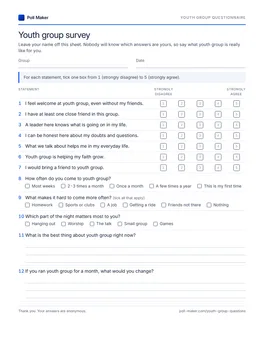
Youth group questionnaire
Page one holds the core 12 as tick boxes. Faith, leaders, planning, retreat and About you follow on later pages.
Download PDF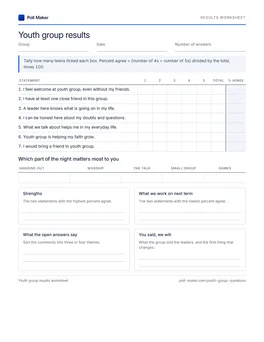
Leaders' results worksheet
Tally the seven core statements and the favorite-part question by hand, then turn each into a percent and choose next term's focus.
Download PDFOne minute at the start of the night
No time for a full survey? These five take a minute at the start of the night and cover welcome, friends, leaders and relevance, with one open question for ideas.
- 01I feel welcome at youth group, even without my friends.
- 02I have at least one close friend in this group.
- 03A leader here knows what is going on in my life.
- 04What we talk about helps me in my everyday life.
- 05If you ran youth group for a month, what would you change?
Polite answers, and how to get past them
Questions teens misread or answer to please you. More fixes for every question type are in the guide to survey questions.
Do you love youth group?
I would bring a friend to youth group.
Teens answer the weak version politely. Whether they would bring a friend shows how they really feel about it.
Are the leaders and the lessons good?
Leaders listen more than they lecture.
What we talk about helps me in my everyday life.
Two subjects in one question. A teen who likes the leaders but not the talks cannot answer it.
Don't you think we should have more game nights?
Which of these would you come to? (tick all that apply)
The weak version is negative and leading at once. A tick list shows real interest across every option.
How is your spiritual life?
How often do you pray or read the Bible on your own?
A vague question gets a vague "good". A habit gives an answer you can compare next term.
What youth pastors ask before surveying teens
For youth pastors, leaders and volunteers running their first survey.
How do I make a survey for a youth group?
Pick the core 12 and at most one extra set, open them in the builder, and change "youth group" to the name your group uses. Share the link as a scan code on youth night, or print the questionnaire. Keep it under ten minutes.
Should a youth group survey be anonymous?
Yes. Teens answer honestly only when no leader can trace an answer back to them. Ask for no names, use a grade band instead of age, and report results only when a group has about ten or more teens in it.
Do I need parents' permission to survey teens at church?
Follow your church's policy for minors. At the least, tell parents before the survey goes out and show them the questions. If your survey asks about sensitive topics, ask for their consent first.
What questions should I ask about youth leaders?
Ask about things teens see every week: whether leaders listen, treat everyone fairly, follow up when someone is missing and keep what they share private. The leaders set asks all four, plus one open question.
Can I use these questions for a youth program outside a church?
Yes. Skip the faith set and change the faith statement in the core to "Coming here is helping me grow." The rest works for youth clubs, scouts and after-school programs as written.
Hear from every teen in the room
Open the core 12 as a phone survey for your next youth night, or print the paper version and a box to collect it in.