Behavioral survey questions: 40 examples that ask what people do
Behavioral survey questions ask what people did, not what they think: whether something happened in a named week, how many times, for how long, and when it last happened. The starter 10 below show one of each kind. Add the sets on money, work, health, online life or community when you need them.
- 40questions
- 10in the starter set
- 4 minfor the starter set
- 7kinds of question
By Michael Hodge, BSc Psychology Updated September 2026
All 40 behavioral survey questions, with answer options
The starter 10 come pre-ticked. Tick any extra set below and send the selection to the builder, the printer or your clipboard. Each item lists the choices respondents get and what a pattern of replies would mean.
Starter 10: one of each kind10 questions
Ten everyday behaviors, each asked a different way: yes or no in a set week, counts of days and times, an open number, how long ago, checklists, one real episode and a stage of change. Together they make a short survey anyone can answer.
-
In the past 7 days, did you walk or cycle for 10 minutes or more to get somewhere?
YesNoA yes or no tied to one named week. It is the easiest kind to answer and to report: the share of people who did it.
-
On how many of the past 7 days did you eat breakfast?
None1 or 23 or 45 or 6All 7Counting days in a single recent week turns a loose habit into a number people can check against their memory.
-
In the past 30 days, how many times did you buy a meal out or by delivery? Write a number.
Open answerAn open number is not nudged by the answer bands you happen to offer, and you can still group the answers afterwards.2
-
Yesterday, about how long did you spend on social media apps?
NoneUnder 30 minutes30 to 60 minutes1 to 2 hoursOver 2 hoursYesterday is remembered in far more detail than last week. The unit sits in every answer, and the survey can go out on different weekdays for a fair average.3
-
When did you last talk with a neighbor for more than a few minutes?
In the past week1 to 4 weeks ago1 to 6 months agoOver 6 months agoCannot recallA recency question for things people do now and then. The bands widen with time because the dates of small events blur quickly.
-
Over the last year, which of these did you do?
VolunteeredGave to a charityContacted an officialWent to a public meetingNoneTick all that applyOne checklist covers several rarer behaviors. The None option tells a true zero apart from a skipped question.
-
Many people miss a due date now and then. Did you pay any bill late in the past 12 months?
NoYes, onceYes, more than oncePrefer not to sayThe opening sentence makes the honest answer an ordinary one. Use the same move for any behavior people might feel judged on.3
-
Think of your last online purchase over $50. Which of these did you do before paying?
Read reviewsCompared pricesLooked for a discountWaited a dayNoneTick all that applyTying the question to one real purchase gets a report of what happened, not of how careful people believe they are.
-
Which statement best describes you and setting money aside each month?
Not planning toPlan to within 6 monthsPlan to next monthStarted in past 6 monthsDoing it over 6 monthsA stage-of-change question. It splits people who already act from those still planning, so a program can meet each group where it is.4
-
Describe the last time you changed a habit on purpose. What did you change, and what helped you stick with it?
Open answerAn open question about one real episode. The answers name the supports that worked, in the respondent's own words.
Money and shopping5 questions
Consumer behavior questions for shops, brands and marketing students. Each one asks about purchases in a set period rather than shopping style.
-
In the past 30 days, how many times did you buy something you had not planned to buy?
None1 or 23 to 56 to 10More than 10Impulse buying counted over a month. Pilot the bands with a few people first so the middle band holds the typical answer.2
-
When did you last compare prices at two or more stores before buying something?
In the past week1 to 4 weeks ago1 to 6 months agoOver 6 months agoNeverShows how actively people shop around without asking them to rate themselves as careful.
-
Where did you buy groceries in the past 30 days?
SupermarketDiscount storeOnline with deliveryLocal market or small shopWarehouse clubSomewhere elseTick all that applyChannels used in one month. Most people tick two or three, which says a lot about store loyalty.
-
In the past 30 days, did you return anything you bought?
NoYes, to a storeYes, by mailYes, both waysA yes or no split by channel, which a shop weighing its returns policy can use straight away.
-
In the past 30 days, how did you pay for most of your purchases?
Debit cardCredit cardPhone or digital walletCashBuy now, pay laterPayment habits shift quickly. A one-month window keeps the answer current.
Work and study habits (people who work or study answer)6 questions
For teams, HR and course leaders. Apart from the usual commute, each item counts an action in a recent working week or month rather than asking people to describe their work style.
-
How do you usually get to work or school?
Car, aloneCar, with othersBus, train or tramWalk or bikeI work or study from home"Usually" is fine for fixed routines people know by heart. Anything that changes from week to week needs a named time window.2
-
On how many of your last 5 working days did you take a break of 20 minutes or more away from your work?
None12 or 34All 5Counts working days, not calendar days, so part-time and shift workers can answer on the same footing.
-
In the past month, how many times did you ask someone for feedback on your work?
NoneOnce2 or 3 times4 or more timesA count of an action, not a rating of openness. It shows whether feedback is sought or only handed out.
-
Last week, how many hours did you work or study outside your scheduled hours?
NoneUnder 2 hours2 to 5 hours6 to 10 hoursMore than 10 hoursExtra hours in one named week. Send it in an ordinary week, not the week of a deadline.
-
When did you last learn a new skill or tool for your work or studies?
In the past month1 to 6 months ago6 to 12 months agoOver a year agoCannot rememberRecency of learning. Long gaps in one team point to where training time is being squeezed out.
-
Which of these did you do in your last working week?
Helped a colleague with their workShared an idea in a meetingRaised a problem with a managerStarted something newNone of theseTick all that applyEveryday work behaviors in a short window. Useful before and after a team change to see what moved.
Health and safety habits4 questions
The kind of items health and community behavior surveys are known for, with answers tied to trips, days and dates rather than to words like "often".
-
In the past 30 days, when you rode in a car, how many of those trips did you wear a seat belt?
Every tripMost tripsAbout halfFewer than halfNoneI did not ride in a carAnswers are fractions of real trips, which read the same to everyone, unlike "sometimes" or "usually".2
-
In the past 30 days, did you read or send a text message while driving?
I did not driveNoYes, once or twiceYes, 3 times or moreA risky behavior asked plainly, with a way out for non-drivers. People report it more honestly on an anonymous link.
-
When did you last visit a dentist?
In the past 6 months6 to 12 months ago1 to 2 years agoMore than 2 years agoNeverA recency question whose bands line up with common checkup intervals, so you can report who is overdue.
-
The last time you spent an hour or more outdoors on a sunny day, did you use sunscreen?
Yes, and I put more on laterYes, onceNoCannot rememberAnchored to one specific day, so people report what they did, not what they mean to do.
Phone and online habits4 questions
Digital behavior asked as actions and dates. Good for IT awareness campaigns, libraries and class projects on online life.
-
How many of your email, banking and shopping accounts use two-step sign-in, such as a code or an app as well as a password?
All of themMore than halfFewer than halfNoneNot sureA count of accounts, not a promise to be careful. Many "Not sure" answers tell an IT team where to start.
-
When did you last back up the photos and files on your phone?
In the past week1 to 4 weeks ago1 to 6 months agoOver 6 months agoNeverNot sureRecency shows who is exposed if a phone is lost today.
-
This morning, how long after waking did you first check your phone?
Within 5 minutes5 to 30 minutes30 to 60 minutesOver an hourI have not checked it yetOne named morning is easy to recall. Ask again on another day to see how steady the habit is.
-
Which of these did you do online in the past 7 days?
Posted on social mediaCommented on a postBought somethingWatched a video over 20 minutesRead a news articleNone of theseTick all that applyA week of online activity in one list. Report each box as its own percent.
Community and civic life4 questions
For councils, neighborhood groups and civics classes. Voting and volunteering are the behaviors people most like to overstate, so these give them easy ways to answer truthfully.
-
Which of these best describes you and the most recent local election where you live?
I did not vote in itI thought about voting but did notI usually vote but did not this timeI am sure I votedI was not eligibleFace-saving options, adapted from a format survey researchers use to cut vote overreporting, make "did not vote" easier to say.3
-
In the past 4 weeks, about how many hours of unpaid volunteer work did you do?
None1 to 4 hours5 to 10 hours11 to 20 hoursMore than 20 hoursHours in a recent month are easier to add up than a yearly total, and None comes first so it is not a last resort.
-
In the past 12 months, how many local events such as fairs, clean-ups or school events did you go to?
None1 or 23 to 56 or moreA yearly window for things that happen a few times a year. The examples in the question act as memory cues.3
-
In the past 30 days, did you borrow something from a neighbor or lend them something?
Yes, I borrowedYes, I lentYes, bothNoA small, concrete sign of neighborly trust that is easier to answer than "Do you trust your neighbors?"
After a program or campaign (participants answer)4 questions
Send with the starter questions again at follow-up, a few weeks or months after a program, class or campaign ends. Edit "the habit" to name yours.
-
Since the program started, have you tried the habit it asked you to try?
Yes, and I still do itYes, but I have stoppedNot yet, but I plan toNoSeparates trying from keeping it up, the two numbers a program report needs.
-
Since you started, what is the longest run of weeks you kept the habit up?
Less than 1 week1 to 3 weeks4 to 8 weeksMore than 8 weeksI have not startedThe longest run is easier to recall than an average and shows how far people got before slipping.
-
What got in the way of keeping it up?
TimeCostForgettingLow energy or illnessOther peopleNothing got in the wayTick all that applyNames the barrier to fix in the next round. Time and forgetting call for a different fix than cost.
-
Which parts of the program did you use in the past 30 days?
Group sessionsReminders or messagesPrinted or online materialsOne-to-one supportNone of theseTick all that applyUse of each part over the last month. Set it beside the first question to see which parts go with keeping the habit.
About you (optional)3 questions
Include these just for group comparisons, and hold back results for any group small enough to identify one person.
-
Which age group are you in?
18 to 2930 to 4445 to 5960 or olderPrefer not to sayMany habits shift with age. Compare age groups before reading anything else into a difference.
-
Which best describes your main activity?
Working full timeWorking part timeStudyingCaring for home or familyRetiredSomething elseTells you who should also see the work and study set when one link goes to everyone.
-
Which best describes where you live?
CitySuburb or townRural areaTravel, shopping and community answers depend on what is nearby, so read those by area.
Seven kinds of behavioral question, and when to use each
Most behavioral questions follow one of seven patterns. The starter 10 has an example of each, so you can see the pattern before you write your own.
| Kind of question | Starter example | Use it for |
|---|---|---|
| Did it happen in a set time? (yes or no) | Question 1 | Behaviors you will report as a simple percent |
| On how many days, or how many times? | Questions 2 and 3 | Habits you want to track as a number over time |
| How much or how long? | Question 4 | Minutes, money or amounts, asked with the unit |
| When did you last? | Question 5 | Things people do every few weeks or months |
| Which of these have you done? | Questions 6 and 8 | Several related behaviors in one question |
| What did you do the last time? | Questions 8 and 10 | Real steps and stories instead of self-image |
| Where are you with this change? | Question 9 | Programs that start from where people are |
Numbers beat frequency words
Answer bands tell respondents what the survey writer thinks is normal, and people place themselves accordingly. In the TV study behind this finding, the share of German respondents reporting over two and a half hours a day more than doubled, from 16.2% to 37.5%, once the bands were moved up.2 Words like "often" fare no better: each person, and each topic, gives them a different size, which is why that review ranks them the worst choice for measuring frequency.2 Ask for a number with its unit, or pilot your bands so the typical answer falls in the middle.
Behavior, attitude and intention are three different questions
A behavioral question asks what someone did. An attitude question asks what they think, and an intention question asks what they plan. Question 9 keeps planning and doing in separate answers. For at-risk groups, the stages-of-change research offers a rule of thumb: 40% are not yet considering a change, 40% are considering it and 20% are preparing to act.4
Questions that get close to what people really did
As the Community Tool Box puts it, a behavioral survey tells you what people say they do. These four habits bring that report as close as possible to what they really did.
How far behavior moved when intentions moved
Separate what people did from what they plan
Plans run ahead of actions. In a review of 47 experiments, moving what people intended to do by a medium-to-large amount (d = 0.66) moved what they actually did by only a small-to-medium amount (d = 0.36).5 So a behavioral survey asks about the doing. When you need plans as well, give them their own question, as question 9 does, and keep the two numbers separate in your report.

Use the shortest window that still catches the behavior
Recall fades fast. People report doctor visits in the last month more accurately than in the last year, and yesterday's TV more accurately than last week's.3 Longer windows also invite telescoping, where an older event gets remembered as more recent than it was. When you do need a year, ask about an earlier stretch first and then the recent one; that simple step trims the pull of old events into the window.3

Anchor the question to one real occasion
Ask about "the last thing you bought online" or "yesterday", not about what someone usually does. A concrete occasion gives memory something to hold, and examples inside the question (fairs, clean-ups, school events) cue episodes people would otherwise leave out.3 Where a list matters item by item, ask each item as its own yes or no: people answer forced-choice items more carefully than a check-all box.3
Make the honest answer the easy one
Voting, volunteering, safe driving and paying bills on time all carry a right answer, and people drift toward it. Collect answers anonymously and let people complete the form on their own. Open a sensitive question with a line that makes the honest answer normal, add "Prefer not to say", and give face-saving options like the ones on the voting question, a format built to reduce overreporting.3
Opening a class, a staff huddle or a community talk? Choose one habit question and open a live poll everyone answers by phone, and reveal the tally before you speak. Our poll how-to covers showing it on a screen or sending the link.
Five behavioral questions to copy first
Writing your own behavioral survey? These five cover the patterns you will reuse most: yes or no in a set week, a day count, an open number, how long ago, and a stage of change. Swap in your own behavior and keep the structure.
- 01In the past 7 days, did you walk or cycle for 10 minutes or more to get somewhere?
- 02On how many of the past 7 days did you eat breakfast?
- 03In the past 30 days, how many times did you buy a meal out or by delivery? Write a number.
- 04When did you last talk with a neighbor for more than a few minutes?
- 05Which statement best describes you and setting money aside each month?
Match the time window to how often the behavior happens
The right window is short enough to remember and long enough to catch the behavior at least once for most people.
| The behavior happens | Ask about | On this page |
|---|---|---|
| Several times a day (phone checks, snacks, social media) | Yesterday, or this morning | Question 4, and question 28 in the online set |
| Most days (breakfast, commuting, breaks) | The past 7 days, or the last 5 working days | Questions 1 and 2 |
| About weekly (eating out, returns, volunteering) | The past 30 days, or 4 weeks | Question 3 and the money set |
| A few times a year (charity, voting, dentist) | The past 12 months, or "when did you last" | Questions 5 and 6 |
| Fixed routines (the usual trip to work) | "Usually" is fine | Question 16 in the work set |
Community health surveys often settle on the last 30 days: every example question in the Community Tool Box chapter on behavioral surveys uses that window.1 Whatever you choose, print it in the question itself, not just in the instructions, and keep it identical every time you repeat the survey.
Repairing four questions that blur what people did
You will find versions like these on plenty of live surveys. The same repairs apply to any topic in the survey question library.
Do you exercise regularly?
In the past 7 days, on how many days did you exercise for 30 minutes or more?
One person hears "regularly" as every day, another as twice a month. Counting days in a named week removes the guesswork.
How often do you shop online? (Rarely / Sometimes / Often)
In the past 30 days, how many times did you buy something online? Write a number, or 0.
Vague frequency words change meaning from person to person. An open count in a set month does not.
Do you always wear a seat belt and never text while driving?
Questions 22 and 23 in the health set: seat belts on trips in the past 30 days, and texting while driving, asked separately.
Two behaviors in one question, and "always" and "never" signal the approved answer. Split them and count real trips.
Are you a careful shopper?
Think about the last thing you bought online that cost over $50. Which of these did you do before paying?
This invites people to describe their self-image. The fix asks for the steps taken on one real purchase.
Measuring a change: before and after
Behavioral surveys earn their keep when you repeat them. The Community Tool Box suggests running one at regular intervals, such as every three months, every six months or once a year, and plotting the results over time.1
A worked example
Suppose a town runs a walk-to-school campaign. In March, before it starts, 120 parents answer the starter set, and 45 say yes to question 1: they walked or cycled somewhere in the past 7 days. In June the same 120 parents get the starter set again plus the follow-up set. This time 66 say yes. That is 21 more parents walking, and the share has moved from under two in five to over half.
The follow-up set then explains the number. If most people who kept going ticked "Reminders or messages" on question 37, and most who stopped ticked "Time" on question 36, you know what to keep and what to fix for the next term.
Keep the comparison fair
Use exactly the same wording, answer options and time window in both rounds. Survey in a similar season, because walking in March and June is not the same task. Where you can, compare the same people, or at least the same kind of group, and put a real count beside the survey, such as a morning tally of children arriving on foot. For judging the program itself, the program evaluation questions ask participants how it ran.
For the clinic desk or a phone-free classroom
Paper works at a clinic desk, a community event or a classroom where phones stay in bags. It prints on A4 or US letter paper.
Swapped in your own behaviors? instead of the full set.
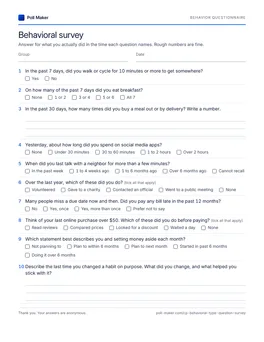
Behavior questionnaire
Page one prints the starter 10 with write-in boxes for the two number questions. Later pages carry every optional set, from money and work through to the follow-up and About you questions.
Download PDFCommon questions about asking what people do
For students, researchers and anyone measuring a habit.
What is a behavioral survey question?
It is a question about something the respondent did: whether it happened in a set time, how often, how much, or when it last happened. Attitude questions ask what people think; behavioral questions ask what they do. The answers are still self-reports, so the wording and the time window decide how close they come to real behavior.1
What are some examples of behavioral survey questions?
"On how many of the past 7 days did you eat breakfast?", "When did you last visit a dentist?" and "In the past 30 days, how many times did you buy a meal from a restaurant, cafe or delivery app?" Each names one behavior, one time window and answers people can count.
Is a behavioral survey the same as a behavioral questionnaire for a job?
No. Employers sometimes send a behavioral questionnaire that asks a candidate how they handled past work situations or how they would react to one. That judges one applicant for one role. A behavioral survey gathers what a group of people did, to measure a habit or track a change over time.
Is a behavioral survey the same as a behavioral style or personality test?
No. A style or personality test sorts people into types from how they say they tend to act. A behavioral survey counts what people did in a set time, and nobody is given a type. To learn how a team actually works, ask about recent actions, as the work and study set on this page does.
How do you reduce bias in behavioral questions?
Use an anonymous link people fill in alone, name a short time window, ask for numbers rather than words like "often", and open sensitive questions with a line that makes the honest answer ordinary. Add "Prefer not to say" and, for things like voting, face-saving answer options.3
How many questions should a behavioral survey have?
Only as many as the behaviors you will act on. The starter 10 take about four minutes. Bolt on a set only for a decision you will make with it. The full 40 fit a study; for a quick check, stop at ten.
Count what your group really does
Open the starter 10 in the builder, swap in the behaviors you care about, pick any extra set and send the link today. Printing for an event? The questionnaire is ready to go.