Union member survey: how satisfied members are with stewards, dues and the contract
A union survey asks members how well their local works for them: stewards, follow-up on problems, union news, dues and the contract. Members answer the core 12 in around five minutes, and a bargaining set is ready for contract time.
- 36questions
- 12in the core set
- 5 minto answer the core
- 6optional sets to add
By Michael Hodge, BSc Psychology Updated September 2026
All 36 union member survey questions
Each question comes with the answers members pick from, plus a line on why the result matters to the local. All twelve core questions begin selected; tick any extra set that suits this round, then open everything in the online builder, print copies for stewards, or paste the wording into the tool your local already uses.
The core 1212 questions
Eight statements about what the local does for members, an overall rating, one question on asking for help, a vote on where the union should put its effort, and a single open question. With no optional set added, they already make a full member survey.
-
My steward is easy to reach when I need help.
Strongly disagree12345Strongly agree1 = Strongly disagree, 5 = Strongly agreeFor most members the steward is the union they actually meet, so read the rest of the chart with this score in mind.
-
Problems I take to the union get followed up.
Strongly disagree12345Strongly agree1 = Strongly disagree, 5 = Strongly agreeFollow-through, not friendliness. Read it next to question 10, which shows how many members have put it to the test.
-
I hear union news before the rumors reach me.
Strongly disagree12345Strongly agree1 = Strongly disagree, 5 = Strongly agreeThe timeliness test. When bargaining news reaches members through a supervisor or the break room first, the union's own version arrives second.
-
Union leaders ask members before big decisions.
Strongly disagree12345Strongly agree1 = Strongly disagree, 5 = Strongly agreeA say inside the union itself. Low scores point to decisions members only heard about once they were made.
-
I know what my dues pay for.
Strongly disagree12345Strongly agree1 = Strongly disagree, 5 = Strongly agreeDues leave every paycheck. This shows whether the local has explained what they buy: representation, bargaining, legal help, training.
-
Our contract is enforced where I work.
Strongly disagree12345Strongly agree1 = Strongly disagree, 5 = Strongly agreeA contract protects members only where it is enforced. Read it by work site or shift, because one weak site hides easily in the average.
-
Our last contract improved my pay or conditions.
Strongly disagree12345Strongly agree1 = Strongly disagree, 5 = Strongly agreeThe bread-and-butter test. What the contract delivers is one of the two things that shape how members rate their union most.1
-
The union stands up for members in jobs like mine.
Strongly disagree12345Strongly agree1 = Strongly disagree, 5 = Strongly agreeFinds the groups who feel left out: part-timers, a newer pay tier, one department. Compare it across the About you answers.
-
Overall, how satisfied are you with our union?
Very satisfiedSatisfiedNeutralDissatisfiedVery dissatisfiedThe single number to track from one year to the next. The eight statements above explain why it moved.
-
In the past year, did you ask the union for help at work?
Yes, resolvedYes, still openYes, not resolvedNoSeparates members who have used their union from those judging it from outside. Compare how each group answers statement 2.
-
What should the union put the most effort into next year?
A stronger contractEnforcing our contractKeeping members informedOrganizing new membersPolitical actionMembers pick one, so the answers rank themselves. It is also the question to put on the screen at a membership meeting.
-
What is one thing the union should do differently?
Open answerOne change, not a wish list. Members name a steward, a meeting time or a grievance that stalled; sort the answers into a few piles.
Before bargaining6 questions
Send this set six to nine months before the contract expires, while the bargaining committee is drafting proposals. It is the one set that asks what to fight for, and it ends by asking who will help.
-
Which issue should be the top priority in the next contract?
WagesHealth insuranceRetirementJob securityStaffing and workloadSchedulingThe first half of a ranked vote. Score it with the next question: two points for a first choice, one for a second.
-
Which issue should come second?
WagesHealth insuranceRetirementJob securityStaffing and workloadSchedulingSecond choices show what members will trade for. An issue that is rarely first but often second can still top the points total.
-
How would you split an extra dollar an hour between wages and retirement?
All to wagesMostly wagesHalf and halfMostly retirementAll to retirementA trade-off question. Many members at one local wrote "more money" as their top issue, yet most split the dollar evenly or gave retirement more.2
-
Which of these have been a problem for you in the past year?
Short staffingForced overtimeUnfair disciplineUnsafe conditionsSchedule changesPay errorsNone of theseTick all that applyTurns complaints into counts the committee can carry to the table. Read it by shift and department, where problems cluster.
-
Which of these would you do to back the bargaining team?
Wear a button or shirtSign a petitionCome to a rallyTalk to coworkersJoin a committeeTick all that applyThe ask that closes a bargaining survey. Every tick is a volunteer to call back, and the totals show how much action the unit is ready for.
-
What one change to the contract would matter most to you?
Open answerWrite-ins catch what the committee never thought to ask. At one shop in a Teamsters local, a paid birthday holiday began as one member's write-in on a bargaining survey.2
First year as a member3 questions
Members in their first year answer these, ideally around 90 days in. They show what a new hire learns about the union, and from whom.
-
How did you first hear about the union here?
At orientationA stewardA coworkerOnlineMuch laterShows whether the union reaches new hires in their first week or leaves it to chance.
-
Someone from the union welcomed me when I started.
Strongly disagree12345Strongly agree1 = Strongly disagree, 5 = Strongly agreeA new member's first contact sets their picture of the union. A low score is a job for the steward network, not a leaflet.
-
I know what the union has won for people here.
Strongly disagree12345Strongly agree1 = Strongly disagree, 5 = Strongly agreeNew members inherit gains they never saw bargained. This shows whether anyone has told them.
Meetings and union news5 questions
For a local planning its communication for the year: where members get union news, how they want to be reached, and what keeps them away from meetings.
-
How often do you go to union meetings?
Most meetingsA few a yearAbout once a yearNeverSets up the next question. Compare the effort vote and the satisfaction scores of members who attend with those who never come.
-
What would help you get to more union meetings?
Another timeJoin onlineChildcareShorter meetingsFoodMore noticeNothingTick all that applyEach tick is a fix with a price. Try the most common one at the next meeting and count who comes.
-
Where do you get most of your union news?
My stewardCoworkersEmailText messagesSocial mediaMeetingsShows which channel really carries union news. If most say coworkers, word of mouth is doing the newsletter's job.
-
How would you like the union to reach you?
TextPersonal emailPhone callSocial mediaIn person at workPersonal channels reach members away from work systems. Use the top answer for the next contract update.
-
I can get a copy of our contract when I need it.
Strongly disagree12345Strongly agree1 = Strongly disagree, 5 = Strongly agreeA contract members cannot find does little for them. The fix is cheap: a printed copy in every break room and a link on the union site.
Dues and member services3 questions
For budget season, or before the local changes what it offers members.
-
Being a member is worth what it costs me.
Strongly disagree12345Strongly agree1 = Strongly disagree, 5 = Strongly agreeValue for money, asked plainly. Read it next to statement 5 to see whether a low score is about the cost or about not knowing what dues buy.
-
Which union services have you used in the past two years?
Grievance helpLegal adviceTrainingHealth or pension fundMember discountsScholarshipsNoneTick all that applyShows which services members know about and use. A service nobody ticks is either unknown or unwanted; the next question tells you which.
-
Which service should the union add or improve first?
TrainingLegal helpHealth and pensionSocial eventsMember discountsWhere members would spend the next dollar of the local's budget.
Stewards and grievances4 questions
Add these when statements 1 or 2 come back weak, or after a year with a lot of grievances. Report them by steward area only when each area has enough answers to stay anonymous.
-
Could you name your steward today?
YesNot sureNoThe plainest test of steward coverage. Every "No" is a member no steward has reached yet.
-
My steward explains my rights under the contract.
Strongly disagree12345Strongly agree1 = Strongly disagree, 5 = Strongly agreeSeparates a steward who takes a problem off a member's hands from one who also teaches the member the contract.
-
I would feel safe filing a grievance if needed.
Strongly disagree12345Strongly agree1 = Strongly disagree, 5 = Strongly agreeFear of payback keeps problems off the books. A low score means the grievance count understates what is going on.
-
If you filed a grievance in the past two years, how was it handled?
Very wellFairly wellNot wellDid not fileRead it only among members who filed. Poor handling of grievances that were won points to updates and explanations, not outcomes.
About you (optional)3 questions
Only to compare groups. Keep back the results of any group small enough for one member to be recognized.
-
How long have you been in the bargaining unit?
Under 1 year1 to 5 years6 to 15 yearsOver 15 yearsNewer members may sit on a different pay scale or tier. Read the priority vote by this to see whether they want the same things.
-
Which shift do you mostly work?
DaysEveningsNightsRotatingShows whether night and weekend workers see as much of their stewards and union news as the day shift does.
-
How are you employed?
Full-timePart-timeTemporary or casualPart-time and casual members can feel like members on paper only. Statement 8 tells you whether they do.
Match the survey to the contract calendar
Most locals survey members at the same few moments. Each one calls for a different mix of the sets above.
| When | What you learn | What to send |
|---|---|---|
| Once a year between contracts | How members rate the local, and where they get news | Core 12, plus meetings and union news |
| Six to nine months before bargaining | What to fight for, and who will act on it | Core 12, plus before bargaining |
| During negotiations | Whether members feel informed and ready | The pulse five, or one live poll at a meeting |
| About 90 days after someone joins | Whether new members were welcomed and told the basics | First year as a member |
| After a heavy grievance year | How stewards and grievance handling look from the floor | Core 12, plus stewards and grievances |
| Budget season | Which services members use and value | Dues and member services |
Why the core asks what it asks: in a study of national survey data, members' satisfaction with their union depended far more on relations between members and the union, and on bread-and-butter results such as wages and benefits, than on quality-of-work issues.1 Statements 1 to 5 cover the first (the steward, follow-up, news, a say in decisions, dues), statements 6 and 7 cover the second, and statement 8 checks that no group of members is left behind.
Running a survey about members' jobs rather than their union? The satisfaction survey questions library has sets on pay, workload and workplace experience.
Chart the eight statements for the executive board
For statements 1 to 8, enter how many members gave each answer. The chart flags the two strongest results and the two weakest, and it fits on one printed page for the board meeting or the union notice board.
- 1Read the statements in two groups: how the local deals with members (1 to 5) and what members get from the contract (6 and 7). Statement 8 then shows whether any group feels left out.
- 2Rerun the chart for each shift and work site. A site where statement 6 sits far below the rest needs a steward before it needs a flyer.
- 3Hold the weakest statement up against the effort vote. When members rate news low and also vote for keeping members informed, that is the first job of the year.
- 4Pin the chart up where members pass every day, along with the one thing the local will change and when. The next survey then shows whether it worked.
Member results
Score the priority vote in points
The two priority questions in the bargaining set add up to a ranked vote that works the same way on paper and on a phone.
The rule
Give each issue two points for every first choice and one point for every second choice. Add them up, then sort the issues from most points to fewest.
A worked example
Say 200 members answer both questions.
| Issue | First + second choices | Points |
|---|---|---|
| Wages | 70 + 40 | 180 |
| Health insurance | 50 + 60 | 160 |
| Staffing and workload | 45 + 35 | 125 |
| Retirement | 20 + 35 | 75 |
| Job security | 10 + 20 | 40 |
| Scheduling | 5 + 10 | 20 |
Wages lead on first choices and on points. Health insurance runs a close second because it collects the most second choices, and staffing is a clear third. Before the committee drafts proposals, check two more answers. If most of the night shift ticked short staffing in the problems question, staffing may matter more than its points suggest. The split-a-dollar question shows whether "wages" really means take-home pay: at Teamsters Local 814, many members named more money as their top issue, yet most split the dollar evenly with retirement or leaned toward retirement.2
Reach beyond the activists
A survey only the activists answer tells you what the activists think. These four habits reach the rest of the membership.

Put it in stewards' hands
The UAW's survey guide calls in-person contact the gold standard for circulating a survey, and suggests walking the floor to tell members about it.3 Give each steward a stack of paper copies and the link, then track returns by steward, shift and building. The president of Teamsters Local 814 recommends exactly that count: it shows where the union is strong, and the stewards who can get coworkers to fill in a survey now are the ones who can move them to bigger actions later.2
Keep it short and end with an ask
The UAW guide's rule of thumb is five to fifteen questions, and it warns that a survey which looks like more than five to ten minutes of work may put members off.3 The core 12 fits inside that. Add one set at a time, and finish with a question that asks for help, such as the list of ways to back the bargaining team. Call every volunteer back within a week, while the offer is fresh.

Share the results before the next ask
Members who think their answers go unread are slower to answer the next survey, and the UAW guide calls sharing results with the people who took part an ethical obligation.3 Post totals, never names or comments that could be traced to someone. At Local 814, more than 200 members came to the contract meeting where the survey results and the proposal were presented, voted to endorse the proposal, and later ratified the contract with a 98 percent yes vote.2
Keep the answers inside the union
Send links to personal email and phones rather than work accounts, and let the union, not the employer, gather the paper copies in a locked return box. Share results only for groups with enough answers to hide any one person, and keep the raw answers where only the survey team can open them. Bargaining tallies belong with the committee's notes: the UAW guide expects them to be referred to all the way through ratification and compared with the next round.3
At a membership meeting the loudest voices tend to carry the room, while a question on the projector counts the quiet members too. Show the effort question as a free online poll members vote in without leaving their chairs, and have stewards drop the same link into their group chats for members on other shifts. The poll how-to guide explains sharing by text message or QR code.
Stacks for stewards and a box in the hall
Plenty of members will fill in a form a steward hands them and never open an emailed link. Print a stack for each steward, put a sealed return box in the union hall, and key in the paper answers afterwards. Either US Letter or A4 paper is fine.
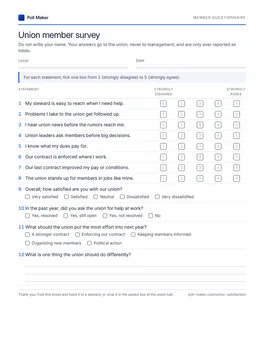
Member questionnaire
Members mark their answers to the twelve core items by pen on sheet 1. The bargaining set and the other optional sets follow, numbered from 13.
Download PDF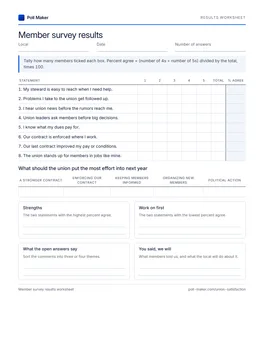
Results worksheet
A tally grid for the paper forms: mark each sheet, find what share of members agree with each statement, count the effort vote, and circle the local's first job for the year.
Download PDFThe spring pulse between bargaining rounds
Years can pass between bargaining rounds. A five-question pulse each spring covers the steward, union news, enforcement and overall satisfaction, and leaves room for one change.
- 01My steward is easy to reach when I need help.
- 02I hear union news before the rumors reach me.
- 03Our contract is enforced where I work.
- 04Overall, how satisfied are you with our union?
- 05What is one thing the union should do differently?
Questions stewards and officers ask
Short answers for the first member survey your local runs.
What questions should a union ask its members?
Ask about what the union does for them day to day: whether their steward is easy to reach, whether problems get followed up, whether news arrives before the rumors, what dues pay for, and whether the contract is enforced and delivering. Before bargaining, add questions on priorities and on what members will do to back the team.
Should a union member survey be anonymous?
The satisfaction survey should be: collect no names and publish only totals. A bargaining survey often asks for contact details so the committee can call volunteers back. Put that request on a separate slip or a final optional question, and say plainly who will see it.
How many questions should a union survey have?
Fewer than most first drafts. The UAW's survey guide gives five to fifteen questions as a rule of thumb.3 The core 12 fits, and each optional set adds three to six questions when you need them.
How often should a local survey its members?
Once a year between contracts, a bargaining survey six to nine months before the contract expires, and a short pulse whenever something big changes. Asking the same core questions each time lets you compare one year with the next.
What is a bargaining survey?
A survey the bargaining committee sends before negotiations to learn which issues members care about most and what they will do to win them. The results shape the proposals, and the committee refers back to them right up to ratification.3
Union survey questions worth rewriting
Most weak union questions fail in one of two ways: they ask for a mood, or they bundle two questions together. Writing survey questions covers the fix for each question type.
Are you satisfied with the union?
Problems I take to the union get followed up.
I hear union news before the rumors reach me.
Satisfied with what? Stewards, news, dues and the contract are separate jobs, and one rating cannot tell the executive board which to fix.
Do union leaders listen to members and keep them informed?
Union leaders ask members before big decisions.
Two questions in one. A member who is kept informed but never consulted cannot answer it truthfully.
Do you support the union's position in negotiations?
Which issue should be the top priority in the next contract?
Before bargaining there is no position yet, and during it the question invites a loyal yes. Asking for priorities gives the committee something to carry to the table.
Would you vote to strike?
Which of these would you do to back the bargaining team?
A strike authorization is a formal vote with its own rules, not a survey item. Smaller steps, from wearing a button to joining a committee, show how ready the unit is and who will lead.
Hear the whole membership before the next meeting
Text the core 12 to members tonight, or hand every steward a pile of printed questionnaires to carry onto the floor.