Social awareness questions for students on empathy, fairness and other points of view
Social awareness is the ability to understand how other people see things and to feel for them, including people whose background is different from yours. These 33 questions ask students how they do that day to day. The core 12 covers all eight social awareness skills; add a set on social issues, on taking action, or for younger grades.
- 33questions
- 12in the core
- 5 minto answer the core
- Grade 3through college
By Michael Hodge, BSc Psychology Updated September 2026
All 33 social awareness questions
Twelve core statements come pre-ticked. Each item carries its answer options and a short note about what the answers say about empathy, perspective or fairness among your students. Tick any extra sets you need; the survey, print and copy buttons use exactly what is ticked.
The core 12: understanding other people12 questions
Eight statements, one for each social awareness skill, then one on mixing with people unlike you, one choice about what students do when someone is left out, and two open questions. Written for grade 6 and up.
-
Before I disagree, I try to see the other side.
Strongly disagree12345Strongly agree1 = Strongly disagree, 5 = Strongly agreeTaking other perspectives. If you add the social issues set, read it next to the item about talking with people who disagree.
-
I see what classmates are good at, not just friends.
Strongly disagree12345Strongly agree1 = Strongly disagree, 5 = Strongly agreeRecognizing strengths in others. It shows whether students see classmates beyond their own friend group.
-
I can tell when a classmate is having a bad day.
Strongly disagree12345Strongly agree1 = Strongly disagree, 5 = Strongly agreeReading feelings from faces, voices and behavior, the first step in empathy.
-
I think about how my words will make someone feel.
Strongly disagree12345Strongly agree1 = Strongly disagree, 5 = Strongly agreeConcern for the feelings of others, asked as a habit students can picture.
-
I thank people who help me, even with small things.
Strongly disagree12345Strongly agree1 = Strongly disagree, 5 = Strongly agreeGratitude is on the CASEL list, and it is the easiest of these skills to practise as a class.1
-
I notice when a school rule is unfair to some students.
Strongly disagree12345Strongly agree1 = Strongly disagree, 5 = Strongly agreeSpotting unjust norms. Read it with the open answers, where students often name the rule.
-
I can tell what a place or situation expects of me.
Strongly disagree12345Strongly agree1 = Strongly disagree, 5 = Strongly agreeRecognizing what a situation calls for before acting, such as a quiet library or a loud game.
-
I can explain how a law or rule changes how people act.
Strongly disagree12345Strongly agree1 = Strongly disagree, 5 = Strongly agreeUnderstanding how organizations and systems shape behavior, the most abstract skill here. Expect lower scores in the younger grades.
-
I spend time with people from backgrounds unlike mine.
Strongly disagree12345Strongly agree1 = Strongly disagree, 5 = Strongly agreeThe CASEL definition names people from diverse backgrounds. Asking about contact, not attitudes, gets an answer students can report accurately.1
-
The last time you saw a classmate being left out, what did you do?
Invited them inChecked on them laterTold an adultNothingI have not seen it happenEmpathy turned into action. The gap between students who notice and students who act is what to teach next.
-
Describe a time you changed your mind after hearing someone else's side.
Open answerA real example is worth more than a rating. Students who cannot think of one are telling you something too.
-
What would help students at this school understand each other better?
Open answerTurns the survey into ideas. The answers usually fall into three or four themes you can share back.
Awareness of social issues7 questions
For a research paper, a club or an awareness campaign: which issues students see, where they hear about them and how well they understand them.
-
Which of these issues affect people in your community the most?
Cost of livingMental healthBullyingRacism and discriminationClimate and pollutionDrugs and alcoholHomelessnessHealth careCrimeSomething elseTick all that applyShows which issues students already see around them, so a campaign or lesson starts where their attention is.
-
How closely do you follow news about social issues?
Very closelyFairly closelyNot very closelyNot at allSeparates students who follow issues on their own from those who meet them only in class.
-
Where do you hear about social issues most often?
Social mediaNews sites or appsTV or radioLessons at schoolFamily or friendsTells a teacher or a campaign which channel actually reaches students.
-
I could explain one social issue in my community to a younger student.
Strongly disagree12345Strongly agree1 = Strongly disagree, 5 = Strongly agreeA check on understanding, not just interest. Pair it with the issue each student names in the open question.
-
Before I share a post about a social issue, I check where it came from.
Strongly disagree12345Strongly agree1 = Strongly disagree, 5 = Strongly agreeIn a Pew survey of US teens, 37% said social media helps people their age find trustworthy information. This shows whether your students check.5
-
I feel comfortable talking about social issues with people who disagree with me.
Strongly disagree12345Strongly agree1 = Strongly disagree, 5 = Strongly agreeAwareness of issues and respect for other views in one item. Compare it with the perspective statement in the core.
-
Which social issue do you most want to learn more about, and why?
Open answerGives a class or club its next topic, chosen by the students themselves.
Online and in group chats3 questions
Much of students' social life happens on phones, so these three bring the survey into group chats and feeds.
-
In group chats, I notice when someone goes quiet or gets left out.
Strongly disagree12345Strongly agree1 = Strongly disagree, 5 = Strongly agreeReading social cues where there are no faces to read. Compare it with the in-person item about a classmate's bad day.
-
I follow people online whose views are different from mine.
Strongly disagree12345Strongly agree1 = Strongly disagree, 5 = Strongly agreeTwo in three teens in a Pew survey said social media helps people their age find different points of view. This asks whether your students do it.5
-
In the past month, how often did you see someone mocked or shut out online?
NeverOnce or twiceA few timesEvery weekAlmost every dayHow often students see it tells you how often the empathy items are tested in real life.
From awareness to action5 questions
For service learning, a volunteer program or a campaign you will repeat. Ask it before and after so you can see what changed.
-
In the past 12 months, how often did you volunteer?
NeverOnce or twiceA few timesAbout once a monthEvery weekThe most common measure of action. Ask it the same way each time so the numbers compare.
-
Which of these did you do for a cause this past year?
Raised money for a causeJoined a group for a causeSigned a petitionSpoke up in classContacted a local leaderNone of theseTick all that applyCounts actions, not intentions. Swap in options that fit the campaign you are running.
-
If students here pushed for a change, we could make it happen.
Strongly disagree12345Strongly agree1 = Strongly disagree, 5 = Strongly agreeWhether students think their effort counts. If it is low, share what past student projects achieved.
-
I know how to find a group working on an issue I care about.
Strongly disagree12345Strongly agree1 = Strongly disagree, 5 = Strongly agreeSeparates wanting to act from knowing how. The second one is fixable in a single lesson.
-
What most often stops you from getting involved?
Not enough timeNot sure where to startNot sure it would helpNobody to go withNothing stops meEach answer points to a different fix: a list of groups, a buddy system, or proof that it works.
Grades 3 to 5 (read aloud)4 questions
Plain sentences with three answers, for children in grades 3 to 5. The teacher reads every item out loud while students circle yes, sometimes or no.
-
I can tell how a friend feels by looking at their face.
YesSometimesNoReading feelings, put in the plainest words the skill allows.
-
I say thank you when someone helps me.
YesSometimesNoGratitude, the skill young classes practise most easily.
-
I play with kids who are not in my usual group.
YesSometimesNoMixing with others, asked about play so children this age can picture it.
-
When someone is sad, I try to help.
YesSometimesNoKindness in action. Read the spread of answers, not only the yes count.
About you (optional)2 questions
Grade and gender let you split results the way the research does. Skip reporting any group small enough for a student to be identified.
-
What grade or year are you in?
Grade 3 to 5Grade 6 to 8Grade 9 to 10Grade 11 to 12CollegePrefer not to sayIn a large panel study, self-reported social awareness fell after grade 6, so compare each grade with itself over time.4
-
What is your gender?
Girl or womanBoy or manAnother genderPrefer not to sayGirls reported higher social awareness than boys in that study, so check the gender mix before comparing two classes.4
Which social awareness scale do you need?
Three published measures turn up when people look for a social awareness scale, and they measure different things. Match the scale to your question before you collect a single answer.
| Measure | Who answers, and what it covers | Pick it when |
|---|---|---|
| CASEL framework | Not a survey. It defines social awareness and lists eight skills under it, from taking others' perspectives to understanding how systems shape behavior.1 | You need a definition for a lesson plan or the introduction of a paper. |
| Panorama Education SEL survey, social awareness scale | Students in grades 3 to 5 and 6 to 12. Eight questions about the past 30 days, each with five labelled answers.2 | You want a published school measure. It is free for educators when credited to Panorama Education; keep its wording as printed. |
| Social Issues Advocacy Scale (Nilsson and colleagues, 2011) | Adults, in two validation studies of 278 and 509 people. Four subscales: political and social advocacy, confronting discrimination, political awareness and social issue awareness.6 | Your research is about awareness of social issues and speaking up about them. |
| Feedback Orientation Scale, social awareness subscale (Linderbaum and Levy, 2010) | Adults at work. Five agree statements about using feedback to learn how others see you.7 | You are studying feedback at work. It measures impression awareness, not empathy. |
| The questions on this page | Students. 33 original questions: a core 12 on the eight CASEL skills, then sets on social issues, action, online life and younger grades. | You want to act on the answers in class, change the wording, or send a single question to a live poll. |
Writing a thesis or research paper? Name the instrument you used in your methods. A published scale should keep its items and answer options exactly as printed; if you adapt these questions, say that you did and list the items in an appendix.
Past the flattering answer on kindness and fairness
Everyone likes to think they are kind and fair, so a social awareness survey has to be built to get past the flattering answer. Four habits do most of the work.

Anchor questions in last month, not in character
Ask "Are you an empathetic person?" and students give the answer they know they should. Duckworth and Yeager list this social desirability bias among the main limits of student questionnaires, along with reference bias: students judge themselves against different standards.3 So every core statement describes something a student did or noticed, and the paper version asks students to think about the last month.
What US teens say social media helps people their age do
Trace where issues reach your students
In Pew Research Center's survey of 743 US teens, 69% said social media helps people their age interact with people from different backgrounds, and 67% said it helps them find different points of view. Just 37% said it helps them find trustworthy information.5 That gap is why the social issues set asks where students hear about issues and whether they check a post before passing it on.

Compare a class with itself
In a panel survey that followed students from grade 4 to grade 12, self-reported social awareness fell after grade 6.4 A grade 7 class scoring below last year's grade 6 may simply be a grade 7 class. Run the same questions twice, before a unit begins and once it ends, or in October and again in May, and read each class against its own first round.
Turn the two lowest skills into next month's lessons
This survey is built for what Duckworth and Yeager call practical measurement: brief, repeatable questions that report back to teachers quickly and are used to improve teaching, rather than to rank schools or diagnose a single child.3 Keep names off the form, report totals for the class, and pick the two lowest statements as the skills to work on next.
Empathy questions make good discussion starters when the whole class can see the spread. Put the news-source question, or any other, up as a free live poll. Everyone answers from a phone or laptop, then you show the results and talk about why the class split. First time running one? This walkthrough on creating a poll covers the QR code and the link.
The whole class on one printed page
Fill in how many students gave each rating for the statements you asked. A bar appears for every statement, with the two best-rated skills tagged as strengths and the two lowest marked for focus, ready to print for a planning folder or show the class.
- 1Agreement for a statement means the students who picked 4 or 5, counted against the total who rated it. That is the number beside each bar.
- 2Look at which skills carry the Focus tag, not at one overall score. Two weak skills tell you more than an average does.
- 3Read the answers about seeing a classmate left out next to the empathy statements. Students who notice but do nothing need practice in what to do, not in noticing.
- 4Plan one class activity for each Focus skill, give it half a term, then put the same core 12 in front of the class again.
Social awareness: class results
Scoring the level of social awareness for a research paper
Research papers on this topic usually report a level of awareness for each statement, not only percentages. That means a weighted mean placed in one of five bands, as in this worked example.
Strongly disagree earns 1 point, disagree 2, neutral 3, agree 4 and strongly agree 5. Multiply each score by its count of students, total the products, then divide by how many students rated the statement. The example uses an imaginary class of 36 and the core statement "I notice when a school rule is unfair to some students."
| Answer | Students | Points |
|---|---|---|
| 1 Strongly disagree | 1 | 1 |
| 2 Disagree | 4 | 8 |
| 3 Neutral | 8 | 24 |
| 4 Agree | 15 | 60 |
| 5 Strongly agree | 8 | 40 |
| All answers | 36 | 133 |
133 points shared by 36 students gives a weighted mean of 3.69. The five bands, from the bottom up:
| Level | Lowest mean | Highest mean |
|---|---|---|
| Very low | 1.00 | 1.80 |
| Low | 1.81 | 2.60 |
| Moderate | 2.61 | 3.40 |
| High | 3.41 | 4.20 |
| Very high | 4.21 | 5.00 |
At 3.69 the example class sits in the high band for that skill. Each band spans 0.8, which is the 4-point gap between the lowest and highest score cut into five equal slices. Report two scores rather than one: a skills score from the nine core statements and an issues score from the three social issues statements, because knowing about poverty and noticing a sad classmate are different abilities. Give the count of respondents beside each mean and say how widely the answers spread.
On sampling and consent: survey intact classes or whole grade levels rather than friends who offer, and open the form with a sentence explaining that it is anonymous and every question can be skipped. Anyone under 18 needs school approval first, and in most schools a parent's consent too.
A homeroom check-in in five questions
Ten minutes of homeroom or advisory is enough for these: seeing the other side, reading feelings, spotting unfairness, mixing with new people, and what students do when someone is left out.
- 01Before I disagree, I try to see the other side.
- 02I can tell when a classmate is having a bad day.
- 03I notice when a school rule is unfair to some students.
- 04I spend time with people from backgrounds unlike mine.
- 05The last time you saw a classmate being left out, what did you do?
Paper answers students give more freely
Paper suits this topic, because students answer more freely when nothing on a screen links the answers to their login. Pass the sheets out when advisory begins and ask a student to gather them face down.
Planning a homeroom session? , one sheet per student.
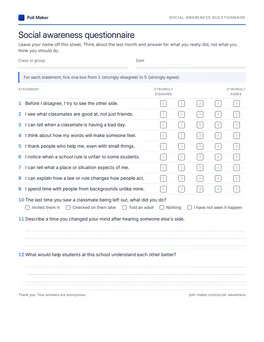
Social awareness questionnaire
Front sheet: the 12 core items with pencil boxes. After it come the social issues set, the online items, the action set, the read-aloud grades 3 to 5 set and the about-you questions.
Download PDF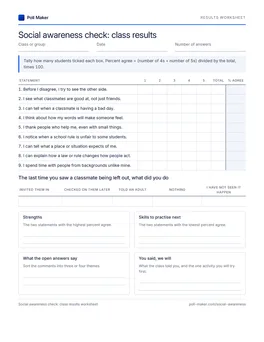
Class results worksheet
Tally the sheets one statement at a time, work out agreement for each skill, and note the two skills the class will practise next.
Download PDFLoaded and double questions, repaired
Loaded words and questions that ask two things at once make this topic harder to measure than most. Three repairs below. For other question types, see our survey question examples.
Are you a socially aware person?
I can tell when a classmate is having a bad day.
A label invites the flattering answer. A specific habit is something a student can check against last week.
Don't you agree that racism is a serious problem at our school?
I notice when a school rule is unfair to some students.
What would help students at this school understand each other better?
Starting with "don't you agree" hands students the expected answer. The better pair asks what students have seen, then lets them name it in their own words.
How aware are you of social issues like poverty, climate change and mental health?
Which of these issues affect people in your community the most?
I could explain one social issue in my community to a younger student.
Three issues packed into one question, and each student reads "aware" their own way. List the issues as choices, then test understanding with a statement.
What teachers ask about social awareness surveys
Quick answers to what teachers and student researchers ask before they run it.
What are examples of social awareness?
Noticing that a classmate is upset, seeing an argument from the other side, thanking someone who helped you, and spotting a rule that treats some people unfairly. CASEL lists eight skills under social awareness, from taking others' perspectives to understanding how organizations and systems shape behavior.1
How is social awareness different from self-awareness?
Self-awareness looks inward: understanding your own emotions, thoughts and values. Social awareness looks outward, to other people's feelings and points of view. CASEL treats them as two of its five core competencies, and this questionnaire covers the second.1
How do you measure social awareness in students?
With a short survey about recent behavior, repeated later in the year, alongside what teachers see in class. Ask about specific things students did, report class totals rather than individual scores, and compare each class with its own earlier results.
Can social awareness be taught?
Yes. A meta-analysis of 213 school-based social and emotional learning programs with 270,034 students found better social and emotional skills, attitudes and behavior, plus an 11-percentile-point gain in achievement.8 Giving the core 12 when a unit starts and again when it finishes shows what changed in your own class.
How do I score a social awareness questionnaire?
Give the answers 1 to 5 points, find the mean for each statement and for the nine core statements together, and place each mean in one of the five bands from the scoring section. Always state how many students the mean is based on.
Ask your class before the next unit
Share the core 12 with your class online, or print sheets for the next homeroom or advisory period.