Online banking survey questions for bank customers
Online banking survey questions ask customers how well their bank works online: speed, uptime, money arriving on time, safety, and help when something breaks. Answering the core 12 needs about four minutes, and it follows a published model of online service quality. Share it by link, print copies for the branch, or turn one question into a poll the room answers live.
- 36questions
- 12in the core
- 4 minto answer the core
- 7service quality areas
By Michael Hodge, BSc Psychology Updated September 2026
Every online banking question, grouped by task
Ticks are already on the core 12. Switch on the problem, security, payment, switching or offline set when its answers have a use. Each row shows the options customers choose between and why the bank should care.
The core 12: everyday online banking12 questions
Three questions that sort customers by how they bank, seven statements on everyday service, a recommend score and one change in their own words.
-
How do you do most of your banking?
On my phoneOn a computer or tabletAt a branch counterAt an ATMCalling the bankThe channel split. These five answers match the channels in the FDIC household survey, so your spread can sit beside the national one.1
-
How often do you log in to your bank online?
DailyA few times a weekWeeklyA few times a monthLess oftenNeverFrequent users judge speed and uptime; occasional users judge whether they can find things again. Read the groups apart.
-
In the last 3 months, did anything go wrong when you banked online?
NoYes, it was fixedYes, still not fixedThe screener for the problem set. Only customers who had a problem can rate how the bank handled it.2
-
Everyday jobs take me less time online than at a branch.
Strongly disagree12345Strongly agree1 = Strongly disagree, 5 = Strongly agreeEfficiency, asked as a comparison customers can actually make from their own week.
-
The menus are laid out the way I expect.
Strongly disagree12345Strongly agree1 = Strongly disagree, 5 = Strongly agreeThe second efficiency item. A low score here beside a high one above means tasks are quick once found, but hard to find.
-
Online banking works whenever I try to use it.
Strongly disagree12345Strongly agree1 = Strongly disagree, 5 = Strongly agreeSystem availability: outages, freezes and forced logouts all land here. Ask again after each app release to see its effect.
-
Money I send arrives on the date the bank shows.
Strongly disagree12345Strongly agree1 = Strongly disagree, 5 = Strongly agreeFulfilment: does the money turn up when the screen said it would? Read it next to the payments set.
-
My balance and transactions online are correct.
Strongly disagree12345Strongly agree1 = Strongly disagree, 5 = Strongly agreeThe other half of fulfilment: records customers can rely on without calling to check.
-
I trust my bank to keep my money and details safe online.
Strongly disagree12345Strongly agree1 = Strongly disagree, 5 = Strongly agreePrivacy and security as the customer feels it. The security set shows which habits sit behind the feeling.
-
The login steps feel secure without slowing me down.
Strongly disagree12345Strongly agree1 = Strongly disagree, 5 = Strongly agreeWeighs every security change against convenience. A drop after a new login step says it needs a faster route, such as face login.
-
How likely are you to recommend your bank's online banking to a friend?
0123456789100 = Not at all likely, 10 = Extremely likelyOne number to track from quarter to quarter. Net Promoter Score is the share of 9s and 10s minus the share of 0s to 6s.
-
What one change would make online banking with your bank better for you?
Open answerA ranked wish list once the answers are grouped. Customers often name the exact screen or step.
When something went wrong6 questions
Only for customers who answered yes to question 3. People who never had a problem cannot judge how one was handled, so keep these away from everyone else.
-
What went wrong most recently?
Could not log inA payment problemCard blockedError or crashSomething elseNames the failure so each rating below has context. Watch how the mix changes between quarters.
-
Where did you go for help first?
Chat in the appHelp pagesPhone callBranchSecure messageThe door customers try first. Chat is now a big one: in 2022 about 37% of the US population used a bank's chatbot.5
-
How many contacts did it take to sort out?
OneTwoThree or moreNot sorted yetFirst-contact resolution: the share fixed at the first try. Each extra contact costs the customer time and the bank a call.
-
The bank fixed the problem quickly.
Strongly disagree12345Strongly agree1 = Strongly disagree, 5 = Strongly agreeResponsiveness, the first of the three recovery areas.2
-
Any fees or losses the problem caused were refunded.
Strongly disagree12345Strongly agree1 = Strongly disagree, 5 = Strongly agreeCompensation: whether the bank left the customer no worse off. Read it with the open answers.
-
I could reach a real person when I needed one.
Strongly disagree12345Strongly agree1 = Strongly disagree, 5 = Strongly agreeContact. A low score beside a big chat share in question 14 says the chat needs a clear route to a person.
Payments and transfers4 questions
For online payment research, and for banks weighing their bill pay and person-to-person tools.
-
How do you usually pay bills?
Bank bill payOn the biller's siteAutomatic debitBy cardCash or checkShows whether bill pay inside online banking earns its place or customers pay somewhere else.
-
How do you usually send money to friends or family?
My bank's appA payment appCashCheckI rarely doHalf of US households (49.7%) used a nonbank service such as PayPal, Venmo or Cash App in 2023, so this shows how much of that your bank keeps.1
-
How easy is it to add a new payee and pay them?
Very difficult12345Very easy1 = Very difficult, 5 = Very easyTests the whole new-payee flow, extra security checks included. Compare it with the login statement in the core.
-
In the last 12 months, did a payment arrive late or go astray?
NoYes, it was lateYes, wrong accountNot sureCounts fulfilment failures directly, to check against the core statement on payments arriving on time.
Security and scam checks5 questions
The habits and worries behind the trust statement in the core, plus the scam contacts customers get in the bank's name.
-
Which of these security features do you use?
Two-step loginFace or fingerprintAccount alertsCard lockNone of theseTick all that applyTake-up of each protection. The ones few customers use are the ones to explain inside the app.
-
I know how my bank will contact me, and how it never will.
Strongly disagree12345Strongly agree1 = Strongly disagree, 5 = Strongly agreeCustomers who know the bank never asks for a PIN or password are harder to fool with a fake call or text.4
-
In the last 12 months, has someone pretended to be your bank to reach you?
Yes, by textYes, by phoneYes, by emailNoNot sureWhere impostors reach your customers. Put your next warning on that channel.
-
I would know what to do about a payment I did not make.
Strongly disagree12345Strongly agree1 = Strongly disagree, 5 = Strongly agreeReadiness to act. A low score calls for one clear way to report a payment, not a long help page.
-
What worries you most about banking online?
Scam messagesSomeone getting inPayment mistakesHow my data is usedNothing muchThe worry your security messages should answer first.
Choosing and switching banks4 questions
For marketing and needs analysis: how settled customers are, and what pulls them toward another bank.
-
Do you have an account with an online-only bank?
Yes, my main oneYes, a second oneNo, but I have lookedNoHow far online-only banks have reached your customers, and whether as a main or a side account.
-
In the last 12 months, have you thought about moving your main account?
NoYes, but I stayedYes, I am movingI already movedSwitching intent. Split the core statements by it to see which areas separate stayers from leavers.
-
What would make you move your main account?
Lower feesA better appBetter savings rateBetter helpA branch nearbyNothingTick all that applyThe reasons to fix before customers act on them.
-
How likely are you to be banking with them a year from now?
Very unlikely12345Very likely1 = Very unlikely, 5 = Very likelyStated retention. Track it beside the recommend score in the core.
If you rarely bank online2 questions
For customers who chose Never in question 2 (they skip statements 4 to 10), and anyone who banks mostly at the counter. Their reasons show what to teach, fix or offer.
-
What keeps you from banking online more?
Security worriesI prefer a personNot sure howNo smartphonePoor internetNo needTick all that applyThe barrier list. Worry and know-how can be answered with teaching; access problems need a different fix.
-
Would you try it if someone at the bank showed you how?
YesMaybeNoSizes the audience for a hands-on session at the branch.
About you (optional)3 questions
Useful for splitting results by age or bank type. Keep every split large enough to protect the people in it.
-
How old are you?
Under 2525 to 3435 to 4445 to 5455 to 6465 or overBanking mainly on a phone runs from about three in four young households to about one in five aged 65 and over, so age is the first split to try.1
-
What kind of bank is your main bank?
Large national bankRegional or local bankCredit unionOnline-only bankNot sureLets a researcher compare bank types. A single bank surveying its own customers can drop it.
-
How long have you banked with them?
Under 1 year1 to 5 years6 to 10 yearsOver 10 yearsNewer customers are still learning the service; long-standing ones compare it with how it used to work.
Banking questionnaire terms, explained
Customers answer the meaning they have in mind, so every banking word needs a plain one. Here it is for each term in this questionnaire and its results, with the question number where it appears.
| Term | What it means | Question |
|---|---|---|
| Online banking | Any banking done over the internet, on a phone, tablet or computer. The FDIC splits it into mobile (phone) and online (computer or tablet).1 | 1 |
| Net Promoter Score | Promoters (answers of 9 or 10) as a percent of everyone, minus detractors (0 to 6) as a percent. | 11 |
| First-contact resolution | The share of problems solved the first time a customer asks. | 15 |
| Bill pay | The bank's own service for paying billers from your account. | 19 |
| Person-to-person payment | Sending money to someone by phone number or email, in a bank app or a payment app. Often shortened to P2P. | 20 |
| Payee | The person or company you are paying. | 21 |
| Two-step login | A second check after the password, such as a code sent to your phone. Also called two-factor authentication. | 23 |
| Face or fingerprint login | Signing in with your face or fingerprint instead of typing a password (biometric login). | 23 |
| Account alerts | Texts, emails or app messages about your balance, payments or unusual activity. | 23 |
| Card lock | A switch in the app that blocks new card payments until you turn it back on. | 23 |
| Online-only bank | An account with no branches, run entirely through an app and website. Also called a neobank or digital bank. | 28 |
Putting a definition in the question
Add the meaning in brackets straight after the term, for example: "Which of these do you use: two-step login (a code sent to your phone after your password)?" Keep each definition to one line, and skip the ones your customers already know.
Earning a straight answer from bank customers
A bank survey arrives next to phishing messages that copy the same look. These four choices make it safe to answer and easy to act on.
Put the survey behind the login
Scammers impersonate banks, and the American Bankers Association lists "They ask you to open a link" and requests for "PINs, passwords or Social Security numbers" among its red flags.4 So place the survey inside online banking, where customers are already signed in, or hand it over at the branch. Open the invitation with a promise that it never asks for account details, and keep it: nothing in this set does.
Households banking mainly on a phone, by age, 2023
Ask for the channel before anything else
Phone and computer banking are different experiences, and the mix moves with age. In the 2023 FDIC survey, 48.3% of banked households used a phone as their main way in, 19.8% a computer or tablet and 15.1% a bank teller.1 Question 1 uses the same channels, so every result can be split by channel and by age from the first report.
Define banking words inside the question
Bill pay, card lock and two-step login mean different things to different customers. Researchers who tested definitions in web surveys found people used them more when they sat beside the question, and concluded that this beats rollovers and links.3 The terms table above gives a plain meaning for each word this questionnaire uses.
Route problems to their own set
When the E-S-QUAL researchers first tested their items, many customers left the problem-handling items blank, apparently because they had never had a problem, so the authors moved those items into a separate recovery scale.2 Question 3 does that job here: only customers who say something went wrong answer the six questions in that set, so those ratings come from people who lived through it.
Running a money class, a branch open day or a community talk? Put question 1 on screen as a live poll, let the room answer on their phones, then show the national mix. For sending it by text, email or Teams, follow our five-step poll guide.
Score the seven everyday service statements
Enter the number of customers behind each score on every core statement. On all seven, agreeing means the service is doing its job, so the two shortest bars show where to start.
- 1For each statement, the panel adds the 4s and 5s and turns them into a percent of the answers to that statement while you type.
- 2Group the bars by area: speed and menus, uptime, money arriving and correct balances, then safety and login.
- 3Build the chart once for phone users and once for computer users. If one group scores far lower, the fault lies with that platform rather than the whole service.
- 4Read the open answers last, sort them into the same areas, and publish two changes with a date.
Online banking results
The service quality areas behind the core
The seven core statements follow E-S-QUAL, a scale by Parasuraman, Zeithaml and Malhotra that splits online service into four everyday areas, plus three recovery areas for when something breaks.2 Our statements are written for banking; none is taken from the scale.
| Area | What customers judge | Questions |
|---|---|---|
| Efficiency | Getting jobs done fast and finding things | 4, 5 |
| System availability | The service being up and working | 6 |
| Fulfilment | Money arriving and records being right | 7, 8 |
| Privacy | Money and personal details kept safe | 9, 10 |
| Responsiveness | Problems handled quickly | 16 |
| Compensation | Being left no worse off | 17 |
| Contact | Reaching a person when needed | 18 |
One score per area
Average the percent agree of the statements in an area. In the worked example below, fulfilment comes out halfway between its two statements.
| Worked example | Percent agree |
|---|---|
| Question 7, payments arrive on time | 82% |
| Question 8, balance correct | 70% |
| Fulfilment area score (the average) | 76% |
Score the recovery areas only from customers who had a problem. The scale's authors split them out because customers without one left those items blank.2
How your customers bank, next to US households
Question 1 offers the same five channels as the FDIC household survey. Banking mainly on a phone grew almost ninefold in the decade to 2023, and it is now the most common way in.1
| Main way in (question 1) | US banked households, 2023 |
|---|---|
| On my phone | 48.3% |
| On a computer or tablet | 19.8% |
| At a branch counter | 15.1% |
| At an ATM | 13.8% |
| Calling the bank | 2.3% |
Figures are from Table 2.1 of the FDIC report; the remaining 0.7% used some other method.1
Reading the gap
The counter stayed more common among older, lower-income and non-metropolitan households in the FDIC data.1 If your customers lean that way, your counter share will sit above the national line, and the difference is the audience your online service can still win. Your own trend, the same question asked each year, is the comparison to watch most closely.
Comparing banking with the other services your customers use? Our satisfaction survey questions include sets for airlines, deliveries, car repairs and public services.
The sign-out pop-up: five questions
For a short pop-up as customers sign out, or a quick class exercise: how they bank, whether it works, whether money arrives, whether they feel safe, and one change they want.
- 01How do you do most of your banking?
- 02Online banking works whenever I try to use it.
- 03Money I send arrives on the date the bank shows.
- 04I trust my bank to keep my money and details safe online.
- 05What one change would make online banking with your bank better for you?
For the branch desk and the lecture hall
Customers who prefer the counter are the voices an online survey misses, so leave a stack at the branch desk or hand copies round a class. The printout suits US Letter and A4 alike.
Leaving copies at the branch desk?
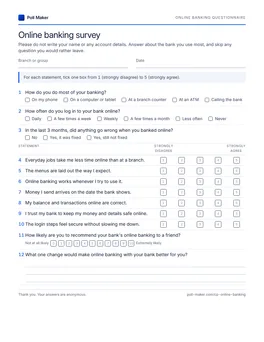
Printable questionnaire
Pen-ready boxes for every core question up front, the optional sets after, and no line anywhere for an account number.
Download PDF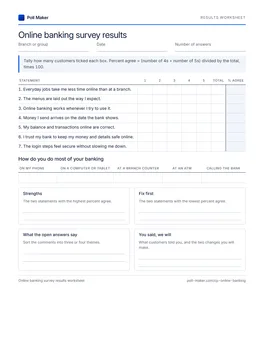
Results worksheet
Count the paper answers, turn the seven statements into percent agree, tally the channel question and choose two fixes.
Download PDFWriting a digital banking questionnaire for a project
A project questionnaire on digital banking needs one research question behind it. Pick the row closest to yours and add those sets to the core 12.
| Research question | Sets to add | What to report |
|---|---|---|
| How do customers rate online banking service quality? | Core only | Percent agree per area, split by channel |
| What keeps some customers away from online banking? | If you rarely bank online; About you | Barriers by age group |
| Are online-only banks drawing customers away? | Choosing and switching banks | Switching intent by bank type |
| How do people pay bills and each other? | Payments and transfers | Method shares, next to the FDIC figure |
| Are customers ready for bank impostor scams? | Security and scam checks | Impostor contacts by channel |
When a validated scale is required
For service quality, cite E-S-QUAL and ask its authors before reusing its items.2 For studies of why people take up internet banking, the technology acceptance model questionnaire gives the usefulness and ease-of-use constructs that adoption studies build on.
Describing your sample
Say who answered and how you reached them, for example students and staff at one college, and keep your conclusions to that group. Collect no names or account details, and let people skip any question.
Banking questions that mislead, rewritten
Four fixes for questions that turn up on bank surveys. Our survey question library has more examples for every question type.
How satisfied are you with our website and app?
How do you do most of your banking?
Online banking works whenever I try to use it.
Two channels at once: someone who likes the app but avoids the website cannot answer it honestly.
Do you feel secure using online banking? (Yes or No)
I trust my bank to keep my money and details safe online.
Yes or no hides how strongly people feel. Five points show whether trust is solid or only just holding.
Do you use P2P, RDC or ACH?
How do you usually send money to friends or family?
Industry shorthand. Customers answer the words they know, so ask about the job in plain words.
How would you rate our digital transformation?
Everyday jobs take me less time online than at a branch.
Customers never see a transformation; they see whether a task got quicker. Ask about the task.
What banks and students ask
Short answers to what comes up before the first send.
What questions should an online banking survey include?
Start with how the customer banks and how often, then short statements on speed, uptime, money arriving and safety, a recommend score and one open question. Add problem, security, payment or switching sets when someone is ready to use what customers say.
How do I make a questionnaire on digital banking for a project?
Write one research question, use the core 12, and add the sets from the project table above that answer it. Try it on five people first, then share the link. Report percent agree per area, split by channel or age.
Can a credit union use these questions?
Yes. After the set loads in the builder, swap "your bank" for your credit union's name, and call people members in the invitation.
Should a bank customer survey be anonymous?
It can be either. Inside online banking you already know who is answering, so say whether answers are linked to the account and why. For research or paper copies, collect no names or account details at all.
How many questions should a bank survey have?
Twelve is plenty for a regular check and takes about four minutes. Use the five-question version after a login or a support chat, and keep the longer sets for a yearly survey.
Hear from customers before the next app release
Start with the core 12 behind your login page, or print a stack for the branch desk. Every question above is ready to copy, poll or print.